-

Bachelor's

-

Masters
-

MBA
-

Doctorate
-

Micro Credit
-

Explore all Courses
-
Postgraduate Certifications

-
Postgraduate Diploma
-
Undergraduate Diploma
-
Diploma



Emerging Careers in Africa's Digital Economy

Author: maharajan p
|8
MINS READ
| 0
| 4
Created On: 28 July, 2026
Share




Table of Contents (TOC):
- Introduction
- Key Takeaways
- Industries Driving Digital Job Creation Across Africa
- Top 11 Emerging Careers in Africa's Digital Economy
- How to Prepare for a Career in Africa's Digital Economy
- Conclusion
- FAQs
Introduction
Africa's digital economy is growing fast—and so are the career opportunities that come with it.
According to Boston Consulting Group (BCG), Africa is the world's fastest-growing fintech market. Meanwhile, GSMA reports that mobile technologies and digital services contributed $240 billion to the continent's economy in 2025, supporting approximately 13 million jobs.
But fintech is just one part of the story. Industries like e-commerce, HealthTech, EdTech, AI, and cloud computing are also expanding rapidly, creating demand for skilled professionals across the region.
If you're looking for future-ready career opportunities, that's exactly where you'll find them.
Key Takeaways:
- Africa's digital economy is expanding rapidly, creating new opportunities and reshaping careers in Africa across technology, finance, sustainability, and online business.
- AI, fintech, e-commerce, climate tech, and software development are among the biggest industries driving digital job growth.
- These industries are also creating emerging jobs, with roles such as AI Specialist, Cybersecurity Expert, ESG Analyst, and Fintech Product Manager seeing growing demand.
- Building relevant digital skills, practical experience, and industry knowledge is essential for succeeding in future-ready careers.
Industries Driving Digital Job Creation Across Africa
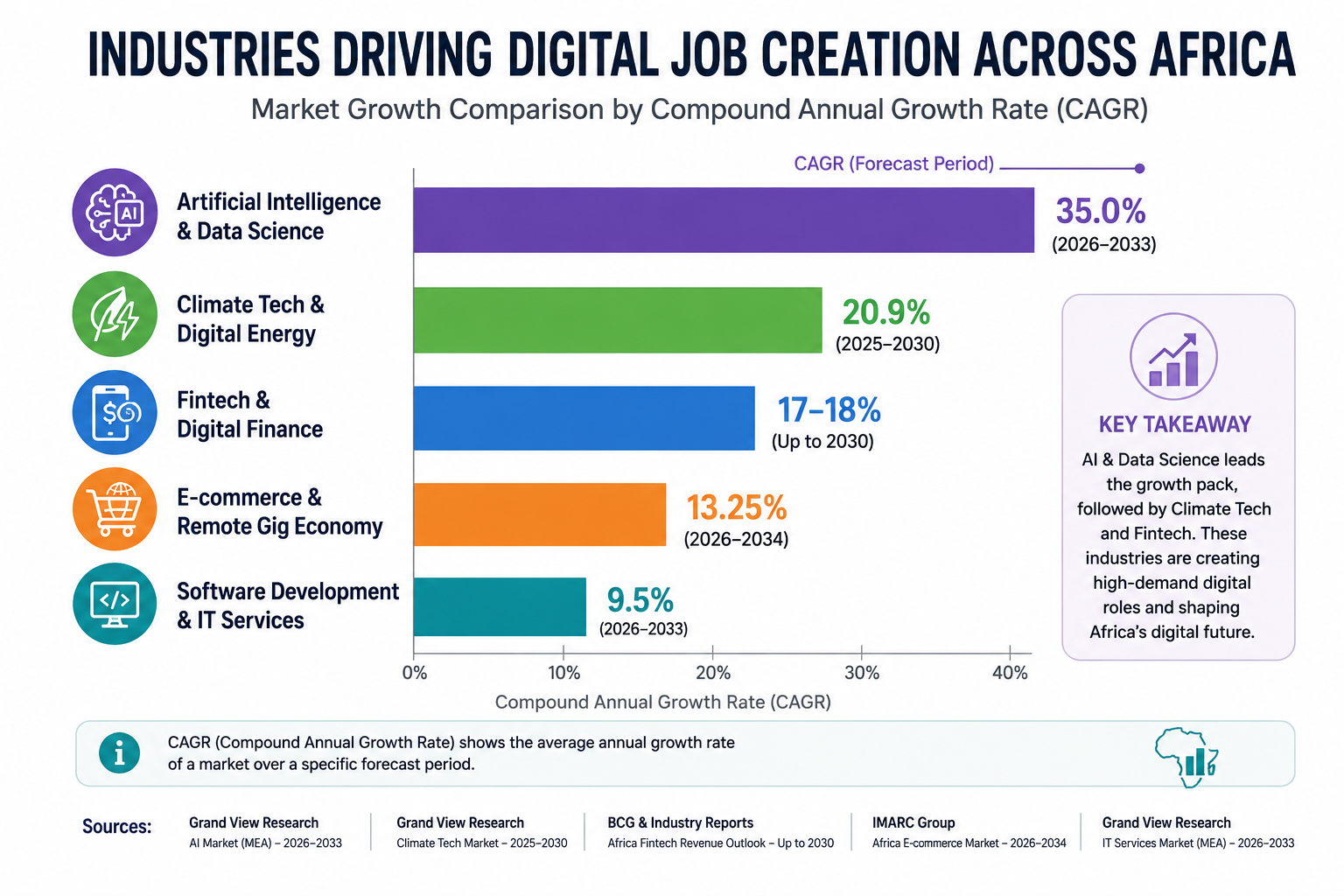
Africa's digital economy is expanding from multiple directions at once. While the spotlight often falls on fintech, it's far from the only industry creating new opportunities. From artificial intelligence to renewable energy, several fast-growing sectors are creating demand for professionals with digital and technical skills.
Some of the biggest growth engines include:
1. Artificial Intelligence and Data Science:
AI is becoming part of everyday business operations. Companies are using it to analyze customer behavior, automate repetitive tasks, improve decision-making, and gain insights from large datasets. As adoption grows, so does the demand for data analysts, AI specialists, and machine learning professionals.
2. Climate Tech and Digital Energy:
As countries invest in renewable energy and sustainability initiatives, technology is becoming essential for monitoring energy systems, managing resources, and improving efficiency. This growth is creating opportunities for professionals who can work at the intersection of technology and sustainability.
3. Fintech and Digital Finance:
Africa is one of the world's most active digital finance markets. Mobile money, digital banking, online payments, and financial apps continue to expand access to financial services. As a result, companies need developers, cybersecurity experts, product managers, and data professionals to support this growth.
4. E-commerce and Remote Gig Economy:
More consumers are shopping online, and more professionals are working remotely. Businesses are investing in digital storefronts, online marketing, logistics, and customer experience, creating opportunities for digital marketers, e-commerce specialists, content creators, and remote professionals.
5. Software Development and IT:
Nearly every digital product relies on software and IT infrastructure. Whether it's a fintech platform, an AI application, or an e-commerce marketplace, developers and IT professionals play a central role in building and maintaining the technology behind it all.
Top 11 Emerging Careers in Africa's Digital Economy
Behind every growing digital industry is a demand for skilled professionals and that's where these emerging careers come in.
1. AI Specialist
AI Specialists develop and implement artificial intelligence solutions that help businesses automate tasks, analyze large amounts of data, improve customer experiences, and make faster, more informed decisions. As AI adoption grows across industries such as fintech, healthcare, education, and e-commerce, demand for these professionals continues to rise.
Key skills:
- Machine Learning
- Python Programming
- Data Analysis
- Natural Language Processing (NLP)
- Deep Learning
2. Data Scientists
Data Scientists analyze large and complex datasets to uncover patterns, predict trends, and help organizations make data-driven decisions. Their work supports everything from customer insights and fraud detection to business strategy and AI development.
Key skills:
- Data Analysis
- Statistical Modeling
- Machine Learning
- Python or R Programming
- Data Visualization
- Critical Thinking
3. Fintech Product Manager
Fintech Product Managers oversee the development and improvement of digital financial products such as mobile banking apps, payment platforms, and digital wallets. They work closely with developers, designers, and business teams to ensure products meet customer needs and business goals.
Key skills:
- Product Management
- Project Management
- Data Interpretation
- Communication and Leadership
4. ESG Analysts
ESG (Environmental, Social, and Governance) Analysts evaluate how organizations perform in areas such as sustainability, social responsibility, and corporate governance. Their insights help businesses meet regulatory requirements, attract investors, and make more responsible decisions.
Key skills:
- ESG Reporting
- Data Analysis
- Regulatory Knowledge
5. Cybersecurity Expert
Cybersecurity Experts protect organizations from cyber threats by securing networks, systems, and sensitive data. As more businesses move online, they play a critical role in preventing data breaches, fraud, and cyberattacks.
Key skills:
- Network Security
- Threat Detection
- Risk Management
- Incident Response
- Ethical Hacking
6. RegTech and Compliance Officer
RegTech and Compliance Officers help organizations comply with industry regulations and financial laws using technology-driven solutions. They monitor risks, ensure regulatory compliance, and support businesses in maintaining secure and transparent operations.
Key skills:
- Regulatory Compliance
- Risk Assessment
- Legal and Financial Knowledge
- Analytical Thinking
7. Digital Marketer
Digital Marketers promote products, services, and brands through online channels such as search engines, social media, email, and websites. They help organizations reach target audiences, generate leads, and drive business growth in the digital marketplace.
Key skills:
- Search Engine Optimization (SEO)
- Content Marketing
- Social Media Marketing
- Email Marketing
8. UI/UX Designers
UI/UX Designers create digital experiences that are visually appealing, easy to navigate, and user-friendly. They research user needs, design interfaces, and improve how people interact with websites, mobile apps, and digital platforms.
Key skills:
- User Research
- Wireframing and Prototyping
- Design Tools (Figma, Adobe XD, Sketch)
9. Full Stack Software Engineers
Full Stack Software Engineers develop and maintain both the front-end and back-end components of web applications. They work across the entire software development process, helping businesses build scalable digital products and services.
Key skills:
- Front-End Development (HTML, CSS, JavaScript)
- Back-End Development
- Database Management
- API Development
- Cloud Computing
10. Social Media Marketer
Social Media Marketers help businesses build brand awareness, engage audiences, and drive sales through platforms such as Facebook, Instagram, LinkedIn, TikTok, and X. They create content, manage campaigns, and analyze performance to improve marketing results.
Key skills:
- Social Media Strategy
- Content Creation
- Community Management
- Social Media Advertising
11. IOT Engineers
IoT (Internet of Things) Engineers develop and manage connected devices that collect, share, and analyze data through the internet. Their work powers smart homes, connected healthcare systems, industrial automation, smart agriculture, and other technology-driven solutions.
Key skills:
- Embedded Systems
- IoT Architecture
- Programming (Python, C++, Java)
- Sensor and Device Integration
While compensation for these roles varies by regions, industry, and experience level, one thing remains consistent: skills drive opportunity. In fields such as AI, digital marketing, UX design, cybersecurity, and data analytics, employers place a high value on professionals who can deliver measurable results. The stronger your skills and the greater your impact, the more opportunities you're likely to unlock as Africa's digital economy continues to grow.
How to Prepare for a Career in Africa's Digital Economy
The growth of Africa's digital economy is creating opportunities, but opportunities alone don't build careers. The professionals who benefit most are those who prepare early by developing relevant skills, gaining practical experience, and staying ahead of industry changes.
- Identify High-Growth Career Paths: Explore emerging fields such as AI, fintech, cybersecurity, data analytics, cloud computing, and digital marketing.
- Build Job-Ready Digital Skills: Learn the tools, technologies, and frameworks commonly used in your chosen field.
- Gain Practical Experience Through Projects: Apply your knowledge through internships, freelance work, personal projects, or case studies.
- Develop a Professional Online Presence: Maintain an updated LinkedIn profile and showcase your work through portfolios or project samples.
- Commit to Continuous Learning: Stay current with industry trends, new technologies, and evolving best practices.
Building a successful digital career starts with closing your skill gaps. That's where structured learning can make a difference.
At UniAthena, we offer a wide range of online, self-paced programs across many of the fields discussed above. Whether you're learning the fundamentals, refreshing your knowledge, or exploring a new domain, you'll find courses designed to help you stay relevant in a changing job market.
Below is a snapshot of some of our short courses that can help you build foundational knowledge in emerging digital fields.
👉 Ready to take the next step? Explore UniAthena's short courses and discover programs that can help you strengthen your skills, expand your knowledge, and prepare for opportunities in Africa's growing digital economy.
Conclusion
Africa's digital economy is creating new opportunities across industries, from artificial intelligence and fintech to e-commerce and climate tech.
As these sectors continue to grow, professionals with digital, technical, and business skills will be well-positioned to take advantage of emerging career paths. Investing in the right skills today can help you stay competitive and build a successful career in the continent's evolving digital landscape.
FAQs
Q1. Which digital industry is growing the fastest in Africa?
A: Artificial intelligence and data science currently show the highest projected growth rates among Africa's major digital industries.
Q2. What are the most in-demand digital skills in Africa?
A: Data analysis, software development, cybersecurity, digital marketing, cloud computing, and AI skills are increasingly sought after.
Q3. Is fintech a good career choice in Africa?
A: Yes, fintech continues expanding rapidly, creating opportunities in product management, software development, cybersecurity, and financial analytics.
Q4. Do I need a technology degree for digital careers?
A: Not always. Many digital careers prioritize practical skills, certifications, and hands-on experience over formal technology degrees.
Our Popular Courses

$14000


Doctoral Degree in Business Administration
Universidad Catolica De Murcia (UCAM), Spain
Duration:
2 - 3 Years
$17,500*
Integrated Doctorate of Business Administration
Guglielmo Marconi University, Italy
Universidad Catolica De Murcia (UCAM), Spain
Duration:
2.5 - 3.5 Years
$5,600*
Master of Business Administration
Guglielmo Marconi University, Italy
Duration:
12 - 24 Months
$5,600*
MBA in Operations & Project Management
Guglielmo Marconi University, Italy
Duration:
12 - 24 Months
$5,600*
Master in Supply Chain and Logistics Management
Guglielmo Marconi University, Italy
Duration:
12 - 24 Months
$5,950*
Master in Data Sciences
Guglielmo Marconi University, Italy
Duration:
12 - 24 Months
$5,600*
Master in Engineering Management
Guglielmo Marconi University, Italy
Duration:
12 - 24 Months
$5,600*
Master in Procurement and Contract Management
Guglielmo Marconi University, Italy
Duration:
12 - 24 Months
$5,600*
Master in Public Health
Guglielmo Marconi University, Italy
Duration:
12 - 24 MonthsOur Popular Courses
COMMENTS(0)
Our Popular Courses
$14000
Doctoral Degree in Business Administration
Universidad Catolica De Murcia (UCAM), Spain
Duration:
2 - 3 Years
$17,500*
Integrated Doctorate of Business Administration
Guglielmo Marconi University, Italy
Universidad Catolica De Murcia (UCAM), Spain
Duration:
2.5 - 3.5 Years
$5,600*
Master of Business Administration
Guglielmo Marconi University, Italy
Duration:
12 - 24 Months
$5,600*
MBA in Operations & Project Management
Guglielmo Marconi University, Italy
Duration:
12 - 24 Months
$5,600*
Master in Supply Chain and Logistics Management
Guglielmo Marconi University, Italy
Duration:
12 - 24 Months
$5,950*
Master in Data Sciences
Guglielmo Marconi University, Italy
Duration:
12 - 24 Months
$5,600*
Master in Engineering Management
Guglielmo Marconi University, Italy
Duration:
12 - 24 Months
$5,600*
Master in Procurement and Contract Management
Guglielmo Marconi University, Italy
Duration:
12 - 24 Months
$5,600*
Master in Public Health
Guglielmo Marconi University, Italy
Duration:
12 - 24 MonthsOur Popular Courses
Our Popular Insights
Careers are shifting faster than ever, and staying relevant takes more than experience. Explore UniAthena’s most-read blogs for sharp insights, emerging skills, and practical pathways that help you move forward with clarity and confidence in a changing professional world.



How to Switch Career to Data Analytics?
Read More
6
mins read




How to Switch Career to Data Analytics?
Read more
6
mins read

Get in Touch

It’s Time to Start
Join NowMost Popular Online Specialization
- Master of International Business Administration
- Master of Business Administration
- MBA in General Management- FastTrack
- Master in Innovation and Entrepreneurship
- MBA-Family Business Management
- Master in Procurement and Contract Management
- Extended Diploma in Business Analytics (SCQF Level 11)
- Diploma in Supply Chain and Logistics Management (SCQF Level 11)
- Strategic Human Resource Management Practitioner
- Master in Data Science
- Master in Engineering Management
Trending Online
- Integrated Doctorate of Business Administration
- Postgraduate Certificate in Finance for Next Generation Managers
- Master of Business Administration- General Management (Fast Track)
- Postgraduate Certificate in Socio-Economic and Legal Framework
- Postgraduate Certificate in Business Sustainability
- Certified Manager
- Supply Chain Management Practitioner
- MBA - AI in Business
- MBA - Accounting & Finance
- Master in Supply Chain and Logistics Management
Top Universities Online Certificates
- Postgraduate Certificate in International Marketing Management
- Postgraduate Certificate In International Human Resource Management
- Postgraduate Certificate in Strategic Management
- Postgraduate Certificate in Procurement & Contracts Management
- Postgraduate Certificate in Business Analytics
- Postgraduate Certificate in Strategic Supply Chain & Logistics Management
- Postgraduate Certificate in Human Resource and Leadership
- Project Management Practitioner
- Postgraduate Certificate in Supply Chain Design & Implementation
- Postgraduate Certificate in Management Accounting and Finance
Accredited Online Degree Program
- MBA - Digital Transformation
- MBA - Family Business Management
- MBA - Marketing Management
- MBA in Quality Management
- MBA - Business Intelligence & Data Analytics
- MBA in Operations & Project Management
- MBA in Energy Management
- MBA In Construction & Safety Management
- Master in Organisational Leadership
- Master in Public Health
- Master in Construction Management
- Bachelor of Arts in Business Administration


 Install Now


UniAthena is an Ed-Tech, offering flexible, affordable learning solutions, including Free-Learning Upskilling Courses and Academic Programs in partnerships with accredited and globally renowned universities and professional qualification bodies.


Do you have any questions ?
Feel free to send us your questions or request a free consultation
Send a message
UK
Athena Global Education
Magdalen Centre,
Robert Robinson Avenue,
Oxford, OX4 4GA, UK
Phone : 01865 784299
MIDDLE EAST
Athena Global Education FZE
Block L-03, First Floor,
P O Box 519265, Sharjah Publishing City,
Free Zone, Sharjah, UAE
Phone : +971 55 879 5492
INDIA
Uniathena Private Limited
9A,Midas Tower
Phase 1
Hinjewadi Rajiv Gandhi Infotech Park
Pune-411057
Phone: +91 9145665544
All Copyrights Reserved @ Athena Global Education 2021-2026