-

Bachelor's

-

Masters
-

MBA
-

Doctorate
-

Micro Credit
-

Explore all Courses
-
Postgraduate Certifications

-
Postgraduate Diploma
-
Undergraduate Diploma
-
Diploma



How to Make Money with AI: 5 Side Hustles That Actually Work

Author: maharajan p
|9
MINS READ
| 0
| 6
Created On: 25 July, 2026
Share




Table of Contents (TOC):
- Introduction
- Key Takeaways
- How to Know You Can Make Money with AI?
- 5 Side Hustles That Actually Work with AI
- How to Start (Simple Action Steps)
- FAQs
Introduction
The best time to figure out AI was probably two years ago.
The second-best time is right now before everyone else in your industry catches on. Most people are either overwhelmed by the noise around AI or sitting on the sidelines waiting for things to “settle.” Meanwhile, smarter people are doing something far more interesting.
They’re not learning AI for the sake of it. They’re plugging it into work they already understand, moving faster, taking on more, and building an edge. That’s how you make better use of AI.
Key Takeaways:
- AI is not a standalone career; it amplifies existing skills like writing, design, analysis, and marketing work.
- Real income comes from combining your current skillset with AI to deliver faster, scalable, and better services.
- Most profitable AI side hustles focus on solving business problems, not building or selling AI tools directly.
- Sustainable side hustles are often built by starting with one marketable skill, using simple AI tools, and offering repeatable services.
How to Know You Can Make Money with AI?
Here’s the simplest way to look at it: AI is a career on its own for specialists building AI systems. But for most professionals, it’s less about becoming an “AI person” and more about using AI to multiply the skills they already have.
So instead of asking, “What AI job can I do?” the better question is, “What skill do I already have that AI can speed up or scale?”
Start there.
Because honestly, AI works best when it’s paired with something real. Writing, design, analysis, marketing, operations, anything where there’s already some value being created. If your skill can solve a problem or help a business in some way, you’re already in the game.
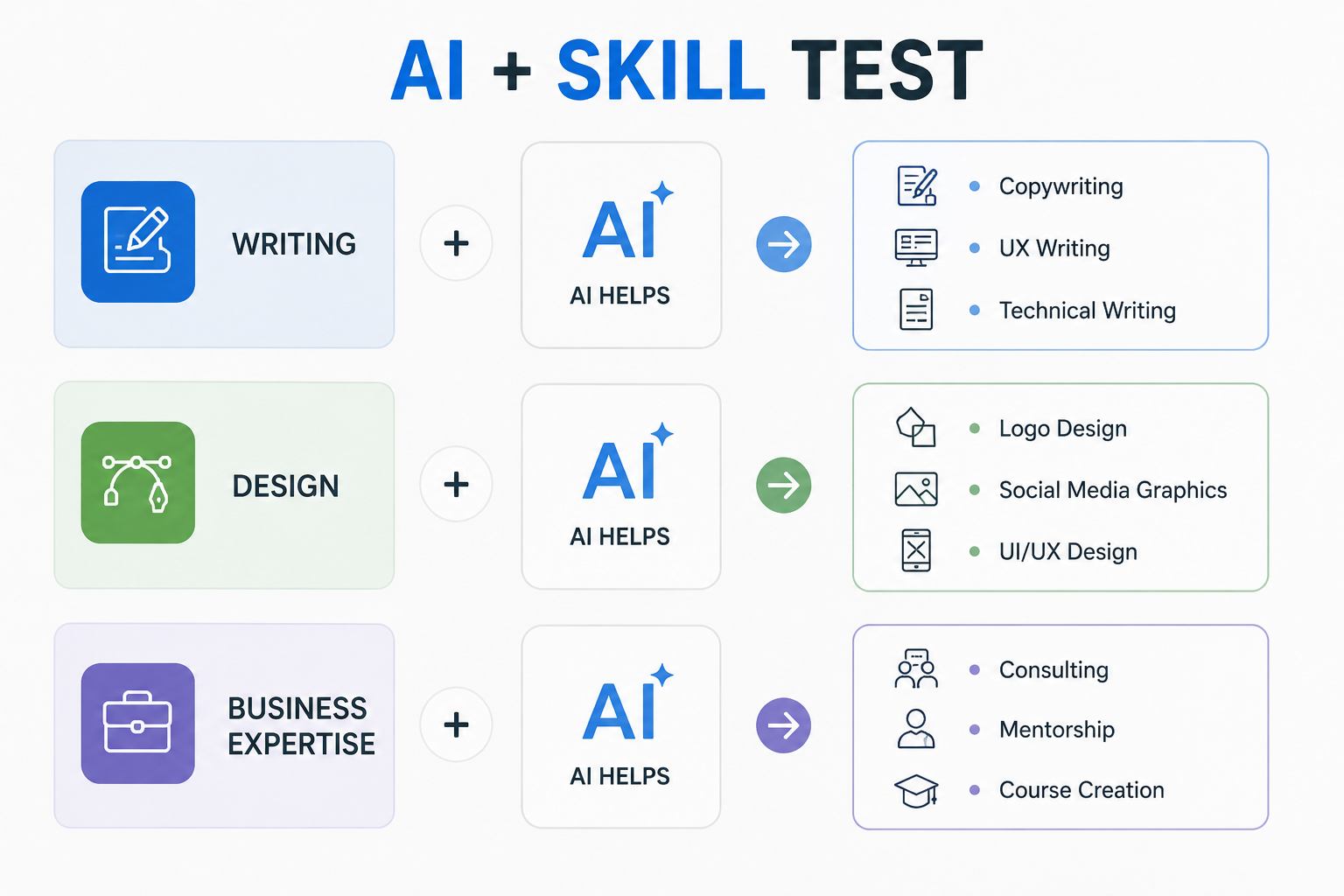
AI is an accelerator. It makes you do what you do faster and better.
- You execute quicker
- You produce more output in less time
- And you can handle more clients or work without burning out
Now, let’s take a look at some of the most in-demand side hustles that are actually working with AI.
5 Side Hustles That Actually Work with AI
AI becomes more valuable when you combine it with a real skill. Here are five side hustles where you can use AI to improve your work and create opportunities.
1. AI-Assisted Content Production (Writing, Scripts, Ads)
This is basically creating content for businesses, but with AI helping you speed things up. It can be blogs, SEO articles, ad copy, video scripts, or even social media posts, anything where words are used to explain, promote, or sell.
Most people don’t struggle with what to write, they struggle with time and consistency. That’s where AI quietly fits in.
How AI helps:
- You don’t spend time staring at a blank page it gives you a first draft quickly
- Helps you explore different angles or versions of the same idea
- Makes rewriting and polishing faster instead of starting from scratch every time
Who can do it: Anyone who already works with writing or communication: writers, marketers, freelancers, or even someone who’s comfortable structuring thoughts into clear sentences.
2. Automation Services for Small Businesses
This is basically about setting up systems that take over repetitive work in a business. Most small businesses already do things like responding to customer messages, tracking leads, or sending follow-ups, but they do it manually, every single time.
Automation just removes that repetition.
For example, instead of someone replying to every inquiry individually, a system can handle the first response. Or instead of manually tracking every lead in a sheet, the system updates it automatically and triggers the next step.
What this usually includes:
- A customer fills a form on a website, they immediately get a confirmation email or WhatsApp reply
- A new lead comes, in it automatically gets saved into a sheet or CRM without anyone touching it
- A common customer query, gets answered through a basic chatbot instead of a human repeating the same response
And AI sits in the middle of this in a very practical way. It helps reduce the manual effort needed to write responses, structure workflows, or handle variations in customer queries. Instead of building everything from scratch, you can generate and refine these parts much faster.
Who can do this: Anyone with basic tech literacy and logical thinking can do this by using no-code tools to save small businesses time.
3. AI E-Commerce Store Setup
This is about helping small businesses or individuals get their online store up and running without them figuring everything out from scratch. Think of it like setting up a “ready-to-sell” store where the structure, products, and basic marketing are already in place.
It usually includes building a store on platforms like Shopify or similar tools, adding products, and making sure the store actually feels ready for customers to browse and buy. Along with that, there’s a bit of research involved too, like figuring out what products make sense for a specific niche and how the store should be positioned.
In simple terms, you’re not just “creating a website.” You’re setting up a small online business that can start selling immediately. This kind of work becomes much faster with AI because a lot of the time goes into writing and research, not technical setup.
AI helps you:
- Write product descriptions in different tones depending on the brand
- Get quick insights for product ideas or niche selection
- Structure store content like homepage copy, product page text, and basic marketing messaging
Instead of spending hours trying to phrase things or research manually, you can generate a strong starting point and refine it based on the brand.
Who can do it: This hustle requires digital literacy to manage store dashboards and marketing empathy to guide AI in creating a trustworthy, well-organized shopping experience.
4. AI-Based Design Services
This is about creating visual content for businesses, mainly things they use for marketing and communication. It could be social media posts, ad banners, promotional creatives, or even a basic brand identity kit. The goal is simple: help businesses look consistent and presentable online without hiring a full design team.
AI makes this process faster by giving you quick visual drafts and multiple variations to choose from. Instead of starting from a blank canvas every time, you’re working with ready-made ideas that you can refine.
How AI helps:
- Generates multiple design variations in seconds so you can test different styles quickly
- Helps convert rough ideas into visual drafts without manual design effort
- Speeds up experimentation with layouts, colors, and formats
Who can do it: People with basic design awareness and an understanding of visual communication. If you’re already a graphic designer, UI/UX designer, or content creator, you can easily transfer those skills and start offering design services to businesses using AI to speed up your workflow.
Also Read: How to Make Money on Social Media?
5. Insight-as-a-Service (AI-Powered Analyst Work)
This is about helping founders and small teams understand what is happening inside their business through data. Instead of hiring a full-time analyst, businesses can work with someone who reviews their numbers, identifies patterns, and turns them into clear insights they can act on.
What this includes:
- Weekly or monthly business performance insights
- Sales funnel analysis to understand where customers are dropping off
- Marketing performance breakdowns across different campaigns and channels
- Growth recommendations based on available data
AI makes this process faster by helping analyze large amounts of information and organize findings into useful reports.
How AI helps:
- Speeds up data analysis by identifying patterns and trends faster
- Summarizes large reports and datasets into clear insights
- Helps spot changes or opportunities that may need deeper attention
Who can do it: People with analytical skills and business understanding. If you work in data analysis, business analysis, marketing analytics, finance, or research, you can use AI to speed up your process and offer insight-based services to founders and small businesses.
Also Read: What Are the Top 5 AI Skills to Learn in 2026?
How to Start (Simple Action Steps)
Getting started with AI side hustles doesn’t mean learning every AI tool available. The better approach is to start with a skill you already have, then use AI to improve how you deliver that skill.
Follow these simple steps:
1. Pick a skill you already have: Start with something you understand: writing, design, analysis, marketing, operations, or any other skill that can solve a business problem.
2. Use AI to improve your workflow: Find areas where AI can save time, whether it’s research, drafting, analysis, design, or repetitive tasks.
3. Create 1–2 sample projects: Before looking for clients, create examples that show what you can do and how you use AI to deliver better results.
4. Start offering it as a service: You can find opportunities through freelance platforms or directly reach out to businesses that may need your skills.
5. Focus on repeatable services: Instead of chasing random one-time projects, build services that businesses can use regularly, like monthly content, reporting, design support, or automation.
If you want to build the skills needed to work with AI, UniAthena’s short courses can help you learn practical skills in a flexible format. You can complete programs at your own pace, build knowledge in your chosen area, and apply those skills to real-world opportunities.
- Master ChatGPT: Learn how to use ChatGPT effectively for research, content creation, problem-solving, and improving your daily productivity with better prompts.
- Essentials of Data Analytics: Learn how businesses use data to identify patterns, understand performance, and make better decisions.
- Executive Diploma in Machine Learning: Learn core machine learning concepts, including regression, classification, decision trees, neural networks, clustering, reinforcement learning, and Python implementation of ML models.
- Diploma in Artificial Intelligence: Learn AI fundamentals, including intelligent agents, algorithms, problem-solving techniques, knowledge representation, logical frameworks, and AI learning models.
Browse through UniAthena’s short courses to strengthen your expertise in areas like technology, business, marketing, design, and analytics and learn how to apply those skills in an AI-driven workplace.
Also Read: 25 Side Hustle Ideas: Creative Ways to Earn Extra Income in 2026
FAQs
Q1. Do I need to learn coding for AI side hustles?
A: No coding is required for most AI side hustles like writing, design, automation, or analytics support services.
Q2. How much money can I make with AI side hustles?
A: Income depends on skills and clients, but freelancers often scale earnings by taking multiple AI-assisted projects.
Q3. Do businesses really pay for AI-based services?
A: Yes, businesses pay for faster content, automation, design, and insights that improve efficiency and decision-making.
Q4. What tools do I need to start working with AI?
A: You can start with tools like ChatGPT, Canva AI, Zapier, and beginner-friendly no-code automation platforms.
Our Popular Courses

$14000


Doctoral Degree in Business Administration
Universidad Catolica De Murcia (UCAM), Spain
Duration:
2 - 3 Years
$17,500*
Integrated Doctorate of Business Administration
Guglielmo Marconi University, Italy
Universidad Catolica De Murcia (UCAM), Spain
Duration:
2.5 - 3.5 Years
$5,600*
Master of Business Administration
Guglielmo Marconi University, Italy
Duration:
12 - 24 Months
$5,600*
MBA in Operations & Project Management
Guglielmo Marconi University, Italy
Duration:
12 - 24 Months
$5,600*
Master in Supply Chain and Logistics Management
Guglielmo Marconi University, Italy
Duration:
12 - 24 Months
$5,950*
Master in Data Sciences
Guglielmo Marconi University, Italy
Duration:
12 - 24 Months
$5,600*
Master in Engineering Management
Guglielmo Marconi University, Italy
Duration:
12 - 24 Months
$5,600*
Master in Procurement and Contract Management
Guglielmo Marconi University, Italy
Duration:
12 - 24 Months
$5,600*
Master in Public Health
Guglielmo Marconi University, Italy
Duration:
12 - 24 MonthsOur Popular Courses
COMMENTS(0)
Our Popular Courses
$14000
Doctoral Degree in Business Administration
Universidad Catolica De Murcia (UCAM), Spain
Duration:
2 - 3 Years
$17,500*
Integrated Doctorate of Business Administration
Guglielmo Marconi University, Italy
Universidad Catolica De Murcia (UCAM), Spain
Duration:
2.5 - 3.5 Years
$5,600*
Master of Business Administration
Guglielmo Marconi University, Italy
Duration:
12 - 24 Months
$5,600*
MBA in Operations & Project Management
Guglielmo Marconi University, Italy
Duration:
12 - 24 Months
$5,600*
Master in Supply Chain and Logistics Management
Guglielmo Marconi University, Italy
Duration:
12 - 24 Months
$5,950*
Master in Data Sciences
Guglielmo Marconi University, Italy
Duration:
12 - 24 Months
$5,600*
Master in Engineering Management
Guglielmo Marconi University, Italy
Duration:
12 - 24 Months
$5,600*
Master in Procurement and Contract Management
Guglielmo Marconi University, Italy
Duration:
12 - 24 Months
$5,600*
Master in Public Health
Guglielmo Marconi University, Italy
Duration:
12 - 24 MonthsOur Popular Courses
Our Popular Insights
Careers are shifting faster than ever, and staying relevant takes more than experience. Explore UniAthena’s most-read blogs for sharp insights, emerging skills, and practical pathways that help you move forward with clarity and confidence in a changing professional world.







Get in Touch

It’s Time to Start
Join NowMost Popular Online Specialization
- Master of International Business Administration
- Master of Business Administration
- MBA in General Management- FastTrack
- Master in Innovation and Entrepreneurship
- MBA-Family Business Management
- Master in Procurement and Contract Management
- Extended Diploma in Business Analytics (SCQF Level 11)
- Diploma in Supply Chain and Logistics Management (SCQF Level 11)
- Strategic Human Resource Management Practitioner
- Master in Data Science
- Master in Engineering Management
Trending Online
- Integrated Doctorate of Business Administration
- Postgraduate Certificate in Finance for Next Generation Managers
- Master of Business Administration- General Management (Fast Track)
- Postgraduate Certificate in Socio-Economic and Legal Framework
- Postgraduate Certificate in Business Sustainability
- Certified Manager
- Supply Chain Management Practitioner
- MBA - AI in Business
- MBA - Accounting & Finance
- Master in Supply Chain and Logistics Management
Top Universities Online Certificates
- Postgraduate Certificate in International Marketing Management
- Postgraduate Certificate In International Human Resource Management
- Postgraduate Certificate in Strategic Management
- Postgraduate Certificate in Procurement & Contracts Management
- Postgraduate Certificate in Business Analytics
- Postgraduate Certificate in Strategic Supply Chain & Logistics Management
- Postgraduate Certificate in Human Resource and Leadership
- Project Management Practitioner
- Postgraduate Certificate in Supply Chain Design & Implementation
- Postgraduate Certificate in Management Accounting and Finance
Accredited Online Degree Program
- MBA - Digital Transformation
- MBA - Family Business Management
- MBA - Marketing Management
- MBA in Quality Management
- MBA - Business Intelligence & Data Analytics
- MBA in Operations & Project Management
- MBA in Energy Management
- MBA In Construction & Safety Management
- Master in Organisational Leadership
- Master in Public Health
- Master in Construction Management
- Bachelor of Arts in Business Administration


 Install Now


UniAthena is an Ed-Tech, offering flexible, affordable learning solutions, including Free-Learning Upskilling Courses and Academic Programs in partnerships with accredited and globally renowned universities and professional qualification bodies.


Do you have any questions ?
Feel free to send us your questions or request a free consultation
Send a message
UK
Athena Global Education
Magdalen Centre,
Robert Robinson Avenue,
Oxford, OX4 4GA, UK
Phone : 01865 784299
MIDDLE EAST
Athena Global Education FZE
Block L-03, First Floor,
P O Box 519265, Sharjah Publishing City,
Free Zone, Sharjah, UAE
Phone : +971 55 879 5492
INDIA
Uniathena Private Limited
9A,Midas Tower
Phase 1
Hinjewadi Rajiv Gandhi Infotech Park
Pune-411057
Phone: +91 9145665544
All Copyrights Reserved @ Athena Global Education 2021-2026