-

Bachelor's

-

Masters
-

MBA
-

Doctorate
-

Micro Credit
-

Explore all Courses
-
Postgraduate Certifications

-
Postgraduate Diploma
-
Undergraduate Diploma
-
Diploma



The Future of Software Development: How AI Is Changing the Way We Code
Author: priyanka chatterjee
|6
MINS READ
| 0
| 10
Created On: 25 July, 2026
Share




Table of Contents (TOC):
- Introduction
- What Is Software Development and Why Is AI Changing It?
- AI in Software Development: Transforming Every Stage of Coding
- What Is Vibe Coding?
- How to Code Using AI Effectively
- Best AI Coding Tools for Developers
- Benefits of AI in Software Development
- The Future of Coding with AI
Introduction
Remember when writing software meant spending hours searching documentation, fixing syntax errors, and repeatedly testing the same piece of code? That workflow is rapidly changing. Today, developers can describe an idea in plain English, receive an initial working code draft within seconds, which developers can then review, refine, and adapt to their specific requirements, and spend more time solving real-world problems instead of handling repetitive tasks.
Artificial intelligence is no longer a futuristic concept reserved for research labs. It has become an everyday development companion, helping beginners learn faster, experienced programmers work more efficiently, and businesses build better software in less time.
As AI continues to evolve, one question is becoming increasingly important: What does the future of software development look like when developers and AI work together?
Let's explore how AI is transforming the way software is built and why it is becoming an essential part of modern development.
What Is Software Development and Why Is AI Changing It?
Before exploring AI's impact, it is important to understand what software development is. It is the process of designing, building, testing, deploying, and maintaining applications that solve real-world problems. Traditionally, developers manually wrote code, searched for bugs, performed extensive testing, and created technical documentation throughout the development lifecycle.
Today, artificial intelligence programming is making these tasks faster and more efficient. AI assists developers by generating code, identifying errors, suggesting improvements, and automating repetitive processes. Rather than replacing programmers, AI allows them to focus more on innovation, architecture, and solving complex challenges.
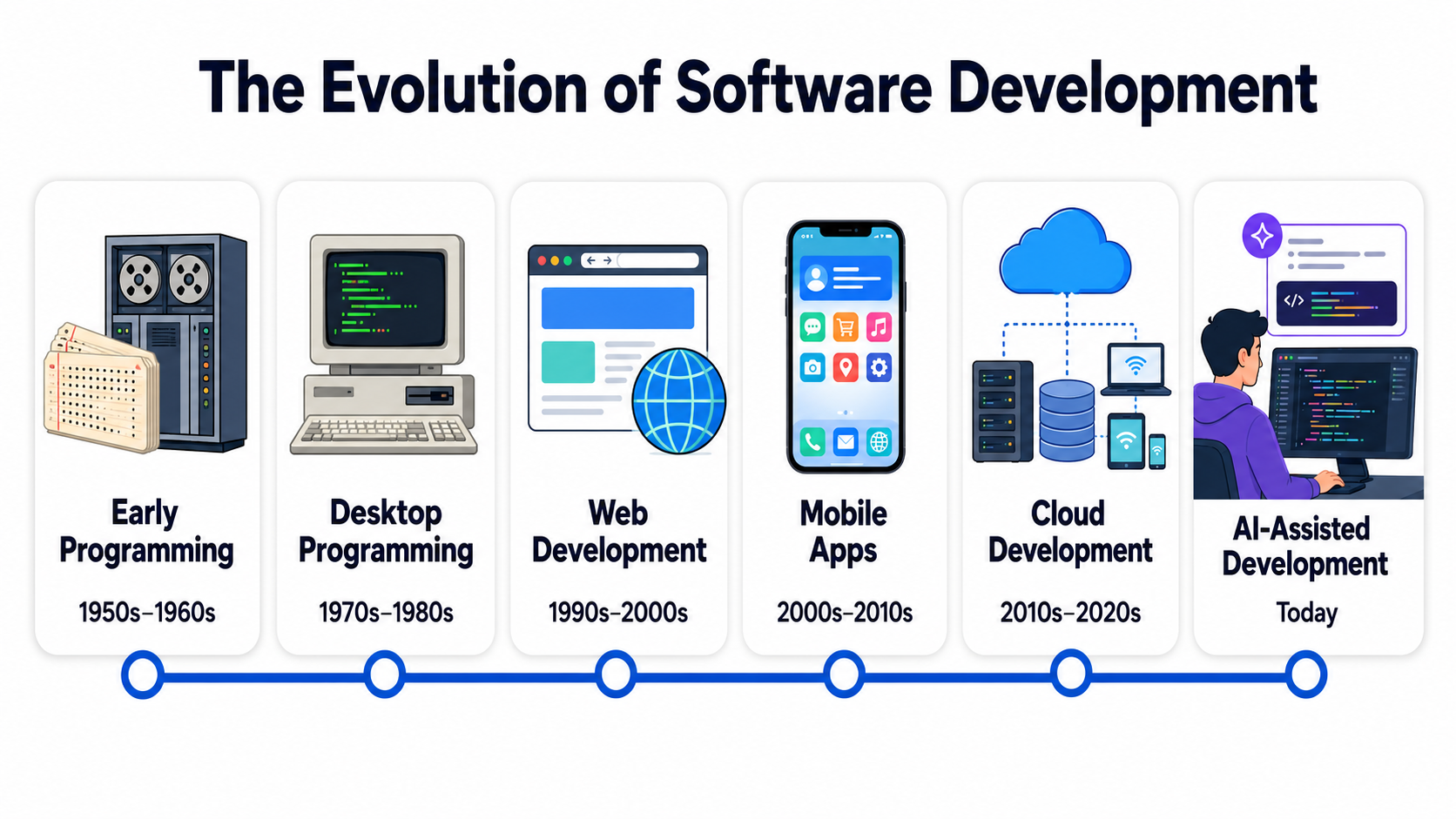
Fig: The Evolution of Software Development
AI in Software Development: Transforming Every Stage of Coding
The growing adoption of AI in software development is reshaping nearly every stage of the software development lifecycle. Modern AI tools for software development understand natural language prompts and assist developers from writing code to testing and optimization.
Some of the most common ways AI is helping developers include:
- Generating code snippets from simple text prompts.
- Detecting syntax and logical errors quickly.
- Automating testing and debugging.
- Improving code readability and documentation.
- Suggesting performance and security enhancements.
- Assisting with code reviews and refactoring.
While AI significantly accelerates many development tasks, its outputs should always be reviewed and tested. AI-generated code can contain logical errors, outdated implementation patterns, or security vulnerabilities that require human expertise to identify and address.
By automating repetitive tasks, AI enables developers to spend more time creating innovative applications and less time on routine maintenance.
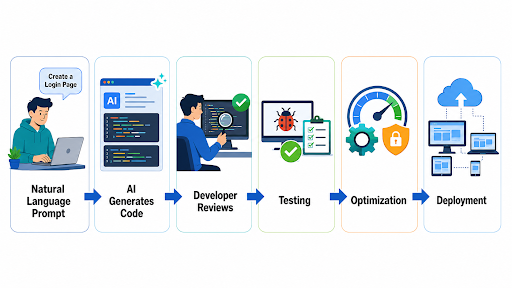
Fig: AI-Assisted Development Workflow
What Is Vibe Coding?
One of the newest concepts gaining attention is vibe coding.
Vibe coding is an AI-assisted approach where developers describe the functionality they want in natural language, and AI generates much of the required code. Instead of writing every function manually, programmers guide the AI, review the generated output, and refine it to meet project requirements.
Although this approach significantly speeds up development, human expertise remains essential to ensure the software is secure, scalable, and maintainable. Vibe coding is particularly valuable for rapid prototyping, experimentation, and accelerating development workflows, but it works best when combined with established software engineering practices such as code reviews, testing, and documentation.
How to Code Using AI Effectively
Learning how to code using AI is becoming an essential skill for modern developers. The goal is not to let AI write everything but to use it as an intelligent coding assistant.
A practical workflow includes:
- Planning the application's requirements.
- Using AI to generate an initial code structure.
- Reviewing and refining the generated code.
- Asking AI to explain unfamiliar concepts.
- Debugging issues with AI assistance.
- Optimizing and documenting the final application.
For students and aspiring developers, understanding how to code with AI for beginners starts with learning programming fundamentals. AI should be used to strengthen those skills, not replace them.
Also Read: Shadow AI: The Hidden Cost of AI Adoption
Best AI Coding Tools for Developers
The rapid growth of AI for programmers has introduced intelligent coding assistants that improve both productivity and code quality. Many of the best AI coding tools for developers can generate code, explain complex algorithms, detect vulnerabilities, automate documentation, and recommend best practices.
As generative AI for developers continues to evolve, these tools are becoming integrated into popular development environments, allowing developers to receive AI-powered assistance without leaving their coding workspace. This seamless integration is making software development faster, more efficient, and increasingly collaborative.
Modern AI coding assistants are also evolving beyond simple code generation. Many now understand entire repositories, assist across multiple files, recommend architectural improvements, and support developers throughout the software development lifecycle rather than during coding alone.
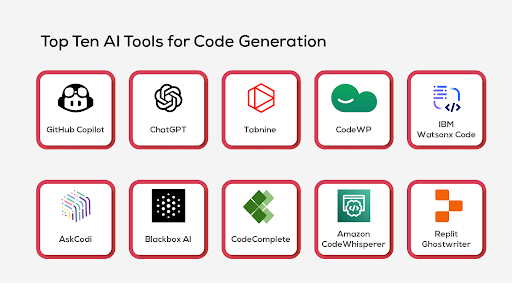
Fig: Popular AI Coding Tools
Benefits of AI in Software Development
The benefits of AI in software development extend far beyond writing code faster. AI is improving the entire software development process while helping teams deliver reliable applications more efficiently.
Some of the biggest advantages include:
- Increased developer productivity.
- Faster debugging and troubleshooting.
- Improved code quality and consistency.
- Better software security through early vulnerability detection.
- Reduced development time for new features.
- Enhanced collaboration with automated documentation and code explanations.
These advantages allow development teams to focus on innovation while reducing repetitive manual work.
Also Read: What Developers Must Never Forget While Vibe Coding
The Future of Coding with AI
The future of coding with AI is not about replacing software engineers. Instead, it is about creating a smarter development environment where AI handles repetitive tasks while developers concentrate on creativity, architecture, and decision-making.
Human expertise will remain essential for understanding business requirements, designing scalable system architectures, making ethical decisions, collaborating with stakeholders, and ensuring that software solutions align with organizational goals.
As artificial intelligence in software development continues to advance, developers who understand both programming fundamentals and AI-assisted workflows are likely to be better prepared for the next generation of software engineering. Emerging AI capabilities such as intelligent software agents, automated testing, AI-assisted documentation, DevOps automation, and code migration are expected to further reshape how development teams build and maintain applications.
The future of software development is already taking shape, with AI helping developers build faster, improve code quality, automate repetitive tasks, and solve increasingly complex problems. However, successful software development will continue to depend on human judgment, rigorous testing, secure coding practices, and thoughtful system design. Developers who embrace AI as a collaborative partner rather than a replacement will be well-positioned to build innovative, reliable, and scalable software in the years ahead.
Also Read: What Jobs Will AI Replace & Which Careers Are Safe?
References:
- https://wefttechnologies.com/blog/how-is-ai-changing-software-development/
- https://towardsdatascience.com/4-techniques-to-optimize-ai-coding-efficiency/
- https://arnaudunjo.com/2025/06/22/vibe-coding-the-immediate-future-of-application-development/
- https://www.thedroidsonroids.com/blog/best-ai-coding-assistant-tools
- https://www.inspirisys.com/blog-details/Top-Ten-AI-Tools-for-Code-Generation/190
Our Popular Courses

$14000


Doctoral Degree in Business Administration
Universidad Catolica De Murcia (UCAM), Spain
Duration:
2 - 3 Years
$17,500*
Integrated Doctorate of Business Administration
Guglielmo Marconi University, Italy
Universidad Catolica De Murcia (UCAM), Spain
Duration:
2.5 - 3.5 Years
$5,600*
Master of Business Administration
Guglielmo Marconi University, Italy
Duration:
12 - 24 Months
$5,600*
MBA in Operations & Project Management
Guglielmo Marconi University, Italy
Duration:
12 - 24 Months
$5,600*
Master in Supply Chain and Logistics Management
Guglielmo Marconi University, Italy
Duration:
12 - 24 Months
$5,950*
Master in Data Sciences
Guglielmo Marconi University, Italy
Duration:
12 - 24 Months
$5,600*
Master in Engineering Management
Guglielmo Marconi University, Italy
Duration:
12 - 24 Months
$5,600*
Master in Procurement and Contract Management
Guglielmo Marconi University, Italy
Duration:
12 - 24 Months
$5,600*
Master in Public Health
Guglielmo Marconi University, Italy
Duration:
12 - 24 MonthsOur Popular Courses
COMMENTS(0)
Our Popular Courses
$14000
Doctoral Degree in Business Administration
Universidad Catolica De Murcia (UCAM), Spain
Duration:
2 - 3 Years
$17,500*
Integrated Doctorate of Business Administration
Guglielmo Marconi University, Italy
Universidad Catolica De Murcia (UCAM), Spain
Duration:
2.5 - 3.5 Years
$5,600*
Master of Business Administration
Guglielmo Marconi University, Italy
Duration:
12 - 24 Months
$5,600*
MBA in Operations & Project Management
Guglielmo Marconi University, Italy
Duration:
12 - 24 Months
$5,600*
Master in Supply Chain and Logistics Management
Guglielmo Marconi University, Italy
Duration:
12 - 24 Months
$5,950*
Master in Data Sciences
Guglielmo Marconi University, Italy
Duration:
12 - 24 Months
$5,600*
Master in Engineering Management
Guglielmo Marconi University, Italy
Duration:
12 - 24 Months
$5,600*
Master in Procurement and Contract Management
Guglielmo Marconi University, Italy
Duration:
12 - 24 Months
$5,600*
Master in Public Health
Guglielmo Marconi University, Italy
Duration:
12 - 24 MonthsOur Popular Courses
Our Popular Insights
Careers are shifting faster than ever, and staying relevant takes more than experience. Explore UniAthena’s most-read blogs for sharp insights, emerging skills, and practical pathways that help you move forward with clarity and confidence in a changing professional world.








Get in Touch

It’s Time to Start
Join NowMost Popular Online Specialization
- Master of International Business Administration
- Master of Business Administration
- MBA in General Management- FastTrack
- Master in Innovation and Entrepreneurship
- MBA-Family Business Management
- Master in Procurement and Contract Management
- Extended Diploma in Business Analytics (SCQF Level 11)
- Diploma in Supply Chain and Logistics Management (SCQF Level 11)
- Strategic Human Resource Management Practitioner
- Master in Data Science
- Master in Engineering Management
Trending Online
- Integrated Doctorate of Business Administration
- Postgraduate Certificate in Finance for Next Generation Managers
- Master of Business Administration- General Management (Fast Track)
- Postgraduate Certificate in Socio-Economic and Legal Framework
- Postgraduate Certificate in Business Sustainability
- Certified Manager
- Supply Chain Management Practitioner
- MBA - AI in Business
- MBA - Accounting & Finance
- Master in Supply Chain and Logistics Management
Top Universities Online Certificates
- Postgraduate Certificate in International Marketing Management
- Postgraduate Certificate In International Human Resource Management
- Postgraduate Certificate in Strategic Management
- Postgraduate Certificate in Procurement & Contracts Management
- Postgraduate Certificate in Business Analytics
- Postgraduate Certificate in Strategic Supply Chain & Logistics Management
- Postgraduate Certificate in Human Resource and Leadership
- Project Management Practitioner
- Postgraduate Certificate in Supply Chain Design & Implementation
- Postgraduate Certificate in Management Accounting and Finance
Accredited Online Degree Program
- MBA - Digital Transformation
- MBA - Family Business Management
- MBA - Marketing Management
- MBA in Quality Management
- MBA - Business Intelligence & Data Analytics
- MBA in Operations & Project Management
- MBA in Energy Management
- MBA In Construction & Safety Management
- Master in Organisational Leadership
- Master in Public Health
- Master in Construction Management
- Bachelor of Arts in Business Administration


 Install Now


UniAthena is an Ed-Tech, offering flexible, affordable learning solutions, including Free-Learning Upskilling Courses and Academic Programs in partnerships with accredited and globally renowned universities and professional qualification bodies.


Do you have any questions ?
Feel free to send us your questions or request a free consultation
Send a message
UK
Athena Global Education
Magdalen Centre,
Robert Robinson Avenue,
Oxford, OX4 4GA, UK
Phone : 01865 784299
MIDDLE EAST
Athena Global Education FZE
Block L-03, First Floor,
P O Box 519265, Sharjah Publishing City,
Free Zone, Sharjah, UAE
Phone : +971 55 879 5492
INDIA
Uniathena Private Limited
9A,Midas Tower
Phase 1
Hinjewadi Rajiv Gandhi Infotech Park
Pune-411057
Phone: +91 9145665544
All Copyrights Reserved @ Athena Global Education 2021-2026