-

Bachelor's

-

Masters
-

MBA
-

Doctorate
-

Micro Credit
-

Explore all Courses
-
Postgraduate Certifications

-
Postgraduate Diploma
-
Undergraduate Diploma
-
Diploma



What Is Corporate Governance?

Author: urvi malusare
|6
MINS READ
| 0
| 321
Created On: 21 October, 2025
Share




Table of Contents (TOC):
- Importance of Corporate Governance
- What Is a Board of Directors?
- Principles of Corporate Governance
- Structure of Corporate Governance
- Benefits of Corporate Governance
- Best Corporate Governance Certification
- 1. Basics of Corporate Governance
- 2. Essentials of Corporate Governance Law
- 3. Mastering International Corporate Governance
- 4. Diploma in International Corporate Governance
- Conclusion
Governance refers to the action or manner of managing or controlling a state or organization. When we talk about corporate governance, it, therefore, means the management of the corporate organization or business.
Simply defined, corporate governance is the way a company is run and the people who are held accountable for the actions and decisions made along the way.
Importance of Corporate Governance
Having a corporate governance framework is important because it sets the tone for your organization’s workings. How your organization handles risks, how it manages data security, and how it contributes to social responsibility all depend on the board of directors in corporate governance.
Even investors look at the company governance before making their decision about whether to invest in a company or not. Good governance equals better accountability. This builds better trust in the minds of investors and stakeholders.
What Is a Board of Directors?
A Board of Directors in corporate governance refers to the primary stakeholders that are directly involved in the running of a company. They represent the best interests of the company’s shareholders and are responsible for major executive decisions.
The board of directors can be made up of inside directors as well as outside directors. Usually, the board members are categorized into specific roles and titles.
Here are some of those roles:
- Chairperson or President: This professional leads the board of directors and is responsible for board meetings, setting up committees, and even representing the company at events.
- Vice Chairperson or Vice President: They work closely with the Chairperson or President and represent the company in the absence of the Chairperson or President.
- Secretary: The Secretary is the primary record keeper of the organization. They also manage a lot of the administrative tasks in the company and take down the minutes of the meeting for every board meeting.
- Treasurer: They are responsible for all of the company’s budget, financial accounting, investments, and financial policies.
Principles of Corporate Governance
Every company can have a different set of principles of corporate governance. These are to be determined by the board of directors, and they define the company and its work.
Here are some common examples of corporate governance principles:
- Fairness: All shareholders must be treated fairly and must have equal rights.
- Transparency: All information regarding the company should be clear, and decisions must be made with full transparency.
- Risk Management: Risks must be assessed, and actions to control them must be taken in time.
- Responsibility: The board of directors must take responsibility for all corporate matters.
- Accountability: All of the company’s actions must be accountable to the board.
- Independence: All decisions must be made independently without any outside bias or influence.
- Social Responsibility: The company must be socially responsible and take actions to address issues in the community.
Structure of Corporate Governance
The objective of corporate governance is responsibility and accountability, and without a proper structure, achieving this won't be possible.
So here are the three top levels in the structure of corporate governance:
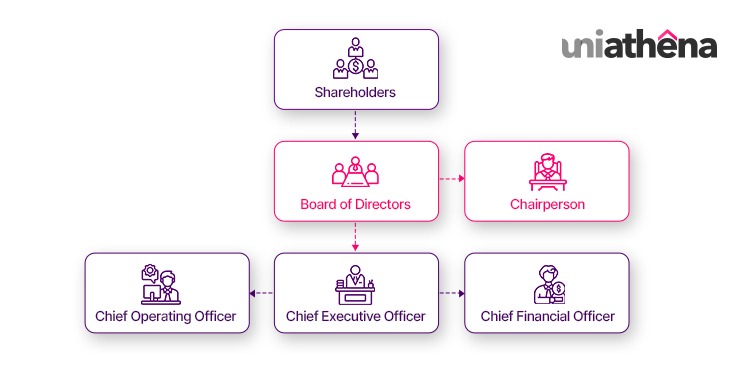
Level 1: Shareholders
Shareholders are the individuals who own major shares of the company, making them part owners. They are usually promoters, institutional investors, or retail investors who have the power to vote and appoint the members of the Board of Directors.
Level 2: Board of Directors
These are internal or external professionals who are appointed by the shareholders, and they are responsible for major decisions made by the company. The board of directors is led by a Chairperson who is responsible for maintaining the unity and integrity of the board.
Level 3: Executive Management
The executive management level consists of the day-to-day managers in the organization. These include the CEO, CFO, COO, and more, and they are responsible for implementing strategies created by the board members and overseeing the daily operations of the organization.
When all these levels work together in tandem, you truly see the benefits of corporate governance in action.
Benefits of Corporate Governance
Speaking of the benefits of the corporate governance framework, here are some of the most common advantages:
- Become trustworthy in the eyes of the investors and stakeholders.
- Map out the organization’s integrity for everyone involved in the business.
- Improve the company’s reputation in the eyes of the customers.
- Manage financial risks better.
- Promote long-term viability of the company.
Best Corporate Governance Certification
If you want to learn more about company governance and get certified in it, here are some free short courses on UniAthena that you can explore:
1. Basics of Corporate Governance
This Basics of Corporate Governance free short course is the perfect place to start for beginners. It will help you understand what corporate governance is and walk you through the models, practices, and theories in corporate governance.
In just 4-6 hours, you will have a fundamental understanding of good corporate governance practices and be ready to get your free certification from CIQ, UK.
2. Essentials of Corporate Governance Law
If you want a better understanding of the legal side of corporate governance policy in the UK, this is the course for you. The Essentials of Corporate Governance Law free short course will help you understand the practical application of corporate governance. It will also specifically cover corporate governance in the UK and how it has evolved over the years.
By the end of this course, you will have a better understanding of the legal and corporate structure in the UK, as well as the laws and regulations around corporate governance in the UK.
3. Mastering International Corporate Governance
Are you looking for a corporate governance course that tells you why certain practices succeed while others fail? You must explore our Mastering International Corporate Governance free course.
This course will not only cover the background on corporate governance but also give you real-world solutions. You will study common corporate governance issues and learn how to solve them. It will also give you an insight into the regimes of corporate governance in various countries and the developments made.
4. Diploma in International Corporate Governance
For a deeper understanding of corporate governance and policy making, explore the Diploma in International Corporate Governance free course. This corporate governance online course covers every aspect of corporate governance.
You will learn theoretical perspectives, legalities, the various phases, as well as the various corporate governance policies. In 1-2 weeks, you will have a full understanding of corporate governance around the world.
Conclusion
If you are new to the corporate world, hopefully this article on corporate governance was helpful. As a stakeholder, investor, or even someone looking to step into the role of a board member, having a proper understanding of corporate governance is important.
We, at UniAthena, offer you a range of corporate governance courses that can help you not only understand the concept better but also get certified. Explore them now!
Bonus Point
- Skills like digital literacy, crisis management, and strategic thinking are extremely valuable in this field.
Explore Related Courses








COMMENTS(0)
Explore Related Courses
Our Popular Insights
Careers are shifting faster than ever, and staying relevant takes more than experience. Explore UniAthena’s most-read blogs for sharp insights, emerging skills, and practical pathways that help you move forward with clarity and confidence in a changing professional world.


🌟 Top Project Performer – June 2026 🌟
Read More
1
mins read


🌟 Top Project Performer – May 2026 🌟
Read More
1
mins read


🌟 Top Project Performer – April 2026 🌟
Read More
1
mins read
🌟 Top Project Performer – June 2026 🌟
Read more
1
mins read
🌟 Top Project Performer – May 2026 🌟
Read more
1
mins read
🌟 Top Project Performer – April 2026 🌟
Read more
1
mins read
Get in Touch

It’s Time to Start
Join NowMost Popular Online Specialization
- Master of International Business Administration
- Master of Business Administration
- MBA in General Management- FastTrack
- Master in Innovation and Entrepreneurship
- MBA-Family Business Management
- Master in Procurement and Contract Management
- Extended Diploma in Business Analytics (SCQF Level 11)
- Diploma in Supply Chain and Logistics Management (SCQF Level 11)
- Strategic Human Resource Management Practitioner
- Master in Data Science
- Master in Engineering Management
Trending Online
- Integrated Doctorate of Business Administration
- Postgraduate Certificate in Finance for Next Generation Managers
- Master of Business Administration- General Management (Fast Track)
- Postgraduate Certificate in Socio-Economic and Legal Framework
- Postgraduate Certificate in Business Sustainability
- Certified Manager
- Supply Chain Management Practitioner
- MBA - AI in Business
- MBA - Accounting & Finance
- Master in Supply Chain and Logistics Management
Top Universities Online Certificates
- Postgraduate Certificate in International Marketing Management
- Postgraduate Certificate In International Human Resource Management
- Postgraduate Certificate in Strategic Management
- Postgraduate Certificate in Procurement & Contracts Management
- Postgraduate Certificate in Business Analytics
- Postgraduate Certificate in Strategic Supply Chain & Logistics Management
- Postgraduate Certificate in Human Resource and Leadership
- Project Management Practitioner
- Postgraduate Certificate in Supply Chain Design & Implementation
- Postgraduate Certificate in Management Accounting and Finance
Accredited Online Degree Program
- MBA - Digital Transformation
- MBA - Family Business Management
- MBA - Marketing Management
- MBA in Quality Management
- MBA - Business Intelligence & Data Analytics
- MBA in Operations & Project Management
- MBA in Energy Management
- MBA In Construction & Safety Management
- Master in Organisational Leadership
- Master in Public Health
- Master in Construction Management
- Bachelor of Arts in Business Administration


 Install Now


UniAthena is an Ed-Tech, offering flexible, affordable learning solutions, including Free-Learning Upskilling Courses and Academic Programs in partnerships with accredited and globally renowned universities and professional qualification bodies.


Do you have any questions ?
Feel free to send us your questions or request a free consultation
Send a message
UK
Athena Global Education
Magdalen Centre,
Robert Robinson Avenue,
Oxford, OX4 4GA, UK
Phone : 01865 784299
MIDDLE EAST
Athena Global Education FZE
Block L-03, First Floor,
P O Box 519265, Sharjah Publishing City,
Free Zone, Sharjah, UAE
Phone : +971 55 879 5492
INDIA
Uniathena Private Limited
9A,Midas Tower
Phase 1
Hinjewadi Rajiv Gandhi Infotech Park
Pune-411057
Phone: +91 9145665544
All Copyrights Reserved @ Athena Global Education 2021-2026