-

Bachelor's

-

Masters
-

MBA
-

Doctorate
-

Micro Credit
-

Explore all Courses
-
Postgraduate Certifications

-
Postgraduate Diploma
-
Undergraduate Diploma
-
Diploma



Budgeting Tips for Students: How to Manage Money Wisely in 2026

Author: munazzah ali
|6
MINS READ
| 0
| 6
Created On: 27 July, 2026
Share




Table of Contents (TOC):
- Key Takeaways
- Why Students Struggle with Money Management
- 8 Practical Budgeting Tips Every Student Should Follow
- Tools & Apps to Simplify Budgeting in 2026
- Common Budgeting Mistakes Students Make
- Turning Budgeting Into a Skill
- Conclusion
- FAQ
Broke by the 20th of every month? You're not alone and it doesn't mean you're bad with money. In between tuition payments, escalating rent, and grocery bills, which continue to increase, the majority of students are pushing their paychecks beyond what they were originally intended to be.
Student budgeting in 2026 is not only about saving for some distant future, but also about not panicking and checking your bank account at the end of the month. The good news? You do not need to have a degree in finance to fix this. This guide will walk you through the process of creating a student budget that will actually work, so your money will last as long as your month does.
Key Takeaways:
- Irregular income and lack of financial knowledge are the greatest obstacles to smart student finance.
- Even the simple frameworks, such as the 50/30/20 rule, can be adapted to fit the income of a student.
- Digital tools and apps make expense tracking almost effortless in 2026.
- Little, regular practices, an emergency fund, cutting subscriptions, and taking advantage of discounts will accumulate quickly.
- Budgeting can be converted into a skill that can be repeated over and over again through structured learning.
Why Students Struggle with Money Management
Irregular Income Is The First Culprit.
Part-time pay, allowances, and financial support rarely land on a fixed schedule, and budgeting can more often appear as a guess than a plan. Money is spent early because it is available, and before the next paycheck, it is gone.
No Prior Financial Education.
Algebra and history are taught to most students, yet no one is ever taught how to budget or read a bank statement. They learn by costly financial mistakes and maxed-out cards, rather than being tutored, and these lessons could have been prevented.
Social Pressure and Inflation Of Lifestyle.
It can hardly be one huge thing that blows out a budget; it is little, regular ones: a coffee here, a night out there, just to keep up with friends. None of it is reckless in itself, yet it comes quickly. It is not a will problem, but a systemic problem in the money management for students that can be addressed through better habits, rather than guilt.
8 Practical Budgeting Tips Every Student Should Follow
1. Track Every Expense
Begin by finding out precisely what happens to your money - every rupee or dollar. This is effortless in 2026 with various apps connecting with your bank and organizing your expenses.
2. Use the 50/30/20 Rule
The most basic formula to divide your income: 50 percent on needs (rent, food, etc.), 30 percent on wants, and 20 percent on savings. When tuition or rent is more, simply change the proportion to your reality.
3. Set Up a Separate Savings Account
Automate a small transfer each payday, even though it may be a small amount. When the savings are automatically made, you will not be as tempted to spend the money that you do not see in your main account.
4. Cut Recurring Costs
Spend a few minutes reviewing what you subscribe to, rent books rather than purchase them, and cook at home more frequently. These are only a few of the simple budgeting tips that can make a difference.
5. Take Advantage of Student Discounts
Your student ID is more valuable than you may believe. You can use it to get discounts on software, transport, and so on. It's one of the simplest ways of saving money as a student without changing your lifestyle.
6. Create a Mini Emergency Fund
A small amount of $200 or 300 can make the difference between a slight inconvenience and a full-blown crisis when your laptop breaks or a medical bill shows up.
7. Use Credit Wisely
Use a credit card and make all payments monthly. If you don't yet, it's okay to wait until your spending habits feel more disciplined.
8. Seek Additional Sources of Revenue
A little part-time work, tutoring, or gig delivery can help relieve the strain on a constrained budget, without costing too much time to your studies.
Also Read: How to Earn Money Online as a Student?
Tools & Apps to Simplify Budgeting in 2026
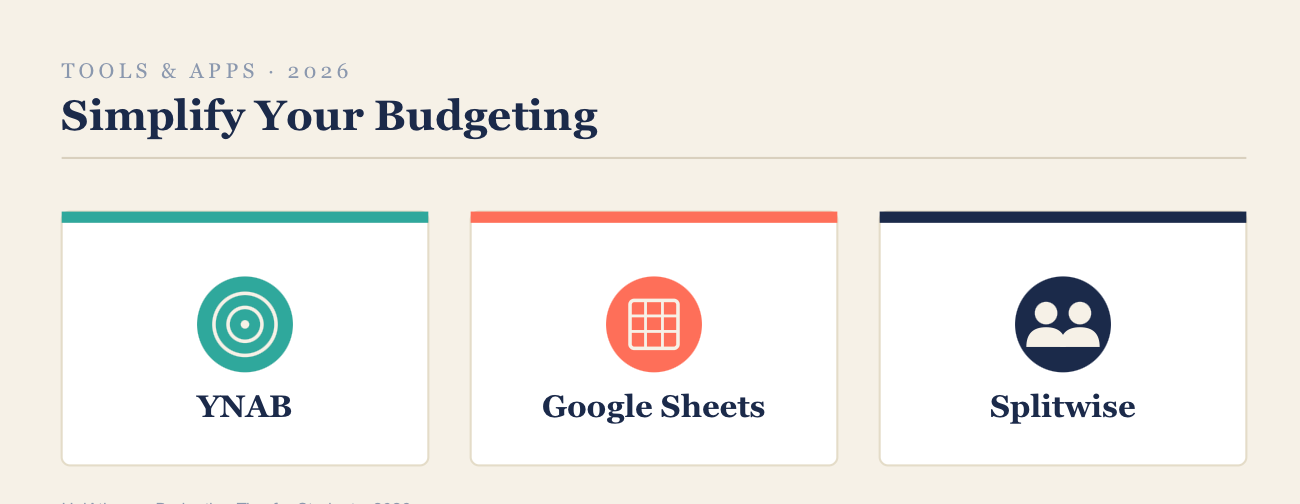
1. YNAB (You Need A Budget): Helps you have specific savings goals, and it monitors your spending in real time, allowing you to know your exact position at any given time.
2. Google Spreadsheet Templates: Free, easy, and completely customizable. Ideal when you'd prefer to create your own budget without downloading another program.
3. Splitwise: A lifesaver in case you are sharing rent, groceries, or bills with your roommates; it keeps a record of who owes what, so no one is left running around trying to get money.
Also Read: Top AI Tools for Students
Common Budgeting Mistakes Students Make
- Using financial help as a lump sum rather than spreading it over the term.
- Neglecting minor, periodic subscription fees that creep up.
- Mixing up "wants" and "needs," making overspending easy to justify.
- Skipping a written budget and tracking spending "in your head" instead.
- Waiting for a high income and then starting to save, rather than developing the habit early.
Turning Budgeting Into a Skill
Conclusion
It is not about perfection, but about small and consistent habits that add up over time in order to manage money as a student in 2026. Follow your money, automate your savings, and rely on free software or structured courses to refine your budgeting guidance toolkit. The earlier these habits are established, the simpler all of the financial decisions become once you graduate.
Also Read: Importance of Goal Setting for Students
FAQ
Q1. How much should a student save each month?
A: It does not have to be a specific target, but a goal of 10-20% of whatever you make, even a little, will get you used to saving, which will become easier to expand as time passes.
Q2. What is the simplest budgeting technique to use as a beginner?
A: The 50/30/20 rule is an effective rule to start with, as it is easy to memorize and can be reduced or increased once you have certain fixed costs, such as rent or tuition.
Q3. Do we need budgeting apps?
A: They are not necessary; a spreadsheet or a notebook is equally effective, but apps will save time, as they will automatically track spending and minimize errors in terms of manual work.
Q4. How can I budget with an irregular income?
A: Rather than planning your budget based on your most profitable month, plan it based on your lowest-earning one. Any additional money beyond that can go straight into savings.
Our Popular Courses

$14000


Doctoral Degree in Business Administration
Universidad Catolica De Murcia (UCAM), Spain
Duration:
2 - 3 Years
$17,500*
Integrated Doctorate of Business Administration
Guglielmo Marconi University, Italy
Universidad Catolica De Murcia (UCAM), Spain
Duration:
2.5 - 3.5 Years
$5,600*
Master of Business Administration
Guglielmo Marconi University, Italy
Duration:
12 - 24 Months
$5,600*
MBA in Operations & Project Management
Guglielmo Marconi University, Italy
Duration:
12 - 24 Months
$5,600*
Master in Supply Chain and Logistics Management
Guglielmo Marconi University, Italy
Duration:
12 - 24 Months
$5,950*
Master in Data Sciences
Guglielmo Marconi University, Italy
Duration:
12 - 24 Months
$5,600*
Master in Engineering Management
Guglielmo Marconi University, Italy
Duration:
12 - 24 Months
$5,600*
Master in Procurement and Contract Management
Guglielmo Marconi University, Italy
Duration:
12 - 24 Months
$5,600*
Master in Public Health
Guglielmo Marconi University, Italy
Duration:
12 - 24 MonthsOur Popular Courses
COMMENTS(0)
Our Popular Courses
$14000
Doctoral Degree in Business Administration
Universidad Catolica De Murcia (UCAM), Spain
Duration:
2 - 3 Years
$17,500*
Integrated Doctorate of Business Administration
Guglielmo Marconi University, Italy
Universidad Catolica De Murcia (UCAM), Spain
Duration:
2.5 - 3.5 Years
$5,600*
Master of Business Administration
Guglielmo Marconi University, Italy
Duration:
12 - 24 Months
$5,600*
MBA in Operations & Project Management
Guglielmo Marconi University, Italy
Duration:
12 - 24 Months
$5,600*
Master in Supply Chain and Logistics Management
Guglielmo Marconi University, Italy
Duration:
12 - 24 Months
$5,950*
Master in Data Sciences
Guglielmo Marconi University, Italy
Duration:
12 - 24 Months
$5,600*
Master in Engineering Management
Guglielmo Marconi University, Italy
Duration:
12 - 24 Months
$5,600*
Master in Procurement and Contract Management
Guglielmo Marconi University, Italy
Duration:
12 - 24 Months
$5,600*
Master in Public Health
Guglielmo Marconi University, Italy
Duration:
12 - 24 MonthsOur Popular Courses
Our Popular Insights
Careers are shifting faster than ever, and staying relevant takes more than experience. Explore UniAthena’s most-read blogs for sharp insights, emerging skills, and practical pathways that help you move forward with clarity and confidence in a changing professional world.

How to Switch Career to Data Analytics?
Read More
6
mins read






How to Switch Career to Data Analytics?
Read more
6
mins read

Get in Touch

It’s Time to Start
Join NowMost Popular Online Specialization
- Master of International Business Administration
- Master of Business Administration
- MBA in General Management- FastTrack
- Master in Innovation and Entrepreneurship
- MBA-Family Business Management
- Master in Procurement and Contract Management
- Extended Diploma in Business Analytics (SCQF Level 11)
- Diploma in Supply Chain and Logistics Management (SCQF Level 11)
- Strategic Human Resource Management Practitioner
- Master in Data Science
- Master in Engineering Management
Trending Online
- Integrated Doctorate of Business Administration
- Postgraduate Certificate in Finance for Next Generation Managers
- Master of Business Administration- General Management (Fast Track)
- Postgraduate Certificate in Socio-Economic and Legal Framework
- Postgraduate Certificate in Business Sustainability
- Certified Manager
- Supply Chain Management Practitioner
- MBA - AI in Business
- MBA - Accounting & Finance
- Master in Supply Chain and Logistics Management
Top Universities Online Certificates
- Postgraduate Certificate in International Marketing Management
- Postgraduate Certificate In International Human Resource Management
- Postgraduate Certificate in Strategic Management
- Postgraduate Certificate in Procurement & Contracts Management
- Postgraduate Certificate in Business Analytics
- Postgraduate Certificate in Strategic Supply Chain & Logistics Management
- Postgraduate Certificate in Human Resource and Leadership
- Project Management Practitioner
- Postgraduate Certificate in Supply Chain Design & Implementation
- Postgraduate Certificate in Management Accounting and Finance
Accredited Online Degree Program
- MBA - Digital Transformation
- MBA - Family Business Management
- MBA - Marketing Management
- MBA in Quality Management
- MBA - Business Intelligence & Data Analytics
- MBA in Operations & Project Management
- MBA in Energy Management
- MBA In Construction & Safety Management
- Master in Organisational Leadership
- Master in Public Health
- Master in Construction Management
- Bachelor of Arts in Business Administration


 Install Now


UniAthena is an Ed-Tech, offering flexible, affordable learning solutions, including Free-Learning Upskilling Courses and Academic Programs in partnerships with accredited and globally renowned universities and professional qualification bodies.


Do you have any questions ?
Feel free to send us your questions or request a free consultation
Send a message
UK
Athena Global Education
Magdalen Centre,
Robert Robinson Avenue,
Oxford, OX4 4GA, UK
Phone : 01865 784299
MIDDLE EAST
Athena Global Education FZE
Block L-03, First Floor,
P O Box 519265, Sharjah Publishing City,
Free Zone, Sharjah, UAE
Phone : +971 55 879 5492
INDIA
Uniathena Private Limited
9A,Midas Tower
Phase 1
Hinjewadi Rajiv Gandhi Infotech Park
Pune-411057
Phone: +91 9145665544
All Copyrights Reserved @ Athena Global Education 2021-2026