-

Bachelor's

-

Masters
-

MBA
-

Doctorate
-

Micro Credit
-

Explore all Courses
-
Postgraduate Certifications

-
Postgraduate Diploma
-
Undergraduate Diploma
-
Diploma



How Reshoring Is Reshaping Supply Chain Careers in a Deglobalising World

Author: maharajan p
|7
MINS READ
| 0
| 5
Created On: 27 July, 2026
Share




Table of Contents (TOC):
- Introduction
- Key Takeaways
- What Is Reshoring in Supply Chain Management?
- Why Are Companies Reshoring Their Supply Chains?
- How Reshoring Is Transforming Supply Chain Careers
- Top Skills Supply Chain Professionals Need in a Reshoring Economy
- Building the Skills Needed for Modern Supply Chain Careers
- FAQs
Introduction
WEF reports that nearly 90% of global manufacturers are considering regionalizing their supply chain operations.
The reason is not hard to see.
If you look at recent times, supply chains have been tested by trade wars, shipping disruptions, geopolitical conflicts, sanctions, and growing tariff pressures. Together, these events have put immense pressure on companies from sourcing materials and finding suppliers to manufacturing products and moving them across markets.
The impact is already visible across procurement, manufacturing, logistics, and trade. But what about careers?
What does all of this mean for professionals already working in supply chain management or for those looking to enter the field? That's what we're going to find out here.
Key Takeaways:
- Global manufacturers are increasingly regionalizing supply chains due to rising geopolitical and trade-related disruptions worldwide.
- Reshoring is reshaping supply chains by prioritizing resilience, control, and proximity over traditional cost-driven sourcing models.
- Supply chain careers are evolving toward data-driven, strategic roles requiring risk management and digital fluency.
- Future professionals must understand regional trade dynamics, analytics tools, and cross-functional supply chain decision-making.
What Is Reshoring in Supply Chain Management?
Reshoring is the practice of bringing manufacturing or production activities back to a company's home country after they were previously moved overseas. For years, businesses offshored operations to reduce labor and production costs.
However, supply chain disruptions, geopolitical tensions, and rising transportation costs have prompted many organizations to rethink that approach. By reshoring, companies aim to improve supply chain resilience, reduce dependence on distant suppliers, and gain greater control over production. As a result, reshoring is becoming an increasingly important strategy in modern supply chain management.
Why Are Companies Reshoring Their Supply Chains?
For decades, companies built supply chains around one goal: keeping production costs as low as possible. That often meant manufacturing products thousands of miles away from the customers who would eventually buy them.
But today, that assumption is being rethought. Several global events have contributed to this shift, including:
- The China–United States trade war, which introduced tariff adjustments and trade restrictions across sectors such as semiconductors and advanced manufacturing
- The Suez Canal obstruction, which disrupted global shipping routes and delayed hundreds of vessels moving critical goods across regions
- The Russian invasion of Ukraine, which triggered sanctions, energy shocks, and supply restrictions across multiple global markets
Together, these events have exposed a hard truth: low-cost production comes with hidden risks.
When a supplier shuts down, shipping routes are disrupted, or trade policies shift overnight, companies are forced into reactive mode just to keep products moving. And those risks aren't easing. In fact, recent 2026 supply chain data shows 73% of supply chain leaders expect tariff pressures to reach a breaking point by the end of this year, forcing companies to pass rising costs directly to customers rather than absorbing them internally.
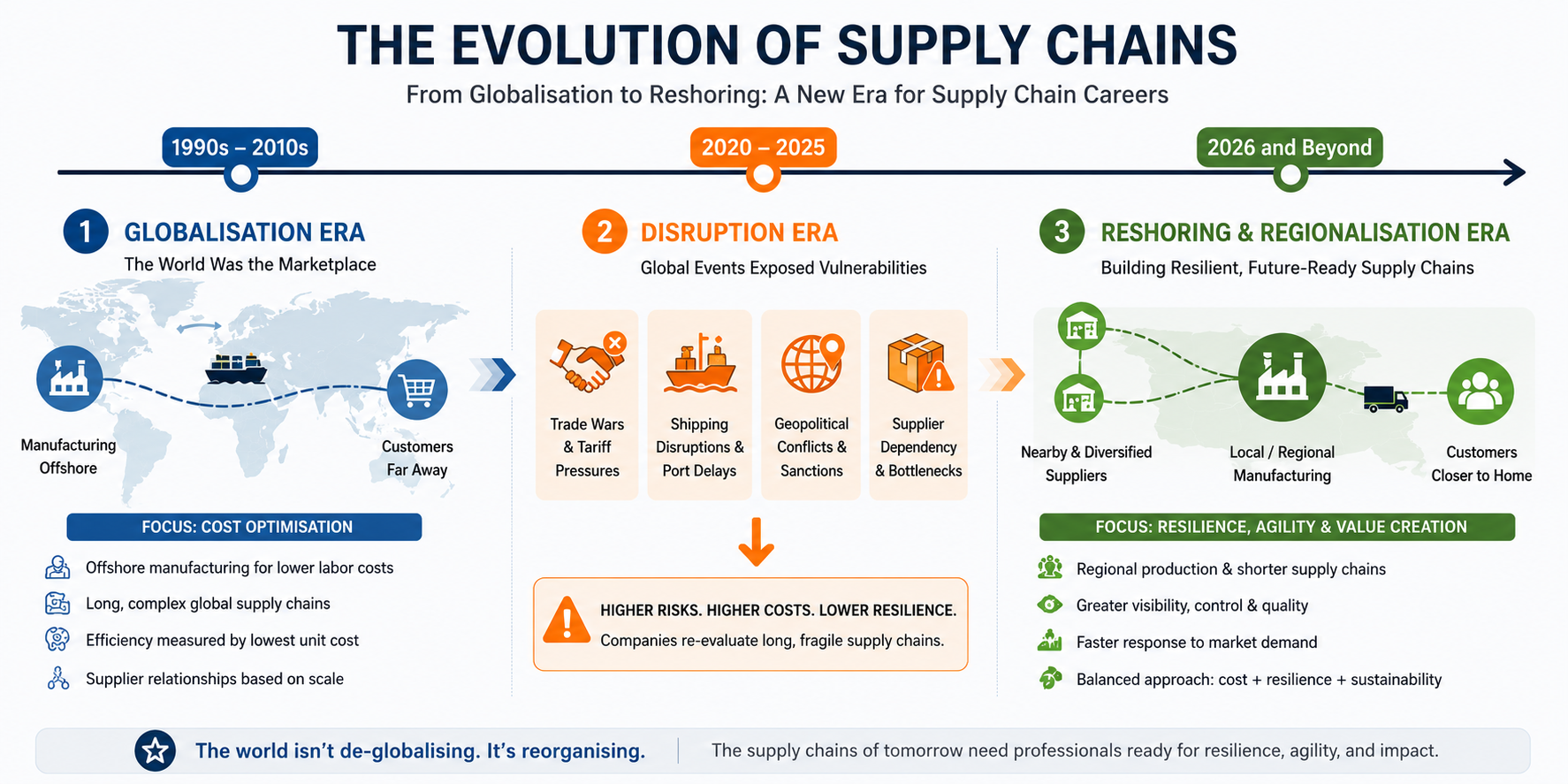
That kind of pressure accelerates a decision many organizations were already weighing: bring production closer to home.
Reshoring has become an increasingly attractive option for companies looking to build more reliable supply chains. Some of the biggest reasons include:
- Reducing supply chain disruptions caused by factory shutdowns, transportation delays, and supplier bottlenecks.
- Improving resilience by bringing production closer to customers and key markets.
- Reducing dependence on overseas suppliers for critical components and materials.
- Protecting intellectual property and sensitive manufacturing processes.
- Increasing visibility and quality control across manufacturing operations.
- Responding faster to market demand with shorter lead times.
And this isn't just a handful of companies experimenting with a new strategy. Around 85% of global companies are now planning to manufacture and sell within the same region by the end of 2026 – a signal that regional supply chains are shifting from a competitive edge to a baseline expectation.
How Reshoring Is Transforming Supply Chain Careers
As production moves closer to end markets, supply chains are becoming shorter in geography but more complex in design. Instead of managing long, linear global flows, professionals are now coordinating multiple regional networks that need to stay stable under constant uncertainty.
That shift is fundamentally changing what supply chain professionals are expected to know, measure, and deliver. And it's raising the bar for anyone entering the field in 2026. The metrics of success are no longer just cost reduction and operational smoothness. Resilience, adaptability, and strategic thinking are now part of the job description.
Also Read: Traditional vs. Digital Supply Chains: What’s Changing?
Here are the key shifts worth understanding if you're looking to build a career in supply chain:
1. New KPIs to measure value differently
Professionals are now assessed on vendor diversification, lead time reduction, and supply chain durability, not just lowest unit cost.
2. Procurement has become a strategic function
Sourcing teams now work directly with domestic engineering and product design teams to ensure localized parts meet exact specifications. This means procurement roles carry more cross-functional responsibility than before, and offer more visibility within organizations.
3. Digital fluency is no longer optional
Planners and managers are expected to navigate cloud platforms, AI-driven spend analysis tools, and predictive analytics software as part of daily work.
4. ESG knowledge is becoming a baseline expectation
Sustainability metrics are being built into supply chain roles at every level, from monitoring the carbon footprint of regional freight to managing domestic material compliance.
Instead of only coordinating movement of goods, professionals are increasingly expected to think in systems: designing supplier networks, managing risk exposure, and balancing cost with resilience across multiple regions.
Top Skills Supply Chain Professionals Need in a Reshoring Economy
The world isn't de-globalizing, but it is reorganizing. Companies are pulling back from fully stretched, highly complex global supply chains and rebuilding closer to home. That shift is creating demand for a new kind of supply chain professional: one who can manage regional complexity, respond to geopolitical pressure, and make decisions backed by data.
Roles like risk analyst, sourcing manager, resilience specialist, and procurement expert are all growing, and carrying heavier responsibilities than they did five years ago. Here are the skills that matter most in this environment:
1. Risk Management
Reshoring doesn't eliminate supply chain risk, it redistributes it. Professionals need to map supplier risk across multiple tiers, build disruption response plans, and run scenario models that account for everything from port delays to policy changes.
2. Analytics and Data Interpretation
Supply chain decisions are increasingly data-driven, and professionals who can work with that data directly will stand out. This includes demand forecasting using statistical models, inventory optimization, and tracking KPIs like OTIF, lead time variability, and fill rates.
3. Digital Tools Exposure
Regional supply chains run on interconnected systems, and professionals are expected to navigate them. Familiarity with ERP platforms like SAP, Oracle, or Microsoft Dynamics, alongside cloud-based planning tools and AI-supported forecasting software, signals that a candidate can operate in a modern supply chain environment from day one.
4. Procurement and Strategic Sourcing
As companies localize their supplier base, procurement teams are doing more than negotiating prices. They're actively developing domestic and regional suppliers who may be newer, smaller, or less established than global alternatives.
5. Trade and Geopolitical Awareness
Supply chain decisions don't happen in a vacuum. Professionals who understand tariff structures, import/export compliance, and regional trade agreements can anticipate how policy changes affect sourcing strategy before those changes create disruptions.
Also Read: The Role of Data Analytics in Supply Chain Management
Building the Skills Needed for Modern Supply Chain Careers
Modern supply chains are becoming more data-driven, technology-enabled, and increasingly regionalized. Whether you're looking to strengthen your fundamentals, expand your knowledge, or prepare for new opportunities in the field, building the right skills can make a difference.
To support that journey, UniAthena offers a range of programs covering key supply chain and business skills. Here are some programs worth exploring.
- Essentials of Risk Management: Learn how businesses identify, assess, and manage risks to reduce disruptions and support better decision-making.
- Basics of Planning & Procurement in Material Management: Understand the fundamentals of material planning, purchasing, supplier selection, and procurement strategies that keep operations running efficiently.
- Diploma in Supply Chain Management: Build a strong foundation in supply chain management, logistics, procurement, and the key processes that move products from suppliers to customers.
- Basics of Data Analytics & Macros in Excel: Develop practical Excel skills for organizing, analyzing, and presenting data, making it a valuable addition for professionals working with supply chain and business data.
Browse our short courses to explore programs covering supply chain management, logistics, procurement, and other business disciplines.
Also Read: Inside the Supply Chain Manager Role: Skills, Salary, and Career Path
FAQs
Q1. What is reshoring in supply chain management?
A: Reshoring is the process of bringing manufacturing or production activities back to a company's home country after operating overseas.
Q2. Why are companies reshoring their supply chains?
A: Companies are reshoring to reduce supply chain risks, improve resilience, shorten lead times, and gain greater control over production.
Q3. How does reshoring affect supply chain careers?
A: Reshoring increases demand for professionals skilled in risk management, strategic sourcing, analytics, procurement, and supply chain planning.
Q4. What skills are most valuable in a reshoring economy?
A: Key skills include risk management, data analytics, ERP software proficiency, strategic sourcing, and trade compliance knowledge.
Q5. Does reshoring mean globalization is ending?
A: No. Many companies are shifting toward regional supply networks rather than abandoning global trade altogether.
Our Popular Courses

$14000


Doctoral Degree in Business Administration
Universidad Catolica De Murcia (UCAM), Spain
Duration:
2 - 3 Years
$17,500*
Integrated Doctorate of Business Administration
Guglielmo Marconi University, Italy
Universidad Catolica De Murcia (UCAM), Spain
Duration:
2.5 - 3.5 Years
$5,600*
Master of Business Administration
Guglielmo Marconi University, Italy
Duration:
12 - 24 Months
$5,600*
MBA in Operations & Project Management
Guglielmo Marconi University, Italy
Duration:
12 - 24 Months
$5,600*
Master in Supply Chain and Logistics Management
Guglielmo Marconi University, Italy
Duration:
12 - 24 Months
$5,950*
Master in Data Sciences
Guglielmo Marconi University, Italy
Duration:
12 - 24 Months
$5,600*
Master in Engineering Management
Guglielmo Marconi University, Italy
Duration:
12 - 24 Months
$5,600*
Master in Procurement and Contract Management
Guglielmo Marconi University, Italy
Duration:
12 - 24 Months
$5,600*
Master in Public Health
Guglielmo Marconi University, Italy
Duration:
12 - 24 MonthsOur Popular Courses
COMMENTS(0)
Our Popular Courses
$14000
Doctoral Degree in Business Administration
Universidad Catolica De Murcia (UCAM), Spain
Duration:
2 - 3 Years
$17,500*
Integrated Doctorate of Business Administration
Guglielmo Marconi University, Italy
Universidad Catolica De Murcia (UCAM), Spain
Duration:
2.5 - 3.5 Years
$5,600*
Master of Business Administration
Guglielmo Marconi University, Italy
Duration:
12 - 24 Months
$5,600*
MBA in Operations & Project Management
Guglielmo Marconi University, Italy
Duration:
12 - 24 Months
$5,600*
Master in Supply Chain and Logistics Management
Guglielmo Marconi University, Italy
Duration:
12 - 24 Months
$5,950*
Master in Data Sciences
Guglielmo Marconi University, Italy
Duration:
12 - 24 Months
$5,600*
Master in Engineering Management
Guglielmo Marconi University, Italy
Duration:
12 - 24 Months
$5,600*
Master in Procurement and Contract Management
Guglielmo Marconi University, Italy
Duration:
12 - 24 Months
$5,600*
Master in Public Health
Guglielmo Marconi University, Italy
Duration:
12 - 24 MonthsOur Popular Courses
Our Popular Insights
Careers are shifting faster than ever, and staying relevant takes more than experience. Explore UniAthena’s most-read blogs for sharp insights, emerging skills, and practical pathways that help you move forward with clarity and confidence in a changing professional world.

How to Switch Career to Data Analytics?
Read More
6
mins read





How to Switch Career to Data Analytics?
Read more
6
mins read

Get in Touch

It’s Time to Start
Join NowMost Popular Online Specialization
- Master of International Business Administration
- Master of Business Administration
- MBA in General Management- FastTrack
- Master in Innovation and Entrepreneurship
- MBA-Family Business Management
- Master in Procurement and Contract Management
- Extended Diploma in Business Analytics (SCQF Level 11)
- Diploma in Supply Chain and Logistics Management (SCQF Level 11)
- Strategic Human Resource Management Practitioner
- Master in Data Science
- Master in Engineering Management
Trending Online
- Integrated Doctorate of Business Administration
- Postgraduate Certificate in Finance for Next Generation Managers
- Master of Business Administration- General Management (Fast Track)
- Postgraduate Certificate in Socio-Economic and Legal Framework
- Postgraduate Certificate in Business Sustainability
- Certified Manager
- Supply Chain Management Practitioner
- MBA - AI in Business
- MBA - Accounting & Finance
- Master in Supply Chain and Logistics Management
Top Universities Online Certificates
- Postgraduate Certificate in International Marketing Management
- Postgraduate Certificate In International Human Resource Management
- Postgraduate Certificate in Strategic Management
- Postgraduate Certificate in Procurement & Contracts Management
- Postgraduate Certificate in Business Analytics
- Postgraduate Certificate in Strategic Supply Chain & Logistics Management
- Postgraduate Certificate in Human Resource and Leadership
- Project Management Practitioner
- Postgraduate Certificate in Supply Chain Design & Implementation
- Postgraduate Certificate in Management Accounting and Finance
Accredited Online Degree Program
- MBA - Digital Transformation
- MBA - Family Business Management
- MBA - Marketing Management
- MBA in Quality Management
- MBA - Business Intelligence & Data Analytics
- MBA in Operations & Project Management
- MBA in Energy Management
- MBA In Construction & Safety Management
- Master in Organisational Leadership
- Master in Public Health
- Master in Construction Management
- Bachelor of Arts in Business Administration


 Install Now


UniAthena is an Ed-Tech, offering flexible, affordable learning solutions, including Free-Learning Upskilling Courses and Academic Programs in partnerships with accredited and globally renowned universities and professional qualification bodies.


Do you have any questions ?
Feel free to send us your questions or request a free consultation
Send a message
UK
Athena Global Education
Magdalen Centre,
Robert Robinson Avenue,
Oxford, OX4 4GA, UK
Phone : 01865 784299
MIDDLE EAST
Athena Global Education FZE
Block L-03, First Floor,
P O Box 519265, Sharjah Publishing City,
Free Zone, Sharjah, UAE
Phone : +971 55 879 5492
INDIA
Uniathena Private Limited
9A,Midas Tower
Phase 1
Hinjewadi Rajiv Gandhi Infotech Park
Pune-411057
Phone: +91 9145665544
All Copyrights Reserved @ Athena Global Education 2021-2026