-

Bachelor's

-

Masters
-

MBA
-

Doctorate
-

Micro Credit
-

Explore all Courses
-
Postgraduate Certifications

-
Postgraduate Diploma
-
Undergraduate Diploma
-
Diploma



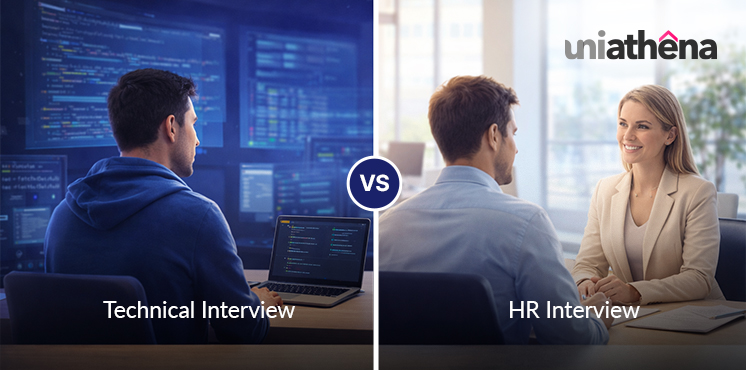
Technical vs HR Interview: What’s the Difference?
Author: maharajan p
|7
MINS READ
| 0
| 206
Created On: 27 April, 2026
Share




Table of Contents (TOC):
- Introduction
- Key Takeaways
- Understanding the Interview Process
- What Is a Technical Interview?
- What Is an HR Interview?
- Technical vs HR Interview: Key Differences
- How to Prepare for Technical and HR Interviews
- Develop Technical and Soft Skills with UniAthena
- FAQs
Introduction
Most companies conduct multiple interview rounds before making a hiring decision. Each stage evaluates a different aspect of a candidate’s suitability for the role.
Two of the most common stages are the technical interview and the HR interview. A technical interview focuses on assessing a candidate’s job-related knowledge, problem-solving ability, and technical expertise. An HR interview evaluates communication skills, professional attitude, cultural fit, and career expectations.
Key Takeaways:
- Most hiring processes include multiple interview rounds. Expect stages such as resume screening, recruiter calls, technical interviews, and HR discussions before a final hiring decision is made.
- Technical interviews evaluate your ability to perform the job. Interviewers focus on your subject knowledge, problem-solving approach, and familiarity with the tools used in the role.
- HR interviews evaluate how you fit within the organization. HR professionals assess communication skills, professional attitude, career goals, and alignment with company expectations.
- Technical rounds require strong conceptual understanding and practical problem-solving, while HR interviews require clear communication and well-thought-out career goals.
Understanding the Interview Process
Most organizations use a multi-stage interview process to evaluate candidates from different angles. The structure may vary by company and role, but the hiring process often includes several common steps.
Typical Interview Stages
- Application Screening: Recruiters review resumes and applications to shortlist candidates whose qualifications match the job requirements.
- Initial Screening Interview: This is often a short call conducted by a recruiter to verify basic information such as experience, availability, and interest in the role.
- Technical Interview: Candidates are evaluated on job-specific knowledge, technical skills, and problem-solving ability. This round is usually conducted by technical experts, team leads, or hiring managers.
- Practical Test or Assessment (Role-Dependent): Some employers may include coding tests, case studies, assignments, or skill assessments to evaluate real-world ability.
- HR Interview: The HR team assesses communication skills, cultural fit, career goals, salary expectations, and workplace attitude.
- Final Discussion or Managerial Round: In some companies, senior managers or department heads conduct a final conversation before making the hiring decision.
Not every company follows all these stages. However, technical interviews and HR interviews remain two of the most common and important rounds in most hiring processes.
What Is a Technical Interview?
A technical interview evaluates whether a candidate has the knowledge and practical skills required for the job. The focus is on job-related expertise, analytical ability, and problem-solving skills.
Technical interviews are usually conducted by professionals who understand the role in detail, such as subject matter experts, team leads, or senior specialists within the team.
For example, if you apply for a junior data analyst position, the technical interview may be conducted by:
- A senior data analyst
- A data science team lead
- An analytics manager
What to Expect in a Technical Interview
Assume the same junior data analyst role. These are some of the questions you may encounter during the interview:
- What is the difference between structured and unstructured data?
- Which tools have you used for data analysis?
- How would you analyze sales data to identify trends?
- If a dataset contains missing values, how would you handle them?
Questions like these test your understanding of fundamental concepts, your ability to apply those concepts in real-world situations, and your familiarity with relevant tools. These are the aspects domain experts typically evaluate during the technical round.
What Is an HR Interview?
An HR interview evaluates whether a candidate is a good fit for the organization beyond technical ability. While technical interviews focus on job-specific skills, HR interviews assess communication, professional attitude, cultural fit, and career expectations.
HR interviews are usually conducted by human resource professionals or talent acquisition managers. Their role is to:
- Understand the candidate’s career goals and motivations
- Evaluate communication and interpersonal skills
- Discuss salary expectations, availability, and workplace policies
- Ensure the candidate aligns with the company culture and long-term needs
What to Expect in an HR Interview
HR interviews typically include questions that explore behavior, personality, and professional outlook rather than technical knowledge.
Some common HR interview questions include:
- Tell me about yourself.
- Why are you interested in this role?
- What are your career goals for the next few years?
- How do you handle challenges or workplace conflicts?
- Why do you want to work with this company?
Also Read: Best Way to Answer “Tell Me About Yourself” in 2026
Technical vs HR Interview: Key Differences
Technical and HR interviews evaluate different aspects of a candidate. One focuses on whether you can do the job, while the other focuses on how you fit within the organization.
How to Prepare for Technical and HR Interviews
Preparing effectively means focusing on the areas each round is designed to assess. The following steps outline how candidates can prepare for both interviews in a practical and structured way.
Preparing for a Technical Interview
Focus on strengthening the knowledge and skills directly related to the role.
- Review the core concepts of your field: Revisit the fundamental topics related to the position. For example, a junior data analyst should be comfortable with data structures, data types, and basic statistical concepts.
- Practice with real problems: Interviewers often present practical scenarios. Work through sample datasets, case studies, or practice problems that require analysis and interpretation.
- Be familiar with the tools used in the role: Know how to use the tools mentioned in the job description. For a data analyst role, this may include Excel, SQL, Python, or data visualization platforms.
Preparing for an HR Interview
HR interviews focus more on communication, clarity of goals, and professional attitude.
- Prepare a clear introduction about yourself: Be ready to explain your background, education, and interests in a structured way.
- Understand the company and the role: Research the organization’s work, values, and industry position. This helps you answer questions like “Why do you want to work here?”
- Think about your career goals: HR professionals often ask about your long-term plans. Prepare answers that show you are motivated and serious about the field.
Preparing with these specific steps helps you approach both technical and HR interviews with greater clarity and confidence.
Also Read: How to Answer – "Why Should We Hire You" in an Interview
Develop Technical and Soft Skills with UniAthena
Landing a job isn't just about what you know, it's also about how you think, communicate, and solve problems. Employers, especially at the entry level, actively look for candidates who can communicate ideas with clarity, and approach challenges with a structured mindset.
Since most fresh graduates haven't yet had significant industry exposure, building these soft skills early can make a real difference in interviews and team settings.
UniAthena offers several short programs designed to help you develop exactly these workplace-ready abilities:
- Executive Diploma in Business Communication — Master the art of professional communication, from structured conversations to polished business interactions in modern workplaces.
- Mastering Design Thinking — Learn a proven, framework-driven approach to problem-solving that is highly valued across industries.
- Essentials of Business Writing — Write with confidence. This program covers everything from crisp emails to well-structured reports and workplace documents.
Beyond soft skills, UniAthena also equips you with technical knowledge that employers are actively hiring for. Whether you're just getting started or looking to upskill, these programs offer a strong foundation:
- Basics of Artificial Intelligence — Understand the core concepts of AI and how it is reshaping industries worldwide.
- Certified Business Analytics Professional — Gain practical analytics skills to interpret data and drive smarter business decisions.
- Essentials of Data Analytics — Explore the fundamentals of working with data, from analysis to meaningful insights.
If your interests lie in marketing, sales, machine learning, or any other professional domain, UniAthena's broader short-course library has programs tailored to where you want to go.
Also Read: How To Use ChatGPT For Interview Preparation In 2026?
FAQs
Q1. What kind of questions are asked in a technical interview?
A: Technical interviews usually include conceptual questions, problem-solving tasks, and scenario-based questions related to the job role.
Q2. What kind of questions are asked in an HR interview?
A: HR interviews often include behavioral and career-related questions, such as career goals, workplace challenges, teamwork experiences, and motivation for applying.
Q3. How long do technical and HR interviews usually take?
A: A technical interview typically lasts 30 to 60 minutes, while an HR interview usually takes 20 to 40 minutes, depending on the company.
Q4. Can you get rejected after clearing the technical interview?
A: Yes. Candidates may still be rejected in the HR round if there is a mismatch in expectations, communication, or organizational fit.
Q5. How should candidates prepare for a technical interview?
A: Review core concepts, practice real problems, and be ready to explain your approach clearly.
Q6. How should candidates prepare for an HR interview?
A: Prepare to introduce yourself clearly, explain your career goals, and discuss your motivation for the role and company.
Explore Related Courses












COMMENTS(0)
Explore Related Courses
Our Popular Insights
Careers are shifting faster than ever, and staying relevant takes more than experience. Explore UniAthena’s most-read blogs for sharp insights, emerging skills, and practical pathways that help you move forward with clarity and confidence in a changing professional world.


How to Switch Career to Data Analytics?
Read More
6
mins read



How to Switch Career to Data Analytics?
Read more
6
mins read
Get in Touch

It’s Time to Start
Join NowMost Popular Online Specialization
- Master of International Business Administration
- Master of Business Administration
- MBA in General Management- FastTrack
- Master in Innovation and Entrepreneurship
- MBA-Family Business Management
- Master in Procurement and Contract Management
- Extended Diploma in Business Analytics (SCQF Level 11)
- Diploma in Supply Chain and Logistics Management (SCQF Level 11)
- Strategic Human Resource Management Practitioner
- Master in Data Science
- Master in Engineering Management
Trending Online
- Integrated Doctorate of Business Administration
- Postgraduate Certificate in Finance for Next Generation Managers
- Master of Business Administration- General Management (Fast Track)
- Postgraduate Certificate in Socio-Economic and Legal Framework
- Postgraduate Certificate in Business Sustainability
- Certified Manager
- Supply Chain Management Practitioner
- MBA - AI in Business
- MBA - Accounting & Finance
- Master in Supply Chain and Logistics Management
Top Universities Online Certificates
- Postgraduate Certificate in International Marketing Management
- Postgraduate Certificate In International Human Resource Management
- Postgraduate Certificate in Strategic Management
- Postgraduate Certificate in Procurement & Contracts Management
- Postgraduate Certificate in Business Analytics
- Postgraduate Certificate in Strategic Supply Chain & Logistics Management
- Postgraduate Certificate in Human Resource and Leadership
- Project Management Practitioner
- Postgraduate Certificate in Supply Chain Design & Implementation
- Postgraduate Certificate in Management Accounting and Finance
Accredited Online Degree Program
- MBA - Digital Transformation
- MBA - Family Business Management
- MBA - Marketing Management
- MBA in Quality Management
- MBA - Business Intelligence & Data Analytics
- MBA in Operations & Project Management
- MBA in Energy Management
- MBA In Construction & Safety Management
- Master in Organisational Leadership
- Master in Public Health
- Master in Construction Management
- Bachelor of Arts in Business Administration


 Install Now


UniAthena is an Ed-Tech, offering flexible, affordable learning solutions, including Free-Learning Upskilling Courses and Academic Programs in partnerships with accredited and globally renowned universities and professional qualification bodies.


Do you have any questions ?
Feel free to send us your questions or request a free consultation
Send a message
UK
Athena Global Education
Magdalen Centre,
Robert Robinson Avenue,
Oxford, OX4 4GA, UK
Phone : 01865 784299
MIDDLE EAST
Athena Global Education FZE
Block L-03, First Floor,
P O Box 519265, Sharjah Publishing City,
Free Zone, Sharjah, UAE
Phone : +971 55 879 5492
INDIA
Uniathena Private Limited
9A,Midas Tower
Phase 1
Hinjewadi Rajiv Gandhi Infotech Park
Pune-411057
Phone: +91 9145665544
All Copyrights Reserved @ Athena Global Education 2021-2026