-

Bachelor's

-

Masters
-

MBA
-

Doctorate
-

Micro Credit
-

Explore all Courses
-
Postgraduate Certifications

-
Postgraduate Diploma
-
Undergraduate Diploma
-
Diploma



Career Change at 40: Why Starting a New Career at 40 Is Not Late But Smart

Author: aishwarya sancheti
|11
MINS READ
| 4
| 28,143
Created On: 16 December, 2025 Updated On: 16 July, 2026
Share




Table of Contents (TOC):
- Introduction
- Key Takeaways
- Why 40 Is a Powerful Age for a Midlife Career Change
- Are People Really Changing Careers at 40? Yes, And They’re Thriving
- What People at 40 Actually Want in a New Career
- Best Career Change Options at 40
- Why These Careers Are Thriving in the Global Job Market in 2026
- Realistic Courses for a Career Change at 40
૦ Short Courses & Professional Certifications (Free Learning)
૦ Academic Degree Programmes - How to Start a New Career at 40 - A Simple 6-Step Plan
- Conclusion
- FAQs
Introduction
A lot of professionals ask, “Is it too late to change careers at 40?” The answer: absolutely not. In 2026, more professionals than ever are choosing a career change at 40 not because they have to, but because they want better opportunities, higher salaries, greater flexibility, and more meaningful work. You’re not starting over; you’re starting with decades of experience, clarity, and real-world skills younger professionals lack.
With AI, data, and digital roles expanding globally, your leadership and emotional intelligence are in high demand. The right strategy and upskilling can turn your 40s into the most powerful decade of your career.
Key Takeaways:
- Career change at 40 is normal, rising, and backed by global data, nearly half of professionals aged 40 - 45 are actively exploring new roles.
- Midlife switchers have advantages younger workers don’t: clarity, emotional maturity, leadership instincts, and stronger decision-making.
- High-growth industries like data, cybersecurity, digital marketing, consulting, and AI openly prefer experienced professionals.
- Short, practical upskilling, especially MBA, analytics, leadership, and AI-aligned programs helps professionals transition faster.
- A structured approach (role clarity → skills → portfolio → networking) dramatically increases success for career changers in their 40s.
Why 40 is a Powerful Age for a Midlife Career Change
By now, you know:
- What you want
- What drains you
- What your strengths are
- What kind of work-life balance you need
- What kind of income you expect
- What values matter to you
This clarity is GOLD.
People in their 40s often choose better, higher-paying, more aligned careers because they finally understand what they don't want. This leads to successful career change at 40 far more often than people think.
Are People Really Changing Careers in Their 40s? Yes, And They’re Thriving
Here’s a simplified chart showing career switch interest:
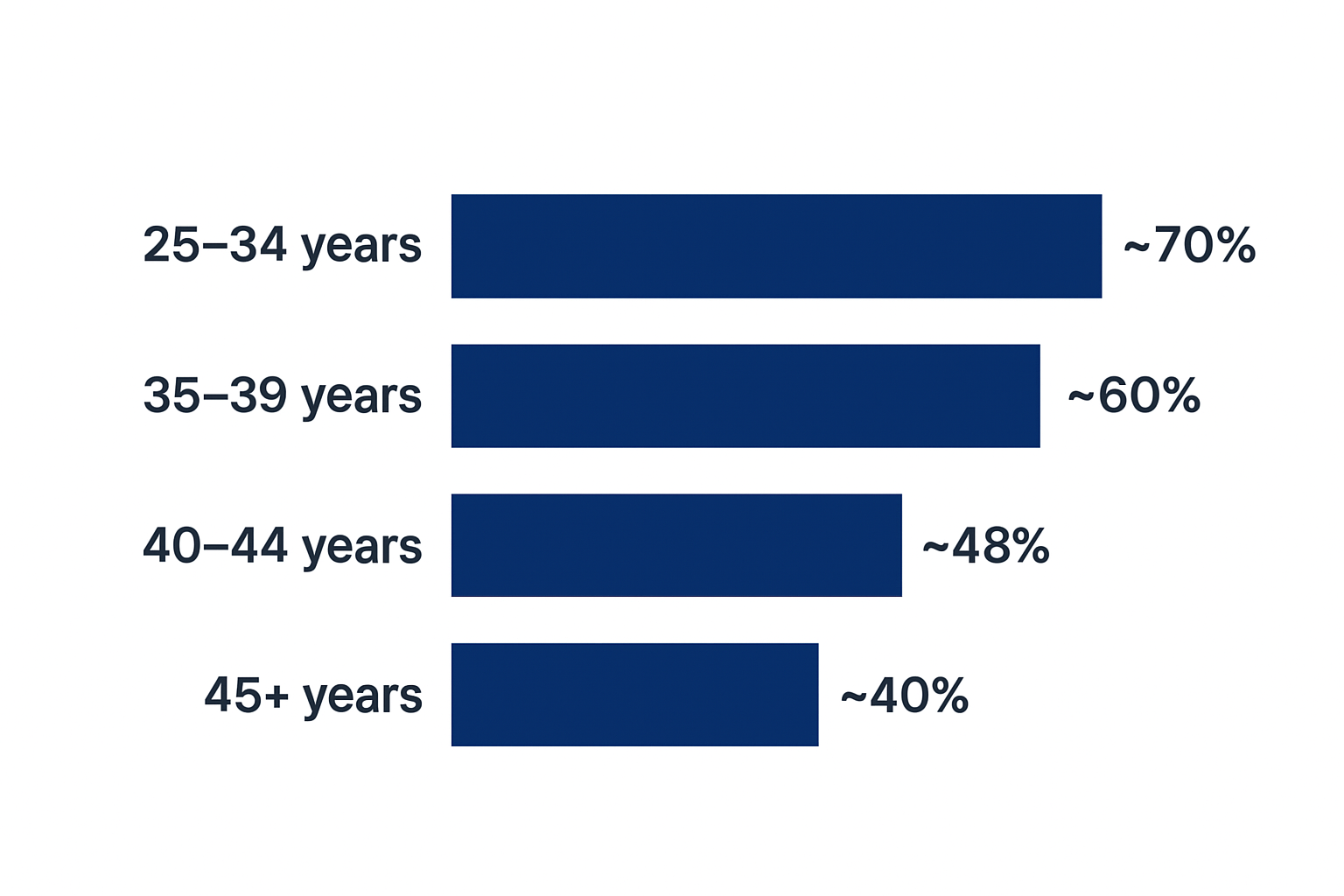
This means: Switching careers at 40 is normal, common, and widely accepted by employers.
Companies actually prefer mid-career professionals for roles requiring:
✔ Leadership
✔ Stability
✔ Decision-making
✔ Communication
✔ Reliability
Your age is an asset not a barrier.
What People at 40 Actually Want in a New Career
Most midlife professionals are not chasing titles, they want quality of life.
Top priorities for people starting a new career at 40:
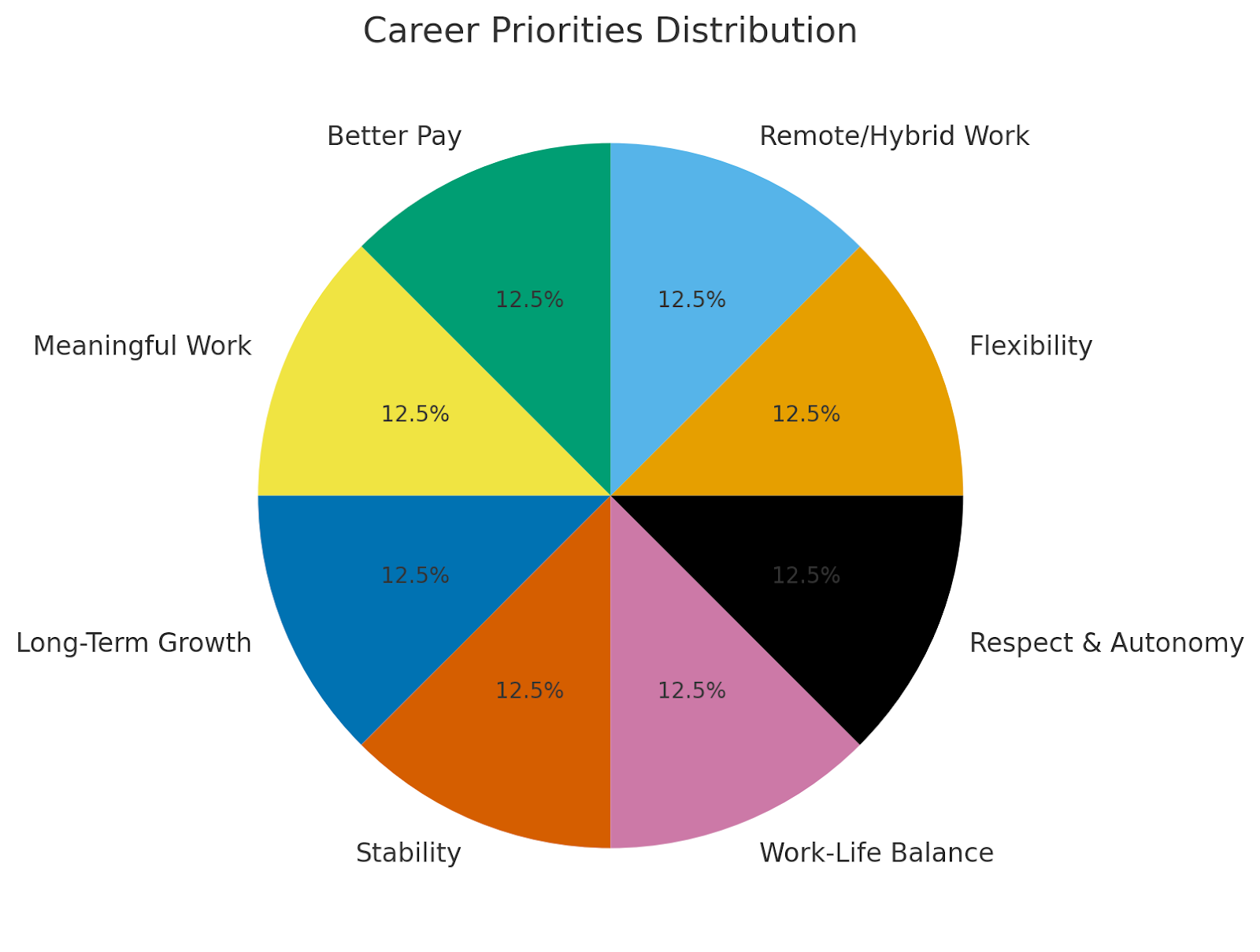
All the things younger careers rarely offer.
Best Career Change Options at 40
Why These Careers Are Thriving in the Global Job Market in 2026
Data & Analytics Roles are Exploding Worldwide
Countries like the US, UK, Canada, UAE, Singapore, and Australia report a 30–35% rise in demand for data analysts, BI experts, and data-driven managers. Companies like Amazon, Microsoft, Deloitte, PwC, and JPMorgan posted record-high analytics job openings in 2024.
Cybersecurity, Talent Gaps are Widening Across Major Economies
The US alone has 600,000+ unfilled cybersecurity roles, while the EU, India, and the Middle East face severe shortages. Big employers like IBM, Accenture, Cisco, and KPMG reported hiring spikes due to rising cyberattacks.
Digital Marketing & Content Roles are becoming Global Essentials
Brands across Europe, Asia, and North America increased digital hiring by 16-18%, with companies like Google, Meta, TCS, Infosys, HubSpot, and Adobe expanding remote and hybrid digital roles.
Remote & Hybrid Jobs are now the Global Norm
Countries like Canada, Germany, UK, and India saw sustained growth in remote roles across tech, marketing, and design. Fortune 500 companies such as SAP, Airbnb, Mastercard, and Dropbox have permanently adopted hybrid-first models.
Employers now Prioritize “Experience + Maturity” over Age
Global surveys show that leadership, communication, emotional intelligence, and crisis-handling are the most valued competencies in 2025, areas where 40+ professionals naturally excel. Companies like Unilever, HSBC, Toyota, and Netflix openly promote age-inclusive hiring.
AI-Driven Roles are Rising, but They Need Human Judgment
AI adoption accelerated in the US, India, UAE, Japan, and UK, but big firms: Google, Nvidia, EY, and IBM emphasize hiring people with decision-making maturity, not just technical skills. This makes AI project, product, and strategy roles perfect for 40+ switchers.
Realistic Courses for Career Change at 40
Choosing the right course after 40 isn't about earning another qualification, it's about gaining practical, job-ready skills that help you move into a new role faster. While returning to university full-time isn't realistic for many working professionals, flexible online programs and short courses allow you to build relevant skills without putting your career or personal commitments on hold.
Whether you're aiming for leadership, data, digital marketing, cybersecurity, design, finance, or healthcare, the right course can shorten your transition and increase your confidence before making the switch.
Short Courses & Professional Certifications (Free Learning)
Not every career change requires a full degree. These free, self-paced short courses help you build practical, industry-relevant skills while learning at your own pace. On successful completion, you can claim a blockchain-verified certificate, making them a great way to strengthen your profile before taking the next step in your career.
1. Essentials of MIS & Cybersecurity
Best for: Professionals looking to move into technology-enabled business or cybersecurity support roles.
Understanding information systems and cybersecurity has become valuable across every industry. This course introduces core concepts in data security, information management, and digital risk.
Realistic career paths:
- MIS Executive
- Information Systems Coordinator
- Cybersecurity Support Analyst
- IT Operations Executive
- Compliance Coordinator
Why it works at 40: You don't need an IT background to understand business technology. Many organisations value experienced professionals who can bridge operations and digital systems.
2. Mastering Digital Marketing Techniques & Trends
Best for: Professionals interested in digital marketing, branding, and online customer engagement.
Digital marketing skills are in demand across businesses of every size. This course covers modern marketing strategies, social media, online campaigns, customer engagement, and emerging digital trends.
Realistic career paths:
- Digital Marketing Executive
- Campaign Manager
- Marketing Strategist
- Growth Marketing Specialist
- Digital Communications Executive
Why it works at 40: Marketing increasingly rewards strategic thinking and customer understanding, qualities experienced professionals already possess.
3. Diploma in Digital Marketing - SEO & SEM
Best for: Professionals who want to specialise in search marketing and online business growth.
Search engines remain one of the biggest drivers of online business. This diploma develops practical knowledge in search engine optimisation (SEO), paid search (SEM), keyword strategy, and website visibility.
Realistic career paths:
- SEO Specialist
- Search Marketing Executive
- Digital Marketing Consultant
- Performance Marketing Executive
- Content SEO Strategist
Why it works at 40: SEO and SEM rely on strategy, planning, and analytical thinking, making them excellent career options for professionals transitioning from traditional business roles.
4. Basics of Content Marketing
Best for: Professionals who enjoy communication, storytelling, and brand building.
Content marketing helps businesses attract and engage customers through valuable digital content. This course introduces content strategy, audience engagement, and digital communication techniques.
Realistic career paths:
- Content Marketing Executive
- Content Strategist
- Brand Communications Executive
- Copywriter
- Social Media Content Specialist
Why it works at 40: Strong communication and industry expertise can become valuable assets in content-focused careers.
5. Executive Diploma in UI/UX Design
Best for: Professionals who enjoy problem-solving, creativity, and designing user-friendly digital experiences.
UI/UX design combines creativity with business thinking to improve websites, apps, and digital products. This course introduces user research, interface design, wireframing, and usability principles.
Realistic career paths:
- UI Designer
- UX Designer
- Product Designer
- User Research Assistant
- Digital Experience Designer
Why it works at 40: Employers increasingly value professionals who understand both business needs and user experience, making this an attractive transition for career changers.
6. MBA Essentials with Healthcare Management
Best for: Professionals looking to move into healthcare administration or management roles.
Healthcare continues to be one of the world's fastest-growing industries. This course combines business fundamentals with healthcare management concepts to prepare professionals for leadership and operational roles
Realistic career paths:
- Healthcare Administrator
- Hospital Operations Executive
- Healthcare Project Coordinator
- Clinical Operations Manager
- Healthcare Consultant
Why it works at 40: Leadership, operations, and people management experience transfer naturally into healthcare management positions.
7. Certification in Finance for Business Leaders
Best for: Professionals who want stronger financial decision-making skills without pursuing a finance career.
Finance knowledge has become essential for managers across every industry. This certification builds confidence in budgeting, financial planning, business performance analysis, and strategic decision-making.
Realistic career paths:
- Business Manager
- Operations Manager
- Department Head
- Business Consultant
- Project Manager
Why it works at 40: Financial literacy enhances leadership credibility and prepares professionals for senior management responsibilities.
Academic Degree Programmes
If you're planning a long-term career transition or aiming for leadership roles, an academic qualification can provide the strategic knowledge and recognised credentials employers value. Delivered 100% online with flexible learning and personalised tutor support, these international programmes are designed to help working professionals advance without putting their careers on hold.
1. Certified Business Analytics Professional - CMI Certification
Best for: Professionals who want to make data-driven decisions without becoming technical programmers.
Business analytics is one of the fastest-growing skills across industries. This certification teaches you how to interpret business data, identify trends, and support strategic decisions using analytical thinking and reporting tools.
Realistic career paths:
- Business Analyst
- Operations Analyst
- Performance Analyst
- Reporting Executive
- Business Intelligence Associate
Why it works at 40: Many experienced professionals already work with reports, KPIs, and operational data. This course helps transform those existing skills into a high-demand analytics career.
2. Master of Business Administration (MBA) - Triple Certification
Best for: Professionals who want to move from execution to decision-making roles.
An MBA helps you translate your 15–20 years of experience into leadership authority. It sharpens skills in strategy, operations, finance, and people management, areas where employers actively seek mature professionals.
Realistic career paths:
- Operations Manager
- Business Consultant
- Project/Program Manager
- Strategy Analyst
- Product Manager
- HR or Talent Development Lead
Why it works at 40: You already understand workplace reality, your experience becomes a business asset.
3. MBA in Business Intelligence & Data Analytics - Triple Certification
Best for: Those who want to work in data but prefer tools, dashboards, and insights instead of heavy programming.
You learn how to use BI tools, analyze trends, and help companies make smart decisions, skills that are in global shortage.
Realistic career paths:
- BI Analyst
- Reporting Manager
- Data Visualization Specialist
- Market Research Analyst
- MIS/Operations Analytics Lead
Why it works at 40: If your past roles involved reports, operations, KPIs, or Excel, you already have an advantage.
4. Doctor of Business Administration (DBA)
Best for: Senior professionals ready for top-tier leadership, consulting, or academic-industry hybrid roles.
A DBA focuses on solving real business challenges using research-driven strategies.
Realistic career paths:
- Senior Management Roles (Director/VP)
- Business Consultant or Advisor
- Organizational Development Specialist
- Corporate Trainer/Coach
- Business School Faculty (full-time or adjunct)
Why it works at 40: Your career history becomes a research foundation, something younger candidates cannot match.
5. DBA in Artificial Intelligence
Best for: Professionals who want to stay ahead as AI reshapes every industry.
Instead of teaching coding, this program focuses on AI strategy, implementation, ethics, and digital transformation.
Realistic career paths:
- AI Strategy Consultant
- Digital Transformation Leader
- Innovation Director
- AI Policy & Governance Specialist
- Tech-Driven Business Consultant
Why it works at 40: AI is not replacing leaders but replacing outdated leadership. Experience + AI knowledge is a powerful combination.
So making a career change?
The best way to make a career change at 40 is to identify a role that aligns with your existing strengths, learn only the skills required for that role, build a small portfolio, and transition gradually through networking, freelance work, or internal opportunities. Rather than starting from scratch, successful career changers use their years of professional experience as a competitive advantage while filling only the necessary skill gaps.
How to Start a New Career at 40 - A Simple 6-Step Plan
1. Choose the Exact Role (Be Specific)
Not “I want a tech job.”
Say “I want to become a Data Analyst in 12 months.”
2. List Your Transferable Skills
Communication, leadership, planning, negotiation, customer handling, these matter more than certificates.
3. Identify 3–5 Hard Skills You Need
SQL, Google Analytics, UX tools, PM frameworks, etc.
4. Build a Small Portfolio
Even 3–4 case studies can get you hired.
5. Network Intentionally
40+ candidates get hired faster through referrals.
6. Transition Gradually if Needed
Freelance → contract → full role.
This removes financial stress.
Conclusion
Changing careers at 40 isn’t starting from zero but starting with the advantage of experience. This decade gives you clarity about what you want, the courage to leave what no longer fits, and access to fast-growing career paths that reward maturity and leadership.
Your 40s can be the most powerful decade of your professional life if you choose growth over fear.
Whether you step into tech, data, digital, consulting, or AI-driven roles, your skills and life experience make you uniquely valuable. With the right plan and focused upskilling, your 40s can become the most financially rewarding and professionally fulfilling years of your life.
FAQs
Q1. Is 40 too late to start a new career?
A: No. Many people successfully change careers at 40 because they bring stronger decision-making, leadership, and professional maturity. Employers increasingly value these qualities, especially in roles like project management, data, consulting, and digital work.
Q2. What is the best career to start at 40?
A: High-demand options include project management, data analytics, cybersecurity, digital marketing, UX/UI design, financial planning, and consulting. These careers rely on transferable skills rather than starting from scratch.
Q3. How can I switch careers at 40 with no experience?
A: Choose a specific role, learn the key hard skills through online courses, build a small portfolio (3–5 projects), and transition gradually through freelance or contract work. Networking speeds up hiring for 40+ candidates.
Q4. Which high-paying jobs are good for career changers over 40?
A: Cybersecurity, data analytics, product management, consulting, operations leadership, AI-aligned roles, and financial advisory offer strong salaries and growth for midlife professionals.
Q5. What skills do I need to start a new career at 40?
A: Most 40+ switchers succeed by combining transferable skills (communication, leadership, planning, people management) with new technical or digital skills like analytics tools, UX fundamentals, project management frameworks, or cybersecurity basics.
Explore Related Courses











COMMENTS(4)

UniAthena
Thank you for your support. Keep browsing. You can visit our page uniathena.com for more informative articles.
Thank you for your support. Keep browsing. You can visit our page uniathena.com for more informative articles.
Explore Related Courses
Our Popular Insights
Careers are shifting faster than ever, and staying relevant takes more than experience. Explore UniAthena’s most-read blogs for sharp insights, emerging skills, and practical pathways that help you move forward with clarity and confidence in a changing professional world.

Best AI Tools for Content Creation
Read More
9
mins read

🌟 Top Project Performer – June 2026 🌟
Read More
1
mins read



🌟 Top Project Performer – May 2026 🌟
Read More
1
mins read


Best AI Tools for Content Creation
Read more
9
mins read
🌟 Top Project Performer – June 2026 🌟
Read more
1
mins read
🌟 Top Project Performer – May 2026 🌟
Read more
1
mins read
Get in Touch

It’s Time to Start
Join NowMost Popular Online Specialization
- Master of International Business Administration
- Master of Business Administration
- MBA in General Management- FastTrack
- Master in Innovation and Entrepreneurship
- MBA-Family Business Management
- Master in Procurement and Contract Management
- Extended Diploma in Business Analytics (SCQF Level 11)
- Diploma in Supply Chain and Logistics Management (SCQF Level 11)
- Strategic Human Resource Management Practitioner
- Master in Data Science
- Master in Engineering Management
Trending Online
- Integrated Doctorate of Business Administration
- Postgraduate Certificate in Finance for Next Generation Managers
- Master of Business Administration- General Management (Fast Track)
- Postgraduate Certificate in Socio-Economic and Legal Framework
- Postgraduate Certificate in Business Sustainability
- Certified Manager
- Supply Chain Management Practitioner
- MBA - AI in Business
- MBA - Accounting & Finance
- Master in Supply Chain and Logistics Management
Top Universities Online Certificates
- Postgraduate Certificate in International Marketing Management
- Postgraduate Certificate In International Human Resource Management
- Postgraduate Certificate in Strategic Management
- Postgraduate Certificate in Procurement & Contracts Management
- Postgraduate Certificate in Business Analytics
- Postgraduate Certificate in Strategic Supply Chain & Logistics Management
- Postgraduate Certificate in Human Resource and Leadership
- Project Management Practitioner
- Postgraduate Certificate in Supply Chain Design & Implementation
- Postgraduate Certificate in Management Accounting and Finance
Accredited Online Degree Program
- MBA - Digital Transformation
- MBA - Family Business Management
- MBA - Marketing Management
- MBA in Quality Management
- MBA - Business Intelligence & Data Analytics
- MBA in Operations & Project Management
- MBA in Energy Management
- MBA In Construction & Safety Management
- Master in Organisational Leadership
- Master in Public Health
- Master in Construction Management
- Bachelor of Arts in Business Administration


 Install Now


UniAthena is an Ed-Tech, offering flexible, affordable learning solutions, including Free-Learning Upskilling Courses and Academic Programs in partnerships with accredited and globally renowned universities and professional qualification bodies.


Do you have any questions ?
Feel free to send us your questions or request a free consultation
Send a message
UK
Athena Global Education
Magdalen Centre,
Robert Robinson Avenue,
Oxford, OX4 4GA, UK
Phone : 01865 784299
MIDDLE EAST
Athena Global Education FZE
Block L-03, First Floor,
P O Box 519265, Sharjah Publishing City,
Free Zone, Sharjah, UAE
Phone : +971 55 879 5492
INDIA
Uniathena Private Limited
9A,Midas Tower
Phase 1
Hinjewadi Rajiv Gandhi Infotech Park
Pune-411057
Phone: +91 9145665544
All Copyrights Reserved @ Athena Global Education 2021-2026