-

Bachelor's

-

Masters
-

MBA
-

Doctorate
-

Micro Credit
-

Explore all Courses
-
Postgraduate Certifications

-
Postgraduate Diploma
-
Undergraduate Diploma
-
Diploma



Top Benefits of Digital Transformation for Companies

Author: munazzah ali
|7
MINS READ
| 0
| 49
Created On: 26 May, 2026
Share




Table of Contents (TOC):
- Introduction
- Key Takeaways
- Digital Transformation Is More Than Just Technology
- What Is Driving Companies Toward Digital Transformation?
- How Digital Transformation Creates Long-Term Business Value
- Future-Ready Programs to Stay Ahead of the Curve
- Businesses That Successfully Embraced Digital Transformation
- Conclusion
- FAQs
Introduction
When the customers are used to getting quick responses, personalized experiences, and frictionless interactions, but your business is still running on processes that were created to work in a slower world?
The lack of that interconnectedness is no longer a technological problem. It's a boardroom problem.
In every industry, companies are re-inventing how they do business, how they compete, and how they innovate. Digital transformation has now become beneficial in all aspects, including customer experience, operational efficiency, innovation, and long-term strategy. The current business world demands businesses to be faster, smarter, and to be able to adapt on the spot.
And automation? That's just the starting point.
The companies that are getting ahead are not just implementing new tools; they are establishing agile operations, stronger customer relationships, and scalable models that are geared towards success in a world that doesn't slow down. With speed and adaptability turning into actual competitive advantages, digital transformation has shifted from a future project and has become an urgent need now.
Key Takeaways:
- Digital transformation helps businesses by making them more efficient, agile, and effective in their decision-making.
- Enterprise digital transformation is helping organizations to adjust more quickly to market disruption.
- Customer experience and AI-driven operations are emerging as a priority in business.
- Companies investing in a digital transformation strategy are building more scalable and future-ready operations.
Digital Transformation Is More Than Just Technology
The concept of digital transformation is still associated with the introduction of new software or the use of advanced technologies by various companies.
But what is digital transformation in business? It is about redefining how organizations operate, collaborate, generate customer value, and respond to changing business environments.
An effective digital transformation strategy aims at streamlining the working processes, speeding up the decision-making process, transforming customer experiences, and creating operational agility.
More importantly, digital transformation is changing the way businesses are pursuing innovation and flexibility. The current organizations are supposed to be quicker in reacting to the needs of the customers, disruptions in the market, and changes in the business trend, and remain efficient in their operations.
This is the reason why enterprise digital transformation has emerged as a strategic focus of businesses that are keen on staying ahead in a fast-changing digital economy.
What Is Driving Companies Toward Digital Transformation?
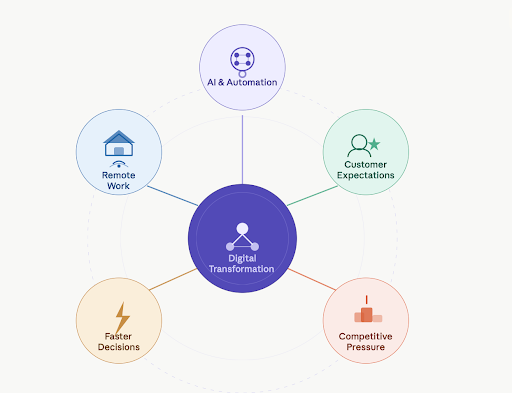
AI and Automation Are Reshaping Business Operations
Artificial intelligence and automation are changing the way organizations conduct their workflows, customer relations, and operational effectiveness. Predictive analytics in AI-based customer care systems are allowing businesses to save on manual work, as well as speed and accuracy.
Remote and Hybrid Work Has Redefined Collaboration
Flexible workplaces have enhanced the level of digital transformation across industries. Companies have turned to cloud-based teamwork solutions, online communication tools, secure remote systems, and remote work models to improve productivity among distributed workforces
Customers are Expecting Smooth Digital Experiences
Modern consumers would like to see businesses become more responsive, deliver a personalized experience, and ensure that the online interaction is hassle-free in various channels. The driving force of digital transformation in business today is the rising demand.
Businesses Need Faster Decision-Making
Organizations are turning to real-time information in order to react fast to market changes and consumer behavior. The quicker firms analyze and take action on the data, the more adaptable and competitive they are likely to be.
Competitive Pressure Is Driving Innovation
Businesses across industries are embracing digital transformation solutions in order to stay relevant in the fast-changing markets. Organizations that are slow in transformation usually find it hard to match the evolving customer demands and new technologies.
How Digital Transformation Creates Long-Term Business Value
Faster Decision-Making Across Teams
One of the major digital transformation benefits is improved access to centralized data and real-time analytics. The leaders become more visible in their operations, and they are able to make quick and more informed business decisions.
Operational Efficiency Improves Significantly
Automation eliminates redundancies, shortens the processes, and lowers operational delays. This enables teams to concentrate more on strategic activities rather than on manual administrative procedures.
Customer Experience Becomes More Personalized
AI-powered systems, personalized recommendations, and omnichannel communication strategies are helping businesses to enhance customer engagement and satisfaction. Today, digital experiences are no longer a luxury but a necessity.
Innovation Happens Faster
The difference between ideas and implementation is reduced by technology. Companies are able to experiment with new ideas, introduce products in a smoother manner, and enhance interdepartmental cooperation. This will establish a more robust culture of relentless innovation and flexibility.
Employee Productivity Improves
Digital tools make it easier to communicate, reduce repetitive work, and enhance cooperation within teams. This has not only led to improved efficiency in businesses but also to greater employee experience.
Data Turns into a Strategic Asset
Contemporary organizations use customer insights, predictive analytics, and data forecasting to make smarter business decisions. The contemporary business world is becoming more competitive based on insights than assumptions.
Future-Ready Programs to Stay Ahead of the Curve
As enterprise digital transformation accelerates across industries, professionals who combine strategic thinking with digital fluency will have a clear edge. To support these evolving business demands, UniAthena offers specialized programs designed around digital innovation, business intelligence, and transformation strategy.
1. Postgraduate Diploma in Digital Transformation through Business Intelligence
This program helps professionals understand digital transformation, business intelligence, analytics, and contemporary business technologies by utilizing practical frameworks and real-world applications in various industries.
This 40 CIQ credit program is awarded by the CIQ, UK, and is characterized by 100% online learning and personal tutor support.
2. Diploma in Digital Transformation Technology & Applications
The program helps professionals in developing practical knowledge of digital transformation, intelligent automation, AI, IoT, blockchain, and contemporary business technologies that shape the industries of the present day.
Awarded by CIQ, UK, this program will take 21-60 days to complete, with no work experience or certification required beforehand.
3. MBA in Digital Transformation
This 90 ECTS MBA program, offered in collaboration with GMU, Italy, assists professionals in acquiring leadership, strategic management, and digital transformation skills required in contemporary business settings.
Students acquire practical knowledge of digital transformation, automation, workflow optimization, and technology-enhanced business strategy to help organizations grow and become efficient.
Businesses That Successfully Embraced Digital Transformation

The best instances of digital transformation are those that have been adopted by companies that have gone all the way to rethink the way they conduct their business, how they relate with their customers, and how they innovate.
1. Netflix Reinvented Entertainment Through Data and Personalization
Netflix transformed from a DVD rental business into a global streaming platform powered by AI-driven personalization and data analytics. By understanding changing customer behavior early, Netflix reshaped the entertainment industry through digital innovation.
2. Amazon Built Operational Efficiency Through Automation and Data
One of the powerful examples of enterprise digital transformation is Amazon. AI-driven automation, predictive analytics and logistics helped Amazon to optimize inventory, customer experience, and scale operational efficiency.
3. Nike Enhanced Customer Relationships by Digital Innovation
Nike has grown its digital environment with e-commerce, mobile apps, and customized digital experiences. Nike leveraged customer data and omnichannel engagement strategies to increase customer loyalty and growth in the digital arena.
4. Domino’s Used Technology to Redefine Convenience
Domino’s invested heavily in digital ordering systems, AI-driven tracking, and omnichannel experiences. Instead of positioning itself as just a food brand, Domino’s has positioned technology as one of its business strategies to stay competitive and customer-focused.
Conclusion
The future of business is more about the entities that are adaptive, innovative, and responsive to the shifting expectations. Operational efficiency, customer experience, and decision-making based on data are just some of the benefits of digital transformation that are transforming how businesses compete and evolve in a digital-first economy.
Companies that adopt digital transformation in the modern world are not just preparing to undergo technological change, but are laying down better platforms to withstand long-term resilience, flexibility, and long-term growth.
FAQs
Q1. Is digital transformation only for large companies?
A: No. Digital transformation is employed by businesses of any size to increase efficiency, customer experience, and growth.
Q2. How long does digital transformation take?
A: It is an ongoing process. Some changes occur very fast, while others occur slowly.
Q3. What are the skills that can help in digital transformation?
A: Skills that are required are digital communication, problem-solving, strategic thinking, and data analysis.
Q4. Can digital transformation improve employee experience, too?
A: Yes. Digital tools may streamline everyday work, enhance collaboration, decrease repetitive work, and help employees perform their work more effectively both at home and in the office.
Explore Related Courses














COMMENTS(0)
Explore Related Courses
Our Popular Insights
Careers are shifting faster than ever, and staying relevant takes more than experience. Explore UniAthena’s most-read blogs for sharp insights, emerging skills, and practical pathways that help you move forward with clarity and confidence in a changing professional world.



🌟 Top Project Performer – June 2026 🌟
Read More
1
mins read



🌟 Top Project Performer – May 2026 🌟
Read More
1
mins read
Best AI Tools for Content Creation
Read More
9
mins read

How to Start Freelancing With No Experience
Read More
8
mins read

🌟 Top Project Performer – April 2026 🌟
Read More
1
mins read
🌟 Top Project Performer – June 2026 🌟
Read more
1
mins read
🌟 Top Project Performer – May 2026 🌟
Read more
1
mins read
Best AI Tools for Content Creation
Read more
9
mins read
How to Start Freelancing With No Experience
Read more
8
mins read
🌟 Top Project Performer – April 2026 🌟
Read more
1
mins read
Get in Touch

It’s Time to Start
Join NowMost Popular Online Specialization
- Master of International Business Administration
- Master of Business Administration
- MBA in General Management- FastTrack
- Master in Innovation and Entrepreneurship
- MBA-Family Business Management
- Master in Procurement and Contract Management
- Extended Diploma in Business Analytics (SCQF Level 11)
- Diploma in Supply Chain and Logistics Management (SCQF Level 11)
- Strategic Human Resource Management Practitioner
- Master in Data Science
- Master in Engineering Management
Trending Online
- Integrated Doctorate of Business Administration
- Postgraduate Certificate in Finance for Next Generation Managers
- Master of Business Administration- General Management (Fast Track)
- Postgraduate Certificate in Socio-Economic and Legal Framework
- Postgraduate Certificate in Business Sustainability
- Certified Manager
- Supply Chain Management Practitioner
- MBA - AI in Business
- MBA - Accounting & Finance
- Master in Supply Chain and Logistics Management
Top Universities Online Certificates
- Postgraduate Certificate in International Marketing Management
- Postgraduate Certificate In International Human Resource Management
- Postgraduate Certificate in Strategic Management
- Postgraduate Certificate in Procurement & Contracts Management
- Postgraduate Certificate in Business Analytics
- Postgraduate Certificate in Strategic Supply Chain & Logistics Management
- Postgraduate Certificate in Human Resource and Leadership
- Project Management Practitioner
- Postgraduate Certificate in Supply Chain Design & Implementation
- Postgraduate Certificate in Management Accounting and Finance
Accredited Online Degree Program
- MBA - Digital Transformation
- MBA - Family Business Management
- MBA - Marketing Management
- MBA in Quality Management
- MBA - Business Intelligence & Data Analytics
- MBA in Operations & Project Management
- MBA in Energy Management
- MBA In Construction & Safety Management
- Master in Organisational Leadership
- Master in Public Health
- Master in Construction Management
- Bachelor of Arts in Business Administration


 Install Now


UniAthena is an Ed-Tech, offering flexible, affordable learning solutions, including Free-Learning Upskilling Courses and Academic Programs in partnerships with accredited and globally renowned universities and professional qualification bodies.


Do you have any questions ?
Feel free to send us your questions or request a free consultation
Send a message
UK
Athena Global Education
Magdalen Centre,
Robert Robinson Avenue,
Oxford, OX4 4GA, UK
Phone : 01865 784299
MIDDLE EAST
Athena Global Education FZE
Block L-03, First Floor,
P O Box 519265, Sharjah Publishing City,
Free Zone, Sharjah, UAE
Phone : +971 55 879 5492
INDIA
Uniathena Private Limited
9A,Midas Tower
Phase 1
Hinjewadi Rajiv Gandhi Infotech Park
Pune-411057
Phone: +91 9145665544
All Copyrights Reserved @ Athena Global Education 2021-2026