-

Bachelor's

-

Masters
-

MBA
-

Doctorate
-

Micro Credit
-

Explore all Courses
-
Postgraduate Certifications

-
Postgraduate Diploma
-
Undergraduate Diploma
-
Diploma



What Is Financial Literacy and Why Does It Matter?

Author: maharajan p
|9
MINS READ
| 0
| 69
Created On: 26 May, 2026
Share




Table of Contents (TOC):
- Introduction
- Key Takeaways
- What is Financial Literacy
- Why Does Financial Literacy Matter?
- Who is Financial Literacy For?
- What Does Financial Literacy Mean for Personal Finance?
- What Financial Literacy Actually Includes
- How to Master Financial Literacy
- Final Take
- FAQs
Introduction
Most people assume financial literacy is for people already inside the industry — analysts at Goldman Sachs reading 10-K filings, or portfolio managers at Fidelity stress-testing models.
Let's clear that up. It's not.
Expanding your financial knowledge is the foundation for anyone who deals with money, which is to say, everyone.
- For a Business Owner, a solid financial education tells them why revenue grew 20% but profit still shrank and exactly which line on the P&L to look at.
- For a Student, it tells them why that $15,000 education loan feels manageable now but quietly doubles over 8 years if they're only paying the minimum, because compounding works against you just as hard as it works for you.
- For a Working Professional, it tells them why their salary has gone up three times in five years, but their savings account looks exactly the same, and what to actually do about it.
It’s a skill anyone can learn. But if you’re a beginner stepping into finance, what exactly are you expected to know?
Key Takeaways:
- Financial literacy means understanding how financial data is structured, interpreted, and applied to make informed decisions in real-world business and financial scenarios.
- The importance of financial literacy is most evident in finance roles, where it’s used to read financial statements, analyze company performance, and support decisions that directly impact growth.
- It requires core skills like interpreting financial statements, performing calculations, evaluating risk–return trade-offs, and connecting numbers to real business outcomes.
- You can build financial literacy step-by-step by learning how data is structured, applying concepts through calculations, and gradually developing decision-making ability.
What is Financial Literacy
Financial literacy is the ability to read, interpret, and reason with financial information. Financial information can be anything, from market data to company reports and financial statements—all of which come with large amounts of data that need to be understood to make sound decisions.
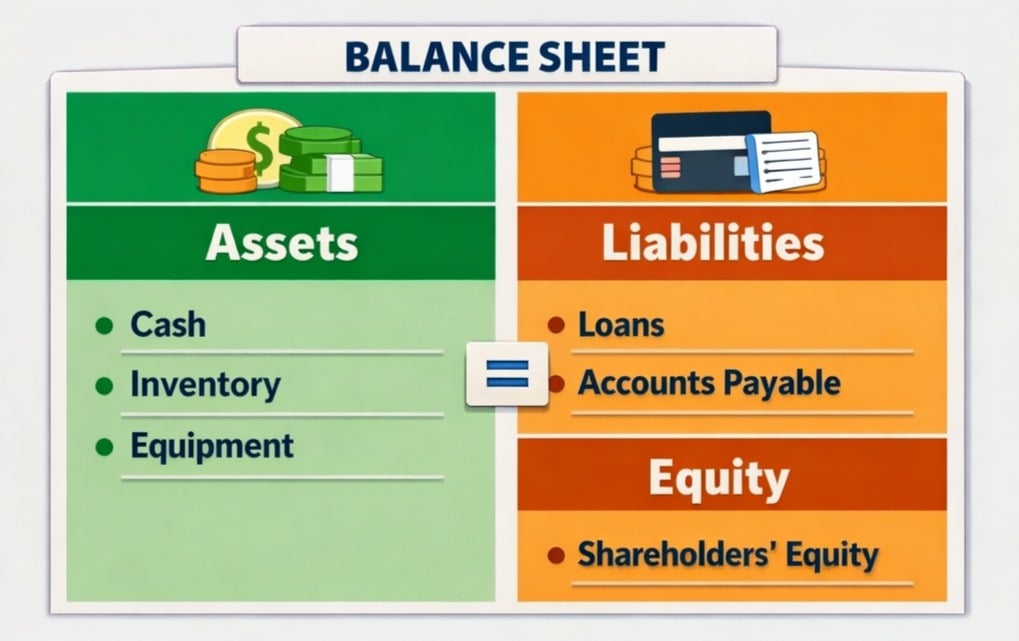
Take a balance sheet, for example. What you’re looking at is what a company owns and owes at a specific point in time. Cash, inventory, and other assets are recorded on one side, while loans, payables, and other liabilities listed on the other, with equity balancing the difference. Financial literacy is what allows you to read this structure, understand how these components relate to each other, and use that to assess the company’s financial position.
Why Does Financial Literacy Matter?
Whether you are getting into corporate finance, investment banking, or wealth management, you will get evaluated for how well you understand and work with financial information.
At an entry level, employers are not looking for a CFO. They want someone who can open a P&L, understand why a number moved, and not break a spreadsheet.
Let's compare it on a simple three core areas of how being financially literate sets you up:
Who is Financial Literacy For?
The straightforward answer: like we already said, anyone who deals with money — which is everyone.
If you're looking to break into finance, applying for roles in investment banking, equity research, financial planning, or corporate finance, this is non-negotiable. You may already have strong analytical instincts, but without knowing how financial data is structured, interpreted, and used in real business decisions, that edge only gets you so far.
But financial literacy doesn't stop at the doors of a finance career. Managing money is something every person does and most do without a real framework.
- Students and young adults: building early habits around saving, handling student loans, and understanding how interest compounds on investments over time. The earlier the foundation, the better the outcome.
- Investors: whether beginners or experienced, who need to read market risks clearly, build diversified portfolios, and make decisions backed by numbers rather than noise.
- Employees: who want to do more with their salary than spend it: budgeting intentionally, setting aside money for retirement, and understanding where their paycheck actually goes.
- Individuals working to get out of debt: who want to reduce financial stress by understanding how to manage cash inflow, prioritize repayments, and stop the cycle.
Financial literacy has no boundaries. The entry point looks different for everyone, but the need is universal.
What Does Financial Literacy Mean for Personal Finance?
As we said, financial literacy is for everyone: a student, a young professional managing their first salary, or someone trying to stay out of a debt trap. You do not need balance sheets for that. You do not need complex formulas either.
It starts much closer to home: with the money coming in every month and the decisions you make around it.
At its core, personal financial literacy asks three simple questions:
- How much of your income goes toward what you need?
- How much goes toward what you want?
- How much is quietly working for your future?
A simple framework to answer all three is the 50/30/20 rule:
- 50% of your income covers needs — rent, groceries, utilities, transport
- 30% goes toward wants — dining out, subscriptions, leisure
- 20% is set aside for savings and paying down debt
It is not a perfect formula for everyone, but it gives structure to money that would otherwise disappear without a trace.
This is where financial literacy begins for most people. But if you are stepping into a finance career, the expectation goes beyond managing your own money. The industry asks you to do this at scale, with other people's capital, and with full accountability.
What Financial Literacy Actually Includes
Across OECD/INFE frameworks, it is defined as a set of practical capabilities used to understand, evaluate, and act on financial information.
- At the base level, it includes money and transactions: understanding income, tracking payments, and maintaining financial records. This is how money flows and gets recorded.
- It then moves into planning and managing finances: budgeting, managing cash flow, saving, handling credit, and making long-term financial plans. This is where allocation decisions happen.
- A critical layer is risk and return: identifying financial risks, understanding trade-offs, and making decisions under uncertainty.
- It also includes understanding financial products and systems: how loans, investments, and financial services actually work.
- On the technical side, it requires core financial knowledge: interest, compounding, inflation, and basic calculations.
- More importantly, it involves application: interpreting financial data and using it to make real decisions.
Together, these form the difference between knowing finance and being able to use it.
Also Read: What Is Fintech? Unpacking the Digital Engine Behind Modern Finance
How to Master Financial Literacy
If you want to become financially literate, you don’t need to learn everything at once. You build it step by step.
- First: understand how financial information is structured. That starts with reading financial statements, tracking how money flows, and knowing what each number represents.
- Second: then apply what you’ve learned. Calculate margins (e.g., gross margin to see profitability), compare outcomes (e.g., two investment options based on returns), and work with basic financial models (e.g., simple cash flow or budgeting models).
- Third: now learn to evaluate decisions. This means using numbers to support or challenge business outcomes. But don’t jump to a conclusion too quickly; look at it from a few different angles before deciding what actually makes sense.
Below, we’ve listed a set of programs from UniAthena that cover these areas step by step. If you’re already comfortable in one area, focus on where your understanding is still limited and build from there.
1. Basics of Accounting
This course explains how financial data is created, structured, and reported within a business.
It introduces accounting as a process of:
- Recording, classifying, and summarizing financial transactions
- Preparing financial information used by investors, lenders, and businesses
You’ll learn:
- The principles of accounting
- How transactions are measured and recorded
- How financial statements are prepared and reviewed
This program prepares you to understand where financial numbers come from, how they are built into reports, and how to work with financial data without relying on assumptions.
2. Basics of Budgeting
This course explains how budgeting works as a structured process for planning and managing financial resources.
It introduces budgeting as a process of:
- Creating a plan to spend money effectively
- Understanding different types of budgets and budgeting approaches
You’ll learn:
- How budgeting supports the smooth flow of business operations
- How to allocate and utilize business funds effectively
- How to evaluate investment options and their expected returns
This program prepares you to participate in financial planning, allocate resources with clarity, and make decisions that balance spending, returns, and risk.
3. Basics of Financial Returns
This course explains how financial returns are evaluated when making investment decisions.
It introduces financial returns as a process of:
- Understanding different types of investments and the returns they generate
- Analyzing how returns vary over a specific period of time
- Evaluating multiple investment options to choose the best fit
You’ll learn:
- The principles and methods used to analyze financial returns
- How return metrics are applied in investment and business decisions
- How to assess profitability and compare different investment opportunities
This program prepares you to evaluate investment decisions, compare returns across options, and choose opportunities based on measurable financial outcomes rather than assumptions.
4. Basics of Financial Statements
This course explains how key financial statements are structured, interpreted, and used in financial reporting.
It introduces financial statements as a system of:
- Understanding the income statement and how it reflects profitability over a period
- Analyzing the balance sheet to assess a company’s financial position at a point in time
- Using financial and CFO dashboards to visualize and interpret key financial metrics
You’ll learn:
- The role and components of core financial statements
- How to understand and interpret balance sheets, income statements, and cash flow statements
- How financial data is used for analysis and decision-making
This program prepares you to interpret financial statements, understand how companies report performance and position, and use financial data to support analysis and decision-making.
5. Diploma in Financial Risk Management
This course explains how financial risks are identified, assessed, and managed across businesses and financial institutions.
It introduces risk management as a system of:
- Understanding risk management processes in enterprise and banking sectors
- Applying risk assessment techniques to prevent losses and reduce damage
- Monitoring and controlling risks through structured frameworks like Enterprise Risk Management (ERM)
You’ll learn:
- Different types of financial risks, including credit, market, operational, and liquidity risk
- How risk management processes are applied in banking and financial environments
- Methods used to assess, monitor, and mitigate risks in real scenarios
This program prepares you to understand how financial risks are evaluated and managed, and how organizations use structured processes to control uncertainty and protect financial outcomes.
Also Read: How To Become a Financial Analyst?
Final Take
Financial literacy is for everyone. It helps people manage money, make better decisions, and avoid costly mistakes. But if you're a graduate looking to build a career in finance, knowing how to budget isn't just enough. Your role demands more: sharper accounting knowledge, stronger management finance techniques, and models that actually reflect how the industry works today.
If you think you already know these fundamentals, why not give our 60-day PG program a try—and build on your knowledge with updated accounting models and financial management techniques applied in real-world scenarios?
Check out the program: Postgraduate Certificate in Management Accounting and Finance
FAQs
Q1. What is financial literacy in simple terms?
A: Financial literacy is the ability to read, interpret, and use financial information to understand data, evaluate situations, and make informed financial decisions.
Q2. Why is financial literacy important for finance careers?
A: It helps you understand financial data, apply concepts in real scenarios, and make decisions, skills that employers expect even at entry-level finance roles.
Q3. Is financial literacy only for finance professionals?
A: No, it applies to everyone. But for finance professionals, it goes beyond managing money to interpreting data, analyzing performance, and supporting business decisions.
Q4. What are the core skills included in financial literacy?
A: It includes reading financial statements, performing calculations, understanding financial products, evaluating risk, and applying financial data to real-world decisions.
Q5. How is financial literacy different from accounting or finance?
A: Accounting and finance are subjects. Financial literacy is the ability to use concepts from these subjects to interpret data and make practical decisions.
Explore Related Courses











.jpg)


COMMENTS(0)
Explore Related Courses
Our Popular Insights
Careers are shifting faster than ever, and staying relevant takes more than experience. Explore UniAthena’s most-read blogs for sharp insights, emerging skills, and practical pathways that help you move forward with clarity and confidence in a changing professional world.


🌟 Students of the Month | May – June 2026 🌟
Read More
1
mins read






🌟 Students of the Month | May – June 2026 🌟
Read more
1
mins read
Get in Touch

It’s Time to Start
Join NowMost Popular Online Specialization
- Master of International Business Administration
- Master of Business Administration
- MBA in General Management- FastTrack
- Master in Innovation and Entrepreneurship
- MBA-Family Business Management
- Master in Procurement and Contract Management
- Extended Diploma in Business Analytics (SCQF Level 11)
- Diploma in Supply Chain and Logistics Management (SCQF Level 11)
- Strategic Human Resource Management Practitioner
- Master in Data Science
- Master in Engineering Management
Trending Online
- Integrated Doctorate of Business Administration
- Postgraduate Certificate in Finance for Next Generation Managers
- Master of Business Administration- General Management (Fast Track)
- Postgraduate Certificate in Socio-Economic and Legal Framework
- Postgraduate Certificate in Business Sustainability
- Certified Manager
- Supply Chain Management Practitioner
- MBA - AI in Business
- MBA - Accounting & Finance
- Master in Supply Chain and Logistics Management
Top Universities Online Certificates
- Postgraduate Certificate in International Marketing Management
- Postgraduate Certificate In International Human Resource Management
- Postgraduate Certificate in Strategic Management
- Postgraduate Certificate in Procurement & Contracts Management
- Postgraduate Certificate in Business Analytics
- Postgraduate Certificate in Strategic Supply Chain & Logistics Management
- Postgraduate Certificate in Human Resource and Leadership
- Project Management Practitioner
- Postgraduate Certificate in Supply Chain Design & Implementation
- Postgraduate Certificate in Management Accounting and Finance
Accredited Online Degree Program
- MBA - Digital Transformation
- MBA - Family Business Management
- MBA - Marketing Management
- MBA in Quality Management
- MBA - Business Intelligence & Data Analytics
- MBA in Operations & Project Management
- MBA in Energy Management
- MBA In Construction & Safety Management
- Master in Organisational Leadership
- Master in Public Health
- Master in Construction Management
- Bachelor of Arts in Business Administration


 Install Now


UniAthena is an Ed-Tech, offering flexible, affordable learning solutions, including Free-Learning Upskilling Courses and Academic Programs in partnerships with accredited and globally renowned universities and professional qualification bodies.


Do you have any questions ?
Feel free to send us your questions or request a free consultation
Send a message
UK
Athena Global Education
Magdalen Centre,
Robert Robinson Avenue,
Oxford, OX4 4GA, UK
Phone : 01865 784299
MIDDLE EAST
Athena Global Education FZE
Block L-03, First Floor,
P O Box 519265, Sharjah Publishing City,
Free Zone, Sharjah, UAE
Phone : +971 55 879 5492
INDIA
Uniathena Private Limited
9A,Midas Tower
Phase 1
Hinjewadi Rajiv Gandhi Infotech Park
Pune-411057
Phone: +91 9145665544
All Copyrights Reserved @ Athena Global Education 2021-2026