The four-day workweek has emerged as a progressive workplace model as organisations and employees increasingly seek a better balance between productivity and well-being.
Under this arrangement, employees work one fewer day per week, either by extending daily hours or by reducing total weekly hours, while maintaining the same level of performance. Looking at this phenomenon through an HR lens, as well as a broader organisational perspective, offers a more complete picture of its impact.
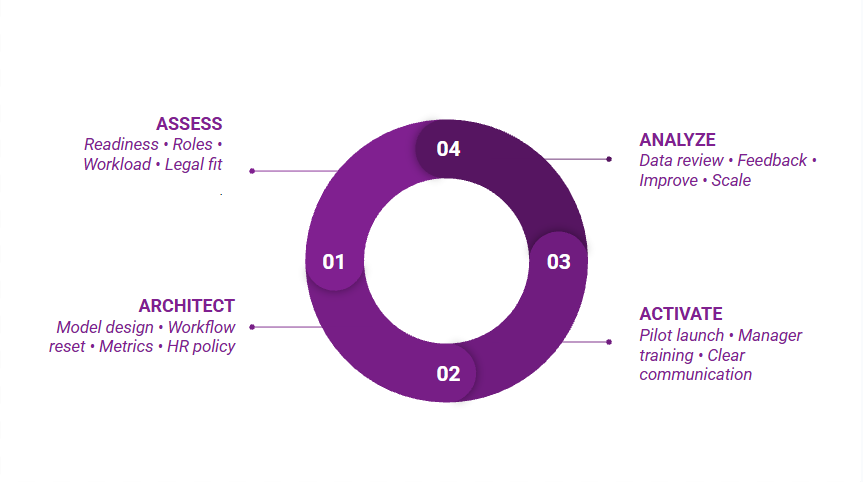
Adopting a four-day workweek usually involves a structured transition process that helps businesses move from concept to implementation, ensuring that the model supports employee productivity, well-being, and organisational sustainability while remaining aligned with business objectives.
4 Phases of Implementing a 4-Day Workweek
In general, perceptions of work and personal life are significantly altered by the four-day workweek. Because it gives employees greater control over their time and priorities, it is often viewed as a more humane and balanced approach to work. The additional day off can improve motivation and overall life satisfaction, which influences how employees approach their workdays.
As teams are required to streamline processes and eliminate unnecessary tasks due to tighter time constraints, this shift can help organisations foster a culture of focus, accountability, and efficiency. However, the model also requires flexibility, as both clients and employees adjust their expectations around work intensity and availability.
The HR Perspective on the 4-Day Workweek
From a human resources perspective, the four-day workweek represents a shift in both workforce strategy and organisational culture. HR professionals view it as an opportunity to redesign job roles, recalibrate performance metrics, and promote outcome-based evaluation rather than time-based measurement.
The model supports employee mental health by providing additional time for rest, learning, and personal responsibilities. This, in turn, leads to higher engagement, morale, and long-term satisfaction. It also strengthens employer branding, making organisations more attractive to both existing and prospective talent.
However, HR teams must also ensure compliance with labour laws, operational continuity, and internal equity. The success of a four-day workweek depends on clearly defined policies, trained managers, effective communication, and ongoing evaluation of productivity and employee experience.
Benefits of a 4-Day Workweek
- Provides more time for personal responsibilities and rest, improving work-life balance
- Supports better mental and emotional health while reducing burnout
- Encourages focused, goal-oriented work practices that enhance productivity
- Increases employee morale, engagement, and overall job satisfaction
- Strengthens employer branding and attracts high-quality talent
- Improves employee retention while reducing hiring and turnover costs
- Promotes effective time management and the removal of non-essential tasks
- Lowers operating costs related to office usage, commuting, and energy consumption
Also Read: Too Much Screen Time at Work? Why Organisations Can’t Ignore It
Challenges of a 4-Day Workweek
- Compressed workloads may lead to longer and more demanding workdays
- Not all industries or roles can easily adopt a four-day structure
- Maintaining customer service levels and business continuity can be difficult
- Requires redesigning workflows and performance measurement systems
- Uneven implementation may create perceptions of unfairness
- Compliance with labour laws and overtime regulations must be carefully managed
- Resistance to change may arise from managers, employees, or clients
- Increased work intensity may negatively affect health if not properly monitored
Also Read: Free Online HR Courses With Certificates
4-Day Work Week Configurations
Organisations may adopt different four-day workweek formats based on operational needs:
- Early Friday Finish: Employees leave work early on Fridays, such as at 1 PM
- Shortened Hours: Six-hour workdays from Monday to Friday
- Choice of Workdays: Employees select their preferred four working days
- Department-Based Schedules: Teams design their own four-day structure
- Location-Based Schedules: Workweeks vary by region or office
- Four-Tens Model: Four 10-hour workdays per week
- Rotating Schedules: Workdays rotate periodically to identify optimal patterns
Conclusion
The four-day workweek is more than a scheduling adjustment. It is a strategic approach to improving organisational resilience, employee well-being, and productivity. Its long-term success depends on flexibility, continuous feedback, and strong alignment with organisational goals.
When thoughtfully implemented, the four-day workweek can deliver meaningful benefits for both employees and employers. And, as HR professionals often joke, “Friday isn’t late—it’s practically a full weekend in disguise.”






































 Install Now