-

Bachelor's

-

Masters
-

MBA
-

Doctorate
-

Micro Credit
-

Explore all Courses
-
Postgraduate Certifications

-
Postgraduate Diploma
-
Undergraduate Diploma
-
Diploma



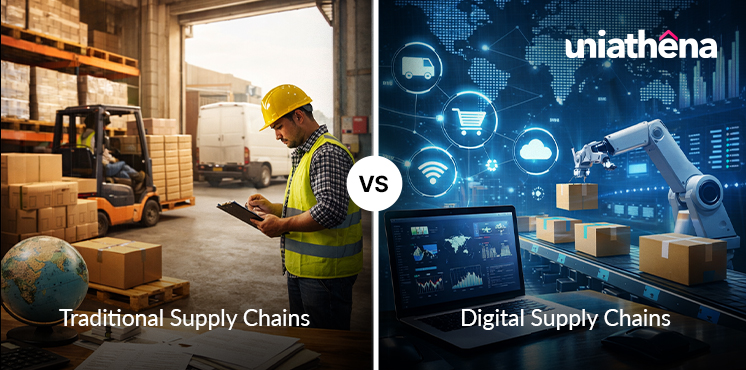
Traditional vs. Digital Supply Chains: What’s Changing?
Author: maharajan p
|7
MINS READ
| 0
| 282
Created On: 24 April, 2026
Share




Table of Contents (TOC):
- Introduction
- Key Takeaways
- Traditional Supply Chain
- Digital Supply Chain
- Traditional vs. Digital Supply Chain: Key Differences
- How Supply Chains Are Changing from Traditional to Digital Models
- Preparing for a More Data-Driven Supply Chain Environment
- Conclusion
- FAQs
Introduction
Traditional supply chains follow a linear path.
You plan based on past demand, move goods step by step, and adjust when issues show up. Visibility is limited, and coordination often depends on manual updates across teams. The system holds together, but it reacts after the fact.
Digital supply chains operate differently.
They connect multiple stages through continuous data flow. Decisions are supported by real-time inputs, and visibility extends across operations. Instead of waiting for disruptions to surface, the system is expected to respond as conditions change.
This is where the shift is happening.
Key Takeaways:
- Supply chains are moving away from periodic updates toward systems that operate with ongoing visibility and faster adjustments.
- Structure is changing from linear to networked. Instead of fixed, step-by-step movement, supply chains are being designed as interconnected systems with multiple suppliers and partners working simultaneously.
- Integrated platforms and automation are reducing the need for constant follow-ups, improving speed and alignment across teams.
- Traditional systems are not disappearing. They are being adapted with digital layers, which is where businesses are currently operating.
Traditional Supply Chain
In a traditional setup, supply chain activities are planned and executed in fixed cycles.
Raw materials move from suppliers to manufacturers, then to distributors, and finally to customers. Each stage works largely on its own, passing information and goods to the next step in sequence.
Most decisions are based on:
- Historical data
- Fixed planning cycles (weekly, monthly, quarterly)
- Manual coordination between teams
The system is built for stability and predictability, not constant change.
How It Functions in Practice
In a typical setup:
- Demand is forecasted in advance using past sales
- Production is planned based on those forecasts
- Inventory is stocked as a buffer to avoid shortages
- Updates move through emails, calls, or internal systems
- Issues (delays, demand spikes) are handled after they appear
Each part of the chain depends on the previous one, which keeps the flow structured but also slow to adjust.
Digital Supply Chain
A digital supply chain connects operations through continuous data flow, rather than periodic updates.
Instead of each stage operating separately, data flows across suppliers, manufacturers, distributors, and logistics in near real time. The focus shifts from planning in cycles to monitoring and adjusting continuously.
How It Functions
In a digital setup:
- Demand signals are captured continuously from multiple sources
- Inventory, production, and movement are tracked in real time
- Systems share updates across functions instead of passing them manually
- Decisions are triggered based on current conditions, not just past data
This doesn’t remove planning, but it reduces the gap between what is planned and what is actually happening. This shift is enabled by a set of technologies that change how information is captured, shared, and used across the supply chain.
- Sensors placed on inventory, equipment, or shipments provide continuous updates. This allows operations to be tracked as they progress, rather than relying on periodic status checks.
- Cloud-based platforms connect procurement, production, and logistics on a shared system. As a result, different functions work with the same set of updated information instead of maintaining separate records.
- With a continuous flow of data in place, AI and analytics tools help identify changes that require attention, such as demand variations, delays, or inventory imbalances. This supports more frequent and timely decision-making.
In specific use cases, blockchain is applied to maintain a consistent and verified record across participants. This becomes relevant where traceability and alignment of records are required.
Traditional vs. Digital Supply Chain: Key Differences
Traditional models are built around structured planning and sequential movement. Digital models, on the other hand, are designed to work with continuous inputs and interconnected processes. Placing these side by side helps clarify where the changes are most visible in day-to-day operations.
How Supply Chains Are Changing from Traditional to Digital Models
The shift from traditional to digital supply chains is not happening in one place. It shows up across how visibility is built, how systems are structured, and how coordination happens in day-to-day operations.
These changes are gradual, but they are already visible in how companies track, plan, and respond.
1. From Periodic to Continuous Visibility
Traditional supply chains rely on periodic updates—reports, checkpoints, and manual status tracking. The issue is not the lack of data, but the delay in accessing it.
Digital models are moving toward continuous visibility, where data flows as operations happen.
This shift is already underway. In 2024, around 60% of companies reported having visibility into their tier-one suppliers, with steady improvement over the past two years.
At the same time, gaps remain. Separate studies show that more than 40% of organizations still report limited or incomplete visibility even at the first supplier level, highlighting that while progress is real, it is far from consistent.
2. From Linear Flow to Networked Systems
Traditional supply chains follow a linear path: supplier to manufacturer to distributor.
Digital supply chains behave more like networks, where multiple suppliers, partners, and systems interact at the same time.
This shift is visible in how companies are restructuring their supply base. In 2024:
- 73% of companies are working on dual sourcing strategies
- 60% are regionalizing supply chains
These changes point to a move away from single-path dependencies.
Instead of a one-way pipeline, supply chains are becoming multi-node networks where suppliers, contract manufacturers, logistics providers, and even customers exchange signals continuously. Planning, fulfillment, and routing are coordinated across this network rather than executed step by step.
3. From Manual to System-Driven Coordination
Traditional supply chains depend on coordination through emails, calls, and manual updates. Digital supply chains reduce this dependency by embedding coordination into systems. This is where automation and integrated platforms come in.
Recent data shows that: Around two-thirds of companies are implementing advanced planning and scheduling systems (APS).
A significant portion of operational tasks can already be automated, especially in logistics-heavy industries. It’s the reduction of dependency on manual follow-ups, which has traditionally been one of the biggest sources of delay and misalignment.
Also Read: Inside the Supply Chain Manager Role: Skills, Salary, and Career Path
Preparing for a More Data-Driven Supply Chain Environment
As supply chains become more connected and responsive, the expectations from teams are also shifting. It is no longer limited to managing vendors or tracking inventory. There is a growing need to understand how systems work, how data flows across operations, and how decisions are made in real time.
For professionals looking to get into the supply chain, they need to equip themselves with a strong operational foundation. Along with that, they also need to develop digital skills—such as how to work with AI tools, how to analyze data, and the basics of how data is stored and managed in systems like blockchain.
You can find programs to learn these skills at UniAthena. Here are a few that fit into this shift:
- Basics of Artificial Intelligence: This program gives a basic understanding of AI. If you are new to it, this can be a starting point to build some clarity before looking at how it can be applied in the supply chain.
- Basics of Blockchain Applications: Here, you learn about key use cases such as asset track and trace and asset provenance, which are relevant in supply chain environments where traceability matters.
- Supply Chain Management Essentials: This program introduces core areas such as demand forecasting, risk management, and planning systems like MRP and ERP. This becomes useful when trying to understand where digital systems are actually making changes.
- Building on that, the Diploma in Supply Chain and Logistics Management expands the view across supplier relationships, logistics, and coordination. This aligns more closely with how supply chains are now moving toward interconnected, multi-node operations. You can take this program along with the essentials.
The idea here is not to move away from traditional supply chain knowledge, but to extend it. As supply chains evolve, the skills required to manage them are expanding in the same direction.
Also Read: A Critical Evaluation of Supply Chain Resilience Strategies in Emerging Markets
Conclusion
The shift from traditional to digital supply chains is not about replacing one model with another. It reflects a change in how supply chains are expected to operate.
Visibility is becoming continuous instead of periodic. Systems are moving from linear flows to interconnected networks. Decisions are supported by current data, and coordination is increasingly handled through integrated platforms.
At the same time, most supply chains are still in transition. Traditional structures continue to exist, often alongside digital systems.
FAQs
Q1. What is the main difference between traditional and digital supply chains?
A: Traditional supply chains follow a linear, step-by-step process with periodic updates. Digital supply chains operate as connected systems with continuous data flow and real-time visibility.
Q2. Are digital supply chains replacing traditional ones?
A: Not entirely. Most businesses operate in a hybrid model where traditional structures are supported by digital tools and systems.
Q3. Why is real-time visibility important in supply chains?
A: Real-time visibility reduces delays in identifying issues. It allows teams to respond closer to when disruptions occur instead of reacting after the impact.
Q4. How do digital supply chains improve decision-making?
A: They use continuous data and analytics to support decisions. This reduces reliance on fixed planning cycles and allows more frequent adjustments.
Explore Related Courses












COMMENTS(0)
Explore Related Courses
Our Popular Insights
Careers are shifting faster than ever, and staying relevant takes more than experience. Explore UniAthena’s most-read blogs for sharp insights, emerging skills, and practical pathways that help you move forward with clarity and confidence in a changing professional world.


🌟 Students of the Month | May – June 2026 🌟
Read More
1
mins read







🌟 Students of the Month | May – June 2026 🌟
Read more
1
mins read
Get in Touch

It’s Time to Start
Join NowMost Popular Online Specialization
- Master of International Business Administration
- Master of Business Administration
- MBA in General Management- FastTrack
- Master in Innovation and Entrepreneurship
- MBA-Family Business Management
- Master in Procurement and Contract Management
- Extended Diploma in Business Analytics (SCQF Level 11)
- Diploma in Supply Chain and Logistics Management (SCQF Level 11)
- Strategic Human Resource Management Practitioner
- Master in Data Science
- Master in Engineering Management
Trending Online
- Integrated Doctorate of Business Administration
- Postgraduate Certificate in Finance for Next Generation Managers
- Master of Business Administration- General Management (Fast Track)
- Postgraduate Certificate in Socio-Economic and Legal Framework
- Postgraduate Certificate in Business Sustainability
- Certified Manager
- Supply Chain Management Practitioner
- MBA - AI in Business
- MBA - Accounting & Finance
- Master in Supply Chain and Logistics Management
Top Universities Online Certificates
- Postgraduate Certificate in International Marketing Management
- Postgraduate Certificate In International Human Resource Management
- Postgraduate Certificate in Strategic Management
- Postgraduate Certificate in Procurement & Contracts Management
- Postgraduate Certificate in Business Analytics
- Postgraduate Certificate in Strategic Supply Chain & Logistics Management
- Postgraduate Certificate in Human Resource and Leadership
- Project Management Practitioner
- Postgraduate Certificate in Supply Chain Design & Implementation
- Postgraduate Certificate in Management Accounting and Finance
Accredited Online Degree Program
- MBA - Digital Transformation
- MBA - Family Business Management
- MBA - Marketing Management
- MBA in Quality Management
- MBA - Business Intelligence & Data Analytics
- MBA in Operations & Project Management
- MBA in Energy Management
- MBA In Construction & Safety Management
- Master in Organisational Leadership
- Master in Public Health
- Master in Construction Management
- Bachelor of Arts in Business Administration


 Install Now


UniAthena is an Ed-Tech, offering flexible, affordable learning solutions, including Free-Learning Upskilling Courses and Academic Programs in partnerships with accredited and globally renowned universities and professional qualification bodies.


Do you have any questions ?
Feel free to send us your questions or request a free consultation
Send a message
UK
Athena Global Education
Magdalen Centre,
Robert Robinson Avenue,
Oxford, OX4 4GA, UK
Phone : 01865 784299
MIDDLE EAST
Athena Global Education FZE
Block L-03, First Floor,
P O Box 519265, Sharjah Publishing City,
Free Zone, Sharjah, UAE
Phone : +971 55 879 5492
INDIA
Uniathena Private Limited
9A,Midas Tower
Phase 1
Hinjewadi Rajiv Gandhi Infotech Park
Pune-411057
Phone: +91 9145665544
All Copyrights Reserved @ Athena Global Education 2021-2026