-

Bachelor's

-

Masters
-

MBA
-

Doctorate
-

Micro Credit
-

Explore all Courses
-
Postgraduate Certifications

-
Postgraduate Diploma
-
Undergraduate Diploma
-
Diploma



What Job Titles Will Disappear by 2030? (And How to Future-Proof Your Career)

Author: maharajan p
|9
MINS READ
| 0
| 6
Created On: 24 July, 2026
Share




Table of Contents (TOC):
- Introduction
- Key Takeaways
- Will Jobs Really Disappear by 2030?
- Key Factors Driving Job Disruption
- Job Categories Most Likely to Decline or Shrink by 2030
- How to Future-Proof Your Career and Stay in Demand
- Conclusion
- FAQs
Introduction
A few years ago, becoming a writer was one of those paths where you could pursue your passion and still build a career out of it: copywriting, content writing, business writing. It made sense.
Then Claude, ChatGPT, and a wave of other AI tools came along and got remarkably good at reasoning and writing. For new writers trying to break in today? The market has never been harder. Entry-level gigs are drying up, rates are dropping, and clients are choosing AI over hiring juniors.
But writing isn't the only career feeling this pressure. Entire job categories are on the verge of being automated, restructured around AI, or quietly downsized to a handful of senior roles doing what whole teams used to do.
So here's the real question: will your job still exist in five years? Let's find out.
Key Takeaways:
- AI is reshaping the future of work, with automation taking over repetitive tasks rather than eliminating entire professions.
- As a result, many routine roles involving predictable workflows and data processing are less likely to remain among the jobs of the future by 2030.
- Future-proof careers require AI skills, strong domain expertise, and human abilities like communication and problem-solving.
- Adapting to technology and continuously building new skills can help professionals stay valuable in the changing workplace.
Will Jobs Really Disappear by 2030?
Not exactly.
For most people, it probably won’t look like waking up one day and finding your entire job replaced by a machine.
What’s more likely to happen is a transformation.
The job title may stay the same, but the actual work inside that role will start changing. A few examples:
- A content writer may spend less time writing first drafts and more time researching, editing, improving AI-generated content, and creating strategies.
- A customer support executive may handle fewer basic queries because AI can answer common questions, while humans step in for complex problems and customer relationships.
- A junior developer may spend less time writing repetitive code and more time reviewing, testing, and solving bigger technical problems.
- An accountant may spend less time manually entering data and more time analyzing numbers and helping businesses make decisions.
The people who adapt may find new opportunities. But the people who continue doing only the parts of their job that AI can already handle may find it harder to stand out.
Key Factors Driving Job Disruption
AI gets most of the attention when people talk about the future of work.
But AI is only one part of the story.
Several factors are pushing companies to rethink how work gets done, from reducing costs and improving efficiency to adopting new technologies. These changes are affecting which roles grow, which roles shrink, and what skills employers value.
Among them, three factors are playing the biggest role:
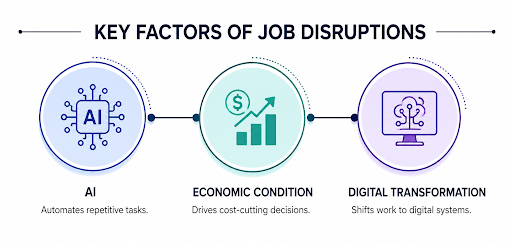
1. AI and Automation
This is the obvious one.
AI is becoming better at handling tasks that involve patterns, repetition, and large amounts of information.
For example:
- Writing basic reports
- Answering common customer questions
- Analyzing simple data
- Creating first drafts
- Automating repetitive office tasks
The impact is not always job replacement. In many cases, companies are redesigning roles around AI expecting employees to use these tools to do more work in less time.
2. Economic Conditions and Business Decisions
Technology is only one part of the story.
The economy also plays a major role in how companies hire, restructure, and reduce teams. When businesses face slower growth, higher costs, or uncertainty, they often look for ways to operate more efficiently.
This can lead to:
- Reducing duplicate roles
- Combining responsibilities into fewer positions
- Prioritizing employees with broader skill sets
- Delaying hiring for entry-level roles
This is why some jobs feel pressure even without direct automation.
3. Digital Transformation
Over the last decade, companies have been moving more operations online. From cloud software and data systems to automated workflows, businesses are replacing many manual processes with digital solutions.
This changes the type of work companies need.
For example:
- Manual data entry roles decline as businesses adopt automated systems
- Traditional marketing roles evolve with analytics and digital platforms
- IT roles shift from basic support toward managing complex systems
As companies adopt new technology, they need people who can manage, implement, analyze, and improve these systems.
Also Read: Hard Skills vs Soft Skills: Which Is More Important?
Job Categories Most Likely to Decline or Shrink by 2030
Before looking at these roles, there’s one important thing to understand: a job shrinking does not mean the job disappears completely.
In most cases, what’s changing is the way the work gets done.
Companies are not simply removing entire professions overnight. They are automating the repetitive parts, redesigning workflows, and shifting human effort toward tasks that require more judgment, creativity, and problem-solving. The roles below are the ones most exposed to automation.
1. Administrative and Clerical Roles
Administrative and clerical roles involve managing documents, entering information, scheduling meetings, organizing records, handling emails, and supporting everyday business operations.
The common thing among these roles is that many tasks follow the same patterns repeatedly. With AI tools and workflow automation, companies can now handle several routine administrative tasks faster with fewer manual steps.
This doesn’t mean every administrative role disappears. But the value is shifting toward professionals who can coordinate teams, solve problems, manage processes, and handle situations that need human judgment.
Jobs most likely to decline or shrink:
- Data Entry Clerks: Many manual data input tasks are being replaced by automated systems that can collect, organize, and process information with minimal human involvement.
- Administrative Assistants Focused on Routine Tasks: Scheduling meetings, managing emails, preparing documents, and organizing information are increasingly handled by AI-powered tools.
- Office Support Roles Focused on Repetitive Processes: Roles involving basic paperwork, file management, and process tracking may reduce as companies adopt more automation.
2. Customer Support and Call Center Jobs
Customer support roles have traditionally been built around helping customers solve problems: answering questions, guiding them through issues, processing requests, and handling complaints.
The shift happening now is that many customer interactions are becoming predictable. A large number of customers ask similar questions every day, which makes these conversations easier to handle through AI chatbots, automated response systems, and self-service platforms.
Jobs most likely to decline or shrink:
- Tier-1 Support Agents: First-level support roles handling common issues like account questions, password resets, and basic troubleshooting are increasingly being supported by AI systems.
- Telemarketers: Repetitive outreach calls and scripted sales conversations are becoming easier to automate with AI voice technology and automated calling systems.
- Basic Customer Service Representatives: Roles focused mainly on answering standard questions and following fixed processes may decline as companies move customers toward automated support channels.
3. Basic Accounting and Bookkeeping Roles
Accounting and bookkeeping roles involve managing financial records, tracking transactions, processing invoices, handling payroll, and preparing regular financial reports for businesses.
The reason these roles are becoming more exposed to automation is because a large part of the work follows structured rules. Numbers need to be recorded, matched, categorized, and reported in a consistent way, tasks that modern accounting software and AI-powered systems can increasingly handle. However, this shift does not remove the need for finance professionals. The value is moving toward people who can interpret financial information, identify problems, support business decisions, and provide strategic insights beyond basic processing.
Jobs most likely to decline or shrink:
- Invoice Processing Roles: Tasks like checking invoices, matching payments, and updating records are increasingly handled by automated accounting systems that reduce manual data entry.
- Payroll Clerks: Payroll calculations, employee payment tracking, and compliance-related processes are becoming easier to manage with specialized software and automation tools.
- Routine Financial Reporting Roles: Preparing standard reports and compiling financial data may decline as businesses use AI tools to generate summaries and identify patterns faster.
4. Entry-Level Content and Writing Jobs
Writing used to be one of those skills where people could start small, take on blog projects, write basic website content, help brands with articles, and gradually build their expertise.
But the entry point has become more difficult.
A big reason is that many beginner-level writing tasks are based on patterns: researching common topics, summarizing information, creating simple drafts, or rewriting existing ideas. AI tools can now handle a lot of this early-stage work quickly, which has changed what companies expect from writers.
Jobs most likely to decline or shrink:
- Generic SEO Content Writers: Writers who mainly produce basic keyword-focused articles on common topics may face more competition as businesses use AI tools to create first drafts and scale content production.
- Basic Translation Jobs: Simple translation work, especially for everyday content, is increasingly handled by AI translation systems that can quickly convert large volumes of text.
- Report Summarization Roles: Tasks like turning long reports, documents, or research materials into short summaries are becoming easier with AI tools that can analyze and condense information.
Also Read: What Jobs Will AI Replace & Which Careers Are Safe?
How to Future-Proof Your Career and Stay in Demand
Future-proofing your career doesn’t have to feel complicated or overwhelming. It usually comes down to a few practical shifts in how you work and what you focus on.
Here are 3 simple ways to stay relevant in the years ahead:
- Learn AI Tools and Workflows: Get comfortable with how AI fits into your work. That includes prompting, using automation tools, and finding ways to speed up or support your daily tasks instead of doing everything manually.
- Build Your Core Domain Expertise: AI can generate information, but it still struggles with deep, real-world understanding. The more you know your field, whether it’s marketing, finance, writing, or engineering, the harder it is to replace your judgment.
- Strengthen Your Soft Skills: Communication, decision-making, and problem-solving are becoming more valuable, not less. As tools handle execution, humans are expected to think clearly, explain well, and make better calls under uncertainty.
Here, we've highlighted a few short courses to help professionals build AI literacy, strengthen their professional skills, and learn how to apply emerging technologies effectively in the workplace. Together, these skills can contribute to long-term career growth and help prepare you for future opportunities.
Whether you're in information technology, artificial intelligence, marketing, HRM, supply chain, management & operations, or oil and gas, explore UniAthena's bite-sized short courses to strengthen your expertise and keep growing in your field.
Conclusion
The future of work is changing, but that does not mean every job will disappear by 2030.
The bigger shift is that the way we work is changing. Tasks are getting automated, expectations are increasing, and professionals who can adapt will have a stronger advantage.
The safest approach is not to compete with technology; it is to learn how to work with it. By building AI skills, strengthening your domain knowledge, and improving skills like communication and problem-solving, you can stay prepared for whatever changes come next.
Also Read: High Demand Skills for the Next 10 Years
FAQs
Q1. Will AI completely replace jobs by 2030?
A: AI is more likely to change jobs by automating tasks rather than completely replacing most professions.
Q2. Which jobs are most at risk from automation?
A: Jobs involving repetitive tasks, data processing, and predictable workflows are more likely to face automation pressure.
Q3. How can I future-proof my career against AI?
A: Learn AI tools, build domain expertise, and strengthen skills like communication, judgment, and problem-solving.
Q4. Are creative jobs safe from AI disruption?
A: Creative roles may change, but human strategy, originality, and understanding audiences will remain valuable.
Our Popular Courses

$14000


Doctoral Degree in Business Administration
Universidad Catolica De Murcia (UCAM), Spain
Duration:
2 - 3 Years
$17,500*
Integrated Doctorate of Business Administration
Guglielmo Marconi University, Italy
Universidad Catolica De Murcia (UCAM), Spain
Duration:
2.5 - 3.5 Years
$5,600*
Master of Business Administration
Guglielmo Marconi University, Italy
Duration:
12 - 24 Months
$5,600*
MBA in Operations & Project Management
Guglielmo Marconi University, Italy
Duration:
12 - 24 Months
$5,600*
Master in Supply Chain and Logistics Management
Guglielmo Marconi University, Italy
Duration:
12 - 24 Months
$5,950*
Master in Data Sciences
Guglielmo Marconi University, Italy
Duration:
12 - 24 Months
$5,600*
Master in Engineering Management
Guglielmo Marconi University, Italy
Duration:
12 - 24 Months
$5,600*
Master in Procurement and Contract Management
Guglielmo Marconi University, Italy
Duration:
12 - 24 Months
$5,600*
Master in Public Health
Guglielmo Marconi University, Italy
Duration:
12 - 24 MonthsOur Popular Courses
COMMENTS(0)
Our Popular Courses
$14000
Doctoral Degree in Business Administration
Universidad Catolica De Murcia (UCAM), Spain
Duration:
2 - 3 Years
$17,500*
Integrated Doctorate of Business Administration
Guglielmo Marconi University, Italy
Universidad Catolica De Murcia (UCAM), Spain
Duration:
2.5 - 3.5 Years
$5,600*
Master of Business Administration
Guglielmo Marconi University, Italy
Duration:
12 - 24 Months
$5,600*
MBA in Operations & Project Management
Guglielmo Marconi University, Italy
Duration:
12 - 24 Months
$5,600*
Master in Supply Chain and Logistics Management
Guglielmo Marconi University, Italy
Duration:
12 - 24 Months
$5,950*
Master in Data Sciences
Guglielmo Marconi University, Italy
Duration:
12 - 24 Months
$5,600*
Master in Engineering Management
Guglielmo Marconi University, Italy
Duration:
12 - 24 Months
$5,600*
Master in Procurement and Contract Management
Guglielmo Marconi University, Italy
Duration:
12 - 24 Months
$5,600*
Master in Public Health
Guglielmo Marconi University, Italy
Duration:
12 - 24 MonthsOur Popular Courses
Our Popular Insights
Careers are shifting faster than ever, and staying relevant takes more than experience. Explore UniAthena’s most-read blogs for sharp insights, emerging skills, and practical pathways that help you move forward with clarity and confidence in a changing professional world.




What is the Role of AI in Education?
Read More
4
mins read





What is the Role of AI in Education?
Read more
4
mins read
Get in Touch

It’s Time to Start
Join NowMost Popular Online Specialization
- Master of International Business Administration
- Master of Business Administration
- MBA in General Management- FastTrack
- Master in Innovation and Entrepreneurship
- MBA-Family Business Management
- Master in Procurement and Contract Management
- Extended Diploma in Business Analytics (SCQF Level 11)
- Diploma in Supply Chain and Logistics Management (SCQF Level 11)
- Strategic Human Resource Management Practitioner
- Master in Data Science
- Master in Engineering Management
Trending Online
- Integrated Doctorate of Business Administration
- Postgraduate Certificate in Finance for Next Generation Managers
- Master of Business Administration- General Management (Fast Track)
- Postgraduate Certificate in Socio-Economic and Legal Framework
- Postgraduate Certificate in Business Sustainability
- Certified Manager
- Supply Chain Management Practitioner
- MBA - AI in Business
- MBA - Accounting & Finance
- Master in Supply Chain and Logistics Management
Top Universities Online Certificates
- Postgraduate Certificate in International Marketing Management
- Postgraduate Certificate In International Human Resource Management
- Postgraduate Certificate in Strategic Management
- Postgraduate Certificate in Procurement & Contracts Management
- Postgraduate Certificate in Business Analytics
- Postgraduate Certificate in Strategic Supply Chain & Logistics Management
- Postgraduate Certificate in Human Resource and Leadership
- Project Management Practitioner
- Postgraduate Certificate in Supply Chain Design & Implementation
- Postgraduate Certificate in Management Accounting and Finance
Accredited Online Degree Program
- MBA - Digital Transformation
- MBA - Family Business Management
- MBA - Marketing Management
- MBA in Quality Management
- MBA - Business Intelligence & Data Analytics
- MBA in Operations & Project Management
- MBA in Energy Management
- MBA In Construction & Safety Management
- Master in Organisational Leadership
- Master in Public Health
- Master in Construction Management
- Bachelor of Arts in Business Administration


 Install Now


UniAthena is an Ed-Tech, offering flexible, affordable learning solutions, including Free-Learning Upskilling Courses and Academic Programs in partnerships with accredited and globally renowned universities and professional qualification bodies.


Do you have any questions ?
Feel free to send us your questions or request a free consultation
Send a message
UK
Athena Global Education
Magdalen Centre,
Robert Robinson Avenue,
Oxford, OX4 4GA, UK
Phone : 01865 784299
MIDDLE EAST
Athena Global Education FZE
Block L-03, First Floor,
P O Box 519265, Sharjah Publishing City,
Free Zone, Sharjah, UAE
Phone : +971 55 879 5492
INDIA
Uniathena Private Limited
9A,Midas Tower
Phase 1
Hinjewadi Rajiv Gandhi Infotech Park
Pune-411057
Phone: +91 9145665544
All Copyrights Reserved @ Athena Global Education 2021-2026