-

Bachelor's

-

Masters
-

MBA
-

Doctorate
-

Micro Credit
-

Explore all Courses
-
Postgraduate Certifications

-
Postgraduate Diploma
-
Undergraduate Diploma
-
Diploma



How to Be More Creative: 7 Practical Tips to Improve Creativity

Author: urvi malusare
|8
MINS READ
| 0
| 7
Created On: 08 July, 2026
Share




Table of Contents (TOC):
- Key Takeaways
- How To Be Creative?
- What Is Creativity?
- Creative Thinking Skills
- How To Improve Creativity?
- Creative Thinking Activities To Help Improve Creativity
- 7 Tips To Improve Creativity
- How to Enhance Creativity with UniAthena?
- FAQs
People usually categorize jobs as “creative” jobs and “technical” jobs.
You can either be an artist, writer, or designer (AKA a creative professional), or you can be a doctor, engineer, or lawyer (AKA a technical professional).
What if we break that myth here?
Every job is a creative job, because without creative thinking, even technical professionals wouldn’t be able to solve problems and face challenges in their daily work-life.
So it doesn’t matter whether you have a traditionally creative job or a non-creative job, creative thinking skills are not optional.
Key Takeaways:
- There is no step-by-step guide to innovation and creativity. One must approach every task with a different thought process and try methods like brainstorming, summarizing, lateral thinking, connecting the dots, questioning, and accepting ambiguity to find creative solutions.
- Creative thinking exercises like the incomplete figure test, repurposing a product, creating a story from words in a dictionary, taking a field trip, reading or writing, and storyboarding can help you bring out your creativity.
- One great brainstorming technique when trying to be creative is dividing the process up into two stages—ideation and editing.
- One more great way to boost creativity is imposing creative limitations on yourself. Fewer resources can still help you produce strong results.
- If you think your work environment is what’s affecting your creativity, seek out a different spot or introduce a different light, music, or scent into your creative workspace.
- Carry around a small notebook or a digital pinned note on your phone screen to capture the spontaneous creative ideas before you lose them.
How To Be Creative?
If you don’t consider yourself to be a thinking-outside-the-box type of person, that’s alright!
The creative part of your brain is just a muscle that’s been out of practice. With some easy creative thinking exercises, you will become ready to use your creativity in your workplace.
What Is Creativity?
First, let’s start by understanding ‘what is creativity?’
Creativity refers to the idea of approaching any task in a unique way and using your imagination to find nuanced solutions. The reason creativity is so important and valued is that it differs from person to person.
Creative thinking skills don’t follow a rule book. You cannot follow a step-by-step process of creative problem solving and reach the same conclusion as someone else. This unique nature of creativity is what sets humans apart from each other.
Creative Thinking Skills
Here are some creative thinking skills that define a creative mind:
- Divergent Thinking: This is your ability to generate multiple ideas from a single starting point. E.g., brainstorming 50 title ideas for an article.
- Convergent Thinking: This is the opposite of divergent thinking. This is where you turn a mountain of chaotic ideas into a single strong idea. E.g., summarising a brainstorming session into an action plan.
- Lateral Thinking: This is commonly referred to as thinking outside the box. E.g. Instead of asking, “How do we get more customers to read our newsletter?” ask, “How do we make our newsletter so good that people are annoyed if they miss it?”
- Associative Thinking: This is the approach where you just connect the dots in front of you. E.g., using everyday metaphors to explain technical jargon, hence bridging the gap.
- Questioning & Intellectual Curiosity: Instead of just blindly following the rules, this approach allows you to be sceptical. E.g., asking ‘why’ instead of just accepting rules or instructions.
- Openness to Experience & Ambiguity: Not everything needs a concrete black and white answer. Creative minds often find comfort in ambiguity. E.g., going with the flow when taking on a new task rather than following the usual SOP.
How To Improve Creativity?
For some people, creative problem solving comes naturally. For others, they need to gain a little knowledge and be a little more disciplined to make their brain think more creatively.
But the important fact to note here is that you can learn innovation and creativity. Let’s look at some creative thinking exercises to help you become more creative in your life.
Creative Thinking Activities To Help Improve Creativity
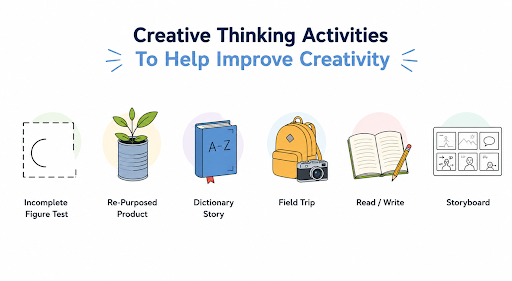
Incomplete Figure Test
This is a drawing exercise. Make a simple free-hand scribble or shape on a piece of paper (or ask someone else to do it) and then use that as a guideline to draw a full image. Your scribble or shape is the prompt that will allow you to use your imagination and conjure up an image that is unique to you. When you do this exercise in a group, you will see how the same scribble or shape can be interpreted differently by different people.
Re-Purposed Product
We all learned about “best out of waste” in school. But somewhere along the way, we forgot to incorporate those skills and creativity into our daily lives. This could be one of those ways to boost creativity for you.
Take an old object that you are about to discard and repurpose it. Not only do you extend the life of a product this way, but you also give yourself the opportunity to think creatively.
Dictionary Story
Open your dictionary and find three random words. Use your imagination to create a short story using those three words. Make sure that you are connecting these words to each other and forming a cohesive narrative.
Field Trip
Being stuck indoors can dampen your creativity. Step outside and take a short field trip. You could just go on a short walk around your workplace or neighborhood and explore the local sites. You could talk to strangers and learn something new in the most organic way possible.
Read / Write
Stepping away from reading reports and emails and reading something creative like a book, story, or poetry can help awaken the creative side of your brain. You can even give writing something creative a go. Depending on how much time you have, you can write anything from a short story to a haiku.
Storyboard
Storyboarding is a great creative outlet. Instead of just writing down steps in a process, you can draw the process like a comic strip. Not only does this help you express yourself creatively, but it also provides visual aid to anyone that might need it.
Also Read: The Future of Creativity: AI-Powered Design Tool
7 Tips To Improve Creativity
1. Embrace the “Two-Step” Brainstorming Method
First, conduct a 10-minute brainstorming session where you only write and add to the ideas without even pressing backspace. Then walk away from the page and come back refreshed to commence stage two: editing.
2. Practice Associative Thinking
Play the dictionary game or pick any two random words or objects and try connecting them. You could connect them to form a story, create a new product in your mind, or just connect their existence to each other.
3. Impose Creative Constraints
Give yourself a word count, a time limit, or limit your resources to coerce your mind into creating something from basically nothing. Sometimes having too much free range can negatively affect your creativity.
4. Change Your Physical Environment
Move to a different desk, a different room, or a different floor of the office for a while. If there is a way for you to sit in nature and work, do that. If moving away from your desk is not an option, change the setting a little. Change the lighting, play some music, or light a scented candle.
5. Capture Ideas Instantly
Sometimes great ideas take you by surprise. They show up at the most inconvenient times—in the shower, when you’re on a train, or at 2 AM when you’re trying to sleep. You think you’ll note it at a more convenient time, but by then the idea’s gone. So to capture your spontaneous ideas, keep a convenient tool on you at all times. This could be a small notebook or just a pinned digital note to your phone’s lock screen.
6. Feed Your Mind
Don’t just consume content that relates to your work. Follow a bunch of unrelated content creators, read articles about the most random topics, watch documentaries that have nothing to do with your work, and feed your mind interesting content to keep those brain muscles working.
7. Give Yourself Permission to Produce “Junk”
Don’t chase perfection. Write drafts that are bad, knowing that you have time to polish them later. Your bad designs or bad ideas will eventually lead you to a good idea and a satisfying end result.
Also Read: How Design Thinking Works: Your Practical Guide
How to Enhance Creativity with UniAthena?
While the tips to improve creativity can be applied anytime at a roadblock, creativity can also be enhanced like any other skill, with knowledge and practice.
UniAthena offers you free short courses in creativity and design thinking to help you hone the art of creative thinking:
- Basics of Creativity and Problem Solving
- Basics for a Design Thinker
- Executive Diploma in Design Thinking
- Essentials of Design Thinking
- Mastering Design Thinking
If you are not used to being creative in your daily life, you will need some time to truly become creative. But incorporating these simple creative thinking techniques and tips will help you.
Also Read: Creativity in Entrepreneurship: Why It Matters for Business Success
FAQs
Q1. Why is creativity important?
A: Your creativity is what makes you different from others. Without creativity, your work will look generic and lack a sense of self. When you approach any task with a creative mind, you are able to find solutions that are unique.
Q2. Can creativity be learned?
A: Yes. Creativity is a skill that can be learned and mastered with practice and time. Simple creative thinking activities like storyboarding, reading and writing, and creating stories can help you become more creative in your daily life.
Q3. How can I improve my creativity?
A: If you are struggling to find the creative side of your brain, take a break. Go for a walk, feed your brain content that is unrelated to your task, and maybe even put some limitations to produce the result. But in general, spending at least an hour a day doing something creative helps you be more creative.
Our Popular Courses

$14000


Doctoral Degree in Business Administration
Universidad Catolica De Murcia (UCAM), Spain
Duration:
2 - 3 Years
$17500*
Integrated Doctorate of Business Administration
Guglielmo Marconi University, Italy
Universidad Catolica De Murcia (UCAM), Spain
Duration:
2.5 - 3.5 Years
$5600*
Master of Business Administration
Guglielmo Marconi University, Italy
Duration:
12 - 24 Months
$5600*
MBA in Operations & Project Management
Guglielmo Marconi University, Italy
Duration:
12 - 24 Months
$5600*
Master in Supply Chain and Logistics Management
Guglielmo Marconi University, Italy
Duration:
12 - 24 Months
$5950*
Master in Data Sciences
Guglielmo Marconi University, Italy
Duration:
12 - 24 Months
$5600*
Master in Engineering Management
Guglielmo Marconi University, Italy
Duration:
12 - 24 Months
$5600*
Master in Procurement and Contract Management
Guglielmo Marconi University, Italy
Duration:
12 - 24 Months
$5600*
Master in Public Health
Guglielmo Marconi University, Italy
Duration:
12 - 24 MonthsOur Popular Courses
COMMENTS(0)
Our Popular Courses
$14000
Doctoral Degree in Business Administration
Universidad Catolica De Murcia (UCAM), Spain
Duration:
2 - 3 Years
$17500*
Integrated Doctorate of Business Administration
Guglielmo Marconi University, Italy
Universidad Catolica De Murcia (UCAM), Spain
Duration:
2.5 - 3.5 Years
$5600*
Master of Business Administration
Guglielmo Marconi University, Italy
Duration:
12 - 24 Months
$5600*
MBA in Operations & Project Management
Guglielmo Marconi University, Italy
Duration:
12 - 24 Months
$5600*
Master in Supply Chain and Logistics Management
Guglielmo Marconi University, Italy
Duration:
12 - 24 Months
$5950*
Master in Data Sciences
Guglielmo Marconi University, Italy
Duration:
12 - 24 Months
$5600*
Master in Engineering Management
Guglielmo Marconi University, Italy
Duration:
12 - 24 Months
$5600*
Master in Procurement and Contract Management
Guglielmo Marconi University, Italy
Duration:
12 - 24 Months
$5600*
Master in Public Health
Guglielmo Marconi University, Italy
Duration:
12 - 24 MonthsOur Popular Courses
Our Popular Insights
Careers are shifting faster than ever, and staying relevant takes more than experience. Explore UniAthena’s most-read blogs for sharp insights, emerging skills, and practical pathways that help you move forward with clarity and confidence in a changing professional world.


🌟 Top Project Performer – May 2026 🌟
Read More
1
mins read


🌟 Top Project Performer – April 2026 🌟
Read More
1
mins read

Top 10 Online Courses for Housewives
Read More
10
mins read

🌟 Top Project Performer – May 2026 🌟
Read more
1
mins read
🌟 Top Project Performer – April 2026 🌟
Read more
1
mins read
Top 10 Online Courses for Housewives
Read more
10
mins read
Get in Touch

It’s Time to Start
Join NowMost Popular Online Specialization
- Master of International Business Administration
- Master of Business Administration
- MBA in General Management- FastTrack
- Master in Innovation and Entrepreneurship
- MBA-Family Business Management
- Master in Procurement and Contract Management
- Extended Diploma in Business Analytics (SCQF Level 11)
- Diploma in Supply Chain and Logistics Management (SCQF Level 11)
- Strategic Human Resource Management Practitioner
- Master in Data Science
- Master in Engineering Management
Trending Online
- Integrated Doctorate of Business Administration
- Postgraduate Certificate in Finance for Next Generation Managers
- Master of Business Administration- General Management (Fast Track)
- Postgraduate Certificate in Socio-Economic and Legal Framework
- Postgraduate Certificate in Business Sustainability
- Certified Manager
- Supply Chain Management Practitioner
- MBA - AI in Business
- MBA - Accounting & Finance
- Master in Supply Chain and Logistics Management
Top Universities Online Certificates
- Postgraduate Certificate in International Marketing Management
- Postgraduate Certificate In International Human Resource Management
- Postgraduate Certificate in Strategic Management
- Postgraduate Certificate in Procurement & Contracts Management
- Postgraduate Certificate in Business Analytics
- Postgraduate Certificate in Strategic Supply Chain & Logistics Management
- Postgraduate Certificate in Human Resource and Leadership
- Project Management Practitioner
- Postgraduate Certificate in Supply Chain Design & Implementation
- Postgraduate Certificate in Management Accounting and Finance
Accredited Online Degree Program
- MBA - Digital Transformation
- MBA - Family Business Management
- MBA - Marketing Management
- MBA in Quality Management
- MBA - Business Intelligence & Data Analytics
- MBA in Operations & Project Management
- MBA in Energy Management
- MBA In Construction & Safety Management
- Master in Organisational Leadership
- Master in Public Health
- Master in Construction Management
- Bachelor of Arts in Business Administration


 Install Now


UniAthena is an Ed-Tech, offering flexible, affordable learning solutions, including Free-Learning Upskilling Courses and Academic Programs in partnerships with accredited and globally renowned universities and professional qualification bodies.


Do you have any questions ?
Feel free to send us your questions or request a free consultation
Send a message
UK
Athena Global Education
Magdalen Centre,
Robert Robinson Avenue,
Oxford, OX4 4GA, UK
Phone : 01865 784299
MIDDLE EAST
Athena Global Education FZE
Block L-03, First Floor,
P O Box 519265, Sharjah Publishing City,
Free Zone, Sharjah, UAE
Phone : +971 55 879 5492
INDIA
Uniathena Private Limited
9A,Midas Tower
Phase 1
Hinjewadi Rajiv Gandhi Infotech Park
Pune-411057
Phone: +91 9145665544
All Copyrights Reserved @ Athena Global Education 2021-2026