-

Bachelor's

-

Masters
-

MBA
-

Doctorate
-

Micro Credit
-

Explore all Courses
-
Postgraduate Certifications

-
Postgraduate Diploma
-
Undergraduate Diploma
-
Diploma



AI Is No Longer Helping You Work. It’s Working With You
Author: maria rashid
|6
MINS READ
| 0
| 114
Created On: 19 March, 2026
Share




Table of Contents (TOC):
- Introduction
- Key Takeaways
- Understanding the Role of AI in the Workplace
- Benefits of AI in the Workplace
- From AI Copilots to AI Coworkers
- The transition from AI Copilots to AI co-workers
- The future of work with AI
- Conclusion
- FAQs
Introduction
Modern workplaces are undergoing a significant transformation. Tasks that once required extensive manual effort can now often be completed more efficiently with the support of artificial intelligence. As AI becomes more accessible, it is increasingly viewed not only as a tool but as a system that can assist and, in some cases, participate in workflows.
Imagine starting your workday with an AI assistant drafting your schedule, summarizing documents, and supporting routine reporting. Such scenarios are becoming increasingly common across several industries, although adoption levels vary by sector and organization.
This blog explores the concept of AI coworkers, systems that extend beyond basic automation to support multi-step workflows and interact more actively with human teams, while also examining their limitations, governance implications, and evolving role in professional environments.
Key Takeaways:
- Artificial intelligence is evolving from task-based automation tools to more interactive, workflow-integrated systems.
- Human–AI collaboration is becoming a core capability in modern organizations.
- AI copilots assist with routine and repetitive tasks.
- AI coworkers represent a more advanced stage, supporting multi-step processes and decision workflows.
- Future workplaces will require stronger governance, oversight, and responsible AI integration.
Understanding the Role of AI in the Workplace
To understand how work is evolving, it is important to define what artificial intelligence in the workplace entails.
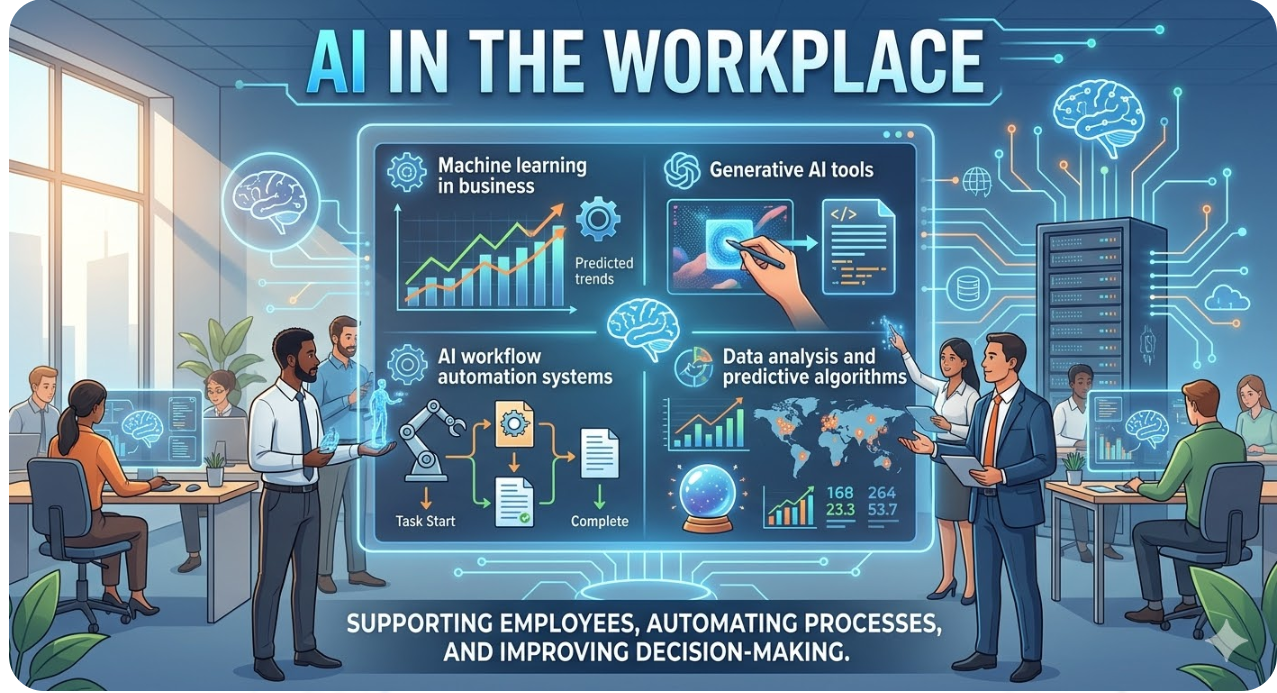
Artificial intelligence in professional settings refers to the use of systems that can analyze data, identify patterns, and support decision-making processes. These capabilities help reduce manual effort and improve the management of information.
Currently, AI systems are not limited to research or specialized technical tasks. They are increasingly integrated into everyday operations, supporting activities such as content creation, report drafting, scheduling, and coding assistance through prompt-based interaction.
Generative AI tools represent a notable development in making AI more accessible across professional roles, as they allow users to interact with systems using natural language.
It is important to recognize that AI systems are generally introduced to augment human work rather than replace it entirely. Their primary role is to reduce repetitive effort and allow professionals to focus on higher-value activities such as analysis, creativity, and strategic thinking.
At the same time, the growing reliance on AI introduces important considerations related to accuracy, data privacy, and human oversight, which organizations must address as adoption increases.
Benefits of AI in the Workplace
As AI adoption increases, several operational benefits are becoming evident. These systems can enhance efficiency and support decision-making, while allowing employees to focus on more complex responsibilities.
While these benefits are significant, they depend on proper implementation, data quality, and ongoing human supervision.
From AI Copilots to AI Coworkers
As AI systems become more integrated into professional workflows, their role is shifting from copilot-style assistance to more active participation.
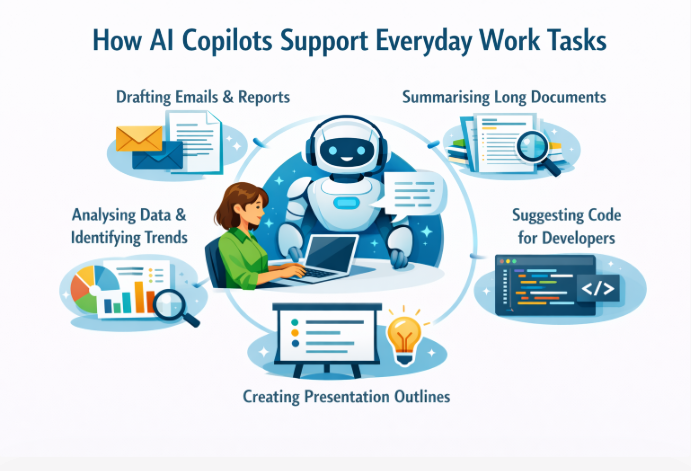
An AI copilot can be understood as a digital assistant that supports individuals in completing tasks. Similar to a copilot in aviation, it assists but does not independently manage operations.
More advanced systems are now being developed that extend beyond task assistance, leading to the concept of AI coworkers.
AI coworkers are systems designed to participate in workflows, manage multi-step processes, and interact with multiple data sources. Rather than responding only to prompts, they can contribute to ongoing operations.
Examples of AI coworker capabilities include:
- Generating workflow updates and tracking project progress
- Identifying inefficiencies through data analysis
- Preparing reports and summaries
- Suggesting process improvements
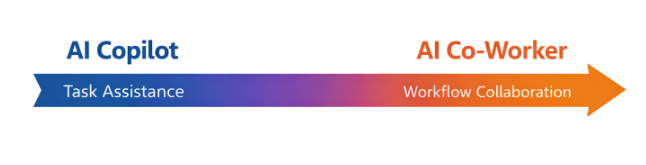
These capabilities illustrate a shift from task-level assistance to process-level support.
The Transition from AI Copilots to AI Coworkers
This transition reflects a movement from automation toward partial autonomy, although current systems still require significant human oversight.
Also Read: Boost Workplace Productivity and Efficiency with Generative AI
The Future of Work with AI
Artificial intelligence continues to develop, and its role in the workplace is expected to expand. The future of work increasingly points toward AI-augmented teams, where human professionals and AI systems collaborate closely.
Emerging trends include:
- AI systems that adapt to individual work patterns
- Greater integration of AI into workflow management
- Increased use of AI in decision-support systems
However, this evolution also raises important challenges. Organizations must address:
- Reliability concerns, including errors or “hallucinations” in AI outputs
- Data privacy and security risks
- Workforce implications, including changes in job roles
- The need for clear governance frameworks and human accountability
As a result, successful integration of AI will depend not only on technological capability but also on responsible implementation and oversight.
Also Read: AI, Analytics, and the Future of Work
Conclusion
Artificial intelligence is influencing how organizations operate, shifting from a purely automation-based role to a more integrated presence within workflows.
From AI copilots that assist with individual tasks to AI coworkers that support broader processes, these systems are becoming increasingly embedded in professional environments.
Rather than replacing human expertise, AI systems are most effective when used to complement human judgment, allowing professionals to focus on complex, strategic, and creative work.
As adoption continues, organizations that balance efficiency gains with governance, transparency, and human oversight are likely to derive the greatest value from AI integration.
FAQs
Q1.What is an AI copilot at work?
A: An AI copilot at work is an AI-powered assistant that helps individuals in performing their routine tasks, such as analysing data, summarising information, writing reports, etc.
Q2. What is an AI coworker?
A: An AI coworker is an intelligent system that works alongside professionals and manages processes and operations to enhance productivity.
Q3. Give some examples of AI-automations in the workplace?
A: Examples include AI chatbots for consumer service, AI-driven data analysis tools, automated marketing systems, and recruitment tools.
Q4. What are the benefits of AI-human collaboration in the workplace?
A: The key benefits of AI-human collaboration include increased efficiency, reduced human errors, more time for complex and strategic tasks, and improved decision-making.
Q5. How will the future of work be affected by AI?
A: The future of work with AI is one in which there will be strong human-AI collaboration, where AI systems will work alongside human employees.
References:
- https://www.mywave.ai/blog/ai-co-pilot-vs-ai-co-worker
- https://www.oneadvanced.com/resources/artificial-intelligence-in-the-workplace-a-comprehensive-guide/
- https://www.elia.io/blog/workplace-automation-examples
- https://www.hydra.pt/en/ia-workplace-benefits-challenges
- https://www.ibm.com/think/insights/ai-and-the-future-of-work
Explore Related Courses









COMMENTS(0)
Explore Related Courses
Our Popular Insights
Careers are shifting faster than ever, and staying relevant takes more than experience. Explore UniAthena’s most-read blogs for sharp insights, emerging skills, and practical pathways that help you move forward with clarity and confidence in a changing professional world.

What is Business Development?
Read More
6
mins read

🌟 Top Project Performer – June 2026 🌟
Read More
1
mins read
What is the Role of AI in Education?
Read More
4
mins read


🌟 Top Project Performer – May 2026 🌟
Read More
1
mins read

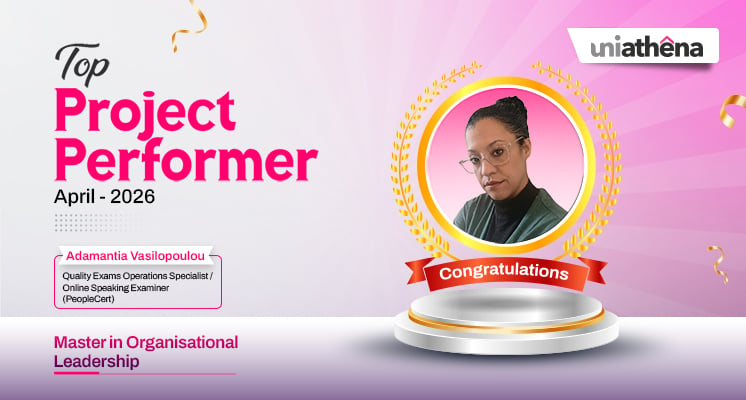
🌟 Top Project Performer – April 2026 🌟
Read More
1
mins read
What is Business Development?
Read more
6
mins read
🌟 Top Project Performer – June 2026 🌟
Read more
1
mins read
What is the Role of AI in Education?
Read more
4
mins read
🌟 Top Project Performer – May 2026 🌟
Read more
1
mins read

🌟 Top Project Performer – April 2026 🌟
Read more
1
mins read
Get in Touch

It’s Time to Start
Join NowMost Popular Online Specialization
- Master of International Business Administration
- Master of Business Administration
- MBA in General Management- FastTrack
- Master in Innovation and Entrepreneurship
- MBA-Family Business Management
- Master in Procurement and Contract Management
- Extended Diploma in Business Analytics (SCQF Level 11)
- Diploma in Supply Chain and Logistics Management (SCQF Level 11)
- Strategic Human Resource Management Practitioner
- Master in Data Science
- Master in Engineering Management
Trending Online
- Integrated Doctorate of Business Administration
- Postgraduate Certificate in Finance for Next Generation Managers
- Master of Business Administration- General Management (Fast Track)
- Postgraduate Certificate in Socio-Economic and Legal Framework
- Postgraduate Certificate in Business Sustainability
- Certified Manager
- Supply Chain Management Practitioner
- MBA - AI in Business
- MBA - Accounting & Finance
- Master in Supply Chain and Logistics Management
Top Universities Online Certificates
- Postgraduate Certificate in International Marketing Management
- Postgraduate Certificate In International Human Resource Management
- Postgraduate Certificate in Strategic Management
- Postgraduate Certificate in Procurement & Contracts Management
- Postgraduate Certificate in Business Analytics
- Postgraduate Certificate in Strategic Supply Chain & Logistics Management
- Postgraduate Certificate in Human Resource and Leadership
- Project Management Practitioner
- Postgraduate Certificate in Supply Chain Design & Implementation
- Postgraduate Certificate in Management Accounting and Finance
Accredited Online Degree Program
- MBA - Digital Transformation
- MBA - Family Business Management
- MBA - Marketing Management
- MBA in Quality Management
- MBA - Business Intelligence & Data Analytics
- MBA in Operations & Project Management
- MBA in Energy Management
- MBA In Construction & Safety Management
- Master in Organisational Leadership
- Master in Public Health
- Master in Construction Management
- Bachelor of Arts in Business Administration


 Install Now


UniAthena is an Ed-Tech, offering flexible, affordable learning solutions, including Free-Learning Upskilling Courses and Academic Programs in partnerships with accredited and globally renowned universities and professional qualification bodies.


Do you have any questions ?
Feel free to send us your questions or request a free consultation
Send a message
UK
Athena Global Education
Magdalen Centre,
Robert Robinson Avenue,
Oxford, OX4 4GA, UK
Phone : 01865 784299
MIDDLE EAST
Athena Global Education FZE
Block L-03, First Floor,
P O Box 519265, Sharjah Publishing City,
Free Zone, Sharjah, UAE
Phone : +971 55 879 5492
INDIA
Uniathena Private Limited
9A,Midas Tower
Phase 1
Hinjewadi Rajiv Gandhi Infotech Park
Pune-411057
Phone: +91 9145665544
All Copyrights Reserved @ Athena Global Education 2021-2026