-

Bachelor's

-

Masters
-

MBA
-

Doctorate
-

Micro Credit
-

Explore all Courses
-
Postgraduate Certifications

-
Postgraduate Diploma
-
Undergraduate Diploma
-
Diploma



Why Data Lineage Is the Backbone of Explainable AI

Author: pallavi patnaik
|11
MINS READ
| 0
| 365
Created On: 19 February, 2026
Share




Table of Contents (TOC):
- Introduction
- Key Takeaways
- What Is Data Lineage
- Why Is Data Lineage Important?
- The Rise of AI-Generated Data and Autonomous Analytics
- How Data Lineage Enables Explainable AI
- Types of Data Lineage in Modern Analytics
- Data Lineage Tracking Methods and Tools
- Autonomous Databases and Analytics Decision Making
- Benefits of Data Lineage for Data-Driven Organizations
- Conclusion
- FAQs
Introduction
A business analyst opens a dashboard on a Monday morning. The numbers look decisive. Revenue is projected to dip in one region, surge in another, and the system recommends an immediate budget shift. No one built this report overnight. No one manually checked the data. The decision came from an AI system working quietly in the background.
Now comes the uncomfortable question: Can we trust it?
As organizations rely more on AI-generated data to power dashboards, forecasts, and real-time insights, autonomous analytics systems are making decisions with minimal human input. When outcomes influence budgets, strategy, or compliance, blind trust is no longer enough.
This is where data lineage becomes essential.
Without clear visibility into where data comes from, how it evolves, and how AI models consume it, organizations are left interpreting outcomes without context. This creates risk not only in analytics decision-making, but also in governance, compliance, and long-term trust in AI-driven systems. Understanding data lineage is no longer optional. It is the foundation for transparency, accountability, and explainable AI.
This blog explores what data lineage is, how it supports artificial intelligence for data analysis, and why it sits at the core of modern autonomous analytics systems.
Key Takeaways:
- Data lineage explains how AI-generated data flows across systems, models, and decisions.
- Autonomous analytics depend on lineage to enable transparency and trust in AI outcomes.
- Explainable AI is not possible without strong data lineage tracking.
- Modern organizations use automated data lineage tools, including open-source options.
- Clear lineage improves compliance, accuracy, and data-driven decision making.
What Is Data Lineage?
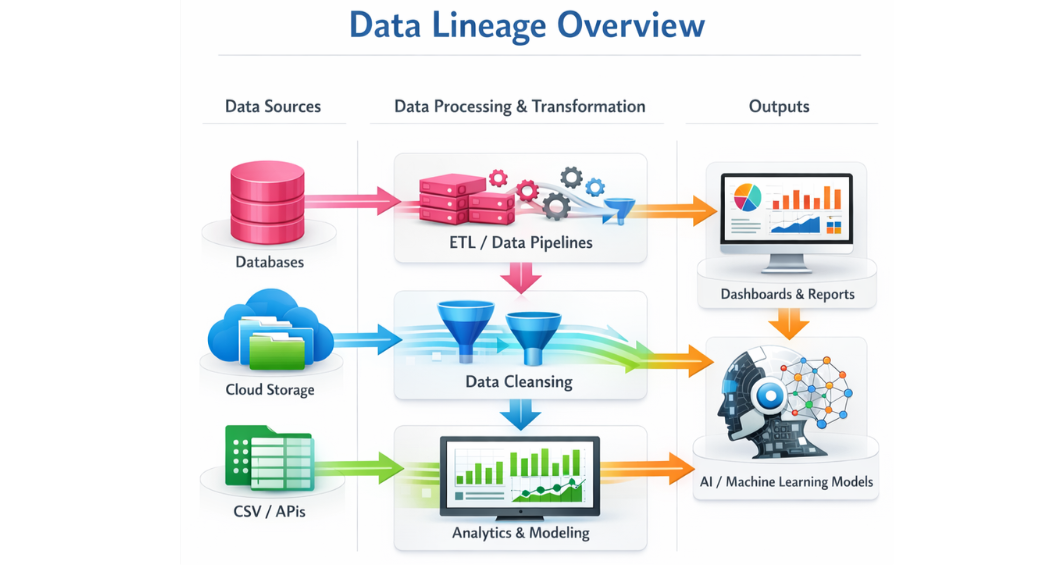
Data lineage describes the complete journey of data as it moves through an organization’s systems, from its original source to its final use. It captures where the data originates, how it is transformed along the way, and which systems, models, or dashboards ultimately consume it. Rather than viewing data as static records, lineage treats data as something that evolves through multiple stages of processing and analysis.
In simple terms, data lineage answers a fundamental question that every analytics user eventually asks: How did we get this result? By making data flows visible, lineage allows teams to understand not just what the output is, but how it was produced.
Why Is Data Lineage Important?
As organizations scale their use of AI and automated analytics, the importance of data lineage increases significantly. The growing reliance on AI-generated data, combined with stricter regulatory expectations around transparency, means that decisions can no longer be accepted at face value. This is especially true when analytics systems operate autonomously, without manual checks at every stage.
Understanding why data lineage is important helps organizations detect errors earlier, validate insights with confidence, and ensure that AI-driven systems are being used responsibly. It provides the context needed to govern data effectively, support explainable analytics, and maintain trust in decisions that increasingly shape business outcomes.
The Rise of AI-Generated Data and Autonomous Analytics
What Is AI Data Analytics?
AI data analytics refers to the use of machine learning and artificial intelligence models to analyze large volumes of data automatically. Instead of relying on predefined rules or manual queries, these systems learn from data patterns, adapt over time, and generate insights with minimal human involvement. This approach allows organizations to move beyond descriptive reporting toward more predictive and responsive analytics.
In practice, AI data analytics powers use cases such as predictive forecasting, customer behavior analysis, fraud detection, and operational optimization. By continuously processing incoming data, AI-driven analytics systems can surface trends and risks that would be difficult to detect through traditional methods alone.
Autonomous Analytics in AI-Driven Data Analysis
Autonomous analytics builds on AI data analytics by reducing human intervention even further. These systems do not just analyze data; they also determine what actions or recommendations should follow. Data is ingested automatically, processed through AI models, and translated into decisions or next steps without requiring analysts to guide each stage.
A common example of data-driven decision making is an AI system that adjusts product pricing in real time based on demand signals, inventory levels, and market conditions. In such scenarios, analytics moves from insight generation to decision execution. This level of autonomy increases speed and efficiency, but it also raises an important question: how do organizations understand and trust decisions made by systems operating largely on their own?
But without data lineage, these decisions become a black box. To understand why this matters, consider a real-world example. A retail organization uses autonomous analytics to adjust product pricing across regions based on demand, inventory levels, and customer behavior.
The system ingests sales data, supply chain updates, and market signals, then recommends price changes automatically. When revenue drops unexpectedly in one region, data lineage allows teams to trace the decision back to the specific datasets, transformations, and AI models involved. Without lineage, the organization would see only the outcome, not the cause.
How Data Lineage Enables Explainable AI
Explainable AI Needs Traceability
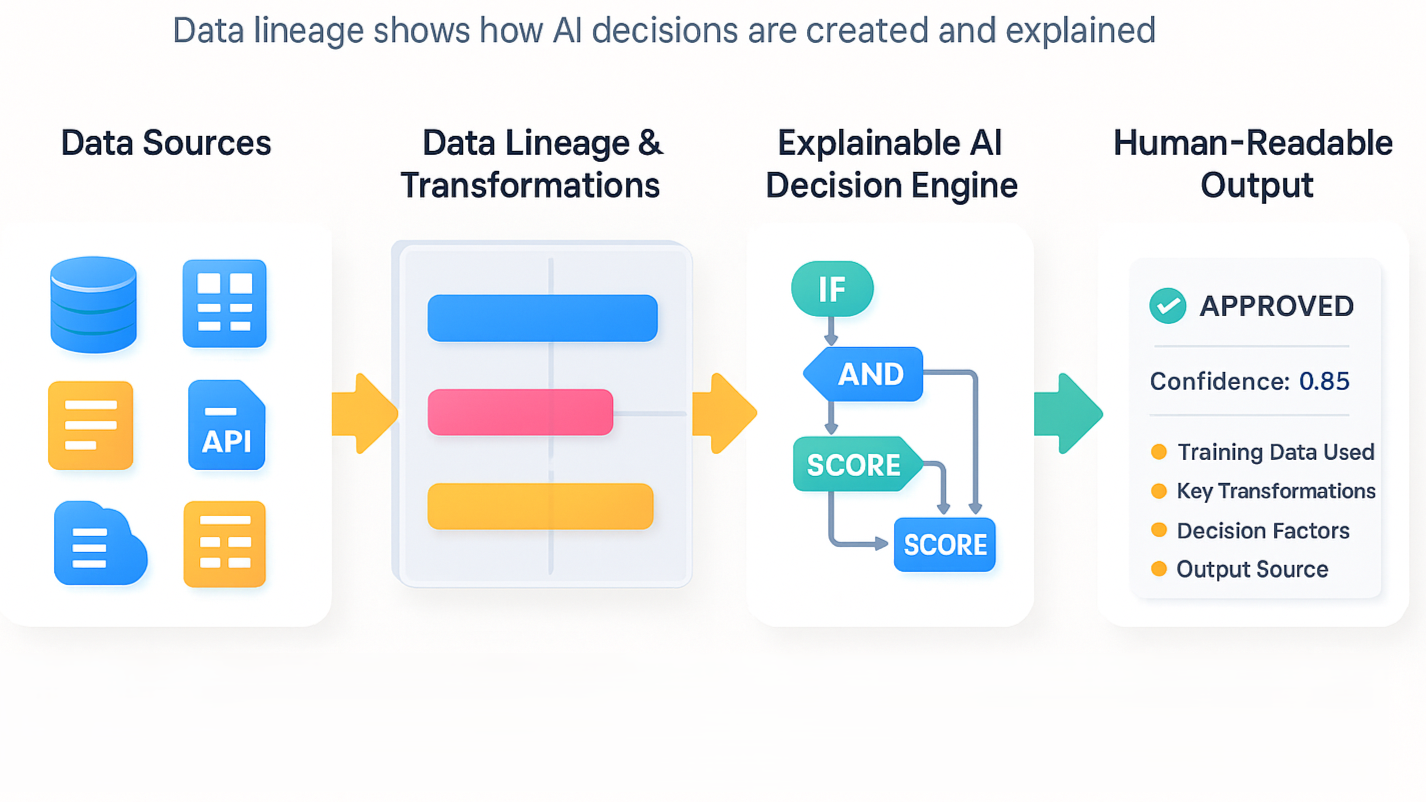
Explainable AI focuses on making the decisions produced by AI systems understandable to humans, especially when those decisions influence business outcomes, compliance, or risk. For explainability to be meaningful, organizations must be able to trace how an AI system arrived at a specific result rather than simply observing the final output.
This is where data lineage plays a critical role. By documenting which datasets were used, how data was transformed, and how outputs were generated, lineage provides the context needed to interpret AI-driven decisions. It allows teams to follow the full path from raw data to model output, making complex analytics processes more transparent and easier to validate.
Without data lineage, explainable AI remains largely theoretical. Organizations may have access to model outputs, but lack the visibility required to explain why a decision was made or whether it can be trusted. Traceability turns explainability into a practical capability rather than an abstract goal.
Linking Data Lineage to AI Accountability
As AI systems increasingly influence outcomes in areas such as finance, healthcare, and regulatory compliance, accountability becomes a non-negotiable requirement. Organizations are no longer judged solely on whether an AI system produces results, but on whether those results can be explained, justified, and defended when questioned.
In practical terms, accountability means being able to explain why a specific decision was made and which data influenced it. This is especially important when decisions affect customers, financial performance, or legal obligations. Data lineage enables this level of accountability by providing a clear record of how data was sourced, transformed, and used throughout the analytics process.
By combining data linkage methods with robust data lineage tracking, organizations gain the ability to trace AI-driven outcomes back to their underlying data and logic. This traceability ensures that decisions are not only automated but also auditable and responsible, which is critical in environments where trust and compliance matter as much as speed.
Types of Data Lineage in Modern Analytics
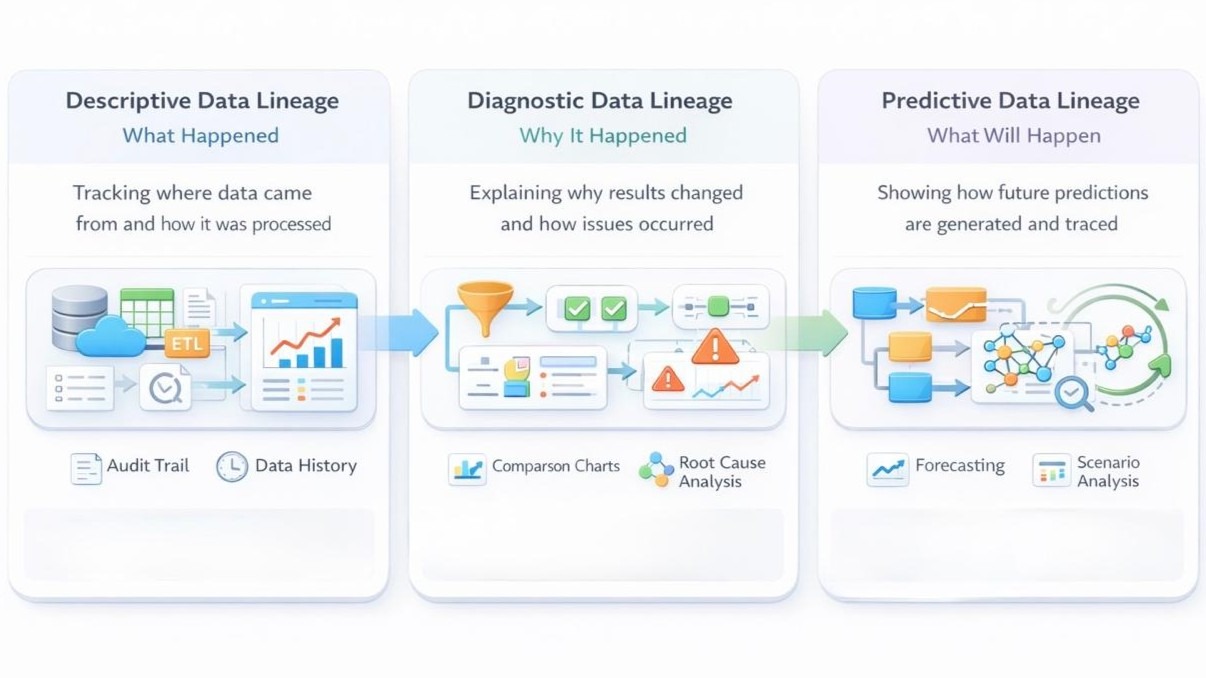
Understanding the different types of data lineage helps organizations choose the right level of visibility and control for their analytics environments. Not all lineages serve the same purpose, and each type supports a different aspect of analytics decision-making.
Descriptive data lineage focuses on documenting how data has already moved through systems. It provides a historical view of data flows and transformations, making it especially useful for audits, reporting, and compliance reviews where teams need to verify how a result was produced.
Diagnostic data lineage is designed to support troubleshooting and root-cause analysis. When analytics outputs appear incorrect or inconsistent, diagnostic lineage helps teams identify where issues occurred within data pipelines, transformations, or integrations.
Predictive data lineage looks forward rather than backward. It helps organizations anticipate how changes to data sources, schemas, or models might affect downstream systems and analytics outputs. This type of lineage is particularly valuable in autonomous analytics environments, where changes can propagate quickly without manual oversight.
Together, these types of data lineage support more reliable and confident analytics decision-making, especially as systems become more automated and complex.
Also Read: LLM in Data Science and Analytics
Data Lineage Tracking Methods and Tools
Data Linkage Definition and Methods
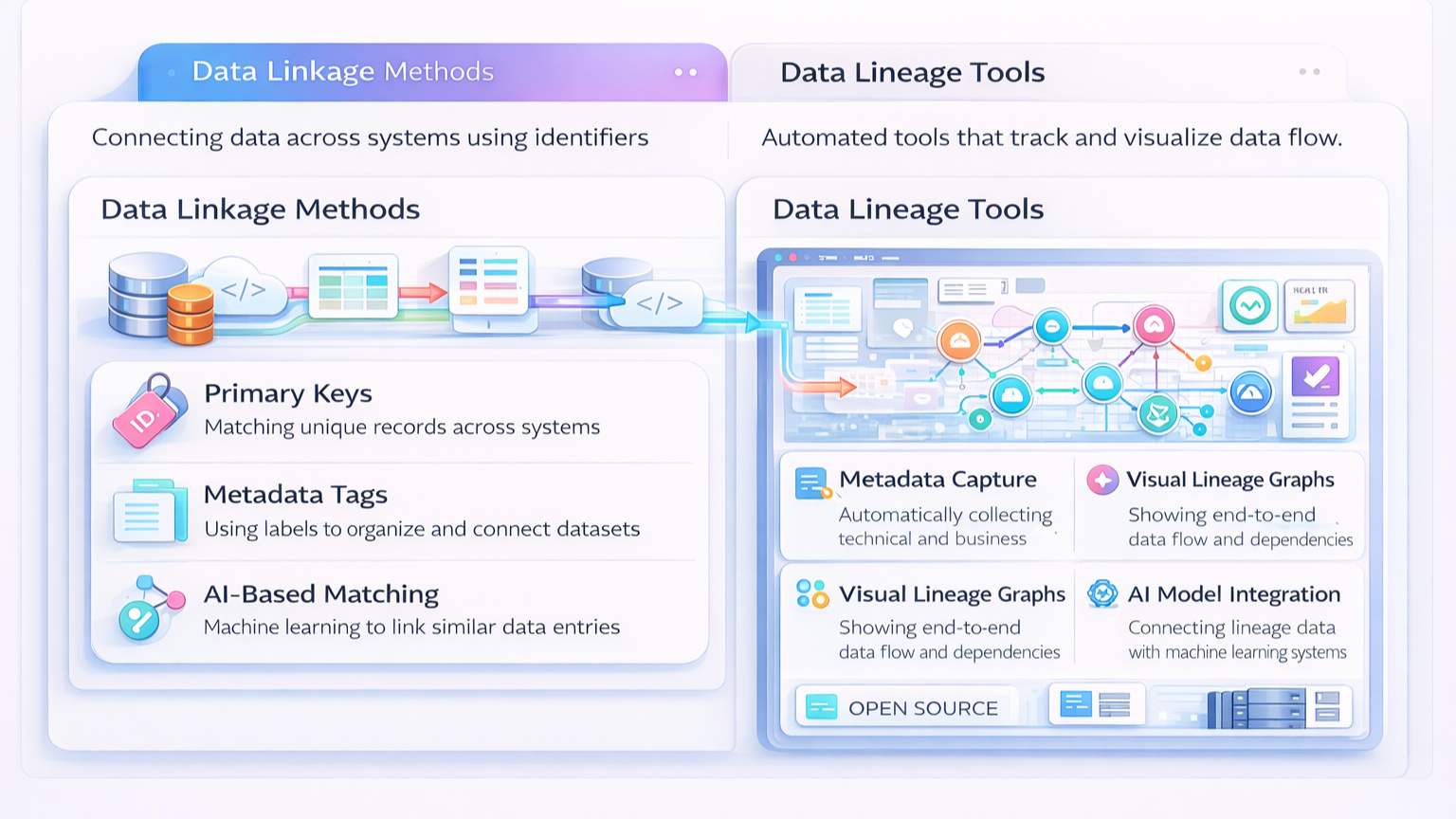
Data linkage refers to the process of connecting related data across different systems, platforms, or datasets so that it can be tracked and analyzed consistently. In modern analytics environments, data rarely exists in a single location. It is spread across databases, cloud platforms, applications, and AI pipelines, making linkage essential for maintaining context and continuity.
Organizations typically establish data linkage using identifiers such as primary keys, metadata tags, or machine learning–based matching techniques. These methods allow data to be associated accurately even when it moves across systems or changes format. Effective data linkage ensures that analytics teams can follow relationships between datasets and maintain a coherent view of how data is used throughout the organization.
Data Lineage Tools
As data ecosystems grow in scale and complexity, manual approaches to tracking lineage quickly become impractical. Modern organizations, therefore, rely on automated data lineage tools to support AI-driven pipelines and analytics workflows. These tools continuously capture metadata, map data flows, and visualize how data moves through systems, models, and dashboards.
In practice, data lineage tools help teams understand dependencies, assess the impact of changes, and troubleshoot issues more efficiently. Many organizations also adopt open-source data lineage tools, particularly when flexibility, transparency, or cost efficiency are priorities. Regardless of whether the tools are commercial or open source, their role is the same: to provide ongoing visibility into data movement and usage in increasingly automated analytics environments.
In practice, organizations adopt automated data lineage tools when manual documentation can no longer keep pace with data volume and system complexity. As data pipelines expand across cloud platforms, AI models, and autonomous databases, automated lineage becomes essential for maintaining accuracy, reducing operational risk, and supporting faster incident resolution. For many teams, lineage tools act as the connective layer between analytics, governance, and AI oversight.
Also Read: The Future of Analytics: Data Mesh Meets Federated Intelligence
Autonomous Databases and Analytics Decision Making
What Is an Autonomous Database?
An autonomous database is a data management system that uses artificial intelligence to operate with minimal human intervention. Instead of relying on manual administration, these databases continuously monitor their own performance and adjust automatically based on usage patterns and system demands.
In practice, an autonomous database handles tasks such as performance tuning, security updates, and scaling in the background. Automating these functions reduces operational overhead while ensuring that data remains optimized, secure, and available for analytics workloads. This level of automation is particularly important in environments that support real-time analytics and AI-driven decision making, where delays or manual configuration can quickly become bottlenecks.
Autonomous Database Example
An autonomous database example includes systems that automatically optimize queries, manage indexing, and allocate resources based on usage patterns, while continuously feeding clean, optimized data into analytics engines. In such environments, data lineage plays a critical role by documenting how data moves through the database, how optimizations affect outputs, and how analytics decisions are ultimately produced.
Role of Lineage in Analytics Decisions
For reliable analytics decision-making, lineage ensures that every insight can be traced back to its data source. This improves confidence in AI-led outcomes.
Also Read: Data Consolidation Simplified
Benefits of Data Lineage for Data-Driven Organizations
The benefits of data lineage extend well beyond technical data teams and apply across the entire organization. By making data flows transparent, lineage helps build trust in AI-driven insights, especially in environments where analytics outcomes influence strategic and operational decisions.
One of the most immediate advantages is faster issue resolution. When anomalies or errors appear in reports or dashboards, data lineage allows teams to trace problems back to their source quickly, reducing downtime and minimizing the impact on decision-making. This visibility also strengthens compliance and governance efforts by providing a clear record of how data is sourced, transformed, and used.
Data lineage also plays a critical role in supporting explainable AI frameworks. By linking analytics outputs to the data and transformations behind them, organizations can better justify AI-driven decisions and maintain accountability. Over time, this leads to more reliable data-driven decision-making, where leaders can act with confidence because insights are both accurate and traceable.
For organizations using artificial intelligence for data analysis, data lineage is what enables scale without sacrificing control. It allows teams to grow autonomous analytics capabilities while maintaining visibility, accountability, and confidence in every decision generated by AI systems.
Conclusion
As AI systems move steadily toward greater autonomy, the ability to understand, explain, and trust analytics outcomes becomes a defining challenge for modern organizations. Knowing what data lineage is and how it traces the full journey of data is no longer limited to technical teams. It is now a core requirement for leaders responsible for governance, compliance, and strategic decision-making.
In 2026, AI-generated data, autonomous analytics, and explainable AI are not isolated capabilities. They operate as a tightly connected ecosystem where automated systems ingest data, apply intelligence, and produce decisions at scale. Without data lineage, this ecosystem lacks transparency. With it, organizations gain the visibility needed to validate insights, audit decisions, and respond confidently to regulatory and ethical expectations.
Data lineage has therefore evolved beyond a backend feature. It acts as the connective layer that enables accountability in analytics, supports responsible use of artificial intelligence for data analysis, and strengthens trust in data-driven outcomes. Organizations that invest in robust data lineage practices position themselves to scale autonomous analytics responsibly, reduce risk, and maintain long-term credibility.
Ultimately, as analytics becomes faster and more autonomous, data lineage ensures it also remains understandable, governable, and aligned with business intent. In an AI-driven future, transparency is not a constraint on innovation. It is what makes sustainable innovation possible.
Also Read: Why DataOps is the Future of Data Engineering and Analytics
FAQs
Q1. What is data lineage in simple terms?
A: Data lineage shows where data comes from, how it changes, and where it is used, helping teams trust analytics results.
Q2. Why is data lineage important for AI analytics?
A: It enables explainable AI by showing how AI-generated data influenced decisions.
Q3. What are data lineage tools used for?
A: They track data movement across systems, models, and dashboards automatically.
Q4. How does data lineage support autonomous analytics?
A: It provides transparency and accountability in AI-driven analytics decision-making.
Q5. Are there open-source data lineage tools?
A: Yes, many organizations use open source data lineage tools for flexibility and cost control.
Explore Related Courses










COMMENTS(0)
Explore Related Courses
Our Popular Insights
Careers are shifting faster than ever, and staying relevant takes more than experience. Explore UniAthena’s most-read blogs for sharp insights, emerging skills, and practical pathways that help you move forward with clarity and confidence in a changing professional world.


How to Switch Career to Data Analytics?
Read More
6
mins read




How to Switch Career to Data Analytics?
Read more
6
mins read

Get in Touch

It’s Time to Start
Join NowMost Popular Online Specialization
- Master of International Business Administration
- Master of Business Administration
- MBA in General Management- FastTrack
- Master in Innovation and Entrepreneurship
- MBA-Family Business Management
- Master in Procurement and Contract Management
- Extended Diploma in Business Analytics (SCQF Level 11)
- Diploma in Supply Chain and Logistics Management (SCQF Level 11)
- Strategic Human Resource Management Practitioner
- Master in Data Science
- Master in Engineering Management
Trending Online
- Integrated Doctorate of Business Administration
- Postgraduate Certificate in Finance for Next Generation Managers
- Master of Business Administration- General Management (Fast Track)
- Postgraduate Certificate in Socio-Economic and Legal Framework
- Postgraduate Certificate in Business Sustainability
- Certified Manager
- Supply Chain Management Practitioner
- MBA - AI in Business
- MBA - Accounting & Finance
- Master in Supply Chain and Logistics Management
Top Universities Online Certificates
- Postgraduate Certificate in International Marketing Management
- Postgraduate Certificate In International Human Resource Management
- Postgraduate Certificate in Strategic Management
- Postgraduate Certificate in Procurement & Contracts Management
- Postgraduate Certificate in Business Analytics
- Postgraduate Certificate in Strategic Supply Chain & Logistics Management
- Postgraduate Certificate in Human Resource and Leadership
- Project Management Practitioner
- Postgraduate Certificate in Supply Chain Design & Implementation
- Postgraduate Certificate in Management Accounting and Finance
Accredited Online Degree Program
- MBA - Digital Transformation
- MBA - Family Business Management
- MBA - Marketing Management
- MBA in Quality Management
- MBA - Business Intelligence & Data Analytics
- MBA in Operations & Project Management
- MBA in Energy Management
- MBA In Construction & Safety Management
- Master in Organisational Leadership
- Master in Public Health
- Master in Construction Management
- Bachelor of Arts in Business Administration


 Install Now


UniAthena is an Ed-Tech, offering flexible, affordable learning solutions, including Free-Learning Upskilling Courses and Academic Programs in partnerships with accredited and globally renowned universities and professional qualification bodies.


Do you have any questions ?
Feel free to send us your questions or request a free consultation
Send a message
UK
Athena Global Education
Magdalen Centre,
Robert Robinson Avenue,
Oxford, OX4 4GA, UK
Phone : 01865 784299
MIDDLE EAST
Athena Global Education FZE
Block L-03, First Floor,
P O Box 519265, Sharjah Publishing City,
Free Zone, Sharjah, UAE
Phone : +971 55 879 5492
INDIA
Uniathena Private Limited
9A,Midas Tower
Phase 1
Hinjewadi Rajiv Gandhi Infotech Park
Pune-411057
Phone: +91 9145665544
All Copyrights Reserved @ Athena Global Education 2021-2026