-

Bachelor's

-

Masters
-

MBA
-

Doctorate
-

Micro Credit
-

Explore all Courses
-
Postgraduate Certifications

-
Postgraduate Diploma
-
Undergraduate Diploma
-
Diploma



LLM in Data Science and Analytics

Author: priyanka chatterjee
|4
MINS READ
| 0
| 350
Created On: 19 September, 2025
Share




These days, data is more than just spreadsheet rows and dashboard charts; it's a swiftly shifting wave that can either carry or drown startups. Today, the true question is not whether AI is appropriate, but rather how to use Large Language Models (LLMs) for analytics and data science to keep one step ahead of the competition.
By going beyond conventional techniques to provide context, predictive capability, and human-like insights, LLMs are driving the next major advance in data analytics. The best LLM for data analysis is revolutionizing decision-making, from identifying fraud in banking to predicting consumer trends in retail.

Source: https://shearwaterjapan.com/blog/how-to-llm
The Reasons LLMs Are the Talk of the Data World
Traditional analytics relied primarily on organized data, such as spreadsheets, tables, and numbers. However, the majority of information in the modern world is unstructured, including research papers, social media posts, chats, and customer evaluations.
In data science, this is where LLMs excel:
- They are able to read, comprehend, and evaluate language.
- They make connections between numerical and textual patterns.
- They find insights that humans might overlook.
In summary, LLMs comprehend data rather than merely counting it.

Source: Exploring LLMs
What Roles Do LLMs Play in Data Science and Analytics?
Businesses are utilizing LLMs in a number of effective ways:
- Predictive Analytics: It can be used to forecast patient risks, market changes, or sales.
- Data Summarization: Transform lengthy reports into manageable summaries.
- Sentiment Analysis: Recognize the tone and purpose of reviews or comments.
- Fraud Detection: Identify anomalous activities in financial systems.
- Using LLMs for Data Visualization: Instantly create dashboards and charts that are simple to read.
Also Read: Understanding Bias and Fairness in Large Language Models
LLM in Healthcare
Imagine a hospital that handles millions of patient records annually. Information is essential to healthcare, including lab results, medications, medical research, patient histories, and even doctor's notes. The difficulty? The majority of this data is dispersed and unstructured, making it difficult for doctors to link every aspect.
Large Language Models (LLMs) act as effective facilitators. They have the ability to quickly scan through thousands of records, identify odd trends, predict the likelihood of diseases, and even summarize complicated medical literature for prompt decision-making. Consider a system that notifies doctors of possible symptoms before problems get worse—that is the power of LLMs.
Outcome:
In addition to quicker data processing, the outcome is more intelligent, individualized care. Hospitals decrease emergency cases, patients receive prompt treatment, and medical staff spend more time treating rather than information gathering.
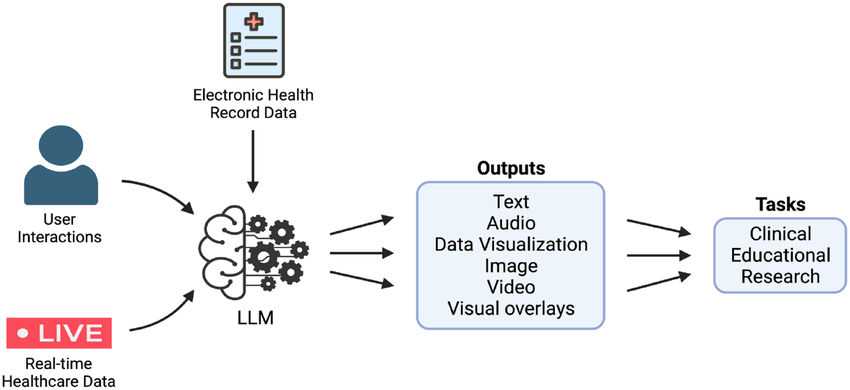
The above image illustrates:
- User Interactions: Doctors, patients or researchers can ask questions, provide guidelines, or seek information.
- Electronic Health Records (EHRs): Prescriptions, lab results, patient records, and medical histories are all entered into the system.
- Real-time Healthcare Data: The model receives real-time updates from hospital systems, devices, and monitors.
- LLM (Large Language Model): Compiles all of this information, identifies patterns, and interprets it.
Result Produced:
- Quick-reading text summaries
- Easy-to-listen audio explanations
- Data visualizations for more explicit understanding
- Images and video to aid in diagnosis or training
- Using visual overlays to direct decision-making in real time
Activities Driven by Outputs:
- Clinical: Assisting doctors in making better choices.
- Educational: Training medical staff and students.
- Research: Boosting healthcare innovation and discovery.
LLM in Banking & Finance
LLMs AI was incorporated into a large bank's fraud system. In contrast to previous models that solely used numbers to flag transactions, the LLM examined:
- Emails that contain unusual language, such as "urgent transfer".
- Chat logs with suspicious wording.
- Transaction details for irregularities.
Outcome:
Fraud was discovered more quickly, saving millions.
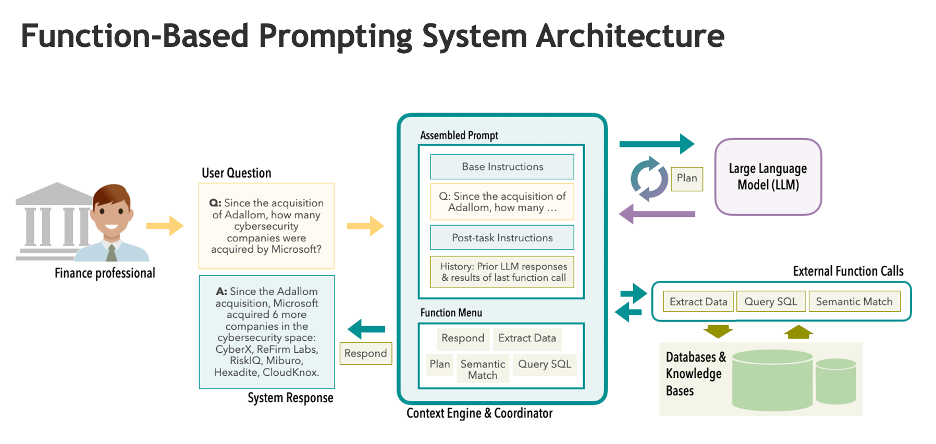
Sourcelink: https://www.moduleq.com/blog/how-new-prompting-techniques-increase-llm-accuracy-in-financial-applications
Prompting Techniques Increase LLM Accuracy in Financial Applications
When it comes to financial applications, precision is crucial because even one mistake might cost millions of dollars. Prompting approaches frame queries correctly, enabling LLMs to provide more accurate insights.
- Models are guided step-by-step by chain-of-thought prompting, which lowers errors in intricate risk assessments.
- Few-shot prompting enhances the identification of suspicious transactions by offering instances of previous fraud incidents.
- Instruction prompting guarantees that compliance inspections adhere to stringent regulatory requirements.
Banks and financial analysts can increase the accuracy of fraud detection, compliance monitoring, and market predictions by implementing intelligent prompts.
LLM in Academia
LLMs were employed in data analysis by an EdTech company to help students study more individually. Based on student errors, the model modified the courses and even simplified the explanations of problems.
Outcome:
Students gained knowledge more quickly, teachers graded assignments more quickly, and student involvement increased.
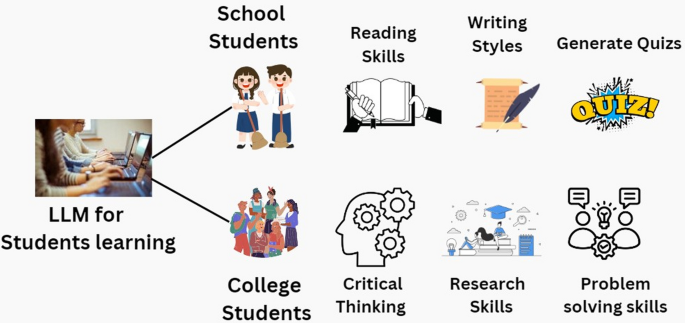
Source link: LLMs in Education
The Conceptual Basis of LLM in Machine Learning
In Machine Learning, What Does LLM Mean?
Deep Learning models that have been trained on billions of words are called LLMs. It is capable of predicting, producing, and analyzing content that is similar to that of a human since it learns the relationships, patterns, and context of language.
The Reasons LLMs Are Now Crucial in AI
LLMs are crucial to AI because of their capacity to combine data science and language. They transform how humans communicate with machines.They explain, demonstrate, and predict in addition to calculating.
They are therefore necessary for:
- More intelligent choices.
- Quicker analytics.
- AI as a genuine business partner in the future.
Conclusion: Choosing the Ideal LLM for Data Analysis
Depending on the objective, there is no one ideal LLM for data analysis. The healthcare industry requires precise predictions, banks prioritize fraud and compliance, retailers prioritize trend forecasting, and educators prioritize adaptive learning. LLMs are increasingly serving as the foundation for analytics, visualization, and predictive decision-making across many industries.
Explore Related Courses











COMMENTS(0)
Explore Related Courses
Our Popular Insights
Careers are shifting faster than ever, and staying relevant takes more than experience. Explore UniAthena’s most-read blogs for sharp insights, emerging skills, and practical pathways that help you move forward with clarity and confidence in a changing professional world.


🌟 Students of the Month | May – June 2026 🌟
Read More
1
mins read





🌟 Students of the Month | May – June 2026 🌟
Read more
1
mins read
Get in Touch

It’s Time to Start
Join NowMost Popular Online Specialization
- Master of International Business Administration
- Master of Business Administration
- MBA in General Management- FastTrack
- Master in Innovation and Entrepreneurship
- MBA-Family Business Management
- Master in Procurement and Contract Management
- Extended Diploma in Business Analytics (SCQF Level 11)
- Diploma in Supply Chain and Logistics Management (SCQF Level 11)
- Strategic Human Resource Management Practitioner
- Master in Data Science
- Master in Engineering Management
Trending Online
- Integrated Doctorate of Business Administration
- Postgraduate Certificate in Finance for Next Generation Managers
- Master of Business Administration- General Management (Fast Track)
- Postgraduate Certificate in Socio-Economic and Legal Framework
- Postgraduate Certificate in Business Sustainability
- Certified Manager
- Supply Chain Management Practitioner
- MBA - AI in Business
- MBA - Accounting & Finance
- Master in Supply Chain and Logistics Management
Top Universities Online Certificates
- Postgraduate Certificate in International Marketing Management
- Postgraduate Certificate In International Human Resource Management
- Postgraduate Certificate in Strategic Management
- Postgraduate Certificate in Procurement & Contracts Management
- Postgraduate Certificate in Business Analytics
- Postgraduate Certificate in Strategic Supply Chain & Logistics Management
- Postgraduate Certificate in Human Resource and Leadership
- Project Management Practitioner
- Postgraduate Certificate in Supply Chain Design & Implementation
- Postgraduate Certificate in Management Accounting and Finance
Accredited Online Degree Program
- MBA - Digital Transformation
- MBA - Family Business Management
- MBA - Marketing Management
- MBA in Quality Management
- MBA - Business Intelligence & Data Analytics
- MBA in Operations & Project Management
- MBA in Energy Management
- MBA In Construction & Safety Management
- Master in Organisational Leadership
- Master in Public Health
- Master in Construction Management
- Bachelor of Arts in Business Administration


 Install Now



UniAthena is an Ed-Tech, offering flexible, affordable learning solutions, including Free-Learning Upskilling Courses and Academic Programs in partnerships with accredited and globally renowned universities and professional qualification bodies.


Do you have any questions ?
Feel free to send us your questions or request a free consultation
Send a message
UK
Athena Global Education
Magdalen Centre,
Robert Robinson Avenue,
Oxford, OX4 4GA, UK
Phone : 01865 784299
MIDDLE EAST
Athena Global Education FZE
Block L-03, First Floor,
P O Box 519265, Sharjah Publishing City,
Free Zone, Sharjah, UAE
Phone : +971 55 879 5492
INDIA
Uniathena Private Limited
9A,Midas Tower
Phase 1
Hinjewadi Rajiv Gandhi Infotech Park
Pune-411057
Phone: +91 9145665544
All Copyrights Reserved @ Athena Global Education 2021-2026