-

Bachelor's

-

Masters
-

MBA
-

Doctorate
-

Micro Credit
-

Explore all Courses
-
Postgraduate Certifications

-
Postgraduate Diploma
-
Undergraduate Diploma
-
Diploma



Explainable AI: Decoding the Black Box of Machine Decisions

Author: priyanka chatterjee
|6
MINS READ
| 0
| 410
Created On: 13 November, 2025
Share




In the era of generative AI and autonomous AI agents, machines are now collaborators rather than merely tools. They design, write, predict, and even diagnose. However, a critical concern arises when these intelligent systems become essential to governance, healthcare, and financial decision-making: Can we trust what we don't understand?
The most advanced AI models available today frequently function as "black boxes"—extremely accurate but lacking in explainable reasoning. One of the most significant challenges in artificial intelligence today lies in this increasing conflict between performance and transparency. Although cutting-edge neural networks often surpass human ability in pattern recognition, their lack of interpretability may limit adoption, damage trust, and lead to moral and legal dilemmas.
Let's explore why explainable AI (XAI) is not merely a trendy term, but a vital bridge between innovation and accountability.

The Invisible Dilemma: When Understanding Is Outpaced by Performance
Many AI systems compromise interpretability for accuracy in the race to cutting-edge performance. For example, deep neural networks function with millions (or billions) of parameters that even their developers find difficult to understand, despite their incredible accuracy in image recognition, text generation, and autonomous decision-making.
A crucial problem in artificial intelligence arises from this "mystery of the machine mind": how can we make sure that AI decisions are both efficient and explicable?
In addition to undermining trust, a lack of explainability presents real-world risks. Suppose an AI flags a traveler at an airport, rejects a loan, or diagnoses a disease without providing a clear explanation. These are not merely technical issues but social and ethical challenges.
What is Explainable Artificial Intelligence?
Explainable AI (XAI) refers to systems designed to make their decision-making process transparent and understandable to humans. Explainable models, in contrast to conventional black box AI, allow users—whether data scientists, regulators, or end-users—to understand the reasoning behind a model's conclusions.
This does not imply that all of the internal logic of an AI model must be fully exposed. Instead, it's about finding a balance between AI interpretability and performance, making sure that systems are reliable and accountable while maintaining their power.
The ultimate objective of explainable AI models is to advance trustworthy AI, where humans can understand and evaluate the logic behind the output, in addition to being able to rely on it.
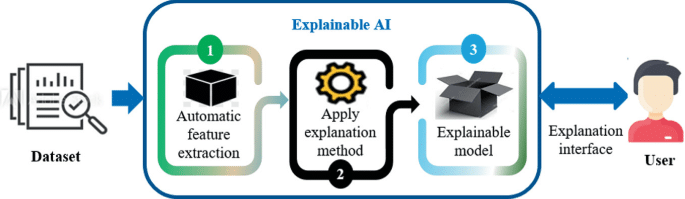
Source: Explainable AI
The image depicts the workflow of an Explainable AI (XAI) system, which aims to increase the transparency, interpretability, and reliability of complex AI models. XAI guarantees that users and developers can comprehend how and why an AI system makes decisions, as opposed to functioning as a "black box" AI.
Let's analyze the procedure depicted in the image:
- Dataset Input: AI starts with a dataset that feeds the model. To mitigate issues with bias and inaccuracy, data quality must be ensured.
- Automatic Feature Extraction: To address data scarcity in AI, relevant features are automatically identified to improve interpretability and reduce data noise.
- Apply Explanation Method: Methods such as SHAP or LIME enhance algorithm transparency and make it clearer how AI generates its outcomes.
- Explainable Model: Develops a reliable AI system that maintains a balance between accountability and performance using explainable AI models.
- Explanation Interface: Strengthens AI transparency and emphasizes the value of transparency in AI systems by providing insights that are understandable by humans.
The Trust Equation: Transparency + Accountability = Confidence
AI systems need to be trusted, not simply enforced. And transparency and accountability are the cornerstones of that trust.
An AI model is said to be transparent if its data, reasoning, and decision-making processes are clear and accessible. This is also known as algorithm transparency. Users are much more inclined to accept a model's outcomes when they can see the assumptions, biases, and logic behind it.
Transparency also promotes privacy and data protection, key principles of ethical AI. We can prevent sensitive information from being misused or handled improperly if we are aware of how AI handles our data. In today's data-driven environment, when privacy concerns are expanding along with AI innovation, striking this balance between clarity and confidentiality is essential.
Also Read: The Next Leap in AI: Why Future Engineers Must Understand Neuromorphic and Bio-Hybrid Computing
Challenges in AI Explainability and Model Evaluation
- Complexity vs. Simplicity: While simple models, like decision trees, are easy to understand, they might not be accurate. Deep learning, on the other hand, performs better but acts like a black-box, making interpretation challenging.
- Accuracy vs. Interpretability Trade-off: Accuracy and clarity must constantly be balanced as models become deeper and more complicated, making it more difficult to understand their decisions.
- Lack of Standard Metrics: AI interpretability is still not universally measured, which leads to inconsistent evaluation, validation, and comparison.
- Regulatory Pressure: Governments are calling for more ethical norms and transparency in AI. Developers must comply with regulations without impeding innovation, particularly in the fields of banking, healthcare, and law.
Data Scarcity in AI: The Hidden Obstacle
Data is the real lifeblood of AI, even if algorithms frequently receive the most attention. However, data scarcity in AI, particularly high-quality, unbiased data, can significantly restrict explainability. AI decisions become less clear and more prone to error when datasets are insufficient or unrepresentative.
For example, generative AI models trained on biased or limited data may produce skewed or harmful outcomes. In addition to undermining trust, this increases concerns about discrimination and fairness in artificial intelligence. Having more data is not enough to address data scarcity; having the right data is what truly matters.
AI Agents and the Black Box Problem
AI nowadays is acting autonomously on information rather than merely analyzing it. AI agents constantly make decisions with minimal human oversight in trading systems, virtual assistants, and autonomous vehicles. However, it becomes crucial to comprehend the reasons behind these agents' failures or unexpected behaviors.
The black-box nature of deep AI systems makes it challenging to identify biases or errors, which can have serious consequences in safety-critical environments. Explainable AI models help open this box, offering insights into decision-making processes and improving the safety, reliability, and compliance of AI systems.
Also Read: Generative AI Vs AI Agents Vs Agentic AI: What’s the Difference?
The Bigger Picture: Developing Trustworthy and Responsible AI
Building trustworthy AI takes time and involves human oversight, ethical design, and constant AI transparency. Explainability must be incorporated throughout all phases of the AI lifecycle, from model building and training to deployment and monitoring.
Additionally, explainability encourages human-machine collaboration. Users may make wise decisions, fix mistakes, and direct the model toward better results when they comprehend AI outputs. Because of this cooperation, AI will enhance human intelligence rather than completely replace it.
The Road Ahead: Transparent Intelligence in the Future
The future of AI is about responsible intelligence, not just smarter algorithms. The explainability of AI will determine its success, scalability, and acceptance as it becomes more embedded in society.
In an increasingly automated world, trust is the new currency. We must understand not only what an AI system decides, but also why—whether it is a diagnostic model detecting diseases, a generative AI composing art, or an AI agent managing investments.
The most effective AI models of the future will be transparent, ethical, and human-centered in addition to being powerful. Because, at the end of the day, unexplainable AI is untrustworthy AI.
Final Thought
As we continue to push the limits of AI's capabilities, keep in mind that trust wins the marathon, even as performance may win races. And explainability—the link between innovation and understanding—is the only way to gain that trust.
References:
- https://www.dataexpertise.in/explainable-ai-enhancing-clarity-machine-learning/
- https://frontiere.io/en/insights/how-explainable-ai-can-help-overcome-mistrust-regarding-the-adoption-of-artificial-intelligence/
- https://www.sciencedirect.com/org/science/article/pii/S1546221825005375
- https://www.geeksforgeeks.org/artificial-intelligence/black-box-problem-in-ai/
Explore Related Courses













COMMENTS(0)
Explore Related Courses
Our Popular Insights
Careers are shifting faster than ever, and staying relevant takes more than experience. Explore UniAthena’s most-read blogs for sharp insights, emerging skills, and practical pathways that help you move forward with clarity and confidence in a changing professional world.


🌟 Students of the Month | May – June 2026 🌟
Read More
1
mins read







🌟 Students of the Month | May – June 2026 🌟
Read more
1
mins read
Get in Touch

It’s Time to Start
Join NowMost Popular Online Specialization
- Master of International Business Administration
- Master of Business Administration
- MBA in General Management- FastTrack
- Master in Innovation and Entrepreneurship
- MBA-Family Business Management
- Master in Procurement and Contract Management
- Extended Diploma in Business Analytics (SCQF Level 11)
- Diploma in Supply Chain and Logistics Management (SCQF Level 11)
- Strategic Human Resource Management Practitioner
- Master in Data Science
- Master in Engineering Management
Trending Online
- Integrated Doctorate of Business Administration
- Postgraduate Certificate in Finance for Next Generation Managers
- Master of Business Administration- General Management (Fast Track)
- Postgraduate Certificate in Socio-Economic and Legal Framework
- Postgraduate Certificate in Business Sustainability
- Certified Manager
- Supply Chain Management Practitioner
- MBA - AI in Business
- MBA - Accounting & Finance
- Master in Supply Chain and Logistics Management
Top Universities Online Certificates
- Postgraduate Certificate in International Marketing Management
- Postgraduate Certificate In International Human Resource Management
- Postgraduate Certificate in Strategic Management
- Postgraduate Certificate in Procurement & Contracts Management
- Postgraduate Certificate in Business Analytics
- Postgraduate Certificate in Strategic Supply Chain & Logistics Management
- Postgraduate Certificate in Human Resource and Leadership
- Project Management Practitioner
- Postgraduate Certificate in Supply Chain Design & Implementation
- Postgraduate Certificate in Management Accounting and Finance
Accredited Online Degree Program
- MBA - Digital Transformation
- MBA - Family Business Management
- MBA - Marketing Management
- MBA in Quality Management
- MBA - Business Intelligence & Data Analytics
- MBA in Operations & Project Management
- MBA in Energy Management
- MBA In Construction & Safety Management
- Master in Organisational Leadership
- Master in Public Health
- Master in Construction Management
- Bachelor of Arts in Business Administration


 Install Now


UniAthena is an Ed-Tech, offering flexible, affordable learning solutions, including Free-Learning Upskilling Courses and Academic Programs in partnerships with accredited and globally renowned universities and professional qualification bodies.


Do you have any questions ?
Feel free to send us your questions or request a free consultation
Send a message
UK
Athena Global Education
Magdalen Centre,
Robert Robinson Avenue,
Oxford, OX4 4GA, UK
Phone : 01865 784299
MIDDLE EAST
Athena Global Education FZE
Block L-03, First Floor,
P O Box 519265, Sharjah Publishing City,
Free Zone, Sharjah, UAE
Phone : +971 55 879 5492
INDIA
Uniathena Private Limited
9A,Midas Tower
Phase 1
Hinjewadi Rajiv Gandhi Infotech Park
Pune-411057
Phone: +91 9145665544
All Copyrights Reserved @ Athena Global Education 2021-2026