-

Bachelor's

-

Masters
-

MBA
-

Doctorate
-

Micro Credit
-

Explore all Courses
-
Postgraduate Certifications

-
Postgraduate Diploma
-
Undergraduate Diploma
-
Diploma



How CRM Applications Improve the Customer Lifecycle
Author: maharajan p
|6
MINS READ
| 0
| 34
Created On: 23 March, 2026
Share




Table of Contents (TOC):
- Introduction
- Key Takeaways
- What CRM Application Is
- Why CRM is Needed if People Can Just Talk to Customers
- Where CRM Actually Makes a Difference
- How CRM Supports Each Part of the Customer Lifecycle
- How Learners Can Build Practical CRM Understanding
- Conclusion
- FAQs
Introduction
Why do customers walk away feeling overlooked, even after reaching out to a company? Often, the breakdown occurs when companies fail to capture prior requests or skip critical details.
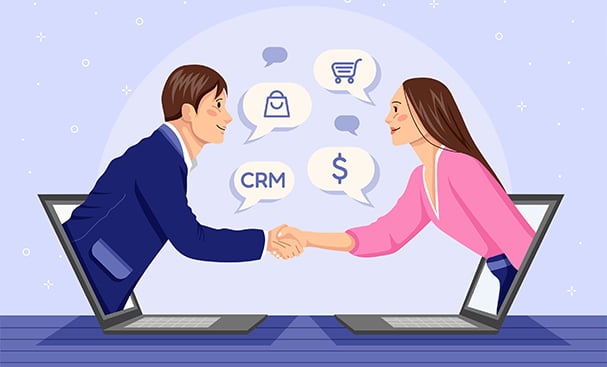
Customer relationship management applications help by keeping all customer information in one place and showing it to the right team at the right time. This article explains how CRM improves the customer journey and how you can learn it practically.
Key Takeaways:
- Customer lifecycle in CRM refers to managing customer interactions from first contact through repeat engagement, not treating each interaction as separate.
- CRM helps teams stay aligned, which reduces repeated questions, missed context, and inconsistent responses.
- CRM for small businesses is just as important as for large organizations, especially when teams need clarity without adding complexity.
- Effective CRM use depends on understanding why specific customer data is tracked and how it supports decisions over time.
- You can learn customer relationship management online for free at a basic level, but practical skill comes from applying CRM thinking to real customer scenarios.
What CRM Application Is
A CRM application is a system businesses use to keep track of their customers in a structured way. It stores customer details, past conversations, purchases, and support history in one place so nothing important gets lost.
Instead of relying on emails, spreadsheets, or memory, teams use a CRM to see the full background of a customer at any point. This helps them understand what has already happened and what may be needed next.
Why CRM is Needed if People Can Just Talk to Customers
Businesses talk to customers every day through calls, emails, chats, and meetings. But conversations alone do not build a clear picture of the customer over time. People forget details. Teams change. Context gets lost between departments. This is where customer relationship management becomes necessary.
A CRM captures what was said, what was done, and what happened next. It turns separate conversations into connected knowledge. Without CRM, customer communication stays fragmented.
Where CRM Actually Makes a Difference
CRM makes a difference at moments where customer information should carry forward but usually does not.
Consider a large, well-known airline.
Before CRM Applications
- A customer books a ticket.
- Later, the flight is delayed.
- The customer contacts support.
The support agent asks for booking details again. The complaint history is not visible. The agent handles the issue in isolation. The problem gets resolved, but the experience feels slow and repetitive.
After CRM Applications
- The same customer books a ticket.
- The delay happens.
When the customer contacts support, the agent already sees the booking details, past issues, and recent communication.
The response is faster. The explanation is relevant. The resolution feels informed, not generic.
How CRM Supports Each Part of the Customer Lifecycle
What is the customer lifecycle?
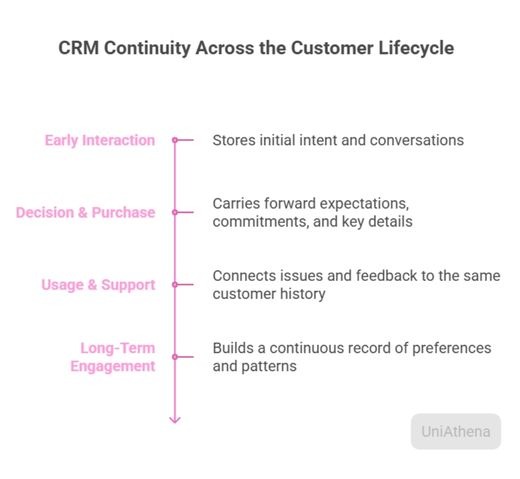
The customer lifecycle refers to the full journey a customer goes through with a business. It begins with the first interaction and continues through purchase, usage, support, and long-term engagement. A customer’s relationship with a business is not limited to a single transaction.
The lifecycle consists of:
1. Early interactions
2. Purchase and decision stage
3. Usage and support
4. Long term engagement
The lifecycle is also not linear. Customers may pause for different reasons, return after a gap, raise issues, or interact with multiple teams at different times. All of these actions are part of the same ongoing relationship.
How CRM maintains continuity across the lifecycle
How Learners Can Build Practical CRM Understanding
Learning customer relationship management is not that complicated. Many CRM platforms allow free sign-ups, demos, or guided walkthroughs. Exploring one of these is often enough to understand how the software works and how customer information is organized.
However, knowing the software is not the end of the game. Right? You must understand how customer relationships work and how to connect that knowledge with the software. Otherwise, the software remains just a tool, sitting there without actually helping you make decisions.
So, how can you build practical understanding?
You need to know:
- Why certain customer information is tracked
- When that information is used
- How it supports decisions across the customer lifecycle
That is where guided learning becomes valuable. A structured program connects CRM concepts with real business scenarios, so you see not just how the system works, but why it matters.
Below are curated CRM programs designed for different levels of experience:.
- Basics of Customer Relationship Management: This course covers core CRM concepts, key elements of managing customer data, and quick approaches organizations use in CRM systems. It is a short course that can be completed in 4 to 6 hours. If you are a beginner and want to grasp the fundamentals, this is for you.
- Mastering Customer Relationship Management Strategies: This course focuses on integrating CRM with marketing and engagement strategies. It also covers analysis and implementation of CRM systems, including mobile and social CRM.
- Executive Diploma in Customer Relationship Management: This program typically takes 2 to 3 weeks, depending on the learner’s interest and pace. Overall, it covers CRM principles and tactics with real-world applications across various models, including AI integration and advanced techniques.
Choose what you need at this moment. If you are unsure, send us a quick message, we are always here to guide you.
Conclusion
CRM applications help businesses manage customer relationships across the entire lifecycle, not just at the point of sale. They bring structure to customer data, connect interactions across teams, and support better decisions at every stage of the relationship.
For learners, if you want to understand customer relationships management, learning how customer information is collected, used and acted upon over time is a must. When you understand this connection, CRM stops being just software and becomes a practical framework for improving customer experience.
FAQs
Q1. Is CRM only for sales roles?
A: No. CRM is used by sales, marketing, support, and operations to manage customer data and interactions across the lifecycle.
Q2. Do small businesses really need CRM thinking?
A: Yes. Even small teams benefit from structured customer data to avoid missed follow-ups and inconsistent communication.
Q3. Can CRM improve customer experience without automation?
A: Yes. Centralized customer information alone improves response quality and decision-making, even without automation.
Q4. Is CRM a tool or a strategy?
A: CRM serves a dual role. The software supports a strategy focused on understanding and managing customer relationships.
Q5. Do customers move through the lifecycle in a fixed order?
A: No. Customers may pause, return, or engage with different teams at different times.
Q6. Is learning CRM only about using software?
A: No. It also involves understanding why data is collected and how it supports decisions at each lifecycle stage.
Explore Related Courses










COMMENTS(0)
Explore Related Courses
Our Popular Insights
Careers are shifting faster than ever, and staying relevant takes more than experience. Explore UniAthena’s most-read blogs for sharp insights, emerging skills, and practical pathways that help you move forward with clarity and confidence in a changing professional world.


How to Switch Career to Data Analytics?
Read More
6
mins read



How to Switch Career to Data Analytics?
Read more
6
mins read

Get in Touch

It’s Time to Start
Join NowMost Popular Online Specialization
- Master of International Business Administration
- Master of Business Administration
- MBA in General Management- FastTrack
- Master in Innovation and Entrepreneurship
- MBA-Family Business Management
- Master in Procurement and Contract Management
- Extended Diploma in Business Analytics (SCQF Level 11)
- Diploma in Supply Chain and Logistics Management (SCQF Level 11)
- Strategic Human Resource Management Practitioner
- Master in Data Science
- Master in Engineering Management
Trending Online
- Integrated Doctorate of Business Administration
- Postgraduate Certificate in Finance for Next Generation Managers
- Master of Business Administration- General Management (Fast Track)
- Postgraduate Certificate in Socio-Economic and Legal Framework
- Postgraduate Certificate in Business Sustainability
- Certified Manager
- Supply Chain Management Practitioner
- MBA - AI in Business
- MBA - Accounting & Finance
- Master in Supply Chain and Logistics Management
Top Universities Online Certificates
- Postgraduate Certificate in International Marketing Management
- Postgraduate Certificate In International Human Resource Management
- Postgraduate Certificate in Strategic Management
- Postgraduate Certificate in Procurement & Contracts Management
- Postgraduate Certificate in Business Analytics
- Postgraduate Certificate in Strategic Supply Chain & Logistics Management
- Postgraduate Certificate in Human Resource and Leadership
- Project Management Practitioner
- Postgraduate Certificate in Supply Chain Design & Implementation
- Postgraduate Certificate in Management Accounting and Finance
Accredited Online Degree Program
- MBA - Digital Transformation
- MBA - Family Business Management
- MBA - Marketing Management
- MBA in Quality Management
- MBA - Business Intelligence & Data Analytics
- MBA in Operations & Project Management
- MBA in Energy Management
- MBA In Construction & Safety Management
- Master in Organisational Leadership
- Master in Public Health
- Master in Construction Management
- Bachelor of Arts in Business Administration


 Install Now


UniAthena is an Ed-Tech, offering flexible, affordable learning solutions, including Free-Learning Upskilling Courses and Academic Programs in partnerships with accredited and globally renowned universities and professional qualification bodies.


Do you have any questions ?
Feel free to send us your questions or request a free consultation
Send a message
UK
Athena Global Education
Magdalen Centre,
Robert Robinson Avenue,
Oxford, OX4 4GA, UK
Phone : 01865 784299
MIDDLE EAST
Athena Global Education FZE
Block L-03, First Floor,
P O Box 519265, Sharjah Publishing City,
Free Zone, Sharjah, UAE
Phone : +971 55 879 5492
INDIA
Uniathena Private Limited
9A,Midas Tower
Phase 1
Hinjewadi Rajiv Gandhi Infotech Park
Pune-411057
Phone: +91 9145665544
All Copyrights Reserved @ Athena Global Education 2021-2026