-

Bachelor's

-

Masters
-

MBA
-

Doctorate
-

Micro Credit
-

Explore all Courses
-
Postgraduate Certifications

-
Postgraduate Diploma
-
Undergraduate Diploma
-
Diploma



How to Start An E-Commerce Business?

Author: munazzah ali
|6
MINS READ
| 0
| 240
Created On: 30 September, 2025
Share




Table Of Contents (TOC):
- Introduction
- How to Start an E-commerce Business from Scratch
- Incorporating and Launching Your E-Commerce Business
- Promoting and Running Your E-commerce Business
- How Much Does It Cost to Start an E-commerce Business?
- Tips for Successfully Starting an E-commerce Business
- Ready to Master the E-commerce Game?
- Conclusion
- Bonus Points
Introduction
"Are you thinking about starting an e-commerce business or wondering what e-commerce is and how to build one from the ground up? Venturing into e- commerce business in the current digital era presents boundless possibilities.
This guide will lead you through a roadmap to open your e-commerce business, offer estimates of monthly income potential, and provide tips to achieve success.
How to Start an E-commerce Business from Scratch?
Starting an e-commerce business can look daunting, but dividing it up into bite-sized steps makes the process easier.
Here are the key steps to get your e-commerce business up and running:
1. Research and Planning
- Select Your Product: Pick what you wish to sell according to your interest, market need, and profit potential. Research trending products and market gaps to look for potential areas to fill.
- Find a Niche: Focus on a specific customer segment or product line. Specialization differentiates your e-commerce venture and creates loyal consumers.
- Competitor Research: Analyze your competitor’s competitive strategies, what they sell, their pricing model, and customer interaction. This will help determine your unique selling point.
- Pick a Unique Name: Choose a catchy and easy-to-recall name that suits your brand image. Check if your desired domain name is available for your online business.
2. Choose Your E-commerce Platform
- Create Your Store: Pick a platform based on your own technical skill and your long-term business strategy. Emphasize a user-friendly interface and smooth buying experiences.
- Design Your Website: Develop a compelling, businesslike store with easy-to-use navigation, attractive visuals, and easily understandable CTA buttons.
- Set up Payment and Shipping: Implement secure payment gateways and shipping providers to make the transaction and delivery processes straightforward and seamless.
Incorporating and Launching Your e-Commerce Business
After having finalised your initial planning stage, you can then set up your business and prepare yourself for launch.
1. Legal and Financial Foundations
- Register Your Business: Depending on where you are based, business registration with the proper bodies will secure legal compliance for you.
- Prepare a Business Plan: Set your aims, target audience, marketing strategy, and financial projections. Having a well-defined plan keeps your activities in line.
- Create Financial Setup: Open a separate business bank account, define accounting procedures, and decide on marketing, inventory, and operational expense budgets.
2. Establish Branding and Product Setup
- Design Your Logo: Develop a unique logo to reflect your brand identity. A good logo creates a high degree of brand recognition.
- Website Design and Development: Develop a responsive, mobile-friendly website with a strong UI/UX so customers will find it easy to navigate and buy.
- Inventory & Product Planning: Determine if you will deliver, store, or produce your products. Develop a comprehensive inventory plan to make products available while avoiding overstocking.
Promoting and Running Your e-commerce Business
With your store open, attention turns to bringing in customers and generating revenue.
Sales and Marketing Channels
- Search Engine Optimization: Utilize key terms, deliver valuable content, and optimize product listings to boost organic traffic.
- Utilize Paid Campaigns: Use targeted social media campaigns and Google Ads to connect with your target audience instantly.
- Explore Additional Channels: Use email marketing campaigns, influencer partnerships, and marketplaces to broaden your audience.
- Customer Referrals and Loyalty: Implement rewards programs and incentives based on customer feedback to foster trust and ensure future sales.
How Much Does It Cost to Start an E-commerce Business?
After launching your e-commerce business, you will have to pay for its maintenance and growth every month. How much you pay depends on your business type, the tools you use, and your marketing activities.
Here is what you can expect to spend each month:
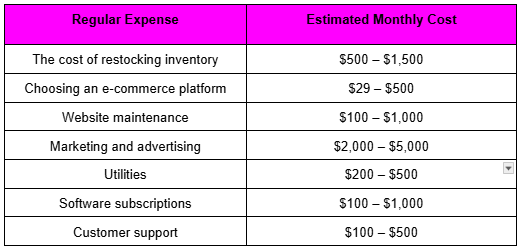
Still, if you want to cut down on expenses, you can start small by using free or low-cost tools, running targeted marketing campaigns, and handling key tasks like customer service or content creation yourself.
Tips for Successfully Starting an E-commerce Business
Achieving e-commerce success is more than launching, it needs to keep improving and using innovative solutions to succeed.
Start Small:
Launch a small product range and see how they do. Collect feedback from your customers before you grow. It helps you reduce dangers and improve your products or services.
Stay Current with Trends:
Stay up-to-date with customer desires, technological advances, and market patterns. Adjusting your product offerings and marketing approaches helps your store stay relevant.
Experiment with Marketing:
Try out various marketing avenues, social media promotions, e-mail campaigns, and influencer collaborations to find out what performs best with your target audience.
Utilize Partnerships and Multi-Channel Selling:
Partner with suppliers, fellow marketers, or influencers for your marketing strategy. Promoting products on several marketplaces helps businesses appear more and sell more.
Ready to Master the E-commerce Game?
If you're looking to gain a deeper understanding, UniAthena offers courses that will help you thrive in this area.
Below are some of the courses:
1. Basics of E-Commerce – Global Developments
This Basics in E-Commerce familiarizes you with the rapidly changing world of e-trading, legalities, and e-commerce trends in different economies worldwide.
Presented in bite-sized format, it takes 4–6 hours to complete and equips you with a certification from CIQ, UK, perfect for those interested in understanding the way the world affects local e-commerce strategy.
2. Basics of E-Commerce
This Basics of e-commerce course enhances your understanding of how the internet and new technologies drive e-commerce.
Whether you are a curious learner or planning to become an entrepreneur, you can finish this self-paced course in 4–6 hours. Upon successful completion, you will also get a chance to earn a CIQ, UK certification, to demonstrate your digital commerce fundamentals know-how.
3. Mastering E-Commerce Transactions
This Mastering e-commerce course takes you through the critical role played by technology in the quick development of e-commerce, reshaping the way business is conducted and the way consumers experience brands digitally.
You will gain an understanding of important areas such as E-Payment Systems, Electronic Data Interchange, Transaction Security, and more.
And the added bonus? You can complete this one week, whenever and wherever you want to study and get certified from AUPD.
4. Diploma in E-Commerce & Applications
From e-retailing and entertainment to retail and logistics, this Diploma in e-commerce will help you examine the wider context within which e-commerce exists.
It will also provide you with the knowledge on how ethical, social, political, and legal issues continue to form and define the digital marketplace.
To further enhance your resume, successful completion will also entitle you to earn a Blockchain-verified certification, demonstrating your skill in the dynamic field of e-commerce.
Conclusion
E-commerce involves more than creating a website, it’s about growing your brand, adding value, and adjusting to new situations.
Whether you are just looking at how to start an e-commerce business or actually setting up an online store, making the initial move is where it starts, and this is the ideal time to bring your business venture into the world.
Bonus Points:
- Automated Processes: Thanks to automation, order confirmations and tracking inventory are faster and less likely to have errors.
- Global Market Access: With e-commerce, small businesses can now sell to customers worldwide.
Explore Related Courses









COMMENTS(0)
Explore Related Courses
Our Popular Insights
Careers are shifting faster than ever, and staying relevant takes more than experience. Explore UniAthena’s most-read blogs for sharp insights, emerging skills, and practical pathways that help you move forward with clarity and confidence in a changing professional world.

Best AI Tools for Content Creation
Read More
9
mins read


🌟 Top Project Performer – June 2026 🌟
Read More
1
mins read



🌟 Top Project Performer – May 2026 🌟
Read More
1
mins read


Best AI Tools for Content Creation
Read more
9
mins read
🌟 Top Project Performer – June 2026 🌟
Read more
1
mins read
🌟 Top Project Performer – May 2026 🌟
Read more
1
mins read
Get in Touch

It’s Time to Start
Join NowMost Popular Online Specialization
- Master of International Business Administration
- Master of Business Administration
- MBA in General Management- FastTrack
- Master in Innovation and Entrepreneurship
- MBA-Family Business Management
- Master in Procurement and Contract Management
- Extended Diploma in Business Analytics (SCQF Level 11)
- Diploma in Supply Chain and Logistics Management (SCQF Level 11)
- Strategic Human Resource Management Practitioner
- Master in Data Science
- Master in Engineering Management
Trending Online
- Integrated Doctorate of Business Administration
- Postgraduate Certificate in Finance for Next Generation Managers
- Master of Business Administration- General Management (Fast Track)
- Postgraduate Certificate in Socio-Economic and Legal Framework
- Postgraduate Certificate in Business Sustainability
- Certified Manager
- Supply Chain Management Practitioner
- MBA - AI in Business
- MBA - Accounting & Finance
- Master in Supply Chain and Logistics Management
Top Universities Online Certificates
- Postgraduate Certificate in International Marketing Management
- Postgraduate Certificate In International Human Resource Management
- Postgraduate Certificate in Strategic Management
- Postgraduate Certificate in Procurement & Contracts Management
- Postgraduate Certificate in Business Analytics
- Postgraduate Certificate in Strategic Supply Chain & Logistics Management
- Postgraduate Certificate in Human Resource and Leadership
- Project Management Practitioner
- Postgraduate Certificate in Supply Chain Design & Implementation
- Postgraduate Certificate in Management Accounting and Finance
Accredited Online Degree Program
- MBA - Digital Transformation
- MBA - Family Business Management
- MBA - Marketing Management
- MBA in Quality Management
- MBA - Business Intelligence & Data Analytics
- MBA in Operations & Project Management
- MBA in Energy Management
- MBA In Construction & Safety Management
- Master in Organisational Leadership
- Master in Public Health
- Master in Construction Management
- Bachelor of Arts in Business Administration


 Install Now


UniAthena is an Ed-Tech, offering flexible, affordable learning solutions, including Free-Learning Upskilling Courses and Academic Programs in partnerships with accredited and globally renowned universities and professional qualification bodies.


Do you have any questions ?
Feel free to send us your questions or request a free consultation
Send a message
UK
Athena Global Education
Magdalen Centre,
Robert Robinson Avenue,
Oxford, OX4 4GA, UK
Phone : 01865 784299
MIDDLE EAST
Athena Global Education FZE
Block L-03, First Floor,
P O Box 519265, Sharjah Publishing City,
Free Zone, Sharjah, UAE
Phone : +971 55 879 5492
INDIA
Uniathena Private Limited
9A,Midas Tower
Phase 1
Hinjewadi Rajiv Gandhi Infotech Park
Pune-411057
Phone: +91 9145665544
All Copyrights Reserved @ Athena Global Education 2021-2026