-

Bachelor's

-

Masters
-

MBA
-

Doctorate
-

Micro Credit
-

Explore all Courses
-
Postgraduate Certifications

-
Postgraduate Diploma
-
Undergraduate Diploma
-
Diploma



From APIs to MCP: How AI Integration is Being Rewritten
Author: lynn lawrence
|6
MINS READ
| 0
| 152
Created On: 24 January, 2026
Share




Table of Contents (TOC):
- Introduction
- Key Takeaways
- What is an MCP Server?
- Who Created MCP?
- Why MCP is Needed
- How MCP Servers Work
- MCP Architecture Explained
- MCP Server vs API
- Benefits of MCP
- MCP Server Use Cases
- Example of an MCP Server
- How to Create an MCP Server
- How to Use an MCP Server
- FAQs
Introduction
As AI systems become more involved in real-world tasks, they need a safe and predictable way to access tools, data sources, and applications. Traditionally, this required APIs, custom scripts, and integrations that were time-consuming and inconsistent. This is where the Model Context Protocol (MCP) comes into the picture.
MCP provides a structured way for AI models to interact with external resources, and the MCP Server acts as the main access point. Understanding what an MCP Server is and how it works helps developers, businesses, and AI users build more reliable automation and agent workflows.
Key Takeaways:
- An MCP Server offers a standardized way for AI systems to access tools and data.
- It reduces the complexity and inconsistency associated with traditional APIs.
- MCP architecture is lightweight and suitable for both small and large environments.
- Businesses and developers use MCP Servers for automation, DevOps, data analysis, and AI agent workflows.
- MCP continues to grow as a preferred method for building scalable AI integrations.
What is an MCP Server?
An MCP Server is a service that exposes tools, data, and predefined instructions to an AI system using the Model Context Protocol. Instead of exposing raw APIs or unstructured information, the server presents capabilities in a consistent, machine-friendly format.
You can think of it as a gateway that connects AI agents to external systems, whether those systems hold files, databases, cloud tools, or scripts. The MCP Server ensures that every interaction happens through a standard, well-defined structure.
Who Created MCP?
The Model Context Protocol was introduced by Anthropic. The goal was simple: create a universal way for AI models to work with external tools without writing separate integrations for each system. Since then, MCP has been adopted widely across AI tooling and agent frameworks.
Why MCP is Needed
AI models are powerful, but they cannot perform real actions without connecting to external tools. Traditional APIs were not designed specifically for AI, which leads to challenges like inconsistent formats, unpredictable responses, and high development effort.
MCP solves this by offering:
- A standard structure for tools
- Clear definitions of resources
- Safe access control
- Predictable outputs for AI models
It reduces integration complexity and supports safer, more reliable AI deployments.
How MCP Servers Work
An MCP Server provides three core components:
Tools:
These represent actions the AI can perform, such as running a script, reading logs, or retrieving database information.
Resources:
These are data sources the AI can access. Resources could be files, URLs, database entries, or system information.
Prompts:
These offer structured instruction templates that help the AI respond more consistently.
When an AI system connects to the MCP Server, it discovers all available tools and resources. The AI then calls these tools whenever required, following a predictable message format. This reduces ambiguity and ensures the AI works within defined boundaries.
MCP Architecture Explained
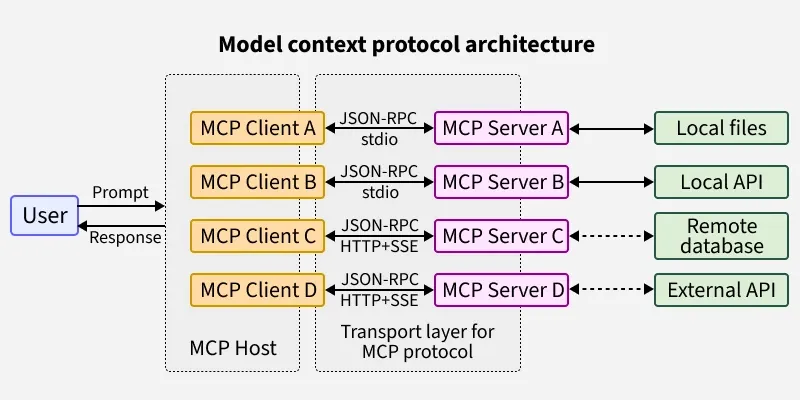
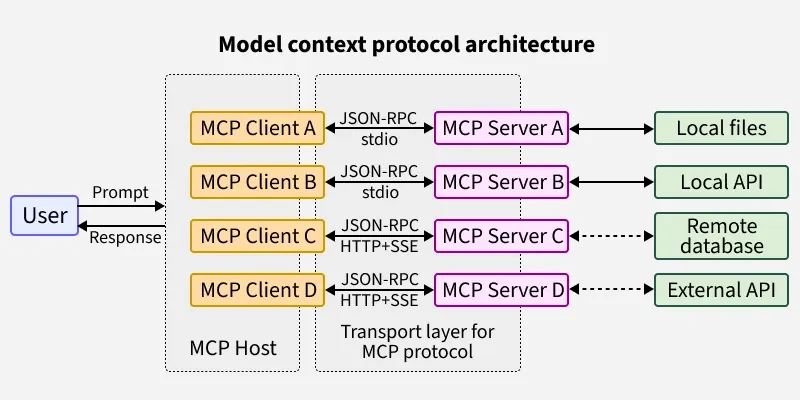
The Model Context Protocol uses a client–server architecture. The MCP Client sits inside the AI application or AI agent, while the MCP Server runs externally and provides capabilities.
Communication happens over channels such as STDIO, WebSockets, or HTTP, depending on the environment. Messages are exchanged in structured JSON format.
This architecture is lightweight, flexible, and suitable for everything from local scripts to enterprise-level cloud systems.
Source: GeeksforGeeks
MCP Server vs API
APIs are a general-purpose integration method for software applications. They vary widely in structure, naming, responses, and error handling.
An MCP Server, however, is designed specifically for AI workflows. It provides:
- Unified message structures
- Consistent formatting
- Clear tool definitions
- Built-in resource exposure
While APIs remain essential for general integrations, MCP Servers are better suited when the primary user is an AI model or agent.
Benefits of MCP
The MCP approach offers multiple advantages:
- Consistency: AI receives information in a predictable format.
- Simplicity: No need to rewrite integrations for every tool.
- Safety: The server exposes only what is necessary, reducing risks.
- Reusability: One MCP Server can serve multiple AI clients.
- Scalability: New tools or resources can be added with minimal effort.
These benefits make MCP useful in both enterprise environments and individual developer projects.
MCP Server Use Cases
Because MCP Servers expose structured tools, they can support a wide range of use cases:
- Automation workflows (e.g., generating reports)
- File and document management
- DevOps operations, such as checking system status or reading logs
- Data analysis, especially when AI needs access to local or cloud data
- AI agents, which require consistent tool access to perform tasks
- Internal business tools, like CRMs, inventory systems, or dashboards
Wherever AI needs predictable access to tools, MCP provides a suitable solution.
Example of an MCP Server
Consider a company that wants an AI assistant to generate insights from weekly sales data. Instead of giving the AI multiple APIs or raw files, the company creates an MCP Server that:
- Exposes the sales spreadsheet as a resource
- Provides a tool to calculate totals
- Includes a prompt template for generating summaries
When the AI connects, it immediately understands what is available and how to use it. This reduces complexity and keeps the entire workflow structured.
How to Create an MCP Server
Creating an MCP Server involves defining tools, resources, and prompts in a supported programming language, commonly Python or JavaScript. Developers structure these definitions using JSON schemas, ensuring the server follows the MCP protocol.
Once the definitions are complete, the server can be launched locally or hosted in a cloud environment. Any MCP-compatible client can then connect to it.
How to Use an MCP Server
To use an MCP Server, an AI application must include an MCP Client. After a connection is established, the client automatically discovers available tools and resources.
When the AI needs to perform an action, it sends a request through the MCP protocol, and the server returns the result in a standardized format. This makes AI-tool interactions far smoother and safer compared to custom integrations.
FAQs
Q1. What does MCP stand for?
A: MCP stands for Model Context Protocol.
Q2. How is an MCP Server different from an API?
A: MCP Servers follow a unified structure designed for AI models, while APIs vary widely and require more custom integration.
Q3. Why is MCP useful for AI agents?
A: It gives AI a predictable way to access tools and data, reducing errors and improving reliability.
Q4. Who can build an MCP Server?
A: Developers can build MCP Servers using languages like Python or JavaScript.
Q5. Can one MCP Server work with multiple AI tools?
A: Yes, MCP is designed to be reusable across different AI models and frameworks.
Explore Related Courses










COMMENTS(0)
Explore Related Courses
Our Popular Insights
Careers are shifting faster than ever, and staying relevant takes more than experience. Explore UniAthena’s most-read blogs for sharp insights, emerging skills, and practical pathways that help you move forward with clarity and confidence in a changing professional world.






Get in Touch

It’s Time to Start
Join NowMost Popular Online Specialization
- Master of International Business Administration
- Master of Business Administration
- MBA in General Management- FastTrack
- Master in Innovation and Entrepreneurship
- MBA-Family Business Management
- Master in Procurement and Contract Management
- Extended Diploma in Business Analytics (SCQF Level 11)
- Diploma in Supply Chain and Logistics Management (SCQF Level 11)
- Strategic Human Resource Management Practitioner
- Master in Data Science
- Master in Engineering Management
Trending Online
- Integrated Doctorate of Business Administration
- Postgraduate Certificate in Finance for Next Generation Managers
- Master of Business Administration- General Management (Fast Track)
- Postgraduate Certificate in Socio-Economic and Legal Framework
- Postgraduate Certificate in Business Sustainability
- Certified Manager
- Supply Chain Management Practitioner
- MBA - AI in Business
- MBA - Accounting & Finance
- Master in Supply Chain and Logistics Management
Top Universities Online Certificates
- Postgraduate Certificate in International Marketing Management
- Postgraduate Certificate In International Human Resource Management
- Postgraduate Certificate in Strategic Management
- Postgraduate Certificate in Procurement & Contracts Management
- Postgraduate Certificate in Business Analytics
- Postgraduate Certificate in Strategic Supply Chain & Logistics Management
- Postgraduate Certificate in Human Resource and Leadership
- Project Management Practitioner
- Postgraduate Certificate in Supply Chain Design & Implementation
- Postgraduate Certificate in Management Accounting and Finance
Accredited Online Degree Program
- MBA - Digital Transformation
- MBA - Family Business Management
- MBA - Marketing Management
- MBA in Quality Management
- MBA - Business Intelligence & Data Analytics
- MBA in Operations & Project Management
- MBA in Energy Management
- MBA In Construction & Safety Management
- Master in Organisational Leadership
- Master in Public Health
- Master in Construction Management
- Bachelor of Arts in Business Administration


 Install Now


UniAthena is an Ed-Tech, offering flexible, affordable learning solutions, including Free-Learning Upskilling Courses and Academic Programs in partnerships with accredited and globally renowned universities and professional qualification bodies.


Do you have any questions ?
Feel free to send us your questions or request a free consultation
Send a message
UK
Athena Global Education
Magdalen Centre,
Robert Robinson Avenue,
Oxford, OX4 4GA, UK
Phone : 01865 784299
MIDDLE EAST
Athena Global Education FZE
Block L-03, First Floor,
P O Box 519265, Sharjah Publishing City,
Free Zone, Sharjah, UAE
Phone : +971 55 879 5492
INDIA
Uniathena Private Limited
9A,Midas Tower
Phase 1
Hinjewadi Rajiv Gandhi Infotech Park
Pune-411057
Phone: +91 9145665544
All Copyrights Reserved @ Athena Global Education 2021-2026