-

Bachelor's

-

Masters
-

MBA
-

Doctorate
-

Micro Credit
-

Explore all Courses
-
Postgraduate Certifications

-
Postgraduate Diploma
-
Undergraduate Diploma
-
Diploma



BERT vs GPT: What's the Difference? (And Why It Matters)
Author: maharajan p
|7
MINS READ
| 0
| 6
Created On: 15 July, 2026
Share




Table of Contents (TOC):
- Introduction
- Key Takeaways
- What is BERT?
- What is GPT?
- Encoder vs Decoder: The Architectural Difference
- What Can an Encoder Do That a Decoder Can't?
- What Can a Decoder Do That an Encoder Can't?
- How Businesses Actually Use BERT and GPT
- Why GPT Became the Face of Modern AI
- FAQs
Introduction
Every time you search something on Google, ask ChatGPT a question, or use an AI-powered tool at work, a language model may be helping process what you type and decide how to respond.
The thing is, not all language models work the same way.
Over the years, different models have been developed to help machines understand and process human language. GPT and BERT are two of the most well-known examples. Both are based on the Transformer architecture and are designed to work with text—but they approach language in very different ways.
So, what exactly are BERT and GPT? How do they work? And why does the difference between them matter? Let’s break it down.
Key Takeaways:
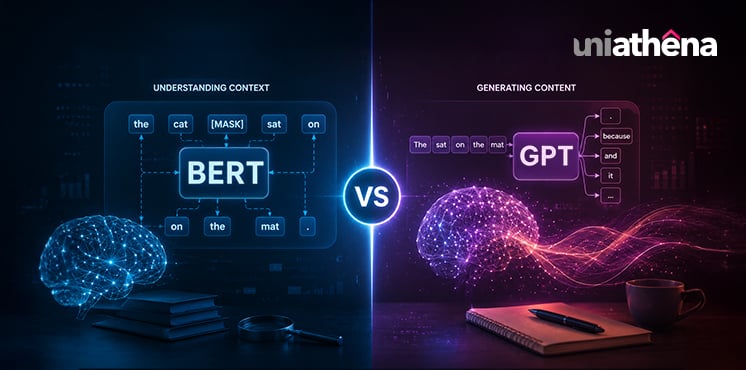
- BERT focuses on understanding language context, while GPT specializes in generating human-like responses using text prediction.
- BERT and GPT use different Transformer architectures, making them suitable for different language processing tasks and applications.
- Businesses use BERT-style models for search, classification, and analysis, while GPT powers content creation and AI assistants.
- GPT became widely popular because users can directly apply it for writing, problem-solving, coding, and everyday tasks.
What is BERT?
Before ChatGPT became a household name, BERT was one of the biggest breakthroughs in natural language processing (NLP).
Short for Bidirectional Encoder Representations from Transformers, BERT is an AI model introduced by Google in 2018 to help computers better understand human language. Rather than generating text, its main job is to analyze and interpret the meaning of words within a sentence.
At a high level, BERT learns language by studying large amounts of text and identifying relationships between words.
- It reads text in both directions: Instead of processing words only from left to right, BERT looks at the full sentence at once to understand context.
- It learns by filling in missing words: During training, certain words are hidden, and BERT must predict them using the surrounding text.
- It focuses on understanding rather than generating: Its goal is to determine what a sentence means, not to create new sentences from scratch.
What BERT is Mainly Used for
Because BERT excels at language understanding, it is commonly used for tasks such as:
- Search engines and query understanding
- Sentiment analysis
- Text classification
- Question answering systems
- Information extraction from documents
- Spam detection and content moderation
In simple terms, if an AI system needs to understand what a piece of text means, there's a good chance a BERT-style model is involved somewhere behind the scenes.
What is GPT?
If BERT was designed to understand language, GPT was built to generate it.
Short for Generative Pre-trained Transformer, GPT is a family of AI models developed by OpenAI. It powers tools like ChatGPT and is designed to produce human-like text based on the input it receives.
Instead of analyzing a sentence to determine its meaning, GPT focuses on predicting what comes next. By doing this repeatedly, it can generate responses, write articles, summarize information, explain concepts, and even produce code.
At a high level, GPT learns patterns in language by processing massive amounts of text and predicting the next word in a sequence.
- It reads text from left to right. GPT looks at the words that came before and uses that context to predict what should come next.
- It learns through next-word prediction. During training, GPT is repeatedly asked to guess the next word in a sentence, helping it learn grammar, facts, patterns, and relationships in language.
- It generates text one token at a time. Each prediction becomes part of the context for the next prediction, allowing GPT to create complete responses, conversations, and documents.
What GPT is Mainly Used for
Because GPT excels at generating language, it is commonly used for tasks such as:
- Conversational AI and chatbots
- Content writing and editing
- Text summarization
- Coding assistance
- Translation
- Brainstorming and idea generation
- Customer support automation
Encoder vs Decoder: The Architectural Difference
So far, we've looked at what BERT and GPT do. But the reason they behave so differently comes down to their underlying architecture.
Shall we move a little deeper into the technical side?
At the heart of the difference is this:
- BERT uses an encoder-only architecture.
- GPT uses a decoder-only architecture.
While both are based on the Transformer architecture, they process information differently and are optimized for different tasks.
What Can an Encoder Do That a Decoder Can't?
Because encoders can examine an entire sentence at once, they are particularly effective at understanding relationships between words and extracting meaning from text.
Some tasks where encoder-based models typically excel include:
- Understanding the intent behind a search query
- Classifying text into categories
- Detecting sentiment in reviews or social media posts
- Identifying entities such as names, locations, and organizations
- Ranking documents based on relevance
- Extracting information from large volumes of text
What Can a Decoder Do That an Encoder Can't?
Decoders are built for a different purpose. Rather than analyzing text, they generate new text one token at a time.
This makes them particularly effective for tasks that require creating content rather than interpreting it.
Some tasks where decoder-based models typically excel include:
- Generating entirely new text sequences from a prompt and continuing to produce output step by step
- Maintaining coherence in long outputs by using each new token as context for the next prediction
- Adapting generation dynamically as context grows during a conversation or document
- Handling open-ended tasks without fixed labels by producing novel responses instead of selecting from predefined categories
Also Read: What is an AI Agent? Simple Explanation for Beginners
How Businesses Actually Use BERT and GPT
In real-world systems, BERT and GPT are rarely used in isolation or shown directly to users. Instead, they sit behind everyday tools and help power different parts of the experience.
Most platforms don’t highlight the model name. They highlight the result: faster search, better answers, or smoother conversations.
Search and Ranking Systems (BERT in Action)
In search-driven systems, the main challenge is understanding what a user actually means. BERT-style models help with this by focusing on meaning instead of exact keywords.
For example:
- A user searches: “policy for working from home for new employees”
- The system does not just match keywords like “work”, “home”, or “policy”
- Instead, it understands the intent as “remote work HR guidelines for onboarding employees”
This is why modern search engines and enterprise search tools feel more “intelligent” compared to older keyword-based systems.
Customer Support Systems (BERT + GPT Working Together)
Many AI support systems use a combination of both models.
- First, a BERT-style model identifies what the user is asking about (refund, login issue, payment problem, etc.)
- Then, a GPT-style model generates a natural, human-like response
For example:
User message:
“Money got deducted but order didn’t confirm”
System flow:
- BERT layer → detects “payment issue + order failure”
- GPT layer → generates a clear explanation and next steps for the user
One model helps the system understand the situation, while the other explains it back to the user.
E-Commerce and Product Platforms
In online shopping platforms, both models quietly improve user experience.
BERT-style models are used to:
- Interpret messy or natural search queries
- Match users with relevant products even when keywords are not exact
GPT-style models are used to:
- Generate product descriptions
- Summarize reviews
- Power chat assistants that answer product-related questions
So when a user types something vague like “comfortable shoes for long standing hours,” the system still returns relevant results instead of failing.
Also Read: How to Improve Your Skills with ChatGPT
Why GPT Became the Face of Modern AI
GPT didn’t become popular because it was the first AI model. It became popular because people could directly use it in real situations and get immediate results.
- It is easy to access. Tools like ChatGPT removed the need for complex setup, model development, or training data preparation.
- It responds in full outputs, not fragments. Users get complete emails, paragraphs, or explanations instead of keywords or labels.
- It works across many everyday tasks. Writing drafts, summarizing text, explaining topics, and generating ideas all work in one place.
- It handles messy, real-world input. People don’t need to format prompts in a strict way for it to respond usefully.
- It produces usable first drafts quickly. The output often needs editing, but it reduces starting effort significantly.
Because of this, GPT became the model most people directly interact with, not just something used inside systems.
Interested in learning how GPT works in practice and how to use it to its full potential?
Take UniAthena’s short course, Master ChatGPT. Here, you’ll learn practical prompt techniques and how to apply ChatGPT in real-world tasks. You’ll also explore simple but powerful ways to use it for writing, ideation, and graphical applications.
Also Read: Best ChatGPT Alternatives: Top AI Tools to Try
FAQs
Q1. Is BERT better than GPT
A: BERT is better for understanding tasks, while GPT performs better in text generation tasks overall.
Q2. Does Google use BERT or GPT?
A: Google uses BERT-like models for search understanding and may use GPT-style models in newer AI systems.
Q3. Can GPT understand a language like BERT?
A: Yes. GPT can understand language effectively, but it is primarily trained for text generation, while BERT is designed specifically for bidirectional language understanding tasks like classification and semantic analysis.
Q4. Are ChatGPT and BERT competitors?
A: Not directly; they are designed for different purposes. ChatGPT is a generative AI model that creates human-like responses, while BERT is mainly used for language understanding tasks such as classification, search, and text analysis.
Our Popular Courses

$14000


Doctoral Degree in Business Administration
Universidad Catolica De Murcia (UCAM), Spain
Duration:
2 - 3 Years
$17500*
Integrated Doctorate of Business Administration
Guglielmo Marconi University, Italy
Universidad Catolica De Murcia (UCAM), Spain
Duration:
2.5 - 3.5 Years
$5600*
Master of Business Administration
Guglielmo Marconi University, Italy
Duration:
12 - 24 Months
$5600*
MBA in Operations & Project Management
Guglielmo Marconi University, Italy
Duration:
12 - 24 Months
$5,600*
Master in Supply Chain and Logistics Management
Guglielmo Marconi University, Italy
Duration:
12 - 24 Months
$5,950*
Master in Data Sciences
Guglielmo Marconi University, Italy
Duration:
12 - 24 Months
$5,600*
Master in Engineering Management
Guglielmo Marconi University, Italy
Duration:
12 - 24 Months
$5,600*
Master in Procurement and Contract Management
Guglielmo Marconi University, Italy
Duration:
12 - 24 Months
$5,600*
Master in Public Health
Guglielmo Marconi University, Italy
Duration:
12 - 24 MonthsOur Popular Courses
COMMENTS(0)
Our Popular Courses
$14000
Doctoral Degree in Business Administration
Universidad Catolica De Murcia (UCAM), Spain
Duration:
2 - 3 Years
$17500*
Integrated Doctorate of Business Administration
Guglielmo Marconi University, Italy
Universidad Catolica De Murcia (UCAM), Spain
Duration:
2.5 - 3.5 Years
$5600*
Master of Business Administration
Guglielmo Marconi University, Italy
Duration:
12 - 24 Months
$5600*
MBA in Operations & Project Management
Guglielmo Marconi University, Italy
Duration:
12 - 24 Months
$5,600*
Master in Supply Chain and Logistics Management
Guglielmo Marconi University, Italy
Duration:
12 - 24 Months
$5,950*
Master in Data Sciences
Guglielmo Marconi University, Italy
Duration:
12 - 24 Months
$5,600*
Master in Engineering Management
Guglielmo Marconi University, Italy
Duration:
12 - 24 Months
$5,600*
Master in Procurement and Contract Management
Guglielmo Marconi University, Italy
Duration:
12 - 24 Months
$5,600*
Master in Public Health
Guglielmo Marconi University, Italy
Duration:
12 - 24 MonthsOur Popular Courses
Our Popular Insights
Careers are shifting faster than ever, and staying relevant takes more than experience. Explore UniAthena’s most-read blogs for sharp insights, emerging skills, and practical pathways that help you move forward with clarity and confidence in a changing professional world.

What is Business Development?
Read More
6
mins read
What is the Role of AI in Education?
Read More
4
mins read

🌟 Top Project Performer – June 2026 🌟
Read More
1
mins read


🌟 Top Project Performer – May 2026 🌟
Read More
1
mins read


🌟 Top Project Performer – April 2026 🌟
Read More
1
mins read
What is Business Development?
Read more
6
mins read
What is the Role of AI in Education?
Read more
4
mins read
🌟 Top Project Performer – June 2026 🌟
Read more
1
mins read

🌟 Top Project Performer – May 2026 🌟
Read more
1
mins read
🌟 Top Project Performer – April 2026 🌟
Read more
1
mins read
Get in Touch

It’s Time to Start
Join NowMost Popular Online Specialization
- Master of International Business Administration
- Master of Business Administration
- MBA in General Management- FastTrack
- Master in Innovation and Entrepreneurship
- MBA-Family Business Management
- Master in Procurement and Contract Management
- Extended Diploma in Business Analytics (SCQF Level 11)
- Diploma in Supply Chain and Logistics Management (SCQF Level 11)
- Strategic Human Resource Management Practitioner
- Master in Data Science
- Master in Engineering Management
Trending Online
- Integrated Doctorate of Business Administration
- Postgraduate Certificate in Finance for Next Generation Managers
- Master of Business Administration- General Management (Fast Track)
- Postgraduate Certificate in Socio-Economic and Legal Framework
- Postgraduate Certificate in Business Sustainability
- Certified Manager
- Supply Chain Management Practitioner
- MBA - AI in Business
- MBA - Accounting & Finance
- Master in Supply Chain and Logistics Management
Top Universities Online Certificates
- Postgraduate Certificate in International Marketing Management
- Postgraduate Certificate In International Human Resource Management
- Postgraduate Certificate in Strategic Management
- Postgraduate Certificate in Procurement & Contracts Management
- Postgraduate Certificate in Business Analytics
- Postgraduate Certificate in Strategic Supply Chain & Logistics Management
- Postgraduate Certificate in Human Resource and Leadership
- Project Management Practitioner
- Postgraduate Certificate in Supply Chain Design & Implementation
- Postgraduate Certificate in Management Accounting and Finance
Accredited Online Degree Program
- MBA - Digital Transformation
- MBA - Family Business Management
- MBA - Marketing Management
- MBA in Quality Management
- MBA - Business Intelligence & Data Analytics
- MBA in Operations & Project Management
- MBA in Energy Management
- MBA In Construction & Safety Management
- Master in Organisational Leadership
- Master in Public Health
- Master in Construction Management
- Bachelor of Arts in Business Administration


 Install Now


UniAthena is an Ed-Tech, offering flexible, affordable learning solutions, including Free-Learning Upskilling Courses and Academic Programs in partnerships with accredited and globally renowned universities and professional qualification bodies.


Do you have any questions ?
Feel free to send us your questions or request a free consultation
Send a message
UK
Athena Global Education
Magdalen Centre,
Robert Robinson Avenue,
Oxford, OX4 4GA, UK
Phone : 01865 784299
MIDDLE EAST
Athena Global Education FZE
Block L-03, First Floor,
P O Box 519265, Sharjah Publishing City,
Free Zone, Sharjah, UAE
Phone : +971 55 879 5492
INDIA
Uniathena Private Limited
9A,Midas Tower
Phase 1
Hinjewadi Rajiv Gandhi Infotech Park
Pune-411057
Phone: +91 9145665544
All Copyrights Reserved @ Athena Global Education 2021-2026