-

Bachelor's

-

Masters
-

MBA
-

Doctorate
-

Micro Credit
-

Explore all Courses
-
Postgraduate Certifications

-
Postgraduate Diploma
-
Undergraduate Diploma
-
Diploma



AI, Analytics, and the Future of Work
Author: maria
|6
MINS READ
| 0
| 113
Created On: 18 June, 2025
Share




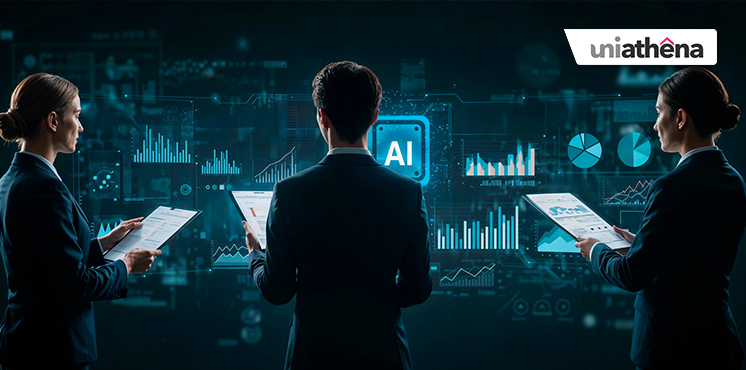
There’s no doubt that AI and Analytics have forever changed how we approach work. Things that once seemed like Sci-Fi movie plotpoints are now a day-to-day reality. As these technologies evolve and integrate, we realise that engaging in the interplay of Artificial Intelligence and Data Analytics across industries is not just for experts; it is for everyone who wishes to grow beyond their current roles and prepare for future ones.

Source: https://www.linkedin.com/pulse/artificial-intelligence-ai-future-work-article-6-where-parfrey/
In this dynamic and fast-paced world, terms like Data Analytics and AI often get tossed around a lot. Understanding the relationship between these elements will help us navigate the opportunities and challenges of the future. So, let us unpack what the future of AI and Analytics holds for us as professionals.
The Power of AI in Data Analytics
No job in the world can be done without the use of data. It is everywhere, in Sales, Supply Chains, Human Resource Management, and Customer Feedback, among others. But raw data without insights is not useful; that’s where AI for Data Analytics comes in. AI-driven Analytic systems do not just analyze past data to make decisions, they transform data to identify patterns, recommend actions, and provide predictions in real-time.
Using AI in data-driven decision-making is an absolute gamechanger, as AI models for Data Analytics analyze a vast array of data to help businesses in predicting future outcomes with great accuracy. These tools also provide personalization in terms of tailored recommendations and marketing campaigns.
These capabilities are being made accessible by businesses and professionals with the help of the following tools:
- Tableau and Power BI - These AI-driven analytics tools help users visualise complex data promptly by integrating AI features like language processing and automated insights.
- Google Cloud AI platform - This AI-driven tool helps in accurate predictive analysis by offering scalable machine learning models.
- Polymer - This is a new AI tool that simplifies Data Analysis with the use of automation and AI. It allows users to upload spreadsheets and converts those spreadsheets into searchable, streamlined, and interactive databases.
- DataGPT - This is an interactive AI tool that allows users to ask questions about their data in natural language and receive answers, helping in identifying trends, reading complex data, and making data-driven decisions.
- IBM Watson Analytics - The Watson analytics tool utilizes AI to uncover hidden trends in complex datasets and suggest data-driven solutions without requiring deep technical expertise.
By leveraging these and many more AI tools and models, workplaces are transforming vast amounts of data into actionable insights, accelerating decision-making and accuracy.
The Future of AI and Data Analytics
AI is not just a tool anymore; it is becoming a strategic partner in how we work. AI in the future would not only be for data experts or professionals, but employees at all levels will be using it for their daily work. This means that learning to work with Artificial Intelligence will be an in-demand skill, as there will be more collaboration between humans and machines, reshaping roles and workflows.
Dispelling Myths About AI: Why AI Is Not the Job Killer
The impact of generative AI is raising questions about the replacement of human workers by AI tools or bots. Generative AI can produce content, automate tasks, design code, and do other things that were once believed to be human expertise. But this does not mean that AI will replace human jobs; rather, jobs will evolve, emphasizing skills where human workers excel, like creativity, complex judgments, and empathy.
There is a lot of fear surrounding AI in the workplace. Some think AI will make human roles and jobs obsolete in the future. On the contrary, AI is far more likely to complement human efforts, automating repetitive tasks that make it easier for humans to focus on higher-level challenges.
Future workplaces will witness the collaboration of humans and AI regularly. This partnership will redefine how work is conducted in various sectors. For instance, AI helps the Finance sector by rapidly analysing financial statements to pinpoint anomalies, allowing auditors to spend the saved time on more complex issues.
In the Customer Service sector, AI chatbots handle routine complaints, which enables human agents to address more sensitive and complicated complaints or issues effectively. Therefore, professionals or businesses that will successfully integrate AI tools as collaborators rather than competitors are set to gain a competitive advantage.
How to prepare for an AI-Driven Workplace?
With AI changing the workplace landscape, what can we do to prepare? One clear way forward is training and education:
- Build AI literacy: Familiarize yourself with AI concepts, applications, and tools present in your field. Enrol in online courses or workshops that offer education and training in Artificial Intelligence. We recommend UniAthena’s AI Short Courses, which can be completed 100% online for free.
- Focus on Human Skills: The skills that machines and AI cannot replicate should be your strength, such as empathy, creativity, emotional intelligence, ethical reasoning, etc.
- Enhance Data-driven Thinking: Go beyond intuition and gut-feel; always seek evidence and use data to support your decisions.
- Promote ethical AI: Seek knowledge about ethical AI and always support responsible and transparent AI practices in workplaces. Cultivate the habit of fairness and accountability.
The future of AI and Data Analytics promises integration and sophistication. AI models and tools are increasingly automating tasks, anticipating needs, and adapting in real-time. As AI evolves, so must our approach to career planning. Professionals must now prioritise continuous learning, embracing change, and flexibility to build a future-proof career.
How AI Is Already Changing Work: Benefits and Challenges
AI and Data Analytics are transforming standard operations in organisations by increasing efficiency and employee support. Some benefits are as follows:
- It enables faster decision-making by analyzing large data quickly, helping professionals in making informed decisions.
- AI provides personalized experiences through tailored programs and resources to individual needs.
- It promotes and suggests effective wellbeing initiatives by taking and analyzing employee feedback.
AI integration in the workplace is not without its challenges:
- There is decreased employee morale and resistance to adoption due to the fear of AI replacing their jobs.
- It is a human that develops, manages, and uses AI. Therefore, businesses need skilled professionals to develop, manage, and train AI.
- AI models or tools do not always provide 100% accurate responses. Their responses depend upon the data they are fed and how they are trained.
Final Thoughts
It is evident that AI and Data Analytics are not just buzzwords; they are powerful tools that are shaping the future of jobs and businesses. We as professionals have to embrace these changes and advancements through training and education to thrive in this new era. The future of workplaces is not a choice between machines and humans; rather, it is a shared collaboration for innovation and growth.
As we step into this AI-powered future, the question should not be how AI will change our work, it should be how we can use these changes for our professional betterment.
References:
https://www.domo.com/learn/article/ai-data-analysis-tools
https://www.forbes.com/councils/forbestechcouncil/2024/07/12/ai-and-the-future-of-work/
Explore Related Courses










COMMENTS(0)
Explore Related Courses
Our Popular Insights
Careers are shifting faster than ever, and staying relevant takes more than experience. Explore UniAthena’s most-read blogs for sharp insights, emerging skills, and practical pathways that help you move forward with clarity and confidence in a changing professional world.


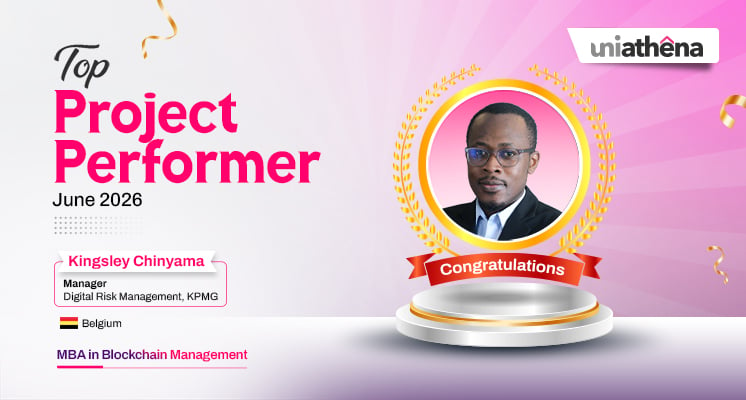
🌟 Top Project Performer – June 2026 🌟
Read More
1
mins read

🌟 Top Project Performer – May 2026 🌟
Read More
1
mins read


🌟 Top Project Performer – April 2026 🌟
Read More
1
mins read
🌟 Top Project Performer – June 2026 🌟
Read more
1
mins read

🌟 Top Project Performer – May 2026 🌟
Read more
1
mins read
🌟 Top Project Performer – April 2026 🌟
Read more
1
mins read
Get in Touch

It’s Time to Start
Join NowMost Popular Online Specialization
- Master of International Business Administration
- Master of Business Administration
- MBA in General Management- FastTrack
- Master in Innovation and Entrepreneurship
- MBA-Family Business Management
- Master in Procurement and Contract Management
- Extended Diploma in Business Analytics (SCQF Level 11)
- Diploma in Supply Chain and Logistics Management (SCQF Level 11)
- Strategic Human Resource Management Practitioner
- Master in Data Science
- Master in Engineering Management
Trending Online
- Integrated Doctorate of Business Administration
- Postgraduate Certificate in Finance for Next Generation Managers
- Master of Business Administration- General Management (Fast Track)
- Postgraduate Certificate in Socio-Economic and Legal Framework
- Postgraduate Certificate in Business Sustainability
- Certified Manager
- Supply Chain Management Practitioner
- MBA - AI in Business
- MBA - Accounting & Finance
- Master in Supply Chain and Logistics Management
Top Universities Online Certificates
- Postgraduate Certificate in International Marketing Management
- Postgraduate Certificate In International Human Resource Management
- Postgraduate Certificate in Strategic Management
- Postgraduate Certificate in Procurement & Contracts Management
- Postgraduate Certificate in Business Analytics
- Postgraduate Certificate in Strategic Supply Chain & Logistics Management
- Postgraduate Certificate in Human Resource and Leadership
- Project Management Practitioner
- Postgraduate Certificate in Supply Chain Design & Implementation
- Postgraduate Certificate in Management Accounting and Finance
Accredited Online Degree Program
- MBA - Digital Transformation
- MBA - Family Business Management
- MBA - Marketing Management
- MBA in Quality Management
- MBA - Business Intelligence & Data Analytics
- MBA in Operations & Project Management
- MBA in Energy Management
- MBA In Construction & Safety Management
- Master in Organisational Leadership
- Master in Public Health
- Master in Construction Management
- Bachelor of Arts in Business Administration


 Install Now


UniAthena is an Ed-Tech, offering flexible, affordable learning solutions, including Free-Learning Upskilling Courses and Academic Programs in partnerships with accredited and globally renowned universities and professional qualification bodies.


Do you have any questions ?
Feel free to send us your questions or request a free consultation
Send a message
UK
Athena Global Education
Magdalen Centre,
Robert Robinson Avenue,
Oxford, OX4 4GA, UK
Phone : 01865 784299
MIDDLE EAST
Athena Global Education FZE
Block L-03, First Floor,
P O Box 519265, Sharjah Publishing City,
Free Zone, Sharjah, UAE
Phone : +971 55 879 5492
INDIA
Uniathena Private Limited
9A,Midas Tower
Phase 1
Hinjewadi Rajiv Gandhi Infotech Park
Pune-411057
Phone: +91 9145665544
All Copyrights Reserved @ Athena Global Education 2021-2026