-

Bachelor's

-

Masters
-

MBA
-

Doctorate
-

Micro Credit
-

Explore all Courses
-
Postgraduate Certifications

-
Postgraduate Diploma
-
Undergraduate Diploma
-
Diploma



Natural Wealth of Venezuela: From Gas to Minerals Beyond Oil
Author: munazzah ali
|8
MINS READ
| 0
| 169
Created On: 27 April, 2026
Share




Table of Contents (TOC):
- Introduction
- Key Takeaways
- Natural Gas: Vital Energy Resource
- Gold and Precious Metals and Other Minerals: Enduring Value Drivers
- Critical Minerals: For the Technological Advancement
- Economic Challenges and Implications
- Future Opportunities
- Conclusion
- FAQs
Introduction
Global energy conversations are no longer just about oil—they are about resilience, diversification, and access to critical resources, shaping the future of oil & gas in a rapidly evolving energy landscape.”
Venezuela, a country located in the northern part of South America, is blessed with the largest oil reserves in the world, estimated to be about 303 billion barrels. It is ninth in the world in terms of natural gas reserves and possesses immensely huge and untapped mineral reserves.
The country is also an original signatory of the Organization of Petroleum Exporting Countries (OPEC). In recent years, attention has expanded beyond oil. The focus is now on resources that support stable power systems and modern technologies—bringing renewed relevance to the Natural Resources of Venezuela and its broader energy sector.
The capture of Nicolás Maduro by U.S. forces carries potentially significant consequences for Venezuela, including in its oil, gas, and mining sectors. Beyond this political incident, it also substantially changed the tenor of the resource economy in Venezuela. Resources had been open to expansion for years, with the nation relying solely on oil for its treasury.
However, in 2026, reforms started the general development of gas, gold, diamonds, and important minerals via new mining law, re-opening resource industries to foreign investors, and establishing a new relationship with the United States.
Key Takeaways:
- Venezuela's wealth is driven by the world’s largest oil reserves and significant natural gas deposits.
- The Venezuelan mining industry is rich in gold, rare earth elements, and other high-value minerals.
- The Orinoco Mining Arc plays a central role in gold mining in Venezuela and future resource development.
- Long-term growth depends on political stability and the effective use of natural resources of Venezuela.
Natural Gas: Vital Energy Resource
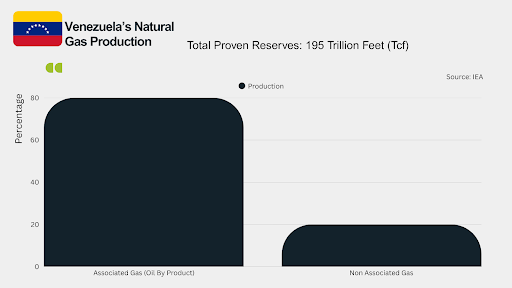
Venezuela is a major player in natural gas, accounting for 73% of South America's total natural gas reserves and holding 195 trillion cubic feet of proven reserves, according to the International Energy Agency (IEA). Some of its most significant reserves lie within the Maracaibo Basin, while others extend offshore, notably in the Perla structure. These resources propel Venezuela to the forefront of the global LNG market.
Sources of natural gas:
- From the Caribbean Sea
- Eastern Venezuela
- Associated with oil production
Venezuela's natural gas production comes from associated gas, or gas produced as a by-product of oil drilling.
Gold and Precious Metals and Other Minerals: Enduring Value Drivers
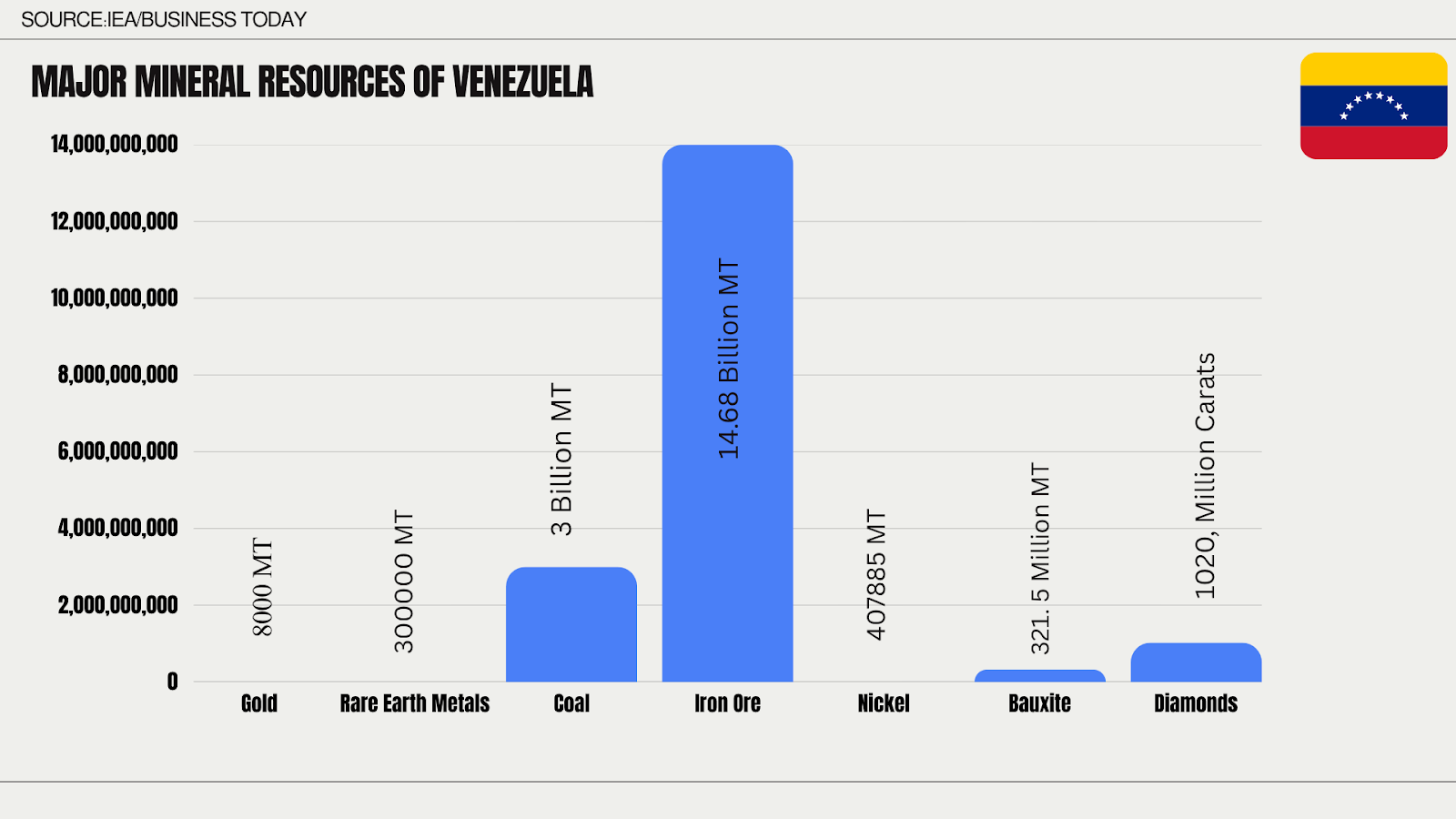
Gold is one of Venezuela’s biggest assets outside of oil. Most of it sits in the Guayana Shield, and experts estimate reserves at more than 8,000 metric tons. Venezuela’s rare earth resources are concentrated in the Orinoco Mining Arc, a massive region in the southeast where miners are already known for its gold and coltan.
Decades ago, governmental surveys put the number of rare-earth elements in the country at about 300,000 metric tonnes, an appreciable amount of stockpile to be used today, anywhere between $200 billion and $500 billion. Venezuela is said to have 3 billion metric tonnes of proven coal reserves and 321.5 million metric tons of bauxite. The nation's iron ore resources stand at 14.68 billion metric tonnes, of which 3.6 billion metric tonnes have already been proven.
Venezuela also has diamond reserves of 1,020 million carats in the Orinoco Mining Arc, and within that, 275 million carats just in the Guanaimo area.
With the AI sector expanding at an increasing speed, manufacturers are seeking rare earth metals and advanced materials... This integration of technology is not just changing mining, but is also defining the future of oil and gas, where Artificial Intelligence (AI) and data analytics are becoming essential for resource optimization.
To investors and policymakers, Venezuela’s rare earth resources are no longer just geological potential but a long-term strategic advantage in an increasingly resource-scarce global market, complementing its influence in the global oil market.
Critical Minerals: For the Technological Advancement
The shift from fossil fuels to renewable energy sources is rapidly advancing around the globe, and the Orinoco Mining Arc has the essential resources needed for reducing environmental impacts associated with internal combustion engines, as well as using electric vehicles (EVs).
The goal of EVs and renewable energy sources is to reduce air pollution while minimizing waste through their respective technologies. One of the most important components in EVs is coltan, which is composed primarily of tantalum and niobium and used in many different applications, including batteries, electric wiring, and lightweight materials to create energy-efficient vehicles.
According to the USGS (United States Geological Survey), the Orinoco Mining Arc is believed to have critical minerals such as coltan for electrical items and aerospace. Rare earth elements include neodymium and dysprosium, vital for permanent magnets in renewable energy and EVs.
The wider demand curve is what makes these resources even more important. The increasing demand for critical minerals is a result of the global trend of shifting to clean energy, battery storage, and electrified transport. The market of important minerals such as nickel, cobalt, and rare earths is still growing, with the fast growth of EVs and renewable technologies. Simultaneously, materials such as neodymium are still required in magnets in EVs and energy systems, which confirms their future significance.
The presence of nickel deposits, about 340 million tonnes, in coexistence with copper and vanadium, also enhances the applicability of the region in battery production and advanced alloys. These resources combined make Venezuela a potentially significant contributor to meeting future material demand as industries grow.
Also Read: Inside the Intelligent Oilfield: AI-Driven Digital Twins and the New Era of Energy Operations
Economic Challenges and Implications
Venezuela's non-oil wealth can bring in more than $100 billion each year and lift mining to nearly 10% of GDP (up from barely 2%). Despite the fact that the mining potential in Venezuela is enormous, the road to achieving this potential is full of challenges. The Orinoco Mining Arc is marked by widespread illegal mining and the established nature of criminal partnerships.
Many major firms are hesitant to invest; as a result, much of the coltan, nickel, and rare earth minerals that currently exist in Venezuela still remain undeveloped due to a lack of capital investment required to unlock them. Consequently, Venezuela finds itself caught in a never-ending cycle of underdevelopment.
Corruption and governance failures pose a massive barrier to Orinoco Mining Arc development. Military bribes from illegal miners, state laundering of illegal gold, and opaque military control divert billions from infrastructure and jobs. Without transparent reforms and demilitarization, this core challenge hinders Venezuela's path to prosperity.
Moreover, the region is still controlled by armed groups, and the control over large areas of land poses a dangerous condition to investors and the local population.
Future Opportunities
The transformation of Venezuela’s resource sector is still at the initial stage, yet there are a number of emerging trends that show the potential for the future. Increased domestic supply and exports of natural gas could be facilitated through the expansion of natural gas projects, including the new offshore development with international partners.
Renewed interest in foreign investment can also be observed in continuation of mining reforms and reopening of gold export, which can help to revive the Venezuelan mining sector. Moreover, the availability of coltan and other key minerals in the Orinoco Mining Arc is also a sign of future potential, but most of it is underdeveloped and needs an organized investment and regulation.
For professionals looking to understand such evolving energy landscapes, structured learning can provide an edge. Programs like:
- Diploma in Oil & Gas Business - Finance & Strategy
- Mastering Business Strategy - Oil & Gas Industry
- Basics of Oil & Gas - Reserves, Risk & Value
- Basics of Oil & Gas - Strategy, Sustainability & Digital Foundations,
offered by UniAthena, can help build a deeper understanding of global energy markets and strategic resource management.
Conclusion
Venezuela has a tremendously diverse and valuable resource base. The country possesses large reserves of natural gas, gold, iron ore, bauxite, diamonds, and other strategic minerals.
Recent times have witnessed a set of economic reforms, the introduction of mining laws, and collaborations with international firms that are changing the face of the country's resource sector with the view of attracting foreign investment and boosting mineral and energy production.
Under the leadership of Nicolás Maduro, Venezuela decided to elevate the importance of mining and resource development projects as alternative sources of income. But various factors like continuous economic downturn, sanctions, and political instability led to a slowdown in progress and a decline in production across several sectors.
If political stability improves, the country may well be able to shift away from an oil-based economy and emerge as a resource diversification hub, having a significant say in international energy and mineral markets.
FAQs
Q1. How significant is Venezuela’s natural gas potential globally?
A: Venezuela has one of the largest natural gas deposits, and a good portion of it is underdeveloped. It has the potential to be a significant provider in both local and international energy markets with the correct infrastructure and investment.
Q2. Why are Venezuela’s mineral resources gaining attention now?
A: As global demand rises for materials used in clean energy and technology, Venezuela’s reserves of gold, rare earth elements, and coltan are becoming strategically important for future supply chains.
Q3. What makes the Orinoco Mining Arc important for the future?
A: One of the most resource-rich areas in South America is the Orinoco Mining Arc, where there are immense quantities of gold and essential minerals that form the core of the economic diversification of Venezuela in the long-term.
Explore Related Courses











COMMENTS(0)
Explore Related Courses
Our Popular Insights
Careers are shifting faster than ever, and staying relevant takes more than experience. Explore UniAthena’s most-read blogs for sharp insights, emerging skills, and practical pathways that help you move forward with clarity and confidence in a changing professional world.


How to Switch Career to Data Analytics?
Read More
6
mins read






How to Switch Career to Data Analytics?
Read more
6
mins read

Get in Touch

It’s Time to Start
Join NowMost Popular Online Specialization
- Master of International Business Administration
- Master of Business Administration
- MBA in General Management- FastTrack
- Master in Innovation and Entrepreneurship
- MBA-Family Business Management
- Master in Procurement and Contract Management
- Extended Diploma in Business Analytics (SCQF Level 11)
- Diploma in Supply Chain and Logistics Management (SCQF Level 11)
- Strategic Human Resource Management Practitioner
- Master in Data Science
- Master in Engineering Management
Trending Online
- Integrated Doctorate of Business Administration
- Postgraduate Certificate in Finance for Next Generation Managers
- Master of Business Administration- General Management (Fast Track)
- Postgraduate Certificate in Socio-Economic and Legal Framework
- Postgraduate Certificate in Business Sustainability
- Certified Manager
- Supply Chain Management Practitioner
- MBA - AI in Business
- MBA - Accounting & Finance
- Master in Supply Chain and Logistics Management
Top Universities Online Certificates
- Postgraduate Certificate in International Marketing Management
- Postgraduate Certificate In International Human Resource Management
- Postgraduate Certificate in Strategic Management
- Postgraduate Certificate in Procurement & Contracts Management
- Postgraduate Certificate in Business Analytics
- Postgraduate Certificate in Strategic Supply Chain & Logistics Management
- Postgraduate Certificate in Human Resource and Leadership
- Project Management Practitioner
- Postgraduate Certificate in Supply Chain Design & Implementation
- Postgraduate Certificate in Management Accounting and Finance
Accredited Online Degree Program
- MBA - Digital Transformation
- MBA - Family Business Management
- MBA - Marketing Management
- MBA in Quality Management
- MBA - Business Intelligence & Data Analytics
- MBA in Operations & Project Management
- MBA in Energy Management
- MBA In Construction & Safety Management
- Master in Organisational Leadership
- Master in Public Health
- Master in Construction Management
- Bachelor of Arts in Business Administration


 Install Now


UniAthena is an Ed-Tech, offering flexible, affordable learning solutions, including Free-Learning Upskilling Courses and Academic Programs in partnerships with accredited and globally renowned universities and professional qualification bodies.


Do you have any questions ?
Feel free to send us your questions or request a free consultation
Send a message
UK
Athena Global Education
Magdalen Centre,
Robert Robinson Avenue,
Oxford, OX4 4GA, UK
Phone : 01865 784299
MIDDLE EAST
Athena Global Education FZE
Block L-03, First Floor,
P O Box 519265, Sharjah Publishing City,
Free Zone, Sharjah, UAE
Phone : +971 55 879 5492
INDIA
Uniathena Private Limited
9A,Midas Tower
Phase 1
Hinjewadi Rajiv Gandhi Infotech Park
Pune-411057
Phone: +91 9145665544
All Copyrights Reserved @ Athena Global Education 2021-2026