-

Bachelor's

-

Masters
-

MBA
-

Doctorate
-

Micro Credit
-

Explore all Courses
-
Postgraduate Certifications

-
Postgraduate Diploma
-
Undergraduate Diploma
-
Diploma



The Deepfake Trust Crisis: Can Blockchain Restore Confidence in Digital Content?

Author: pallavi patnaik
|9
MINS READ
| 0
| 9
Created On: 22 July, 2026
Share




Table of Contents (TOC):
- Introduction
- Key Takeaways
- What Is the Deepfake Trust Crisis?
- Why Deepfakes Are Eroding Digital Trust
- How Blockchain Technology Works as a Verification Tool
- Blockchain-Based Solutions Already in Use
- Limitations of Blockchain in Fighting Deepfakes
- The Road Ahead: A Hybrid Trust Model
- Conclusion
- FAQs
Introduction
You've probably seen it happen already: a video, a voice note, or an image that stopped you mid-scroll because something felt off, only for you to later find out it wasn't real at all. This is the reality of synthetic media today: content generated by AI that looks and sounds convincing enough to fool even careful viewers. Deepfakes are showing up in scam calls, fake political statements, and manipulated "evidence" that's eroding trust in digital media faster than most people realize.
As deepfake detection struggles to keep pace with how quickly this technology is evolving, people are increasingly turning to blockchain for digital content verification, asking whether it can genuinely restore the confidence we've lost. Let's dig into what's driving the deepfake trust crisis and whether blockchain is the fix it's often made out to be.
Key Takeaways:
- The deepfake trust crisis stems from AI-generated content evolving faster than our ability to verify what's real.
- Blockchain for digital content verification works like a tamper-proof receipt, using cryptographic verification to record when and where content was actually created.
- Industry frameworks like C2PA already apply decentralized ledger technology to establish content provenance.
- Blockchain confirms a file hasn't been altered, but it can't independently perform deepfake detection on the original content.
- The most realistic path forward blends blockchain solutions for deepfake detection with AI tools, platform policy, and digital forensics.
What Is the Deepfake Trust Crisis?
Deepfakes use generative AI to produce synthetic media (videos, images, or audio clips) that appear completely authentic even when nothing about them is real. What began as face-swap apps and celebrity parody videos has escalated into something with serious financial and social consequences. Take the 2024 case out of Hong Kong, where a finance employee was tricked into wiring $25 million after a video call with what looked like his company's real executives. That's a textbook example of deepfake financial risks in action, convincing enough to bypass every instinct that would normally raise a red flag.
Around election cycles, fake audio clips of political leaders have circulated widely enough to genuinely worry regulators about voter manipulation. This is the deepfake trust crisis in a nutshell: we can no longer assume that video or audio proof reflects something that actually happened, and that shift is reshaping how we consume news, evidence, and even everyday conversations online.
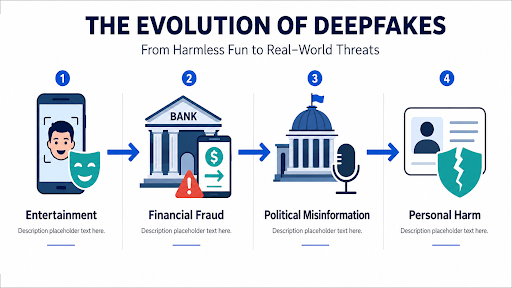
Figure 1: Deepfakes have evolved from entertainment tools into serious threats, enabling financial fraud, political misinformation, and identity misuse, making it increasingly difficult to trust digital content.
Why Deepfakes Are Eroding Digital Trust
A few forces are colliding to make this worse right now. Deepfake generation no longer requires technical skill, since plenty of free apps can produce convincing synthetic media in a few clicks. Then there's the speed problem: fake content spreads so fast that by the time anyone fact-checks it, millions have already seen and believed it.
Perhaps the bigger shift is psychological, since the assumption that "seeing is believing" is quietly falling apart, and that's a serious problem for digital forensics. Investigators and legal teams can no longer treat video evidence as automatically credible; every file now potentially needs authentication before it holds up in court or reporting. Journalists have to double-check footage they'd normally take at face value, and everyday users are left wondering if a clip shared online is even genuine.
The fallout shows up everywhere, from fraudulent transactions triggered by deepfake calls to fabricated political speeches shaping public opinion to individuals dealing with the real damage of non-consensual deepfake content. All of this is steadily undermining trust in digital media at a scale we haven't seen before.
Deepfake Threat Landscape
How Blockchain Technology Works as a Verification Tool
So where does blockchain for digital content verification actually fit into this picture? At its core, blockchain is a decentralized ledger technology, a shared record that is highly resistant to unauthorized modification because changes require network consensus and are transparently recorded across participating nodes. Applied to content, here's the idea: every time a photo or video is created, the system generates a unique cryptographic fingerprint, or hash, and stores it on the blockchain.
If even a single pixel changes later, that fingerprint changes too, allowing verification systems to detect that the registered content has been altered. This process of cryptographic verification also locks in exactly when and where content was first created, which matters when someone needs to prove a video existed before or after a specific event.
And because no single company controls the ledger, verification isn't dependent on trusting one platform's word; it's distributed across a decentralized network, which is precisely what makes blockchain for media authenticity a compelling alternative to centralized fact-checking. This same infrastructure is increasingly discussed alongside secure digital assets and identity verification, since the underlying trust model works similarly across use cases.
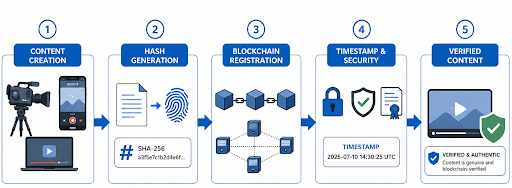
Figure 2: Blockchain creates a unique cryptographic fingerprint for digital content and records it on a decentralized ledger, helping verify its authenticity and detect tampering.
Blockchain-Based Solutions Already in Use
This isn't just theoretical; real blockchain solutions for deepfake detection support already exist. C2PA (the Coalition for Content Provenance and Authenticity) is backed by heavyweights like Adobe, Microsoft, Intel, and the BBC, and works by attaching "Content Credentials" to files, essentially a digital paper trail documenting content provenance and edit history. Although C2PA does not require blockchain, its cryptographic content provenance model complements blockchain-based verification approaches by helping establish trusted records of content origin and edit history.
Truepic takes a similar approach, verifying that photos and videos were captured in real time and haven't been altered afterward, with adoption already underway in insurance and identity verification. Numbers Protocol lets photographers and journalists register original work on-chain, so ownership can be proven later if needed.
None of these tools can look at a video and definitively flag it as AI-generated; that's still the job of deepfake detection models. What they offer instead is a verifiable chain of custody, giving users a practical way to check whether content truly comes from where it claims to, which is a meaningful step toward a trusted content ecosystem.
Also Read: How Generative AI and Deepfakes Enable Cyber Attacks
Limitations of Blockchain in Fighting Deepfakes
It's worth being honest about where this technology falls short, since it's easy to oversell. Blockchain confirms that a file hasn't been tampered with since registration; it says nothing about whether the original content was synthetic to begin with, and how blockchain can prevent deepfakes remains a genuinely open question rather than a solved one. There's also an adoption gap: this system only works if content is registered the moment it's captured, and most cameras and apps don't do that automatically yet.
Storing full media files directly on-chain is expensive too, so most systems store only hashes, which means additional infrastructure is needed to make verification practically useful. And even where these tools exist, most people scrolling through their feed simply won't stop to check content credentials before sharing. Solid technology doesn't move the needle much if adoption stays low.
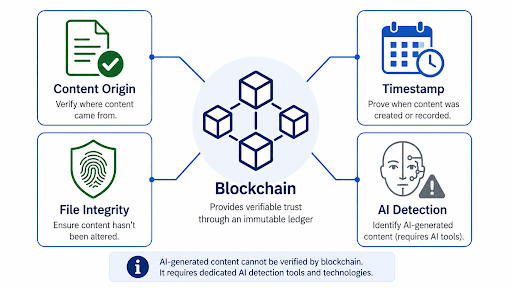
Figure 3: Blockchain helps verify a file's origin, timestamp, and integrity, but identifying AI-generated content still requires dedicated deepfake detection tools.
Also Read: Why Blockchain Is the Future of Trustworthy Public Records
The Road Ahead: A Hybrid Trust Model
Most experts studying this space agree there's no single fix. What's likely to actually work is a layered approach: blockchain handling content provenance and origin verification, AI-powered deepfake detection flagging likely synthetic manipulation, platform policies requiring clear labeling of AI-generated media, stronger digital forensics practices supporting legal and journalistic scrutiny, and emerging approaches such as AI watermarking, secure hardware-based capture, and standardized content credentials that further strengthen digital trust.
Media literacy matters too, helping everyday users know what to check before they believe or share something. Technology alone cannot solve the trust crisis if users continue sharing unverified content without considering its authenticity. Public awareness and responsible digital behavior will remain just as important as technological innovation. None of these alone solves the deepfake trust crisis. But stacked together, they start building the kind of trusted content ecosystem the internet badly needs, one where authenticity can be verified rather than simply assumed.
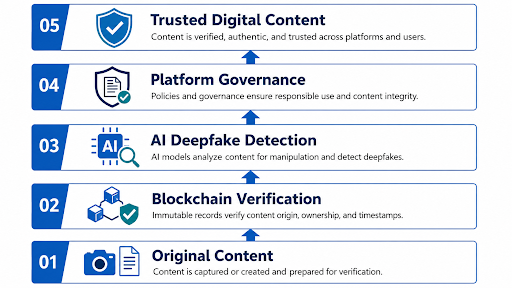
Figure 4: Building trust in digital media requires multiple layers of protection, combining blockchain verification, AI-powered deepfake detection, platform governance, and responsible content practices.
Conclusion
The deepfake trust crisis is reshaping how we think about finance, politics, journalism, and personal reputation, and it isn't going away anytime soon. Blockchain for digital content verification offers a genuinely useful piece of the solution, giving us a tamper-proof way to establish content provenance and rebuild trust in digital media.
But it works best as one layer in a broader system, alongside AI-driven deepfake detection and platform accountability, rather than as a standalone fix. As synthetic media becomes increasingly convincing, verification systems must evolve just as quickly.
Digital trust will increasingly depend on technologies that verify authenticity rather than expecting users to judge it themselves. Blockchain appears well positioned to become one important layer within a broader trust infrastructure that also includes AI-powered detection, content provenance standards, and responsible platform governance.
Also Read: Is Blockchain the Next Internet? Here’s What You Should Know
FAQs
Q1. Can blockchain detect deepfakes directly?
A: Not entirely. Blockchain can confirm whether a file has been altered since it was originally registered, but it cannot analyze the content itself to determine if it was AI-generated. That capability still requires dedicated AI detection tools working alongside blockchain verification.
Q2. What is C2PA and how does it relate to blockchain?
A: C2PA (Coalition for Content Provenance and Authenticity) is an industry initiative that embeds verifiable "Content Credentials" into media files. It uses cryptographic methods similar to blockchain to trace a file's origin and document its editing history.
Q3. Are there real companies using blockchain to fight deepfakes?
A: Yes. Truepic and Numbers Protocol are two notable examples, both leveraging blockchain technology to verify authentic, unaltered content for applications in journalism, insurance claims, and identity verification.
Q4. Why can't blockchain solve the deepfake problem alone?
A: Blockchain can only confirm whether a file has been modified. It cannot verify whether the original content was AI-generated. Combined with limited industry-wide adoption and low user awareness, this makes blockchain a valuable but incomplete solution on its own.
Q5. Will blockchain-based content verification become mainstream?
A: Given the rising frequency of deepfake incidents and growing support from major technology companies through initiatives like C2PA, broader adoption of blockchain-based content verification appears increasingly likely in the coming years.
Our Popular Courses

$14000


Doctoral Degree in Business Administration
Universidad Catolica De Murcia (UCAM), Spain
Duration:
2 - 3 Years
$17,500*
Integrated Doctorate of Business Administration
Guglielmo Marconi University, Italy
Universidad Catolica De Murcia (UCAM), Spain
Duration:
2.5 - 3.5 Years
$5,600*
Master of Business Administration
Guglielmo Marconi University, Italy
Duration:
12 - 24 Months
$5,600*
MBA in Operations & Project Management
Guglielmo Marconi University, Italy
Duration:
12 - 24 Months
$5,600*
Master in Supply Chain and Logistics Management
Guglielmo Marconi University, Italy
Duration:
12 - 24 Months
$5,950*
Master in Data Sciences
Guglielmo Marconi University, Italy
Duration:
12 - 24 Months
$5,600*
Master in Engineering Management
Guglielmo Marconi University, Italy
Duration:
12 - 24 Months
$5,600*
Master in Procurement and Contract Management
Guglielmo Marconi University, Italy
Duration:
12 - 24 Months
$5,600*
Master in Public Health
Guglielmo Marconi University, Italy
Duration:
12 - 24 MonthsOur Popular Courses
COMMENTS(0)
Our Popular Courses
$14000
Doctoral Degree in Business Administration
Universidad Catolica De Murcia (UCAM), Spain
Duration:
2 - 3 Years
$17,500*
Integrated Doctorate of Business Administration
Guglielmo Marconi University, Italy
Universidad Catolica De Murcia (UCAM), Spain
Duration:
2.5 - 3.5 Years
$5,600*
Master of Business Administration
Guglielmo Marconi University, Italy
Duration:
12 - 24 Months
$5,600*
MBA in Operations & Project Management
Guglielmo Marconi University, Italy
Duration:
12 - 24 Months
$5,600*
Master in Supply Chain and Logistics Management
Guglielmo Marconi University, Italy
Duration:
12 - 24 Months
$5,950*
Master in Data Sciences
Guglielmo Marconi University, Italy
Duration:
12 - 24 Months
$5,600*
Master in Engineering Management
Guglielmo Marconi University, Italy
Duration:
12 - 24 Months
$5,600*
Master in Procurement and Contract Management
Guglielmo Marconi University, Italy
Duration:
12 - 24 Months
$5,600*
Master in Public Health
Guglielmo Marconi University, Italy
Duration:
12 - 24 MonthsOur Popular Courses
Our Popular Insights
Careers are shifting faster than ever, and staying relevant takes more than experience. Explore UniAthena’s most-read blogs for sharp insights, emerging skills, and practical pathways that help you move forward with clarity and confidence in a changing professional world.



🌟 Students of the Month | May – June 2026 🌟
Read More
1
mins read





🌟 Students of the Month | May – June 2026 🌟
Read more
1
mins read
Get in Touch

It’s Time to Start
Join NowMost Popular Online Specialization
- Master of International Business Administration
- Master of Business Administration
- MBA in General Management- FastTrack
- Master in Innovation and Entrepreneurship
- MBA-Family Business Management
- Master in Procurement and Contract Management
- Extended Diploma in Business Analytics (SCQF Level 11)
- Diploma in Supply Chain and Logistics Management (SCQF Level 11)
- Strategic Human Resource Management Practitioner
- Master in Data Science
- Master in Engineering Management
Trending Online
- Integrated Doctorate of Business Administration
- Postgraduate Certificate in Finance for Next Generation Managers
- Master of Business Administration- General Management (Fast Track)
- Postgraduate Certificate in Socio-Economic and Legal Framework
- Postgraduate Certificate in Business Sustainability
- Certified Manager
- Supply Chain Management Practitioner
- MBA - AI in Business
- MBA - Accounting & Finance
- Master in Supply Chain and Logistics Management
Top Universities Online Certificates
- Postgraduate Certificate in International Marketing Management
- Postgraduate Certificate In International Human Resource Management
- Postgraduate Certificate in Strategic Management
- Postgraduate Certificate in Procurement & Contracts Management
- Postgraduate Certificate in Business Analytics
- Postgraduate Certificate in Strategic Supply Chain & Logistics Management
- Postgraduate Certificate in Human Resource and Leadership
- Project Management Practitioner
- Postgraduate Certificate in Supply Chain Design & Implementation
- Postgraduate Certificate in Management Accounting and Finance
Accredited Online Degree Program
- MBA - Digital Transformation
- MBA - Family Business Management
- MBA - Marketing Management
- MBA in Quality Management
- MBA - Business Intelligence & Data Analytics
- MBA in Operations & Project Management
- MBA in Energy Management
- MBA In Construction & Safety Management
- Master in Organisational Leadership
- Master in Public Health
- Master in Construction Management
- Bachelor of Arts in Business Administration


 Install Now


UniAthena is an Ed-Tech, offering flexible, affordable learning solutions, including Free-Learning Upskilling Courses and Academic Programs in partnerships with accredited and globally renowned universities and professional qualification bodies.


Do you have any questions ?
Feel free to send us your questions or request a free consultation
Send a message
UK
Athena Global Education
Magdalen Centre,
Robert Robinson Avenue,
Oxford, OX4 4GA, UK
Phone : 01865 784299
MIDDLE EAST
Athena Global Education FZE
Block L-03, First Floor,
P O Box 519265, Sharjah Publishing City,
Free Zone, Sharjah, UAE
Phone : +971 55 879 5492
INDIA
Uniathena Private Limited
9A,Midas Tower
Phase 1
Hinjewadi Rajiv Gandhi Infotech Park
Pune-411057
Phone: +91 9145665544
All Copyrights Reserved @ Athena Global Education 2021-2026