-

Bachelor's

-

Masters
-

MBA
-

Doctorate
-

Micro Credit
-

Explore all Courses
-
Postgraduate Certifications

-
Postgraduate Diploma
-
Undergraduate Diploma
-
Diploma



Why Financial Audits Are Moving Toward Blockchain Technology

Author: neha mondal
|7
MINS READ
| 0
| 15
Created On: 20 July, 2026
Share




Table of Contents (TOC):
- Introduction
- What Is Blockchain in Finance, Actually?
- How Blockchain Improves Financial Audits
- Blockchain in Risk Management
- The Honest Limitations
- Is Blockchain the Future of Financial Auditing?
Introduction
Financial audits are not exactly known for being exciting. They involve mountains of paperwork, weeks of back-and-forth verification, and a fair amount of trust that the numbers haven't been quietly changed somewhere along the way.
That last part is the problem. And blockchain is quietly solving it.
This blog breaks down how blockchain is being applied in financial audits and risk management. In plain language, with real context, and without the buzzword fog that usually surrounds this topic.
What Is Blockchain in Finance, Actually?
Let's start with the easiest way to grasp blockchain: think of a spreadsheet that is visible to many people but cannot be changed secretly by one person. All entries are designed to be highly resistant to unauthorized alteration, and every authorized change is permanently recorded and traceable. The same version of the truth can be verified at the same time by everyone who has access.
That's the core concept. Then do it with financial records, audit trails, and transaction histories. A digital ledger that is not managed by one organization but shared among multiple parties. Each transaction is packaged together in a block, the network verifies that block, and it is chained to the previous blocks. Once entered, it becomes extremely difficult to alter the information without network consensus and a transparent record of the change.
This establishes a secure history of financial transactions, making blockchain especially useful in any environment where transparency and accountability are crucial.
How Blockchain Improves Financial Audits
1. A Tamper-Proof Audit Trail
Traditional audits work by looking backwards. Auditors gather documents, compare records, and attempt to reconstruct events, weeks or months later. The trouble is that records can be modified, erased, or "accidentally" lost before anyone can see them.
By design, blockchain provides an audit trail that can't be erased. Each transaction is added to a block and is time-stamped. After being written, it becomes highly resistant to unauthorized modification, making any attempted changes transparent and traceable. Auditors do not need to assume the accuracy of the records; they can check them themselves.
This isn't only quicker. It is basically more dependable than any paper-based or conventional digital system.
2. Real-Time Auditing Instead of Annual Reviews
Most companies go through audits once a year. This means that problems can go unnoticed for a year before they are identified. The time it takes to flag is after the damage has been done.
With blockchain in accounting and auditing, financial data is updated continuously on a shared ledger. If auditors and regulators are allowed, they can keep track of transactions as they occur. Rather than a painful annual review, you have visibility all year long. The extent of this real-time visibility depends on governance arrangements, system integration, and the level of access granted to auditors, regulators, and other authorized participants.
It's similar to moving from an annual health checkup to a fitness tracker that you wear daily. The issues are identified at an earlier stage, before they become significant.
3. Fraud Detection Using Blockchain
Financial fraud typically takes place in the gaps between systems, between departments, between records that don't quite match. The tricksters use complexity and delay.
Blockchain removes both. Since each transaction is linked to previous records in an immutable ledger, unusual patterns become easier to identify when combined with appropriate monitoring systems and analytical tools. While blockchain strengthens transparency and traceability, organizations still rely on analytics, internal controls, and fraud detection systems to identify suspicious activity effectively.
There are already a number of financial institutions that are implementing blockchain-based systems to detect suspicious activity as it occurs. Something traditional fraud detection software, which is often based on rules set months ago, can't do.
4. Blockchain for Regulatory Compliance
Financial regulatory compliance can be costly and time-consuming. Companies invest a lot of resources to simply demonstrate to regulators that they complied with the regulations, collecting records, creating reports, and answering questions.
This is made much simpler with blockchain. The transparency and immutability of the ledger allow companies to provide direct access to regulators with the information they require. No more creating compliance packages from scratch. The evidence exists and is verifiable and timestamped.
Blockchain can also support more continuous monitoring where governance frameworks and access permissions allow. This enables regulators and auditors to identify potential issues earlier rather than relying solely on periodic reviews.
Blockchain in Risk Management
1. Financial Risk Assessment with Better Data
Risk management is as robust as the data it's based on. Without complete, timely, and possibly tampered data, your risk models are constructed on sand.
Blockchain provides risk teams with verified transaction records that offer greater transparency and traceability than many traditional systems. If all transactions in a supply chain, a loan portfolio, or a trading desk are written onto a shared ledger, the patterns that signal risk become far more obvious and much earlier.
This is important for financial institutions that are dealing with large portfolios. Pre-crisis indicators of counterparty risk, liquidity stress, or concentration can be identified.
2. Secure Financial Transactions and Smart Contracts
The smart contract is one of the most practical blockchain applications in finance, which is essentially a self-executing agreement written in code. If a specific condition is met, a payment or transfer will occur, or an action will take place without any action from the user.
From a risk management perspective, it is important because it eliminates human error and intentional manipulation in critical financial processes. A loan repayment that is automatically deducted when there are funds available. An insurance payout that is paid out as soon as a verified event has taken place. A trade that is executed in real-time without the need to wait for days for manual settlement.
Fewer manual handling equals fewer errors, fewer chances for fraud, and a lower risk of operational issues. However, smart contracts must be carefully designed, tested, and independently audited. Errors in the underlying code can automate mistakes just as efficiently as they automate legitimate financial processes.
3. Blockchain Governance and Accountability
Governance is one of the lesser-known use cases of blockchain in financial services. In large organizations, particularly financial institutions such as banks and investment companies, it is difficult to have clear accountability throughout complex hierarchies.
Blockchain provides an unarguable and permanent record of who approved what, when, and why. Effective governance also requires clearly defined permissions, identity management, and access controls to ensure that only authorized participants can validate, view, or record transactions. All transactions that impact the ledger can be traced. This is a strong tool for internal control, and it is also a good indicator of accountability to boards, shareholders, and regulators.
Blockchain allows the tracing of the exact cause of the failure and the exact party responsible.
Also Read: Smart but Trustworthy: Why AI Needs Blockchain
The Honest Limitations
Blockchain is not a magic fix. Implementation is expensive. Legacy financial systems don't always integrate easily. There are real questions about who controls the ledger and who gets access to what.
Organizations must also address scalability, interoperability with legacy financial systems, regulatory uncertainty, and cybersecurity considerations when implementing blockchain solutions at enterprise scale.
And like any technology, blockchain is only as good as the people and processes built around it. A transparent ledger doesn't help if nobody is looking at it.
But as a foundation for more reliable, more transparent, and more secure financial operations, it's one of the most significant tools available right now.
Also Read: Is Blockchain the Next Internet? Here’s What You Should Know
Is Blockchain the Future of Financial Auditing?
The direction appears increasingly positive, although adoption will likely vary across industries, jurisdictions, and regulatory environments. More financial institutions are piloting blockchain-based audit and compliance systems every year. Regulators in the EU, UK, and US are actively exploring how to incorporate blockchain data into oversight frameworks.
The future of financial auditing isn't a once-a-year exercise driven by paperwork. It's continuous, transparent, and verifiable, built on systems that don't rely on trust alone.
Blockchain doesn't eliminate the need for auditors or risk managers. It gives them better tools, better data, and more time to focus on judgment rather than verification.
That's not a small thing. In finance, judgment is everything.
Our Popular Courses

$14000


Doctoral Degree in Business Administration
Universidad Catolica De Murcia (UCAM), Spain
Duration:
2 - 3 Years
$17,500*
Integrated Doctorate of Business Administration
Guglielmo Marconi University, Italy
Universidad Catolica De Murcia (UCAM), Spain
Duration:
2.5 - 3.5 Years
$5,600*
Master of Business Administration
Guglielmo Marconi University, Italy
Duration:
12 - 24 Months
$5,600*
MBA in Operations & Project Management
Guglielmo Marconi University, Italy
Duration:
12 - 24 Months
$5,600*
Master in Supply Chain and Logistics Management
Guglielmo Marconi University, Italy
Duration:
12 - 24 Months
$5,950*
Master in Data Sciences
Guglielmo Marconi University, Italy
Duration:
12 - 24 Months
$5,600*
Master in Engineering Management
Guglielmo Marconi University, Italy
Duration:
12 - 24 Months
$5,600*
Master in Procurement and Contract Management
Guglielmo Marconi University, Italy
Duration:
12 - 24 Months
$5,600*
Master in Public Health
Guglielmo Marconi University, Italy
Duration:
12 - 24 MonthsOur Popular Courses
COMMENTS(0)
Our Popular Courses
$14000
Doctoral Degree in Business Administration
Universidad Catolica De Murcia (UCAM), Spain
Duration:
2 - 3 Years
$17,500*
Integrated Doctorate of Business Administration
Guglielmo Marconi University, Italy
Universidad Catolica De Murcia (UCAM), Spain
Duration:
2.5 - 3.5 Years
$5,600*
Master of Business Administration
Guglielmo Marconi University, Italy
Duration:
12 - 24 Months
$5,600*
MBA in Operations & Project Management
Guglielmo Marconi University, Italy
Duration:
12 - 24 Months
$5,600*
Master in Supply Chain and Logistics Management
Guglielmo Marconi University, Italy
Duration:
12 - 24 Months
$5,950*
Master in Data Sciences
Guglielmo Marconi University, Italy
Duration:
12 - 24 Months
$5,600*
Master in Engineering Management
Guglielmo Marconi University, Italy
Duration:
12 - 24 Months
$5,600*
Master in Procurement and Contract Management
Guglielmo Marconi University, Italy
Duration:
12 - 24 Months
$5,600*
Master in Public Health
Guglielmo Marconi University, Italy
Duration:
12 - 24 MonthsOur Popular Courses
Our Popular Insights
Careers are shifting faster than ever, and staying relevant takes more than experience. Explore UniAthena’s most-read blogs for sharp insights, emerging skills, and practical pathways that help you move forward with clarity and confidence in a changing professional world.

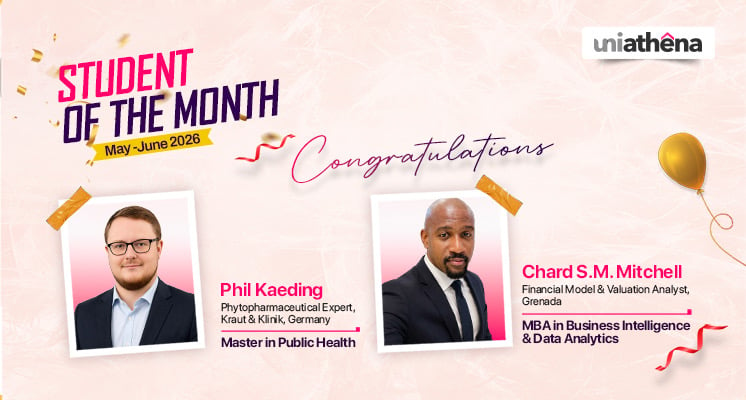
🌟 Students of the Month | May – June 2026 🌟
Read More
1
mins read





🌟 Students of the Month | May – June 2026 🌟
Read more
1
mins read

Get in Touch

It’s Time to Start
Join NowMost Popular Online Specialization
- Master of International Business Administration
- Master of Business Administration
- MBA in General Management- FastTrack
- Master in Innovation and Entrepreneurship
- MBA-Family Business Management
- Master in Procurement and Contract Management
- Extended Diploma in Business Analytics (SCQF Level 11)
- Diploma in Supply Chain and Logistics Management (SCQF Level 11)
- Strategic Human Resource Management Practitioner
- Master in Data Science
- Master in Engineering Management
Trending Online
- Integrated Doctorate of Business Administration
- Postgraduate Certificate in Finance for Next Generation Managers
- Master of Business Administration- General Management (Fast Track)
- Postgraduate Certificate in Socio-Economic and Legal Framework
- Postgraduate Certificate in Business Sustainability
- Certified Manager
- Supply Chain Management Practitioner
- MBA - AI in Business
- MBA - Accounting & Finance
- Master in Supply Chain and Logistics Management
Top Universities Online Certificates
- Postgraduate Certificate in International Marketing Management
- Postgraduate Certificate In International Human Resource Management
- Postgraduate Certificate in Strategic Management
- Postgraduate Certificate in Procurement & Contracts Management
- Postgraduate Certificate in Business Analytics
- Postgraduate Certificate in Strategic Supply Chain & Logistics Management
- Postgraduate Certificate in Human Resource and Leadership
- Project Management Practitioner
- Postgraduate Certificate in Supply Chain Design & Implementation
- Postgraduate Certificate in Management Accounting and Finance
Accredited Online Degree Program
- MBA - Digital Transformation
- MBA - Family Business Management
- MBA - Marketing Management
- MBA in Quality Management
- MBA - Business Intelligence & Data Analytics
- MBA in Operations & Project Management
- MBA in Energy Management
- MBA In Construction & Safety Management
- Master in Organisational Leadership
- Master in Public Health
- Master in Construction Management
- Bachelor of Arts in Business Administration


 Install Now


UniAthena is an Ed-Tech, offering flexible, affordable learning solutions, including Free-Learning Upskilling Courses and Academic Programs in partnerships with accredited and globally renowned universities and professional qualification bodies.


Do you have any questions ?
Feel free to send us your questions or request a free consultation
Send a message
UK
Athena Global Education
Magdalen Centre,
Robert Robinson Avenue,
Oxford, OX4 4GA, UK
Phone : 01865 784299
MIDDLE EAST
Athena Global Education FZE
Block L-03, First Floor,
P O Box 519265, Sharjah Publishing City,
Free Zone, Sharjah, UAE
Phone : +971 55 879 5492
INDIA
Uniathena Private Limited
9A,Midas Tower
Phase 1
Hinjewadi Rajiv Gandhi Infotech Park
Pune-411057
Phone: +91 9145665544
All Copyrights Reserved @ Athena Global Education 2021-2026