-

Bachelor's

-

Masters
-

MBA
-

Doctorate
-

Micro Credit
-

Explore all Courses
-
Postgraduate Certifications

-
Postgraduate Diploma
-
Undergraduate Diploma
-
Diploma



Multi-Cloud Security: Challenges, Myths, and Best Practices
Author: maria rashid
|8
MINS READ
| 0
| 13
Created On: 23 June, 2026
Share




Table of Contents (TOC):
- Introduction
- Key Takeaways
- What is a Multi-Cloud Structure?
- What is Multi-Cloud Security?
- Multi-Cloud Security Architecture
- Challenges in Multi-Cloud Security
- Popular Myths About Multi-Cloud Security
- Best Practices for Multi-Cloud Security
- Conclusion
- FAQs
Introduction
As the business landscape is leading towards a digitalized economy, businesses are heavily relying upon multi-cloud providers. While a multi-cloud provider provides flexibility and efficiency to businesses, it also poses certain security and compliance risks. Managing digital security across different platforms has become more complex than ever.
To secure data and remove cyber threats, businesses should know what multi-cloud security is. With the correct implementation of multi-cloud security systems, businesses can build more secure and resilient digital environments. However, as organisations expand across multiple cloud platforms, security challenges often become more complex rather than simply more distributed
Key Takeaways:
- A multi-cloud structure means using the services of various cloud providers. But this practice increases security complexity.
- Multi-cloud security helps in preventing risks and protects data and workloads across multiple cloud platforms.
- Common multi-cloud security challenges include poor visibility, misconfigurations, and inconsistent policies.
- A strong cloud security system requires identity management, encryption, and continuous monitoring.
- Businesses need a well-planned multi-cloud architecture to improve their cloud data security and protection.
What is a Multi-Cloud Structure?
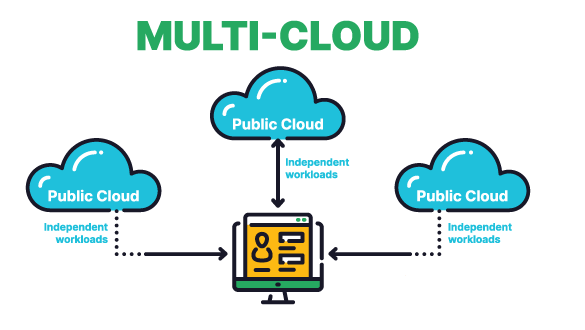
In a multi-cloud structure, organizations use services from multiple cloud service providers instead of relying on a single vendor. Organizations may use different cloud platforms to enhance their efficiency, flexibility, performance, and reliability.
For instance, an organization may utilize:
- Azure for application hosting
- Amazon warehouse services for storage
- Google Cloud for AI tools and analytics
A multi-cloud approach allows businesses to fetch the best services from various providers as per their operational and strategic needs.
Although a multi-cloud structure provides various benefits to businesses, it also poses various compliance issues and increases security complexity. That is why businesses should be very careful when using a multi-cloud structure and focus on the best multi-cloud security strategies to protect data and applications.
What is Multi-Cloud Security?
Multi-cloud security refers to the strategies, technologies, or policies that protect applications, data, and infrastructure across multiple service providers. It aims to provide a comprehensive and consistent risk management approach to secure all applications, workloads, and APIs in the environment of an organization, regardless of where they are hosted.
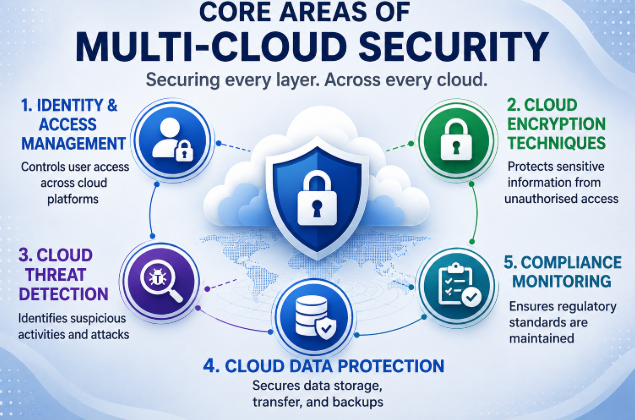
Multi-cloud security enables consistent visibility, security, governance, and policy across multiple cloud environments through a single point of management.
Multi-Cloud Security Architecture
A multi-cloud security structure typically includes the following components to provide a layered security system for multiple clouds.
- Centralized Management: Provides consolidated monitoring, logging, reporting, and governance across all clouds.
- Core Services: Improve cloud structure security through networking, traffic control, and segmentation.
- Advanced Services: Use advanced tools like zero-trust network access (ZTNA) to provide strong protection and security.
- Data Protection: Data is secured and protected through encryption, disaster recovery, and backup systems.
- Identity & Access Management (IAM): The multi-cloud security systems control user and application access to enhance security across multiple cloud platforms.
- Network Security: Multi-cloud architecture uses secure connections and protocols to protect data moving between networks.
- API Management: Provide protection and security for APIs and applications working across multiple clouds.
- Compliance and Governance Policies: Ensure that the security policies meet industry regulations and compliance requirements.
- Threat Detection and Response Capabilities: Quickly detect and respond to cyber threats across multiple cloud environments.
- Ecosystem Integrations: Integrates automation systems, security tools, and application delivery services to enhance efficiency and flexibility.
While these components are often discussed individually, their effectiveness depends on how they work together. Identity and Access Management (IAM), for example, frequently acts as the control layer that connects multiple cloud environments. Weak identity controls can undermine encryption, monitoring, and network security measures, regardless of how advanced those systems are.
Similarly, visibility and threat detection depend on consistent logging and governance policies across providers. In practice, multi-cloud security is less about securing individual services and more about maintaining consistent controls across different environments, architectures, and operating models.
Modern multi-cloud environments are also increasingly adopting Zero Trust principles, where every user, device, application, and connection must be continuously verified rather than automatically trusted. This approach helps organisations reduce risks associated with distributed infrastructure and remote access.
Another growing component is Cloud Security Posture Management (CSPM), which continuously monitors cloud environments for misconfigurations, compliance violations, and security gaps. CSPM tools help organisations maintain consistent security standards across multiple providers and reduce the risk of configuration-related breaches.
Challenges in Multi-Cloud Security
Multi-cloud security systems experience certain challenges because it is complex to manage security across multiple cloud platforms. It creates several operational and technical challenges.
Some of these common challenges are as follows:
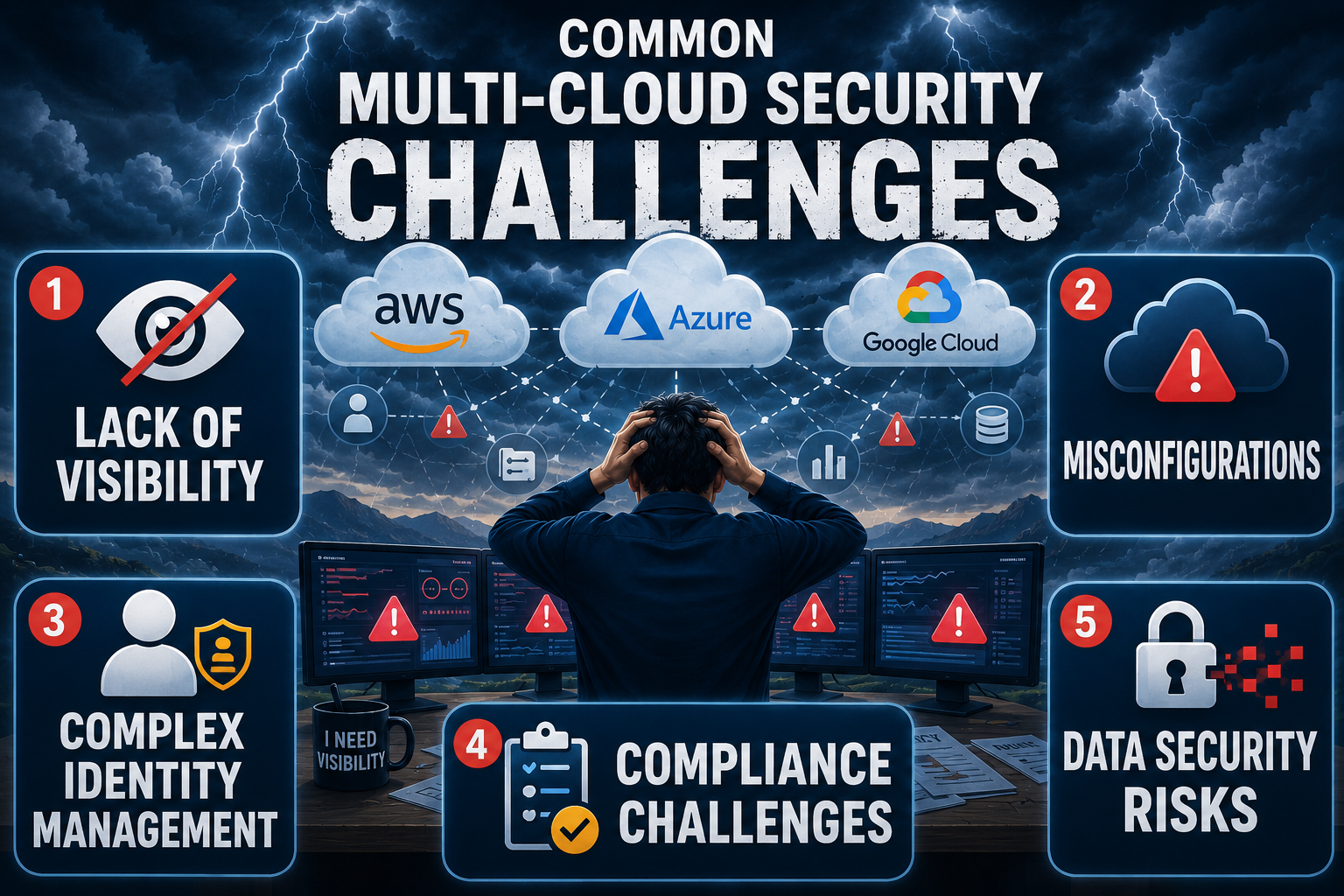
1. Lack of Visibility:
In a multi-cloud security system, the inability to achieve complete visibility arises because each service provider has its own management console, dashboards, monitoring tools, and configurations. This hampers threat detection, and threats could go unnoticed as it becomes difficult to monitor all sources from one place.
Beyond visibility gaps, organisations often struggle with fragmented logging systems, inconsistent monitoring tools, and operational blind spots across providers. Security teams may also experience alert fatigue when different platforms generate large volumes of notifications without sufficient context, making it more difficult to identify genuine threats quickly.
2. Misconfigurations:
Each service provider has different configuration settings and policies; therefore, it is possible that organizations may accidentally leave resources exposed due to a lack of expertise or human error.
Misconfigurations remain one of the leading causes of cloud security incidents because each provider implements services, permissions, and controls differently. As organisations expand their cloud footprint, maintaining consistent security configurations becomes increasingly difficult.
3. Complexity in Identity Management:
Large organizations with a large number of employees, vendors, and third-party applications face issues with managing identities and user permissions across multiple platforms. Without a centralized identity management system, organizations struggle with consistent access policies.
4. Compliance Challenges:
The data privacy policies and regulations are different in different industries and regions. Therefore, ensuring that each service provider meets compliance requirements becomes difficult.
5. Data Security Risks:
In multi-cloud environments, data is continuously being transferred and moved between users, applications, devices, and providers. Therefore, it becomes vulnerable during moving or storage without proper encryption techniques and monitoring systems.
6. Policy Inconsistency Across Providers:
Different cloud providers often implement security controls, access policies, and compliance frameworks differently. As a result, organisations may unintentionally create gaps between environments, leading to inconsistent governance and increased security risks. Maintaining policy consistency across platforms is often one of the most overlooked challenges in multi-cloud security.
7. Complexity Versus Resilience:
One of the central trade-offs in multi-cloud security is the balance between resilience and complexity. Using multiple cloud providers can reduce dependence on a single vendor, improve availability, and strengthen business continuity. However, it also increases the attack surface, expands governance requirements, and introduces additional operational complexity. Organisations must carefully balance these benefits against the security challenges created by managing multiple environments simultaneously.
Also Read: Inside AI-Driven Cybersecurity: How Modern Threats Are Detected in Real Time
Popular Myths About Multi-Cloud Security

Certain misconceptions about multi-cloud security systems may result in security gaps and increased security risks. Let us know about some of the popular myths and their reality:
Myth 1: More Cloud Providers mean Better Protection
Many businesses assume that using the services of multiple cloud platforms increases their security. But in reality, it does not actually guarantee protection. Each provider has its own configurations and management console, which, without proper monitoring and consistent policies, creates more complexity across the cloud environment.
Myth 2: Cloud Providers Are Responsible for Complete Security
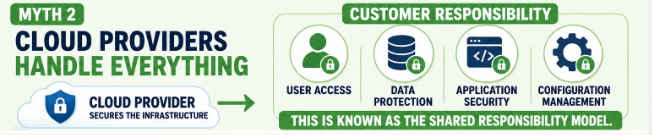
This is one of the biggest misunderstandings about multi-cloud security systems. While the service providers are responsible and take care of their own infrastructure, organizations are still responsible for protecting their own applications, user access, and data. This is known as the shared responsibility model.
Myth 3: Multi-Cloud Security Is Only Important for Large Enterprises
It is a very big misconception that cyber criminals only target large organizations and enterprises. However, cyber attackers often target small enterprises because they believe small enterprises may have weak security systems and controls. At present, businesses of all sizes use cloud platforms for their varied uses.
Myth 4: Multi-Cloud Environments Are Too Difficult to Secure
Many users believe that multi-cloud environments are very difficult to secure. But in reality, multi-cloud security systems provide centralized monitoring systems, automated threat detection, and maintain consistent security policies.
Also Read: A Critical Evaluation of Generative AI in Enhancing and Challenging Cloud Security
Best Practices for Multi-Cloud Security
Following the best practices for implementing a multi-cloud security system helps organizations improve and strengthen protection across cloud environments.
Organisations should also consider integrating Infrastructure as Code (IaC) security into their development processes. By embedding security checks directly into automated deployment pipelines, teams can identify vulnerabilities and configuration issues before resources are deployed to production environments.
Additionally, AI-powered threat detection solutions are becoming increasingly valuable in multi-cloud environments. These systems can analyse large volumes of activity data, identify unusual behaviour patterns, and accelerate incident response across distributed cloud infrastructures.
Also Read: How Small Businesses Can Strengthen Their Cloud Security
Conclusion
As businesses increasingly adopt multi-cloud structures to support operational flexibility and resilience, securing those environments becomes a strategic priority rather than a purely technical task. Multi-cloud security is not simply about protecting individual cloud platforms. It is about maintaining consistent visibility, governance, identity controls, and security policies across multiple providers operating under different architectures and management models.
The challenge is no longer securing a cloud environment. It is maintaining effective security across several cloud environments that operate under different controls, configurations, and compliance requirements. Organisations that successfully balance flexibility with governance and resilience with security will be better positioned to manage evolving cyber threats while fully realising the benefits of multi-cloud adoption.
FAQs
Q1. What is a multi-cloud structure?
A: A multi-cloud structure is one where a business uses the services of multiple cloud service providers rather than using just a single vendor.
Q2.What is multi-cloud security?
A: Multi-cloud security refers to the technologies, policies, and strategies that are used or implemented to protect and secure data and applications across a multi-cloud structure.
Q3. What are the challenges in multi-cloud security?
A: The major challenges in a multi-cloud security system are: lack of complete visibility, increased misconfigurations, data breaches, identity and access management complexity, and compliance issues.
Q4. How can companies overcome the challenges present in multi-cloud security systems?
A: Companies can use and implement best practices for multi-cloud systems, such as complete encryption, standardized security frameworks, unified monitoring, automated threat detection, etc.
Our Popular Courses

$14000


Doctoral Degree in Business Administration
Universidad Catolica De Murcia (UCAM), Spain
Duration:
2 - 3 Years
$17500*
Integrated Doctorate of Business Administration
Guglielmo Marconi University, Italy
Universidad Catolica De Murcia (UCAM), Spain
Duration:
2.5 - 3.5 Years
$5600*
Master of Business Administration
Guglielmo Marconi University, Italy
Duration:
12 - 24 Months
$5600*
MBA in Operations & Project Management
Guglielmo Marconi University, Italy
Duration:
12 - 24 Months
$5600*
Master in Supply Chain and Logistics Management
Guglielmo Marconi University, Italy
Duration:
12 - 24 Months
$5950*
Master in Data Sciences
Guglielmo Marconi University, Italy
Duration:
12 - 24 Months
$5600*
Master in Engineering Management
Guglielmo Marconi University, Italy
Duration:
12 - 24 Months
$5600*
Master in Procurement and Contract Management
Guglielmo Marconi University, Italy
Duration:
12 - 24 Months
$5600*
Master in Public Health
Guglielmo Marconi University, Italy
Duration:
12 - 24 MonthsOur Popular Courses
COMMENTS(0)
Our Popular Courses
$14000
Doctoral Degree in Business Administration
Universidad Catolica De Murcia (UCAM), Spain
Duration:
2 - 3 Years
$17500*
Integrated Doctorate of Business Administration
Guglielmo Marconi University, Italy
Universidad Catolica De Murcia (UCAM), Spain
Duration:
2.5 - 3.5 Years
$5600*
Master of Business Administration
Guglielmo Marconi University, Italy
Duration:
12 - 24 Months
$5600*
MBA in Operations & Project Management
Guglielmo Marconi University, Italy
Duration:
12 - 24 Months
$5600*
Master in Supply Chain and Logistics Management
Guglielmo Marconi University, Italy
Duration:
12 - 24 Months
$5950*
Master in Data Sciences
Guglielmo Marconi University, Italy
Duration:
12 - 24 Months
$5600*
Master in Engineering Management
Guglielmo Marconi University, Italy
Duration:
12 - 24 Months
$5600*
Master in Procurement and Contract Management
Guglielmo Marconi University, Italy
Duration:
12 - 24 Months
$5600*
Master in Public Health
Guglielmo Marconi University, Italy
Duration:
12 - 24 MonthsOur Popular Courses
Our Popular Insights
Careers are shifting faster than ever, and staying relevant takes more than experience. Explore UniAthena’s most-read blogs for sharp insights, emerging skills, and practical pathways that help you move forward with clarity and confidence in a changing professional world.

How Do I Improve My Grammar?
Read More
5
mins read

🌟 Top Project Performer – May 2026 🌟
Read More
1
mins read



🌟 Top Project Performer – April 2026 🌟
Read More
1
mins read

Best Courses In The Philippines 2026
Read More
7
mins read



How Do I Improve My Grammar?
Read more
5
mins read
🌟 Top Project Performer – May 2026 🌟
Read more
1
mins read
🌟 Top Project Performer – April 2026 🌟
Read more
1
mins read
Best Courses In The Philippines 2026
Read more
7
mins read
Get in Touch

It’s Time to Start
Join NowMost Popular Online Specialization
- Master of International Business Administration
- Master of Business Administration
- MBA in General Management- FastTrack
- Master in Innovation and Entrepreneurship
- MBA-Family Business Management
- Master in Procurement and Contract Management
- Extended Diploma in Business Analytics (SCQF Level 11)
- Diploma in Supply Chain and Logistics Management (SCQF Level 11)
- Strategic Human Resource Management Practitioner
- Master in Data Science
- Master in Engineering Management
Trending Online
- Integrated Doctorate of Business Administration
- Postgraduate Certificate in Finance for Next Generation Managers
- Master of Business Administration- General Management (Fast Track)
- Postgraduate Certificate in Socio-Economic and Legal Framework
- Postgraduate Certificate in Business Sustainability
- Certified Manager
- Supply Chain Management Practitioner
- MBA - AI in Business
- MBA - Accounting & Finance
- Master in Supply Chain and Logistics Management
Top Universities Online Certificates
- Postgraduate Certificate in International Marketing Management
- Postgraduate Certificate In International Human Resource Management
- Postgraduate Certificate in Strategic Management
- Postgraduate Certificate in Procurement & Contracts Management
- Postgraduate Certificate in Business Analytics
- Postgraduate Certificate in Strategic Supply Chain & Logistics Management
- Postgraduate Certificate in Human Resource and Leadership
- Project Management Practitioner
- Postgraduate Certificate in Supply Chain Design & Implementation
- Postgraduate Certificate in Management Accounting and Finance
Accredited Online Degree Program
- MBA - Digital Transformation
- MBA - Family Business Management
- MBA - Marketing Management
- MBA in Quality Management
- MBA - Business Intelligence & Data Analytics
- MBA in Operations & Project Management
- MBA in Energy Management
- MBA In Construction & Safety Management
- Master in Organisational Leadership
- Master in Public Health
- Master in Construction Management
- Bachelor of Arts in Business Administration


 Install Now


UniAthena is an Ed-Tech, offering flexible, affordable learning solutions, including Free-Learning Upskilling Courses and Academic Programs in partnerships with accredited and globally renowned universities and professional qualification bodies.


Do you have any questions ?
Feel free to send us your questions or request a free consultation
Send a message
UK
Athena Global Education
Magdalen Centre,
Robert Robinson Avenue,
Oxford, OX4 4GA, UK
Phone : 01865 784299
MIDDLE EAST
Athena Global Education FZE
Block L-03, First Floor,
P O Box 519265, Sharjah Publishing City,
Free Zone, Sharjah, UAE
Phone : +971 55 879 5492
INDIA
Uniathena Private Limited
9A,Midas Tower
Phase 1
Hinjewadi Rajiv Gandhi Infotech Park
Pune-411057
Phone: +91 9145665544
All Copyrights Reserved @ Athena Global Education 2021-2026