-

Bachelor's

-

Masters
-

MBA
-

Doctorate
-

Micro Credit
-

Explore all Courses
-
Postgraduate Certifications

-
Postgraduate Diploma
-
Undergraduate Diploma
-
Diploma



A Critical Evaluation of Generative AI in Enhancing and Challenging Cloud Security

Author: priyanka chatterjee
|4
MINS READ
| 0
| 95
Created On: 06 May, 2026
Share




Table of Contents (TOC):
- The Transformative Power of Generative AI in Cloud Security
- Reinforcing Data Protection and Privacy Through AI
- The Emerging Risks of Generative AI
- Balancing Innovation with Control
- Conclusion
The cloud was once seen as a stronghold, scalable, resilient, and secure by design. But as organisations rush to integrate generative AI into their workflows, that stronghold is evolving into something far more dynamic and unpredictable. Generative AI is not just another tool in cybersecurity; it is a double-edged force, both strengthening and challenging cloud security in ways we are only beginning to understand.
While it accelerates detection and response, it also introduces new forms of dependency, complexity, and risk that traditional security models were not designed to handle.
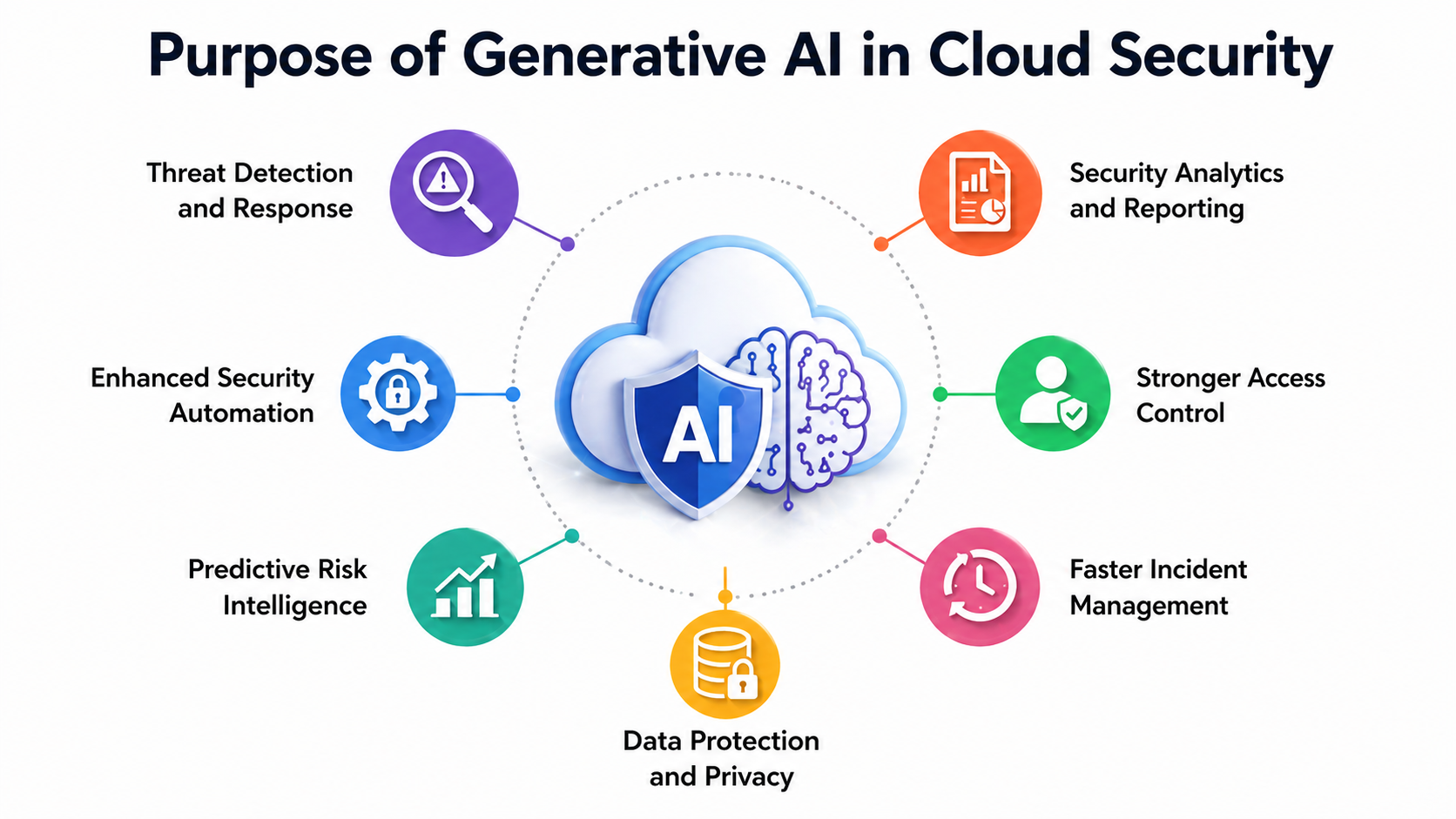
The Transformative Power of Generative AI in Cloud Security
Generative AI is changing how security works in cloud environments. Traditional rule-based systems are being replaced by smarter models that can learn patterns, identify unusual activity, and respond in real time. This shift has improved cloud computing security, especially in areas like anomaly detection, AI, and threat detection systems.
AI-driven automation helps organisations handle large amounts of data across different layers of cloud infrastructure security. For example, AI threat intelligence can help predict new types of cyberattacks, while incident response automation allows faster action without waiting for human input. However, while automation reduces response time, it can also increase false positives in complex environments, creating operational noise that teams must manage carefully.
These features support modern zero-trust security, where every access request is checked instead of automatically trusted. Generative AI also plays an important role in development practices like DevSecOps security, where security is built into the process. This approach, often called security as code, helps teams find and fix issues early, improving overall cloud risk management.
In practice, organisations using AI-assisted monitoring have reported faster detection cycles, but they also face challenges in interpreting AI-generated alerts, particularly when models operate as black-box systems.
Reinforcing Data Protection and Privacy Through AI
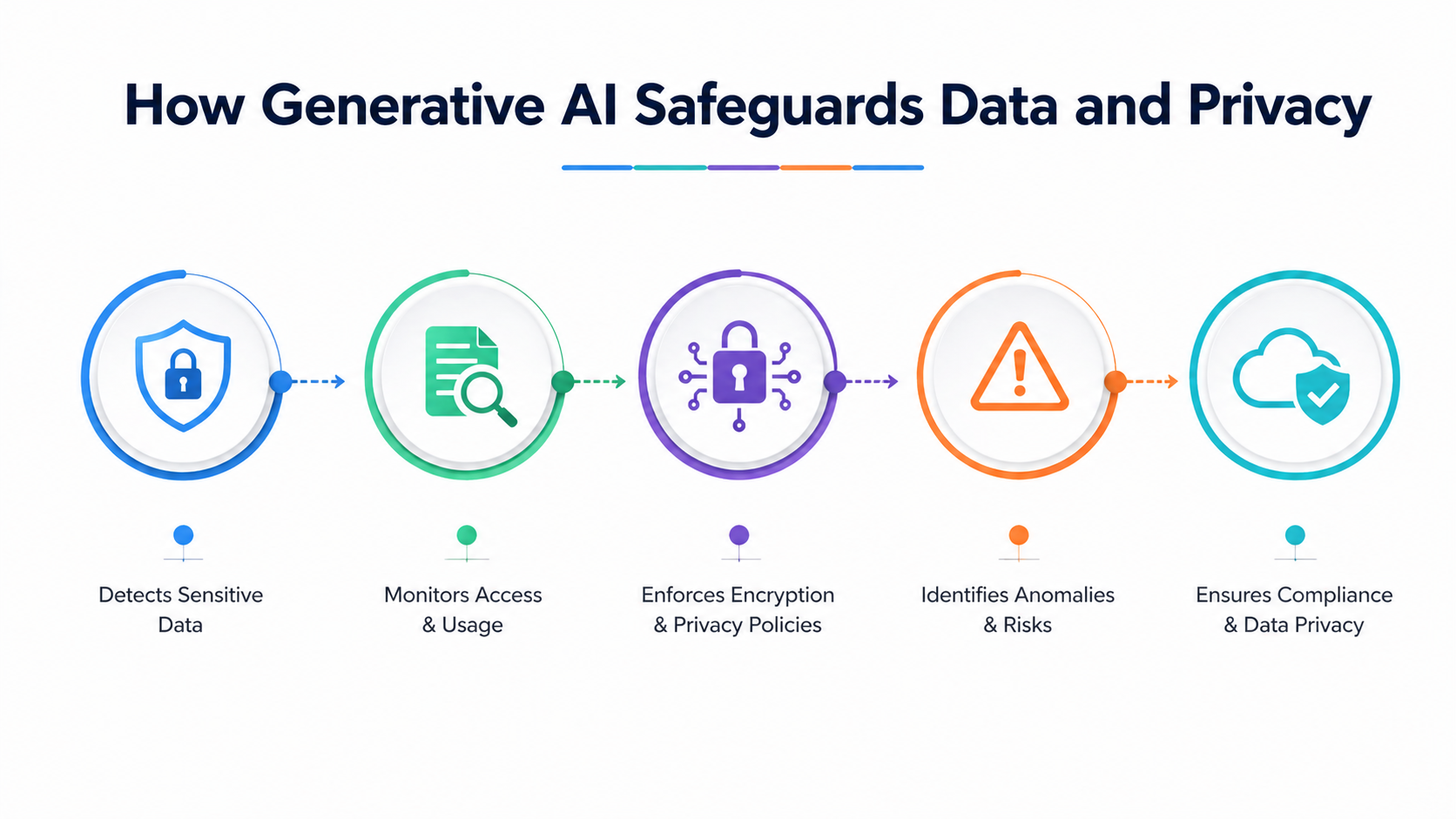
Generative AI also helps improve data security in cloud computing. It can track how data is accessed, apply encryption rules, and detect unusual behaviour that may signal a security problem. In terms of the data privacy cloud, AI can automatically identify sensitive data and help organisations follow privacy regulations.
In addition, AI-powered monitoring systems give continuous visibility into cloud environments. This makes it easier for organisations to manage complex systems, especially as multi-cloud and hybrid setups become more common.
However, this same capability introduces a trade-off. The more data AI systems require to function effectively, the greater the exposure risk if that data is improperly governed or accessed.
The Emerging Risks of Generative AI
Even with its benefits, generative AI brings serious generative AI security risks. One major concern is that attackers can use AI to create more advanced threats, such as realistic phishing messages or automated hacking tools.
For instance, AI-generated phishing emails can now mimic internal communication styles, making them significantly harder for employees to detect. This increases the success rate of social engineering attacks despite improved defensive systems.
AI systems themselves can also be targeted. If they are compromised, they may give incorrect results, ignore cloud risks and controls, or provide misleading threat information. This can reduce trust in generative AI cybersecurity and create new weaknesses in cloud systems.
In some cases, biased or incomplete training data can lead to misclassification of threats, where genuine risks are overlooked while harmless activity is flagged, weakening the overall security posture.
Another concern is data privacy. Generative AI depends on large amounts of data, which raises questions about how sensitive information is stored and used. Poor handling of data in data privacy cloud environments can lead to data leaks or legal issues.
Balancing Innovation with Control
To safely use generative AI, organisations need a balanced approach. Strong cloud risk management is important, including proper access control, regular system checks, and continuous monitoring. Following zero-trust security ensures that no system, including AI, is trusted without verification.
It is also important to include AI governance in DevSecOps practices. By adding security checks at every stage, organisations can better control both their cloud systems and AI tools.
The challenge lies in maintaining control without slowing innovation. Over-reliance on AI-driven automation can reduce human oversight, while excessive control can limit the efficiency gains AI is meant to deliver.
Conclusion
Generative AI is changing the future of cloud security. It provides powerful tools for faster response and better protection, but it also introduces new risks that cannot be ignored.
The real challenge is not whether to adopt generative AI, but how to manage its dual impact. As AI capabilities advance, security frameworks must evolve at the same pace, or risk falling behind the very systems they are designed to protect.
Generative AI will continue to reshape cloud security, whether organisations are fully prepared or not. The advantage will lie with those who treat it not just as a tool, but as a system that requires constant governance, scrutiny, and strategic control.
References:
- https://www.microsoft.com/en-us/security/blog/2025/10/30/the-5-generative-ai-security-threats-you-need-to-know-about-detailed-in-new-e-book/
- Generative AI revolution in cybersecurity: a comprehensive review of threat intelligence and operations
- Securing Generative AI Systems: Threat-Centric Architectures and the Impact of Divergent EU–US Governance Regimes
- https://www.techtarget.com/searchSecurity/tip/Ways-AI-is-transforming-cloud-security-according-to-experts
Our Popular Courses

$14000


Doctoral Degree in Business Administration
Universidad Catolica De Murcia (UCAM), Spain
Duration:
2 - 3 Years
$17,500*
Integrated Doctorate of Business Administration
Guglielmo Marconi University, Italy
Universidad Catolica De Murcia (UCAM), Spain
Duration:
2.5 - 3.5 Years
$5,600*
Master of Business Administration
Guglielmo Marconi University, Italy
Duration:
12 - 24 Months
$5,600*
MBA in Operations & Project Management
Guglielmo Marconi University, Italy
Duration:
12 - 24 Months
$5,600*
Master in Supply Chain and Logistics Management
Guglielmo Marconi University, Italy
Duration:
12 - 24 Months
$5,950*
Master in Data Sciences
Guglielmo Marconi University, Italy
Duration:
12 - 24 Months
$5,600*
Master in Engineering Management
Guglielmo Marconi University, Italy
Duration:
12 - 24 Months
$5,600*
Master in Procurement and Contract Management
Guglielmo Marconi University, Italy
Duration:
12 - 24 Months
$5,600*
Master in Public Health
Guglielmo Marconi University, Italy
Duration:
12 - 24 MonthsOur Popular Courses
COMMENTS(0)
Our Popular Courses
$14000
Doctoral Degree in Business Administration
Universidad Catolica De Murcia (UCAM), Spain
Duration:
2 - 3 Years
$17,500*
Integrated Doctorate of Business Administration
Guglielmo Marconi University, Italy
Universidad Catolica De Murcia (UCAM), Spain
Duration:
2.5 - 3.5 Years
$5,600*
Master of Business Administration
Guglielmo Marconi University, Italy
Duration:
12 - 24 Months
$5,600*
MBA in Operations & Project Management
Guglielmo Marconi University, Italy
Duration:
12 - 24 Months
$5,600*
Master in Supply Chain and Logistics Management
Guglielmo Marconi University, Italy
Duration:
12 - 24 Months
$5,950*
Master in Data Sciences
Guglielmo Marconi University, Italy
Duration:
12 - 24 Months
$5,600*
Master in Engineering Management
Guglielmo Marconi University, Italy
Duration:
12 - 24 Months
$5,600*
Master in Procurement and Contract Management
Guglielmo Marconi University, Italy
Duration:
12 - 24 Months
$5,600*
Master in Public Health
Guglielmo Marconi University, Italy
Duration:
12 - 24 MonthsOur Popular Courses
Our Popular Insights
Careers are shifting faster than ever, and staying relevant takes more than experience. Explore UniAthena’s most-read blogs for sharp insights, emerging skills, and practical pathways that help you move forward with clarity and confidence in a changing professional world.


How to Switch Career to Data Analytics?
Read More
6
mins read




How to Switch Career to Data Analytics?
Read more
6
mins read

Get in Touch

It’s Time to Start
Join NowMost Popular Online Specialization
- Master of International Business Administration
- Master of Business Administration
- MBA in General Management- FastTrack
- Master in Innovation and Entrepreneurship
- MBA-Family Business Management
- Master in Procurement and Contract Management
- Extended Diploma in Business Analytics (SCQF Level 11)
- Diploma in Supply Chain and Logistics Management (SCQF Level 11)
- Strategic Human Resource Management Practitioner
- Master in Data Science
- Master in Engineering Management
Trending Online
- Integrated Doctorate of Business Administration
- Postgraduate Certificate in Finance for Next Generation Managers
- Master of Business Administration- General Management (Fast Track)
- Postgraduate Certificate in Socio-Economic and Legal Framework
- Postgraduate Certificate in Business Sustainability
- Certified Manager
- Supply Chain Management Practitioner
- MBA - AI in Business
- MBA - Accounting & Finance
- Master in Supply Chain and Logistics Management
Top Universities Online Certificates
- Postgraduate Certificate in International Marketing Management
- Postgraduate Certificate In International Human Resource Management
- Postgraduate Certificate in Strategic Management
- Postgraduate Certificate in Procurement & Contracts Management
- Postgraduate Certificate in Business Analytics
- Postgraduate Certificate in Strategic Supply Chain & Logistics Management
- Postgraduate Certificate in Human Resource and Leadership
- Project Management Practitioner
- Postgraduate Certificate in Supply Chain Design & Implementation
- Postgraduate Certificate in Management Accounting and Finance
Accredited Online Degree Program
- MBA - Digital Transformation
- MBA - Family Business Management
- MBA - Marketing Management
- MBA in Quality Management
- MBA - Business Intelligence & Data Analytics
- MBA in Operations & Project Management
- MBA in Energy Management
- MBA In Construction & Safety Management
- Master in Organisational Leadership
- Master in Public Health
- Master in Construction Management
- Bachelor of Arts in Business Administration


 Install Now


UniAthena is an Ed-Tech, offering flexible, affordable learning solutions, including Free-Learning Upskilling Courses and Academic Programs in partnerships with accredited and globally renowned universities and professional qualification bodies.


Do you have any questions ?
Feel free to send us your questions or request a free consultation
Send a message
UK
Athena Global Education
Magdalen Centre,
Robert Robinson Avenue,
Oxford, OX4 4GA, UK
Phone : 01865 784299
MIDDLE EAST
Athena Global Education FZE
Block L-03, First Floor,
P O Box 519265, Sharjah Publishing City,
Free Zone, Sharjah, UAE
Phone : +971 55 879 5492
INDIA
Uniathena Private Limited
9A,Midas Tower
Phase 1
Hinjewadi Rajiv Gandhi Infotech Park
Pune-411057
Phone: +91 9145665544
All Copyrights Reserved @ Athena Global Education 2021-2026