-

Bachelor's

-

Masters
-

MBA
-

Doctorate
-

Micro Credit
-

Explore all Courses
-
Postgraduate Certifications

-
Postgraduate Diploma
-
Undergraduate Diploma
-
Diploma



Doctorate in Project Management: Is It Worth It?

Author: aishwarya sancheti
|8
MINS READ
| 0
| 3
Created On: 22 June, 2026
Share




Table of Contents (TOC):
- Introduction
- Key Takeaways
- First, Let's Clear Up the Alphabet Soup
- Is Project Management a Good DBA Specialization?
- What the Data Actually Says About Project Management Career Growth
- Highest Paying Project Management Jobs - Where a Doctorate Positions You
- DBA Project Management Salary: Honest Expectations
- Is a DBA Degree Worth It?
- What Makes a Strong Online Doctorate in a Project Management Program?
- A Program Worth Knowing: UniAthena's DBA in Project Management
- Project Management Leadership Skills a Doctorate Develops (That Nothing Else Does)
- Conclusion
- FAQs
Introduction
Most senior project management professionals reach a point where a PMP (Project Management Professional certification) or even an MBA no longer moves the needle. You've led complex portfolios, managed cross-functional teams, and navigated organizational chaos. The question you're quietly sitting with isn't "should I keep growing?" - it's "what kind of growth actually matters at this stage?"
A doctorate in project management is one answer. But it's not the right answer for everyone, and this blog won't pretend otherwise.
Here's what this actually covers: what a DBA in project management is, what it's not, whether the salary and career outcomes justify it, and how to honestly assess if this is the move for you.
Key Takeaways:
- A DBA in Project Management is designed for experienced professionals seeking executive influence, not just project delivery expertise.
- Project management remains one of the fastest-growing leadership disciplines globally, with demand continuing to rise across industries.
- Doctoral-level professionals often transition into enterprise leadership, consulting, PMO governance, and strategic transformation roles.
- The value of a DBA lies in career repositioning, thought leadership, and organizational impact rather than an immediate salary increase.
- Strong online doctorate programs combine academic rigor, applied research, industry-relevant faculty, and flexible learning formats.
First, Let's Clear Up the Alphabet Soup
There are three terminal degrees professionals in this space consider:
- PhD in Project Management: Research-oriented, designed for academics, ends in a dissertation that contributes to theory.
- Doctor of Business Administration (DBA) in Project Management: Practitioner-focused, designed for working professionals, ends in applied research that solves real organizational problems.
- Executive MBA in Project Management: Not a doctorate, but often confused with one. It's a master's-level degree with a strategic leadership lens.
If you're a practicing professional, not someone planning to teach full-time at a university, a DBA in project management is the more relevant path. It's built around applying scholarly research to industry problems, not producing academic theory for its own sake.
The distinction matters because the entire ROI calculation changes depending on which degree you're actually pursuing.
Is Project Management a Good DBA Specialization?
Yes.
Project management sits at the intersection of strategy execution, organizational behavior, risk, and leadership, all of which are legitimate domains for doctoral-level research. The DBA specialization in project management isn't a narrow technical track; it's a lens through which you can investigate enterprise-level problems: why megaprojects fail, how agile transformations succeed or collapse, what separates high-performing PMOs from average ones.
Think about the scale of project management failure in the real world - the Boston Big Dig running 275% over budget, the NHS IT modernization written off at £10 billion, or the countless enterprise SAP and Salesforce rollouts that stall mid-implementation. These aren't technology failures. They're leadership, governance, and strategic execution failures, exactly the kind of problems doctoral research in project management is built to investigate.
For professionals who've lived through these problems and have the scar tissue to prove it, doctoral research isn't abstract. It's the formal articulation of what you already know, pressure-tested against evidence.
The other practical argument: project management is one of the few disciplines where a doctorate in project management online is genuinely viable at top-tier institutions. The asynchronous cohort model works because most candidates are mid-to-senior practitioners who can't relocate for a residential program. The degree structure accommodates that reality without compromising rigor.
What the Data Actually Says About Project Management Career Growth
Before we talk about whether the degree is worth it, here's what the broader landscape looks like:
- The Project Management Institute (PMI) projects 25 million new project management roles globally by 2030, across industries from construction to healthcare to tech.
- The median salary for a project manager in the U.S. is approximately $100,750 per year according to the U.S. Bureau of Labor Statistics. At senior and executive levels, this rises considerably.
- At the doctorate level, professionals moving into VP of Portfolio Management, Chief of Staff, or organizational consulting roles often see total compensation in the $2,00,000 - $250,000+ range, depending on sector and geography.
Project management is not a career in decline. It's a career in expansion, and the ceiling is rising with organizational complexity.
Highest Paying Project Management Jobs - Where a Doctorate Positions You
The keyword here isn't just salary but leverage. A doctorate changes who invites you into the room.
DBA Project Management Salary: Honest Expectations
There's no clean "doctorate premium" number because outcomes depend heavily on industry, geography, and how strategically you leverage the credential. That said, patterns emerge:
Professionals who pursue a DBA in project management and actively apply it through consulting, executive roles, published research, or thought leadership tend to see 15–30% compensation increases within 3-5 years of completion. Those who complete the degree without repositioning their role typically see smaller immediate jumps.
The degree is the key. What door it opens depends entirely on where you point it.
Is a DBA Degree Worth It?
Here's a simple filter. A DBA in project management makes sense if three or more of these apply to you:
1. You've plateaued at the senior manager or director level and want to access C-suite or executive consulting roles.
2. You have a genuine intellectual question - something you've observed in your career that organizational research hasn't fully answered.
3. You're interested in thought leadership, speaking, or publishing in your field.
4. You want the academic credential without leaving your current role.
5. You're considering a pivot into academia, even partially.
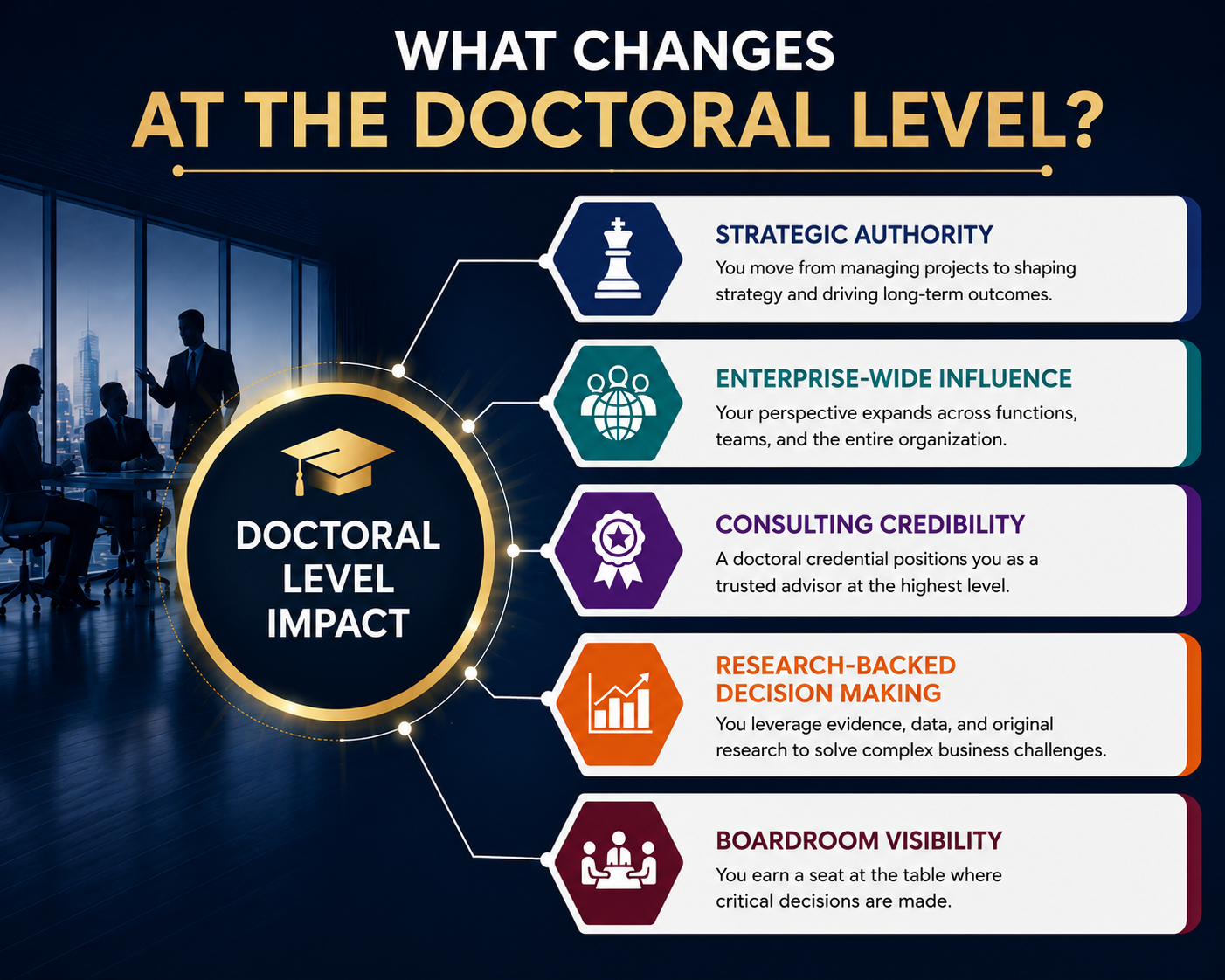
It's likely not the right move if you're primarily seeking a salary bump in your current role or if you haven't yet developed senior-level experience; the research work genuinely requires depth of professional context to be meaningful.
What Makes a Strong Online Doctorate in a Project Management Program?
If you're evaluating programs, here's what separates substantive programs from credential mills:
1. Accreditation: Prospective learners should evaluate institutional recognition, accreditation status, and quality assurance frameworks relevant to their region and career goals.
2. Applied Dissertation Model: The DBA should culminate in practitioner research, a real problem, real data, real recommendations for real organizations. Not a theoretical literature review.
3. Faculty with Industry Credibility: Look for faculty who have both academic publishing records and practitioner backgrounds. Pure academics teaching a practitioner degree is a red flag.
4. Cohort Structure: Strong DBA project management online programs run cohort-based models, and you progress with a peer group of senior professionals, which is often cited as one of the most valuable elements of the experience.
5. Program Length: Most legitimate programs run 3 – 4 years part-time. Anything faster should be scrutinized carefully.
A Program Worth Knowing: UniAthena's DBA in Project Management
For professionals actively evaluating an online doctorate in project management, UniAthena's DBA in Project Management, delivered in partnership with Guglielmo Marconi University (GMU), Italy, aligns with many of the characteristics professionals commonly evaluate when assessing doctoral programs.
- GMU is Italy's first-ever Open University, recognized by Italy's Ministry of Education (MIUR), NARIC-approved, and part of the European Bologna Process, giving the degree a global vision.
- The program runs over 3 years, 100% online, carries 180 ECTS credits (ISCED Level 8), and is structured around real applied research.
- It's built without career interruption in mind: flexible installments, 1:1 academic supervision, and a modular learning structure that fits around a full-time executive schedule.
Project Management Leadership Skills a Doctorate Develops (That Nothing Else Does)
This deserves specific mention because it's undersold. The skills developed through doctoral-level study are distinct from what executive education or an MBA provides:
- Research Design and Evidence-Based Decision-Making: you stop making arguments from experience alone and start making them from structured inquiry.
- Critical Synthesis: the ability to read across disciplines and integrate diverse bodies of knowledge into a coherent framework.
- Scholarly Writing and Executive Communication: the rigor of doctoral writing translates directly into high-stakes business communication.
- Intellectual Confidence: having defended original research to a doctoral committee changes how you engage in boardrooms.
These aren't soft skills. They're strategic differentiators at the senior level.
Conclusion
A doctorate in project management, specifically a DBA, is a serious, multi-year commitment that pays off in specific ways for specific people. It is not a quick credential, and it's not primarily a salary lever. It's a repositioning tool for professionals who have already built deep expertise and want to operate at a higher altitude: leading enterprise transformation, shaping organizational strategy, influencing how project management is practiced, not just practising it themselves.
If that's the version of your career you're building toward, the degree earns its place in that plan.
If you're still building the experience base, focus there first. The degree will mean more and deliver more once the depth is there to fuel the research.
FAQs
Q1. What is a Doctorate in Project Management?
A: A doctorate in project management is the highest academic qualification in the field, focused on advanced leadership, strategy, governance, and applied research.
Q2. Is Project Management a good DBA specialization?
A: Yes, it combines strategy, leadership, organizational behavior, and execution, making it highly relevant for senior business professionals.
Q3. What is the difference between a PhD and a DBA in Project Management?
A: A PhD focuses on academic research, while a DBA focuses on solving real-world organizational challenges through applied research.
Q4. Is an online doctorate degree in project management credible?
A: Yes, provided it is offered by a recognized and accredited institution with rigorous academic standards.
Q5. What are the highest-paying project management jobs?
A: VP of Program Management, Portfolio Executive, Chief Operating Officer, Chief of Staff, PMO Director, and Management Consultant are among the highest-paying roles.
Q6. Does a DBA in Project Management increase salary?
A: A DBA can improve access to executive and consulting opportunities, which often carry significantly higher compensation potential.
Q7. How long does a DBA in Project Management take?
A: Most reputable DBA programs take between three and four years to complete on a part-time basis.
Our Popular Courses

$14000


Doctoral Degree in Business Administration
Universidad Catolica De Murcia (UCAM), Spain
Duration:
2 - 3 Years
$17500*
Integrated Doctorate of Business Administration
Guglielmo Marconi University, Italy
Universidad Catolica De Murcia (UCAM), Spain
Duration:
2.5 - 3.5 Years
$5600*
Master of Business Administration
Guglielmo Marconi University, Italy
Duration:
12 - 24 Months
$5600*
MBA in Operations & Project Management
Guglielmo Marconi University, Italy
Duration:
12 - 24 Months
$5600*
Master in Supply Chain and Logistics Management
Guglielmo Marconi University, Italy
Duration:
12 - 24 Months
$5950*
Master in Data Sciences
Guglielmo Marconi University, Italy
Duration:
12 - 24 Months
$5600*
Master in Engineering Management
Guglielmo Marconi University, Italy
Duration:
12 - 24 Months
$5600*
Master in Procurement and Contract Management
Guglielmo Marconi University, Italy
Duration:
12 - 24 Months
$5600*
Master in Public Health
Guglielmo Marconi University, Italy
Duration:
12 - 24 MonthsOur Popular Courses
COMMENTS(0)
Our Popular Courses
$14000
Doctoral Degree in Business Administration
Universidad Catolica De Murcia (UCAM), Spain
Duration:
2 - 3 Years
$17500*
Integrated Doctorate of Business Administration
Guglielmo Marconi University, Italy
Universidad Catolica De Murcia (UCAM), Spain
Duration:
2.5 - 3.5 Years
$5600*
Master of Business Administration
Guglielmo Marconi University, Italy
Duration:
12 - 24 Months
$5600*
MBA in Operations & Project Management
Guglielmo Marconi University, Italy
Duration:
12 - 24 Months
$5600*
Master in Supply Chain and Logistics Management
Guglielmo Marconi University, Italy
Duration:
12 - 24 Months
$5950*
Master in Data Sciences
Guglielmo Marconi University, Italy
Duration:
12 - 24 Months
$5600*
Master in Engineering Management
Guglielmo Marconi University, Italy
Duration:
12 - 24 Months
$5600*
Master in Procurement and Contract Management
Guglielmo Marconi University, Italy
Duration:
12 - 24 Months
$5600*
Master in Public Health
Guglielmo Marconi University, Italy
Duration:
12 - 24 MonthsOur Popular Courses
Our Popular Insights
Careers are shifting faster than ever, and staying relevant takes more than experience. Explore UniAthena’s most-read blogs for sharp insights, emerging skills, and practical pathways that help you move forward with clarity and confidence in a changing professional world.


Best Courses In The Philippines 2026
Read More
7
mins read

🌟 Top Project Performer – May 2026 🌟
Read More
1
mins read


🌟 Top Project Performer – April 2026 🌟
Read More
1
mins read



Best Courses In The Philippines 2026
Read more
7
mins read
🌟 Top Project Performer – May 2026 🌟
Read more
1
mins read
🌟 Top Project Performer – April 2026 🌟
Read more
1
mins read
Get in Touch

It’s Time to Start
Join NowMost Popular Online Specialization
- Master of International Business Administration
- Master of Business Administration
- MBA in General Management- FastTrack
- Master in Innovation and Entrepreneurship
- MBA-Family Business Management
- Master in Procurement and Contract Management
- Extended Diploma in Business Analytics (SCQF Level 11)
- Diploma in Supply Chain and Logistics Management (SCQF Level 11)
- Strategic Human Resource Management Practitioner
- Master in Data Science
- Master in Engineering Management
Trending Online
- Integrated Doctorate of Business Administration
- Postgraduate Certificate in Finance for Next Generation Managers
- Master of Business Administration- General Management (Fast Track)
- Postgraduate Certificate in Socio-Economic and Legal Framework
- Postgraduate Certificate in Business Sustainability
- Certified Manager
- Supply Chain Management Practitioner
- MBA - AI in Business
- MBA - Accounting & Finance
- Master in Supply Chain and Logistics Management
Top Universities Online Certificates
- Postgraduate Certificate in International Marketing Management
- Postgraduate Certificate In International Human Resource Management
- Postgraduate Certificate in Strategic Management
- Postgraduate Certificate in Procurement & Contracts Management
- Postgraduate Certificate in Business Analytics
- Postgraduate Certificate in Strategic Supply Chain & Logistics Management
- Postgraduate Certificate in Human Resource and Leadership
- Project Management Practitioner
- Postgraduate Certificate in Supply Chain Design & Implementation
- Postgraduate Certificate in Management Accounting and Finance
Accredited Online Degree Program
- MBA - Digital Transformation
- MBA - Family Business Management
- MBA - Marketing Management
- MBA in Quality Management
- MBA - Business Intelligence & Data Analytics
- MBA in Operations & Project Management
- MBA in Energy Management
- MBA In Construction & Safety Management
- Master in Organisational Leadership
- Master in Public Health
- Master in Construction Management
- Bachelor of Arts in Business Administration


 Install Now


UniAthena is an Ed-Tech, offering flexible, affordable learning solutions, including Free-Learning Upskilling Courses and Academic Programs in partnerships with accredited and globally renowned universities and professional qualification bodies.


Do you have any questions ?
Feel free to send us your questions or request a free consultation
Send a message
UK
Athena Global Education
Magdalen Centre,
Robert Robinson Avenue,
Oxford, OX4 4GA, UK
Phone : 01865 784299
MIDDLE EAST
Athena Global Education FZE
Block L-03, First Floor,
P O Box 519265, Sharjah Publishing City,
Free Zone, Sharjah, UAE
Phone : +971 55 879 5492
INDIA
Uniathena Private Limited
9A,Midas Tower
Phase 1
Hinjewadi Rajiv Gandhi Infotech Park
Pune-411057
Phone: +91 9145665544
All Copyrights Reserved @ Athena Global Education 2021-2026