-

Bachelor's

-

Masters
-

MBA
-

Doctorate
-

Micro Credit
-

Explore all Courses
-
Postgraduate Certifications

-
Postgraduate Diploma
-
Undergraduate Diploma
-
Diploma



Top In-Demand and Trending Courses in Bhutan

Author: maharajan p
|9
MINS READ
| 0
| 254
Created On: 12 March, 2026
Share




Table of Contents (TOC):
- Introduction
- Key Takeaways
- Most Sought-After Skills in Bhutan’s Job Market
- Top 5 Skills Worth Learning in Bhutan Right Now
- Conclusion
- FAQs
Introduction
In Bhutan, job options are limited, with most opportunities in government, a small private sector, or project-based industries like construction and hydropower. When hiring slows or contracts end, even qualified candidates struggle to move forward.
At the same time, companies are changing how they hire. They are looking for people who can work with data, manage systems, handle compliance, run digital operations, or support business decisions. These roles don’t always require another full degree, but they do require specific, job-ready skills.
Let’s break down which skills are in demand in Bhutan today, and the courses that can help you build them.
Key Takeaways:
- Bhutan’s job market favors candidates with practical, applied skills rather than broad academic qualifications alone.
- Many of the skills employers want today can be built through online courses in Bhutan, making learning more flexible and accessible.
- Data, software, digital operations, finance, compliance, and IT security stand out as some of the best skills to learn in 2026 based on current hiring patterns.
- Choosing skills aligned with Bhutan’s market needs improves long-term job stability and earning potential.
Most Sought-After Skills in Bhutan’s Job Market
In Bhutan, employers tend to pay more for roles that work with data, technology, finance, security, and compliance. General roles still exist, but they usually offer limited salary growth.
As digital systems, reporting requirements, and online operations expand, companies are looking for people who can handle specific responsibilities, not just general tasks.
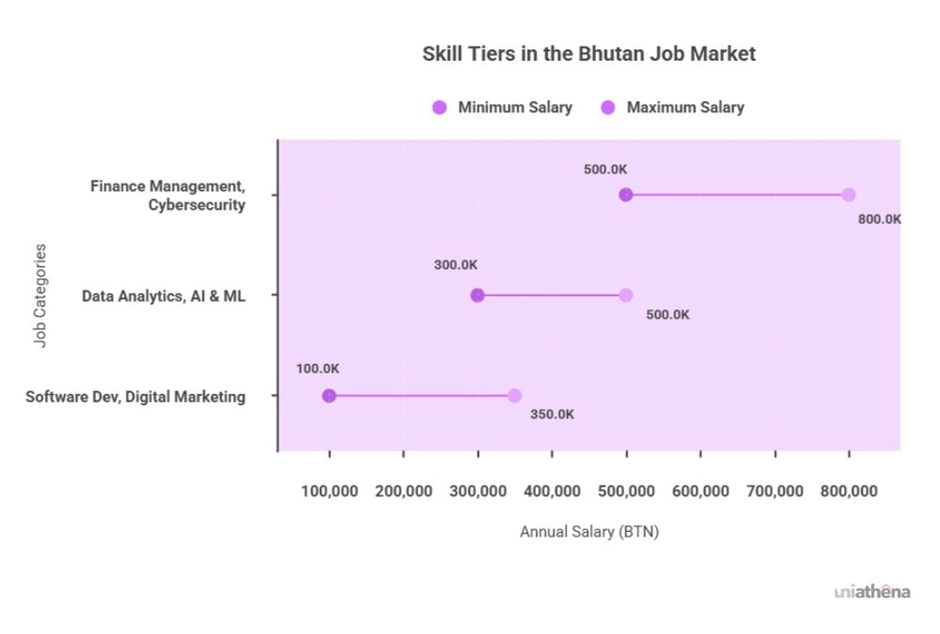
The table below summarizes verified salary benchmarks for in-demand entry-level and early-career roles in Bhutan, based on recent data from trusted salary platforms like Glassdoor and global salary aggregators.
It shows how skill-based roles create stronger earning potential, even at the early stages of a career.
What it means for job seekers in Bhutan: Higher-value technical and analytical skills pay more:
- For example, data analytics is a rapidly growing remote field. Even from your home in Bhutan, you can take on these roles and earn well into the $60,000–$90,000+ range, tapping into global opportunities without leaving the country.
- Accountability and financial reporting roles attract solid pay, near or above the median for specialized roles like data analysts.
Top 5 Skills Worth Learning in Bhutan Right Now
1. Data Analytics & Business Intelligence
Data analytics is recognized worldwide as a top remote job opportunity that anyone can pursue, regardless of their location. According to Glassdoor research, data analysts earn over 50,000 USD per year on average, with salaries varying based on experience, skill level, and expertise.
The best part? This is not a job that requires you to be physically at a desk. You can work from your home in Bhutan and still build a rewarding career.
Career paths in Data Analytics & BI
What You Need to Learn
To succeed in these roles, you’ll want to focus on:
- Data collection and cleaning
- Excel and spreadsheet analytics
- SQL fundamentals
- Data visualization and dashboards
- Business intelligence basics
- Interpreting data to tell a story
These are core skills employers look for and they’re exactly what the courses below help you build.
Best For:
People who enjoy working with numbers, patterns, and decisions based on facts.
If this role aligns with where you want to go, the next step is learning how data is actually used in business.
- The Diploma in Data Analytics by UniAthena focuses on data handling, analysis, and interpretation across real business contexts.
➡️ Check out: Diploma in Data Analytics
- To move from analysis to decision-making, the Basics of Business Intelligence course from UniAthena explains how organizations use dashboards, reports, and BI systems to guide strategy.
➡️ Check out: Basics of Business Intelligence
2. Software Development & Programming (Python, JavaScript, Blockchain)
In Bhutan, software and programming skills are becoming important. More companies are digitizing, and even traditional businesses need basic coding support. You don’t need to be a unicorn developer to start. You just need to build practical skills that employers can see you use.
Software development isn’t one thing. It includes:
- Python: Simple but powerful for automation, analytics, and backend systems.
- JavaScript: The language of the web and interactive apps.
- Blockchain: Becoming valuable where secure systems and digital trust matter.
Learning any of these can open doors in tech teams, startups, or remote work.
Career Paths in Software & Programming
What You Need to Learn
To work in development, you’ll want skills like:
- Python fundamentals
- JavaScript basics
- Writing and testing code
- Understanding how apps work
You don’t start as an expert. You start by building projects, solving problems, and showing results.
Best For:
People who enjoy logic, problem-solving, and building things that work.
If you want to build software and programming skills, you can pursue programs that focus on Python and blockchain fundamentals.
- The Python course can teach you coding from the ground up, helping you write scripts, automate tasks, and solve practical problems.
➡️ Check out: Basics of Python
- The Blockchain fundamentals program introduces you to secure, decentralized systems and how they are applied in real-world solutions.
➡️ Check out: Diploma in Blockchain Fundamentals
These programs give you hands-on exposure, help you understand how apps and systems work, and prepare you for roles in software development, IT support, and tech teams.
3. Digital Marketing & E-commerce
In Bhutan, people are shopping online more than ever. From ordering groceries to booking services, Bhutanese consumers are turning to websites and apps. Businesses are noticing this shift and need professionals who can drive traffic, create campaigns, and manage online sales.
Digital marketing today goes beyond social media posts. It includes strategy, advertising, SEO, content, and e‑commerce operations, all working together to turn visitors into customers.
Career Paths in Digital Marketing & E-commerce
What You Need to Learn
To work in this area, you’ll want to learn:
- Search Engine Optimization (SEO)
- Social media marketing and advertising
- Content creation and planning
- Email and campaign analytics
- E-commerce store setup and performance tracking
These are practical skills employers look for when hiring digital marketing and e-commerce professionals.
Best For:
People who enjoy strategy, creativity, analytics, and online engagement.
If this area interests you, you can pursue a program focused on digital marketing and e-commerce. Such programs teach how online marketing, social media, SEO, content strategy, and e-commerce operations work together to attract audiences and drive sales. You learn how to plan campaigns, analyze performance, optimize websites, and manage online stores effectively.
➡️ Check out: Diploma in Digital Marketing
4. Financial Literacy & Accounting
Finance roles are more than bookkeeping. Companies today need people who can analyze numbers, guide decisions, and manage budgets. Globally, 77% of firms struggle to find skilled accounting and finance professionals, often valuing practical skills over degrees.
In Bhutan, even as a small market, businesses across banking, tourism, and corporate services need experts who can turn financial data into actionable insights. Learning these skills opens doors to stable, well-paying roles and positions you as a key contributor to any organization’s growth.
Career Paths in Financial Literacy & Accounting
What You Need to Learn
To succeed in financial and accounting roles, you’ll need skills such as:
- Basic accounting principles
- Financial statements and reporting
- Budgeting and cash-flow basics
- Financial decision-making
- Use of finance tools (Excel, T-accounts, ledgers)
They’re the foundation of how finance teams help organizations stay healthy and compliant.
Best For:
People who like working with numbers, rules, and logic.
If this fits your goals, you can pursue a postgraduate program in management accounting and finance. Such programs go beyond basic bookkeeping and focus on how accounting supports business strategy, controls, and financial planning. You learn how financial statements are used for decision-making, how budgets and cash flows are managed, and how finance teams support leadership at an organizational level.
➡️ Check out: Postgraduate Certificate in Management Accounting and Finance
If you want to sharpen applied accounting techniques, the Mastering Accounting short course focuses on core accounting methods and financial analysis used in real business scenarios. The program also includes a CIQ certification that can strengthen your professional accounting profile.
➡️ Check out: Mastering Accounting CIQ - Certified
5. EHS Management (Environment, Health & Safety)
In Bhutan, work often happens close to nature and people. Hydropower projects run through mountain terrain. Tourism relies on trekking routes, hotels, and transport safety. Construction sites operate in challenging conditions where small risks matter.
In these settings, environment, health, and safety are part of daily operations, not abstract ideas. EHS management focuses on identifying on-site risks, setting safety procedures, tracking incidents, and supporting environmental care at the workplace level.
Career Paths in EHS Management
What You Need to Learn (Core Skill Areas)
To work in EHS roles, employers expect practical knowledge in:
- Workplace safety standards and hazard identification
- Risk assessment and control measures
- Incident reporting and corrective actions
- Environmental management systems
- Health, safety, and compliance documentation
- Audit preparation and regulatory reporting
These skills help organizations meet legal obligations and reduce workplace risks.
Best For:
People who prefer structured work, clear rules, and responsibility. If you like ensuring systems work safely and correctly, EHS fits well.
If this path aligns with your interests, you can pursue an MBA with a focus on environment, health, and safety management. Such programs approach EHS from a management and operations perspective, showing how safety and environmental practices fit into everyday business decisions. You learn core EHS principles, how policies are implemented across organizations, risk and compliance responsibilities, and how EHS supports operational continuity and governance.
➡️ Check out: MBA Essentials with Environment Health and Safety Management
If you prefer starting with the basics, the Diploma in Environment Health and Safety Management offers a free, self-paced introduction to core EHS concepts and workplace safety practices.
➡️ Check out: Diploma in Environment Health and Safety Management
Conclusion
These courses reflect where Bhutan’s job market is actually moving. They help beginners and working professionals build skills that employers are actively hiring for.
But completing a course is only the starting point. Real progress comes from applying what you learn, gaining hands-on experience, and showing measurable results. Focus on skill use, not just certification, and better opportunities will follow.
FAQs
Q1. Do I need a technical background to start these courses?
A: No. Most courses are designed for beginners and start from fundamentals.
Q2. Are these skills relevant to Bhutan’s job market?
A: Yes. These skills align with hiring needs in growing sectors like IT, business, compliance, and digital services.
Q3. Can I learn these courses while working full-time?
A: Yes. The courses are self-paced and can be completed alongside a job.
Q4. Which skill should I choose if I’m confused?
A: Start with the skill that matches your current role or the industry you want to enter.
Q5. Are these skills useful for remote or international roles?
A: Yes. Skills like data, software development, digital marketing, and cybersecurity are globally applicable.
Explore Related Courses












COMMENTS(0)
Explore Related Courses
Our Popular Insights
Careers are shifting faster than ever, and staying relevant takes more than experience. Explore UniAthena’s most-read blogs for sharp insights, emerging skills, and practical pathways that help you move forward with clarity and confidence in a changing professional world.




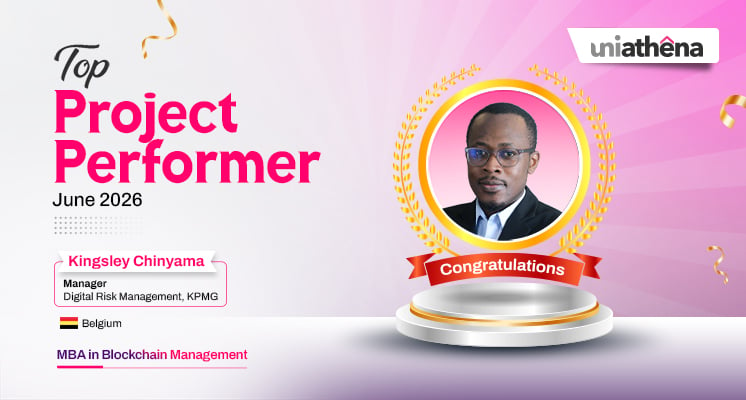
🌟 Top Project Performer – June 2026 🌟
Read More
1
mins read

🌟 Top Project Performer – May 2026 🌟
Read More
1
mins read

🌟 Top Project Performer – June 2026 🌟
Read more
1
mins read

🌟 Top Project Performer – May 2026 🌟
Read more
1
mins read
Get in Touch

It’s Time to Start
Join NowMost Popular Online Specialization
- Master of International Business Administration
- Master of Business Administration
- MBA in General Management- FastTrack
- Master in Innovation and Entrepreneurship
- MBA-Family Business Management
- Master in Procurement and Contract Management
- Extended Diploma in Business Analytics (SCQF Level 11)
- Diploma in Supply Chain and Logistics Management (SCQF Level 11)
- Strategic Human Resource Management Practitioner
- Master in Data Science
- Master in Engineering Management
Trending Online
- Integrated Doctorate of Business Administration
- Postgraduate Certificate in Finance for Next Generation Managers
- Master of Business Administration- General Management (Fast Track)
- Postgraduate Certificate in Socio-Economic and Legal Framework
- Postgraduate Certificate in Business Sustainability
- Certified Manager
- Supply Chain Management Practitioner
- MBA - AI in Business
- MBA - Accounting & Finance
- Master in Supply Chain and Logistics Management
Top Universities Online Certificates
- Postgraduate Certificate in International Marketing Management
- Postgraduate Certificate In International Human Resource Management
- Postgraduate Certificate in Strategic Management
- Postgraduate Certificate in Procurement & Contracts Management
- Postgraduate Certificate in Business Analytics
- Postgraduate Certificate in Strategic Supply Chain & Logistics Management
- Postgraduate Certificate in Human Resource and Leadership
- Project Management Practitioner
- Postgraduate Certificate in Supply Chain Design & Implementation
- Postgraduate Certificate in Management Accounting and Finance
Accredited Online Degree Program
- MBA - Digital Transformation
- MBA - Family Business Management
- MBA - Marketing Management
- MBA in Quality Management
- MBA - Business Intelligence & Data Analytics
- MBA in Operations & Project Management
- MBA in Energy Management
- MBA In Construction & Safety Management
- Master in Organisational Leadership
- Master in Public Health
- Master in Construction Management
- Bachelor of Arts in Business Administration


 Install Now


UniAthena is an Ed-Tech, offering flexible, affordable learning solutions, including Free-Learning Upskilling Courses and Academic Programs in partnerships with accredited and globally renowned universities and professional qualification bodies.


Do you have any questions ?
Feel free to send us your questions or request a free consultation
Send a message
UK
Athena Global Education
Magdalen Centre,
Robert Robinson Avenue,
Oxford, OX4 4GA, UK
Phone : 01865 784299
MIDDLE EAST
Athena Global Education FZE
Block L-03, First Floor,
P O Box 519265, Sharjah Publishing City,
Free Zone, Sharjah, UAE
Phone : +971 55 879 5492
INDIA
Uniathena Private Limited
9A,Midas Tower
Phase 1
Hinjewadi Rajiv Gandhi Infotech Park
Pune-411057
Phone: +91 9145665544
All Copyrights Reserved @ Athena Global Education 2021-2026