-

Bachelor's

-

Masters
-

MBA
-

Doctorate
-

Micro Credit
-

Explore all Courses
-
Postgraduate Certifications

-
Postgraduate Diploma
-
Undergraduate Diploma
-
Diploma



How to Become a CFO: Education & Career Path

Author: aishwarya sancheti
|7
MINS READ
| 0
| 71
Created On: 29 June, 2026
Share




Table of Contents (TOC):
- Introduction
- Key Takeaways
- Before You Map the Path, Know the Terrain
- The Map Nobody Draws Clearly - The Career Progression: What the Path Actually Looks Like
- The Single Biggest Shift Since 2022 - How AI has Rewritten the CFO Skill Stack - Permanently
- Where the Gap Really Lives: The Education Question: Beyond the MBA
- The Most Honest Section in this Blog - Six Questions that Tell You Exactly Where You Stand
- FAQs
Introduction
For finance professionals who are done playing the long game blindly and want a clear, honest picture of what actually separates the ones who get there from the ones who stall at VP indefinitely.
The uncomfortable truth: The CFO role has changed more in 5 years than in the previous 20. Here's a hard truth that boards are already acting on: the CFO who only knows finance is becoming a liability. The role has evolved from financial gatekeeper to enterprise co-pilot, and the path to the chair now requires fundamentally more than it used to.
- 82% of CFOs globally report significant role expansion in the past 5 years
- 70%+ of CFOs now hold responsibilities beyond traditional finance
- 58% are actively investing in new tech to enhance forecasting & planning
- 15% projected growth in financial manager roles 2024 - 2034
"Once seen as a back-office bean counter, the modern finance leader is now expected to be a primary driver of enterprise-wide strategy."
- Workday Finance Leadership Research, 2025
Key Takeaways:
- The modern CFO is a strategic partner to the CEO, not just the head of finance.
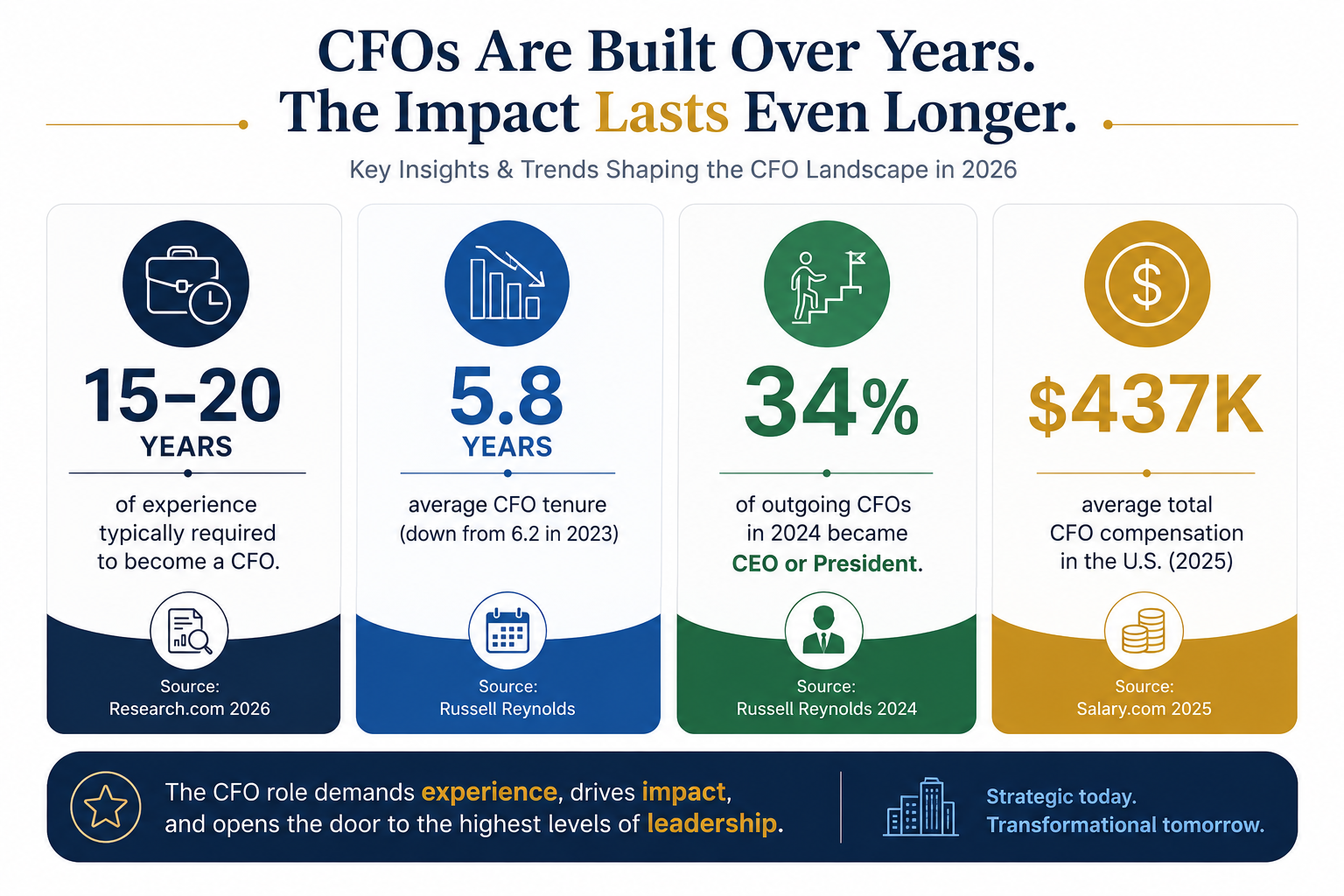
- Most professionals need 15 - 20 years of progressive experience to reach the CFO role.
- Cross-functional exposure and board visibility are critical to advancement.
- AI, data strategy, and digital transformation are now core CFO responsibilities.
- Traditional qualifications open doors, but strategic depth differentiates candidates.
- A DBA in Finance can strengthen research-driven decision-making and executive credibility.
- CFO appointments go to leaders who combine financial expertise with enterprise vision.
Before You Map the Path, Know the Terrain
What the numbers actually say about getting there.
Most finance professionals underestimate both the timeline and the opportunity. CFO turnover hit 15.1% globally in 2024, creating real vacancies. Average tenure is now 5.8 years (depending on company size). The window is open, but you need to be positioned right when it opens.
The Map Nobody Draws Clearly - The Career Progression: What the Path Actually Looks Like
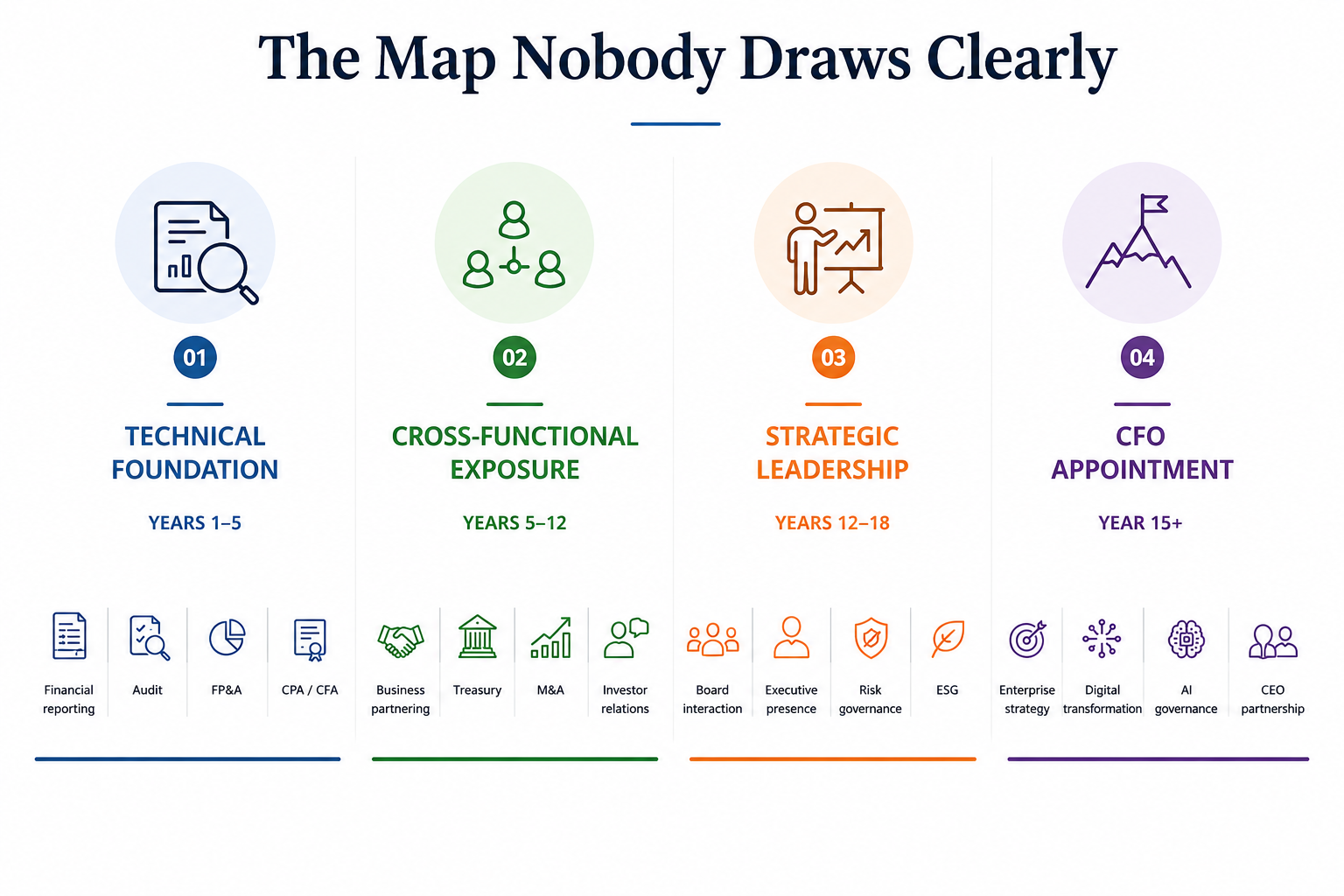
There's no single route, but the patterns among successful CFOs are consistent. What kills most trajectories isn't a lack of competence; it's stalling at the wrong stage too long.
1. Technical Foundation
Years 1 - 5
Accounting, financial analysis, audit, investment banking, or FP&A. Build precision. Understand how financial data is created, not just consumed. This stage is about credibility, not ambition.
- Financial reporting
- Audit
- FP&A
- CPA / CFA
2. Cross-Functional Exposure
Years 5 - 12
Finance Manager, Controller, FP&A Director. This is where cross-functional exposure is critical. Understand operations, commercial strategy, and capital allocation decisions, not just the numbers behind them.
- Business partnering
- Treasury
- M&A
- Investor relations
3. Strategic Leadership
Years 12 - 18
VP Finance, SVP, or Divisional CFO. The preparation ground. You must be managing teams, interfacing with the board, presenting to investors, and leading strategic initiatives, all three. Miss anyone and your trajectory stalls.
- Board interaction
- Executive presence
- Risk governance
- ESG
4. CFO Appointment
Year 15+
Many boards and executive search committees increasingly look for finance leaders who combine financial expertise with strategic leadership, risk oversight, and enterprise-wide decision-making capabilities. The question they're asking: can this person drive growth, manage risk, govern AI, and communicate financial strategy to all stakeholders at the highest level?
- Enterprise strategy
- Digital transformation
- AI governance
- CEO partnership
The Single Biggest Shift Since 2022 - How AI has Rewritten the CFO Skill Stack - Permanently
This isn't about "keeping up with technology." AI has fundamentally restructured what the CFO role demands. The finance leaders who understand this are repositioning now. The ones who don't will be overtaken by peers who do.
Three numbers that contextualize this shift:
- 58% of finance organizations adopted AI in 2024, a 54 - 7% increase over 2023.
- The Deloitte survey found that 64% of finance leaders believe they need more tech skills now.
- And 69% of CFOs expect data analytics to be even more central to their role in the next five years.
Where the Gap Really Lives: The Education Question: Beyond the MBA
The baseline is settled. A bachelor's in finance, accounting, economics, or business, plus a professional certification (CPA, CFA, CMA), gets you in the room. An MBA accelerates leadership frameworks and expands your network. Most boards still view it favorably.
But here's where the conversation is shifting for senior professionals with 10 - 15 years of experience already behind them.
The case for doctoral-level thinking in finance leadership -
1) Traditional MBA programs typically focus on management, leadership, and business operations. The CFO role today demands something different: the ability to conduct rigorous, applied research and translate it into enterprise-level decisions under uncertainty.
2) That gap between operational finance expertise and strategic, research-driven leadership is precisely where a DBA in Financial Management becomes relevant for experienced professionals.
3) Unlike a PhD (theoretical, academia-oriented), a DBA is built for working professionals in senior roles. It focuses on applied research solving real, complex business problems using advanced analytical frameworks.
4) Most programs are structured so professionals continue working full-time, making it a practical investment rather than a career pause.
5) An 180 ECTS DBA in Financial Management (from GMU, Italy) equips professionals with advanced expertise in financial risk, global markets, strategic decision-making, and evidence-based leadership, the exact capabilities that define the modern CFO mandate and differentiate candidates in competitive appointment processes.
- Advanced risk management
- Applied research methodology
- Global financial markets
- Strategic decision science
- Doctoral-level credibility
- Work while you study
Also Read: Why Finance Leaders Are Pursuing a DBA in Financial Management
The Most Honest Section in this Blog - Six Questions that Tell You Exactly Where You Stand
Your title doesn't determine your trajectory. These questions do. Answer them without rationalizing.
1. Am I being exposed to board-level conversations or just supporting them from a distance?
2. Is my current organization building me toward strategic leadership or capping me there?
3. Can I genuinely govern an AI-driven finance function, or would I be delegating that entirely to my team?
4. Does my educational foundation reflect where the CFO role is going or where it was when I studied?
5. Am I developing the research and analytical depth that modern enterprise decisions require?
6. If a board asked why they should pick me over 5 other highly qualified internal candidates, do I have a genuinely differentiated answer?
The CFO role is one of the most consequential leadership positions in any organization. Getting there requires more than tenure and technical skill; it requires a deliberate investment in the kind of thinking, credibility, and strategic depth that boards select for.
The path is structured. The credentials matter. The timing is real. And the next decision worth making isn't about waiting for the right opportunity.
It's about building the right foundation - one that's hard to overlook.
FAQs
Q1. How many years does it take to become a CFO?
A: Most professionals require 15 - 20 years of progressive experience across finance, strategy, and leadership roles.
Q2. What degree is best for becoming a CFO?
A: A bachelor’s degree in finance or accounting is standard, often complemented by certifications and advanced degrees such as an MBA or DBA.
Q3. Is an MBA enough to become a CFO?
A: An MBA is highly respected, but senior professionals may pursue a DBA to deepen strategic and research capabilities.
Q4. Do you need a CPA or CFA to become a CFO?
A: Not always, but professional credentials can significantly strengthen your technical credibility.
Q5. What roles typically lead to CFO?
A: Common stepping stones include Controller, Finance Director, VP Finance, and Divisional CFO.
Q6. How important is AI knowledge for aspiring CFOs?
A: Increasingly essential, as CFOs are now expected to oversee AI governance, analytics, and digital transformation.
Q7. What is the average tenure of a CFO?
A: The average CFO tenure globally is approximately 5.8 years (depending on company size).
Q8. Can a CFO become a CEO?
A: Yes. In 2024, 34% of outgoing CFOs moved into CEO or President roles.
Q9. How much does a CFO earn?
A: Average total CFO compensation in the U.S. was approximately $375,000 and $450,000 in 2025, with substantial upside in larger organizations.
Explore Related Courses














COMMENTS(0)
Explore Related Courses
Our Popular Insights
Careers are shifting faster than ever, and staying relevant takes more than experience. Explore UniAthena’s most-read blogs for sharp insights, emerging skills, and practical pathways that help you move forward with clarity and confidence in a changing professional world.


How to Switch Career to Data Analytics?
Read More
6
mins read





How to Switch Career to Data Analytics?
Read more
6
mins read

Get in Touch

It’s Time to Start
Join NowMost Popular Online Specialization
- Master of International Business Administration
- Master of Business Administration
- MBA in General Management- FastTrack
- Master in Innovation and Entrepreneurship
- MBA-Family Business Management
- Master in Procurement and Contract Management
- Extended Diploma in Business Analytics (SCQF Level 11)
- Diploma in Supply Chain and Logistics Management (SCQF Level 11)
- Strategic Human Resource Management Practitioner
- Master in Data Science
- Master in Engineering Management
Trending Online
- Integrated Doctorate of Business Administration
- Postgraduate Certificate in Finance for Next Generation Managers
- Master of Business Administration- General Management (Fast Track)
- Postgraduate Certificate in Socio-Economic and Legal Framework
- Postgraduate Certificate in Business Sustainability
- Certified Manager
- Supply Chain Management Practitioner
- MBA - AI in Business
- MBA - Accounting & Finance
- Master in Supply Chain and Logistics Management
Top Universities Online Certificates
- Postgraduate Certificate in International Marketing Management
- Postgraduate Certificate In International Human Resource Management
- Postgraduate Certificate in Strategic Management
- Postgraduate Certificate in Procurement & Contracts Management
- Postgraduate Certificate in Business Analytics
- Postgraduate Certificate in Strategic Supply Chain & Logistics Management
- Postgraduate Certificate in Human Resource and Leadership
- Project Management Practitioner
- Postgraduate Certificate in Supply Chain Design & Implementation
- Postgraduate Certificate in Management Accounting and Finance
Accredited Online Degree Program
- MBA - Digital Transformation
- MBA - Family Business Management
- MBA - Marketing Management
- MBA in Quality Management
- MBA - Business Intelligence & Data Analytics
- MBA in Operations & Project Management
- MBA in Energy Management
- MBA In Construction & Safety Management
- Master in Organisational Leadership
- Master in Public Health
- Master in Construction Management
- Bachelor of Arts in Business Administration


 Install Now


UniAthena is an Ed-Tech, offering flexible, affordable learning solutions, including Free-Learning Upskilling Courses and Academic Programs in partnerships with accredited and globally renowned universities and professional qualification bodies.


Do you have any questions ?
Feel free to send us your questions or request a free consultation
Send a message
UK
Athena Global Education
Magdalen Centre,
Robert Robinson Avenue,
Oxford, OX4 4GA, UK
Phone : 01865 784299
MIDDLE EAST
Athena Global Education FZE
Block L-03, First Floor,
P O Box 519265, Sharjah Publishing City,
Free Zone, Sharjah, UAE
Phone : +971 55 879 5492
INDIA
Uniathena Private Limited
9A,Midas Tower
Phase 1
Hinjewadi Rajiv Gandhi Infotech Park
Pune-411057
Phone: +91 9145665544
All Copyrights Reserved @ Athena Global Education 2021-2026