-

Bachelor's

-

Masters
-

MBA
-

Doctorate
-

Micro Credit
-

Explore all Courses
-
Postgraduate Certifications

-
Postgraduate Diploma
-
Undergraduate Diploma
-
Diploma



Vibe Coding: What It Is, Why It Went Viral, and Will It Replace Developers?
Author: aishwarya sancheti
|13
MINS READ
| 0
| 132
Created On: 15 June, 2026
Share




Table of Contents (TOC):
- Key Takeaways
- What Is Vibe Coding?
- Why Is It Called "Vibe Coding"?
- How Does Vibe Coding Actually Work?
- Vibe Coding vs Traditional Coding
- The Numbers That Made Everyone Pay Attention
- Top Vibe Coding Tools Right Now
- Four Distinct Ways People Vibe Code
- Who Vibe Coding Is Actually Built For
- The Vibe Coding Process: How Smart Builders Do It
- Where Vibe Coding Wins and Where It Doesn't
- Pros and Cons of Vibe Coding
- The Limitations Are Real - Don't Ignore Them
- Will Vibe Coding Replace Developers?
- What Is Vibe Coding in AI, Really?
- The Future of Vibe Coding: What's Actually Coming
- Courses That Make You Sharper at This
- FAQs
You don't need to know what a for loop is anymore. You don't need to memorize syntax, debug stack traces, or obsess over indentation. You just… describe what you want and the AI builds it. That's vibe coding in a sentence.
And in under two years, it went from one researcher's tweet to a $4.7 billion industry with 92% of US developers using AI coding tools daily. So let's break it down properly: what it actually is, how it works, who it's for, and whether it's coming for developers' jobs.
Key Takeaways:
- Vibe coding is an AI-driven approach to software development where users describe what they want, and AI generates the code.
- The concept exploded in popularity because it dramatically lowers the barrier to building software and speeds up product development.
- Today's leading vibe coding tools include Cursor, GitHub Copilot, Claude Code, Replit, Lovable, Bolt.new, and ChatGPT.
- Vibe coding is being used by developers, founders, designers, analysts, and other non-technical professionals to build real-world applications.
- While it enables faster prototyping and experimentation, AI-generated code can introduce security risks, technical debt, scalability challenges, and compliance concerns.
- The most effective vibe coding workflows combine AI speed with human review, testing, and strategic decision-making.
- AI is changing how software is built, but developers remain essential for architecture, security, problem-solving, and long-term product success.
- The future of vibe coding points toward agentic AI workflows, built-in compliance systems, automated AI code reviews, and new AI-focused career opportunities.
What Is Vibe Coding?
Vibe coding is a software development approach where you write prompts instead of code. You describe the outcome you want in plain language, "build me a login page with Google OAuth" and an AI writes the code.
The term was coined by Andrej Karpathy, a former OpenAI and Tesla AI lead, in a February 2025 tweet. His exact framing: "You fully give in to the vibes, embrace exponentials, and forget that the code even exists." Collins Dictionary named it Word of the Year 2025. That's how fast this moved.
The key distinction from regular AI-assisted coding: in vibe coding, you accept the AI's output without necessarily understanding every line. You're directing, not writing. The AI is the hands. You're the brain.
Why Is It Called "Vibe Coding"?
Because you're working off vibes - intent, feel, outcome, not precise technical instruction.
Traditional coding is: "Write a recursive function that traverses a binary tree in post-order."
Vibe coding is: "I need something that checks each item in a folder and gives me a summary at the end."
You're communicating the what, not the how. The AI handles the how.
How Does Vibe Coding Actually Work?
Here's the typical vibe coding workflow:
1. Describe Your Goal: In plain English (or any language). "Build me a dashboard that shows sales data by region."
2. AI Generates Code: The tool writes functional code based on your prompt.
3. Review and Iterate: You test it, describe what's off, and the AI revises. ("The chart colors are wrong, make them match my brand palette.")
4. Deploy or Extend: Once it works, you ship it or keep adding features through more prompts.
No manual syntax. No documentation deep dives. Just conversation and iteration.
Vibe Coding vs Traditional Coding
Neither is better by default. Context matters entirely.
The Numbers That Made Everyone Pay Attention
- 41% of all global code is now AI-generated - 256 billion lines written in 2024 alone.
- 63% of vibe coding users are non-developers - designers, founders, marketers building real products
- Teams using vibe coding report completing tasks 51% faster
- 87% of Fortune 500 companies have adopted at least one vibe coding platform
- A quarter of Y Combinator's Winter 2025 batch had codebases that were 95% AI-generated
- The market is projected to hit $12.3 billion by 2027 at a 38% CAGR
- Lovable, a vibe coding tool hit $100M ARR in just 8 months
- Cursor reached a $9.9 billion valuation with $500M ARR
This isn't a trend on its way. It's already here.
Top Vibe Coding Tools Right Now
For developers:
- Cursor: AI-native code editor; describe changes, it rewrites your codebase
- GitHub Copilot: The OG; now with multi-file editing and agents; 20M+ users
- Claude Code: Anthropic's terminal-based agentic coding tool; strong at complex reasoning
- Replit: Browser-based; great for full-stack vibe builds without local setup
For non-developers / beginners:
- Lovable: Describe an app, get a deployed web app. No code needed.
- Bolt.new: Similar to Lovable; fast full-stack prototypes from prompts
- v0 by Vercel: UI-first; describe a component, get React code instantly
Using ChatGPT for vibe coding: ChatGPT (especially GPT-4o) works well for smaller tasks - writing functions, explaining errors, generating boilerplate. For full-project vibe coding, dedicated tools like Cursor or Lovable give you a better loop since they're connected to your actual codebase or deploy pipeline.
Four Distinct Ways People Vibe Code
Not everyone uses vibe coding the same way. There are four approaches that have emerged, each suited to a different mindset and goal:
- Prompt-Driven Development: You describe what you want in natural language and the AI generates the code. No syntax knowledge needed. This is the purest form of vibe coding and works best for functional MVPs and standalone tools.
- Exploratory Coding: You use AI to brainstorm through multiple solution paths simultaneously, without committing to one early. Less about shipping fast, more about discovering what's even possible. Ideal for founders validating a concept before investing in it.
- Adaptive Iteration: You build a working base, then continuously refine it through real-time AI feedback. The product evolves through conversation, not through a fixed spec. This is how most professional indie developers use vibe coding once they're past the beginner stage.
- Flow-Centric Building: You prioritize creative momentum over precision. You keep the build moving, accept imperfect outputs, and circle back to fix things later. It's fast, and it works - as long as "later" actually arrives.
Knowing which mode you're in helps you set the right expectations and catch where things might go wrong before they do.
Who Vibe Coding Is Actually Built For
The 63% stat non-developers making up the majority of vibe coding users tells you exactly who this is really for.
1. Founders who can't afford a dev team yet. Vibe coding lets you validate your idea, build a prototype, and get it in front of users without a $15,000 development invoice. You test first. You invest later.
2. Designers who are tired of translation loss. When a designer builds the prototype themselves via prompts, nothing gets lost between vision and implementation. The mockup is the product.
3. Operators and analysts who need internal tools. Not every dashboard needs an engineering sprint. Vibe coding turns a manual reporting process into a self-serving tool in an afternoon.
4. Developers who want to move at a different speed. Senior engineers aren't using vibe coding to replace their craft, they're using it to skip the scaffolding and get to the interesting problems faster.
If you fall into any of these categories, the friction to start is lower than it's ever been.
The Vibe Coding Process: How Smart Builders Do It
There's a difference between randomly prompting an AI and running a disciplined vibe coding workflow.
Here's the approach that actually produces shippable output:
Start with user experience, not features. Don't begin by listing what the app should do. Begin with how someone should feel using it. "A first-time user should be able to sign up, create a project, and see results in under three minutes." That framing gives the AI far more useful context than a feature list.
Build the skeleton first. Get the structure: layout, navigation, basic data flow, before touching logic or edge cases. AI handles structure well. Stacking logic on a messy skeleton is how projects spiral.
Use constraints as creative tools. "Build this in under 80 lines, no external libraries, mobile-first" is not a limitation, it's a direction. Constrained prompts produce leaner, more maintainable code than open-ended ones.
One concern per prompt. The more you ask for in a single prompt, the more the AI has to guess about priorities. Split it up. "Now add form validation" beats "add validation, error states, a loading spinner, and redirect logic" in one shot.
Treat every output as a draft. Not a finished product. A draft. Review it with that mindset, and you'll catch problems before they compound.
Where Vibe Coding Wins and Where It Doesn't
This is the part most blog posts skip, because honest context doesn't generate as much excitement as hype. But knowing this saves you significant wasted time.
Vibe coding performs best when:
- The problem is new and the requirements are fuzzy, rapid prototyping thrives in ambiguity
- The stakes of early failure are low, a broken prototype is a learning, not a crisis
- Speed of communication matters more than precision, showing a stakeholder a working mockup beats describing it in a spec document
- You're a solo builder or small team, the overhead of traditional development outweighs its benefits at that scale
Vibe coding underperforms when:
- Regulatory compliance is non-negotiable - AI doesn't inherently know your industry's legal requirements
- The codebase needs to scale significantly - AI-generated code often lacks the architectural foresight that handles real load
- Long-term maintainability is a priority - code duplication has risen 4x in AI-assisted projects; someone has to own that debt
- Security is a core product feature - 45% of AI-generated code carries potential vulnerabilities, and that number demands active mitigation, not passive trust
The productive question isn't "should I vibe code?" It's "which parts of this project should I vibe code?"
Pros and Cons of Vibe Coding: Straight Up
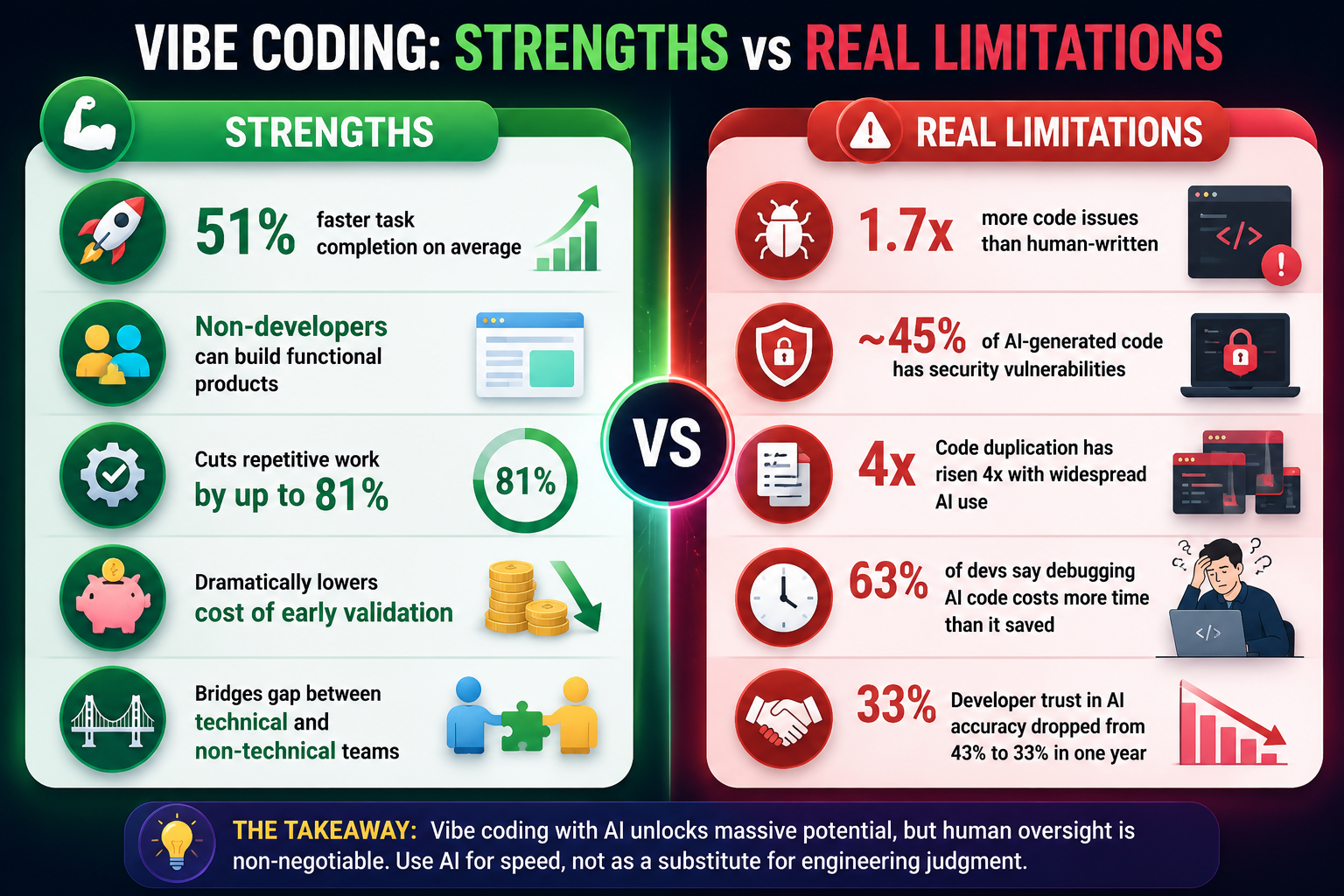
The trade is real: you gain access and speed upfront. You accept quality responsibility throughout. Neither side of that trade goes away.
The Limitations Are Real - Don't Ignore Them
Vibe coding has a credibility problem that's entirely self-inflicted. Builders overpromise, skip review, and ship vulnerable products, then blame the tools when things break.
The documented failure modes are worth knowing:
1. Security is the sharpest edge. AI models generate code based on patterns, not principles. They don't instinctively apply secure coding standards. They pattern-match to what they've seen, which includes plenty of insecure code. The 2025 audit of 1,645 Lovable-built apps found 170 with critical security flaws. That's not a fringe failure rate.
2. Scalability is a deferred problem. A vibe-coded app that handles 200 users fine may collapse at 2,000. AI-generated architecture rarely accounts for database indexing, rate limiting, or load distribution unless you explicitly ask and you need to know enough to ask.
3. Compliance doesn't care about your workflow. In fintech, healthcare, or legal applications, regulatory requirements are precise and consequential. AI will generate code that looks compliant without being compliant. A human with domain knowledge has to own that review.
4. Technical debt accrues silently. Every time the AI duplicates logic, ignores edge cases, or generates overlapping functions, it's adding to a maintenance burden you'll feel later. It just doesn't feel like debt when everything is working.
None of this means stop. It means: build the review habit in from the start, not as a remediation step.
Will Vibe Coding Replace Developers?
No, but the framing of this question is already slightly outdated. The better question is: what kind of developer is irreplaceable in a world where AI writes the first draft?
Google, Microsoft, and Amazon each have 20 - 30% of their new code AI-generated today. Meta projects 50% within the year. And yet software engineering remains one of the most in-demand professions on the market. The work hasn't disappeared but moved upstream.
What's shifting: junior developers who spent most of their time on boilerplate, repetitive functions, and basic CRUD operations are the most exposed. That work is being absorbed by AI rapidly.
What's not shifting: architectural thinking, security judgment, system design at scale, and the ability to understand what a codebase will need to handle two years from now. These require context that AI doesn't have access to your users, your business model, your growth assumptions.
The developers thriving right now have added one skill to their existing expertise: directing AI effectively. They're not writing less but producing more, faster, with AI doing the scaffolding while they handle the reasoning.
Vibe coding is a productivity tool with a very high ceiling and a very visible floor. The floor is "anyone can start." The ceiling is "the best human judgment wins."
What Is Vibe Coding in AI, Really?
Behind every vibe coding tool is a large language model trained on billions of lines of public code, documentation, Stack Overflow threads, and technical writing.
When you prompt it, it's not reasoning through your problem from first principles. It's identifying the most statistically probable code pattern that fits your description, based on everything it has been trained on. That's a meaningful distinction. It means the model is excellent at common patterns and poor at novel constraints. It means context you don't provide, it will invent, often plausibly, sometimes incorrectly. It means the more specific and bounded your prompt, the more reliably the model can draw on relevant training data.
Vibe coding fluency is, at its core, the skill of giving a very capable pattern-matcher enough context to match the right pattern.
The Future of Vibe Coding: What's Actually Coming
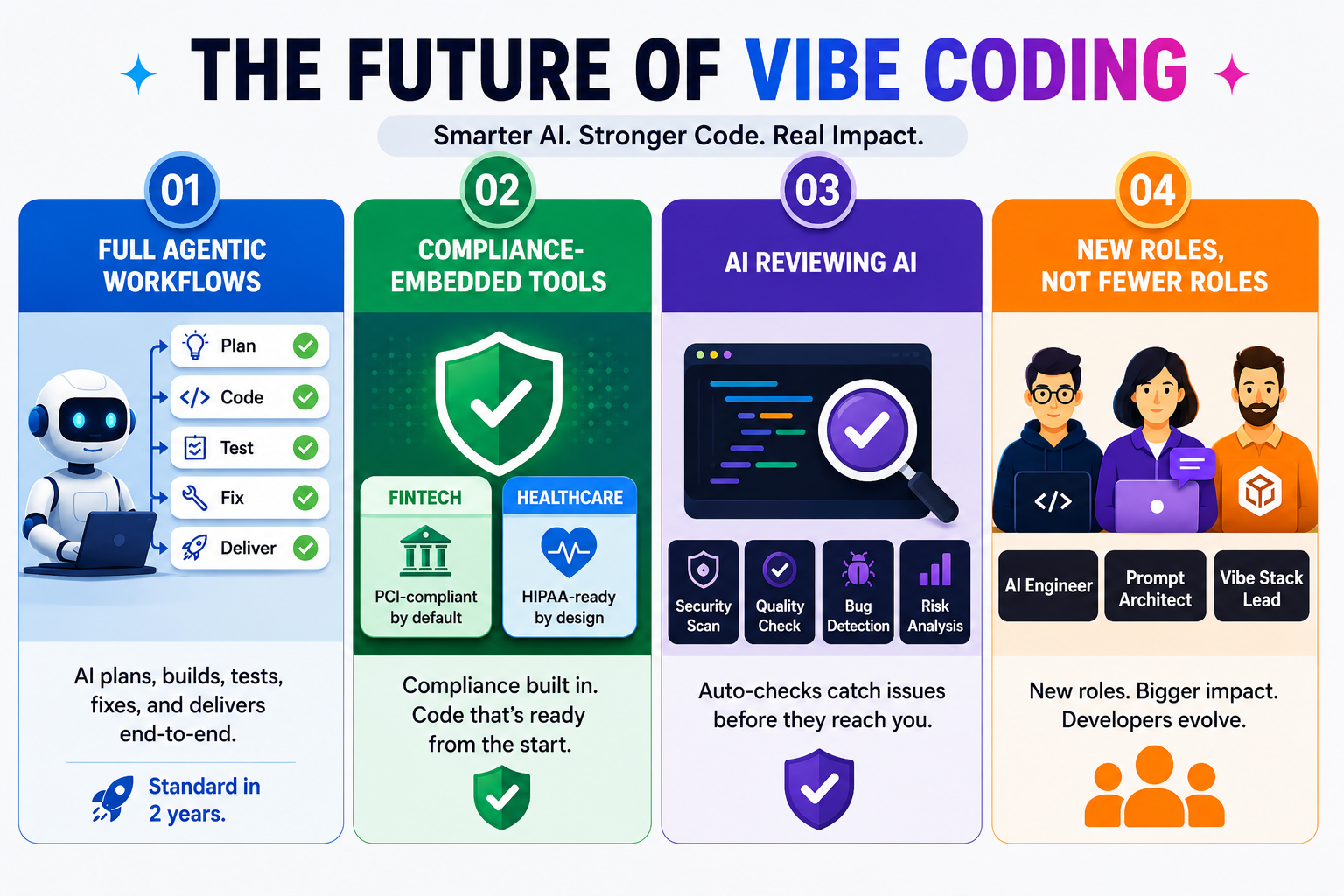
The current wave - "describe it, get code" is the primitive version. Here's the next layer:
Courses That Make You Sharper at This
Vibe coding is the output. Your prompting instincts, your AI literacy, and your understanding of what's happening underneath are the input.
These courses build the input:
- Master ChatGPT (4 -5 Hours): The single fastest way to improve your vibe coding results. Prompting well is a learnable skill, and this is where to learn it.
- Basics of Artificial Intelligence (4 -5 Hours): Understand what these tools actually are, not just what they do. It changes how you use them.
- Basics of Machine Learning Algorithms (4 -5 Hours): Gives you the mental model to understand why AI makes the choices it makes including the wrong ones.
- Basics of Data Science (4 -5 Hours): If your vibe-coded product handles any meaningful data, this background is essential for building it responsibly.
- MBA Essentials with Machine Learning (4 - 5 Weeks): Learn how to combine business decision-making with AI capabilities. Perfect for professionals who want to lead AI projects, not just build them.
These short courses from UniAthena give you a kick start with CIQ (Cambridge International Qualifications, UK) and Acacia University Professional Development certification and minimum time duration, self paced, and 100% online mode to get your hands-on on Vibe coding.
Then moving beyond basics, follows-
- Postgraduate Certificate in Machine Learning (21 - 60 Days): Go beyond using AI tools and learn how AI models are built, trained, and improved. Ideal if you want to move from AI user to AI practitioner.
- Master in Artificial Intelligence and Machine Learning (15 Months): Build advanced expertise in AI, machine learning, and intelligent systems. A strong choice for those looking to develop high-impact AI solutions and future-ready technical skills.
- MBA in Generative AI (Artificial Intelligence) (15 Months): Understand how businesses are adopting Generative AI and how to turn AI capabilities into real business value. Designed for professionals who want to lead AI transformation initiatives with confidence.
All these courses blend advanced technical skills with applied analytics and strategic context. The program prepares learners to work confidently across the AI lifecycle. 100% online programs offer flexible learning, with options ranging from a single-module Postgraduate Certificate to triple-certification Master and MBA programs supported by dedicated 1:1 personal tutor guidance.
You don't need to become a developer. You need to become a better collaborator with the AI that's doing the development.
FAQs
Q1. Is vibe coding just for beginners?
A: No. 50%+ of professional developers use AI coding tools daily. The difference is experienced developers use vibe coding strategically for specific tasks while beginners often use it as a replacement for understanding entirely.
Q2. Can I build a real, production app with vibe coding?
A: Yes, and thousands already have. Lovable reached $100M ARR on exactly that premise. The condition is: mandatory security review, proper testing, and version control. Skip those and "production" becomes a liability.
Q3. How is vibe coding different from just using ChatGPT to write code?
A: ChatGPT is a general-purpose model. Dedicated vibe coding tools like Cursor, Lovable, and Claude Code are integrated into your actual build environment, they have context about your codebase, can read files, run commands, and deploy. The loop is tighter and far more powerful.
Q4. What's the biggest mistake people make?
A: Shipping without reviewing. The speed of vibe coding creates a false sense that the output is finished. It never is, it's a very fast first draft that still needs your eyes on it.
Q5. Does vibe coding have a future in enterprise?
A: Absolutely, 87% of Fortune 500 companies have already adopted at least one vibe coding platform. The remaining adoption barrier is compliance and security tooling, which is actively being built.
Explore Related Courses













COMMENTS(0)
Explore Related Courses
Our Popular Insights
Careers are shifting faster than ever, and staying relevant takes more than experience. Explore UniAthena’s most-read blogs for sharp insights, emerging skills, and practical pathways that help you move forward with clarity and confidence in a changing professional world.


🌟 Top Project Performer – June 2026 🌟
Read More
1
mins read


🌟 Top Project Performer – May 2026 🌟
Read More
1
mins read

🌟 Top Project Performer – April 2026 🌟
Read More
1
mins read
🌟 Top Project Performer – June 2026 🌟
Read more
1
mins read
🌟 Top Project Performer – May 2026 🌟
Read more
1
mins read
🌟 Top Project Performer – April 2026 🌟
Read more
1
mins read
Get in Touch

It’s Time to Start
Join NowMost Popular Online Specialization
- Master of International Business Administration
- Master of Business Administration
- MBA in General Management- FastTrack
- Master in Innovation and Entrepreneurship
- MBA-Family Business Management
- Master in Procurement and Contract Management
- Extended Diploma in Business Analytics (SCQF Level 11)
- Diploma in Supply Chain and Logistics Management (SCQF Level 11)
- Strategic Human Resource Management Practitioner
- Master in Data Science
- Master in Engineering Management
Trending Online
- Integrated Doctorate of Business Administration
- Postgraduate Certificate in Finance for Next Generation Managers
- Master of Business Administration- General Management (Fast Track)
- Postgraduate Certificate in Socio-Economic and Legal Framework
- Postgraduate Certificate in Business Sustainability
- Certified Manager
- Supply Chain Management Practitioner
- MBA - AI in Business
- MBA - Accounting & Finance
- Master in Supply Chain and Logistics Management
Top Universities Online Certificates
- Postgraduate Certificate in International Marketing Management
- Postgraduate Certificate In International Human Resource Management
- Postgraduate Certificate in Strategic Management
- Postgraduate Certificate in Procurement & Contracts Management
- Postgraduate Certificate in Business Analytics
- Postgraduate Certificate in Strategic Supply Chain & Logistics Management
- Postgraduate Certificate in Human Resource and Leadership
- Project Management Practitioner
- Postgraduate Certificate in Supply Chain Design & Implementation
- Postgraduate Certificate in Management Accounting and Finance
Accredited Online Degree Program
- MBA - Digital Transformation
- MBA - Family Business Management
- MBA - Marketing Management
- MBA in Quality Management
- MBA - Business Intelligence & Data Analytics
- MBA in Operations & Project Management
- MBA in Energy Management
- MBA In Construction & Safety Management
- Master in Organisational Leadership
- Master in Public Health
- Master in Construction Management
- Bachelor of Arts in Business Administration


 Install Now


UniAthena is an Ed-Tech, offering flexible, affordable learning solutions, including Free-Learning Upskilling Courses and Academic Programs in partnerships with accredited and globally renowned universities and professional qualification bodies.


Do you have any questions ?
Feel free to send us your questions or request a free consultation
Send a message
UK
Athena Global Education
Magdalen Centre,
Robert Robinson Avenue,
Oxford, OX4 4GA, UK
Phone : 01865 784299
MIDDLE EAST
Athena Global Education FZE
Block L-03, First Floor,
P O Box 519265, Sharjah Publishing City,
Free Zone, Sharjah, UAE
Phone : +971 55 879 5492
INDIA
Uniathena Private Limited
9A,Midas Tower
Phase 1
Hinjewadi Rajiv Gandhi Infotech Park
Pune-411057
Phone: +91 9145665544
All Copyrights Reserved @ Athena Global Education 2021-2026