-

Bachelor's

-

Masters
-

MBA
-

Doctorate
-

Micro Credit
-

Explore all Courses
-
Postgraduate Certifications

-
Postgraduate Diploma
-
Undergraduate Diploma
-
Diploma



Shadow AI: The Hidden Cost of AI Adoption

Author: lynn lawrence
|6
MINS READ
| 0
| 67
Created On: 17 June, 2026
Share




Table of Contents (TOC):
- Introduction
- Why Shadow AI Is Growing
- Understanding Shadow AI
- The Hidden Risks of Generative AI
- Why Unmanaged APIs Increase AI Security Risks
- The Business Impact of Shadow AI
- Managing AI in the Workplace
- Building Strong AI Governance
- AI Security Best Practices
- Looking Ahead: The Future of Enterprise AI Governance
- Conclusion
Introduction
A marketing employee needs help preparing a client presentation.
Instead of using company-approved tools, they paste confidential customer data into a free AI chatbot they found online.
The task takes minutes.
The risk lasts much longer.
The employee had good intentions. They wanted to work faster. But at that moment, sensitive information left the organization's controlled environment without anyone realizing it.
This is the reality of Shadow AI.
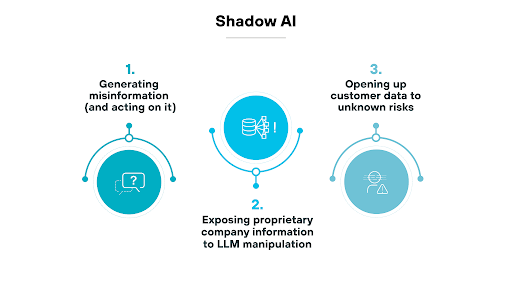
As artificial intelligence becomes part of everyday work, organizations face a growing challenge: employees are adopting AI tools faster than security teams can monitor them. Combined with unmanaged APIs, these tools can create security gaps that remain invisible until something goes wrong.
Why Shadow AI Is Growing
Artificial intelligence is no longer limited to IT departments or data science teams. Employees across marketing, HR, finance, customer service, and operations are using AI tools to save time and improve productivity.
Several factors are driving this trend:
- Easy Access to Free and Low-Cost AI Platforms
AI tools are widely available, making it easy for employees to adopt them without seeking approval.
- Growing Pressure to Work Faster and Smarter
Teams are constantly looking for ways to improve efficiency and meet increasing productivity expectations.
- Increasing Availability of Generative AI Applications
New AI-powered tools are emerging rapidly, offering capabilities that appeal to both technical and non-technical users.
- Limited Awareness of Security Implications
Many employees do not fully understand how AI tools collect, process, and store data. As a result, employee use of unauthorized AI tools is becoming common across many organizations.
Understanding Shadow AI
Shadow AI refers to the use of artificial intelligence tools, applications, or services that have not been approved, monitored, or governed by an organization's IT or security teams.
Unlike officially sanctioned AI platforms, these tools operate outside established security controls.
The challenge becomes even greater when these solutions connect through unmanaged APIs that security teams may not know exist.
What appears to be a simple productivity tool can quickly become a hidden security concern.
The Hidden Risks of Generative AI
The benefits of generative AI are clear.
It can summarize documents, generate content, analyze data, and automate repetitive tasks.
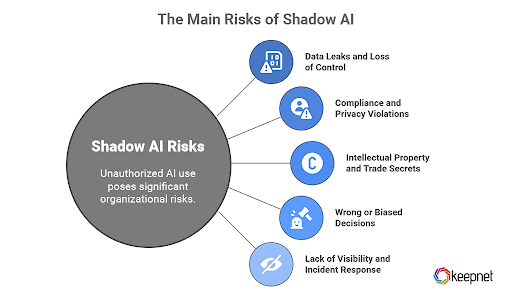
However, the hidden risks of generative AI often receive less attention.
- Exposure of Sensitive Business Information
Confidential business data may be shared with external AI platforms without proper safeguards.
- Unauthorized Sharing of Customer Data
Employees may unknowingly expose customer information by entering it into unauthorized AI systems.
- Loss of Intellectual Property
Proprietary content, business strategies, or internal knowledge may be exposed through AI interactions.
- Inaccurate or Misleading Outputs
AI-generated content may contain errors, creating risks for decision-making and business operations.
- Compliance and Regulatory Concerns
Unauthorized AI usage can lead to violations of data protection and industry regulations.
Without proper oversight, organizations may struggle to understand where their data is going and how it is being used.
Also Read: How to Stay Relevant in a Future Powered by AI?
Why Unmanaged APIs Increase AI Security Risks
Many AI tools rely on APIs to exchange information with other applications and services.
When these APIs are not monitored or properly secured, they can create unexpected vulnerabilities.
- Uncontrolled Data Transfers
Sensitive information may move between systems without visibility or approval.
- Weak Authentication Mechanisms
Poor authentication controls can increase the risk of unauthorized access.
- Excessive Permissions
Overly broad permissions may allow applications to access more data than necessary.
- Lack of Visibility into Third-Party Connections
Organizations may not be aware of all external services connected to their environment.
This is why strong API Security is becoming a critical part of modern cybersecurity strategies.
An unsecured API can provide attackers with access to valuable data or systems without triggering traditional security controls.
The Business Impact of Shadow AI
The consequences of Shadow AI extend beyond technology.
Organizations may face:
- Data Breaches and Privacy Incidents
Sensitive information can be exposed through unauthorized AI tools or integrations.
- Regulatory Penalties
Failure to comply with data protection requirements can result in significant fines.
- Loss of Customer Trust
Security incidents can damage an organization's reputation and customer confidence.
- Operational Disruptions
Security breaches may interrupt normal business processes and productivity.
- Increased Security Costs
Organizations often spend substantial resources responding to and recovering from incidents.
Issues related to Data Privacy in AI are particularly important because many organizations operate in heavily regulated environments where data protection requirements are strict.
Managing AI in the Workplace
Completely banning AI is rarely the answer. Instead, organizations need a structured approach to Managing AI in the Workplace.
- Providing Approved AI Tools for Employees
Offering secure alternatives reduces the need for employees to seek external solutions.
- Establishing Clear Usage Policies
Well-defined guidelines help employees understand acceptable AI usage.
- Delivering Regular AI Awareness Training
Training ensures users understand both the benefits and risks associated with AI tools.
- Monitoring AI Adoption Across Departments
Visibility helps organizations identify and address emerging risks.
- Encouraging Responsible Innovation
Employees should be empowered to use AI while following security and compliance requirements.
When employees understand both the benefits and risks of AI, they are more likely to make informed decisions.
Also Read: AI and Legal Ethics: Navigating Responsibilities in the Digital Age
Building Strong AI Governance
As AI adoption grows, AI Governance becomes essential. Effective governance ensures that AI systems are used responsibly, securely, and in alignment with business objectives.
Strong AI governance frameworks help organizations:
- Define Acceptable AI Usage
Clear standards establish what AI tools can and cannot be used for.
- Assign Accountability
Ownership ensures responsibility for AI-related decisions and outcomes.
- Monitor Compliance
Regular oversight helps ensure regulatory and policy requirements are met.
- Manage Security and Privacy Risks
Governance frameworks reduce the likelihood of uncontrolled AI usage.
- Support Ethical AI Practices
Organizations can encourage transparency, fairness, and responsible AI adoption.
Governance provides the structure needed to balance innovation with control.
AI Security Best Practices
Organizations can reduce exposure by following proven AI security best practices.
- Maintain an Inventory of AI Tools and Services
Organizations cannot secure AI assets they do not know exist.
- Review All AI-Related APIs Regularly
Regular assessments help identify vulnerabilities before they become security incidents.
- Conduct Ongoing AI Risk Management Assessments
Continuous evaluation ensures emerging risks are identified and addressed.
- Implement Strong Access Controls
Limiting access reduces the chance of unauthorized data exposure.
- Monitor Data Flows and User Activity
Visibility helps detect unusual behavior and potential misuse.
- Evaluate All Third-Party AI Integrations Before Deployment
Security reviews help identify risks associated with external AI providers.
These measures strengthen overall Enterprise AI Security and reduce the likelihood of hidden vulnerabilities.
Also Read: Responsible AI: Navigating AI Risks and Challenges
Looking Ahead: The Future of Enterprise AI Governance
AI adoption will continue to accelerate.
New tools, platforms, and integrations will emerge faster than ever before.
The Future of enterprise AI governance will depend on an organization's ability to maintain visibility, enforce security controls, and support responsible innovation.
Organizations that proactively manage AI risks today will be better positioned to capture the benefits of AI tomorrow.
Conclusion
Shadow AI is not simply a technology issue.
It is a visibility, governance, and security challenge.
The combination of unauthorized AI tools and unmanaged APIs creates risks that can easily go unnoticed until a breach occurs.
The goal is not to slow innovation.
The goal is to ensure innovation happens safely.
By strengthening governance, improving API security, and adopting responsible AI practices, organizations can unlock the value of AI while minimizing the risks hidden in the shadows.
Explore Related Courses












COMMENTS(0)
Explore Related Courses
Our Popular Insights
Careers are shifting faster than ever, and staying relevant takes more than experience. Explore UniAthena’s most-read blogs for sharp insights, emerging skills, and practical pathways that help you move forward with clarity and confidence in a changing professional world.



🌟 Top Project Performer – June 2026 🌟
Read More
1
mins read



🌟 Top Project Performer – May 2026 🌟
Read More
1
mins read



🌟 Top Project Performer – April 2026 🌟
Read More
1
mins read
🌟 Top Project Performer – June 2026 🌟
Read more
1
mins read
🌟 Top Project Performer – May 2026 🌟
Read more
1
mins read
🌟 Top Project Performer – April 2026 🌟
Read more
1
mins read
Get in Touch

It’s Time to Start
Join NowMost Popular Online Specialization
- Master of International Business Administration
- Master of Business Administration
- MBA in General Management- FastTrack
- Master in Innovation and Entrepreneurship
- MBA-Family Business Management
- Master in Procurement and Contract Management
- Extended Diploma in Business Analytics (SCQF Level 11)
- Diploma in Supply Chain and Logistics Management (SCQF Level 11)
- Strategic Human Resource Management Practitioner
- Master in Data Science
- Master in Engineering Management
Trending Online
- Integrated Doctorate of Business Administration
- Postgraduate Certificate in Finance for Next Generation Managers
- Master of Business Administration- General Management (Fast Track)
- Postgraduate Certificate in Socio-Economic and Legal Framework
- Postgraduate Certificate in Business Sustainability
- Certified Manager
- Supply Chain Management Practitioner
- MBA - AI in Business
- MBA - Accounting & Finance
- Master in Supply Chain and Logistics Management
Top Universities Online Certificates
- Postgraduate Certificate in International Marketing Management
- Postgraduate Certificate In International Human Resource Management
- Postgraduate Certificate in Strategic Management
- Postgraduate Certificate in Procurement & Contracts Management
- Postgraduate Certificate in Business Analytics
- Postgraduate Certificate in Strategic Supply Chain & Logistics Management
- Postgraduate Certificate in Human Resource and Leadership
- Project Management Practitioner
- Postgraduate Certificate in Supply Chain Design & Implementation
- Postgraduate Certificate in Management Accounting and Finance
Accredited Online Degree Program
- MBA - Digital Transformation
- MBA - Family Business Management
- MBA - Marketing Management
- MBA in Quality Management
- MBA - Business Intelligence & Data Analytics
- MBA in Operations & Project Management
- MBA in Energy Management
- MBA In Construction & Safety Management
- Master in Organisational Leadership
- Master in Public Health
- Master in Construction Management
- Bachelor of Arts in Business Administration


 Install Now


UniAthena is an Ed-Tech, offering flexible, affordable learning solutions, including Free-Learning Upskilling Courses and Academic Programs in partnerships with accredited and globally renowned universities and professional qualification bodies.


Do you have any questions ?
Feel free to send us your questions or request a free consultation
Send a message
UK
Athena Global Education
Magdalen Centre,
Robert Robinson Avenue,
Oxford, OX4 4GA, UK
Phone : 01865 784299
MIDDLE EAST
Athena Global Education FZE
Block L-03, First Floor,
P O Box 519265, Sharjah Publishing City,
Free Zone, Sharjah, UAE
Phone : +971 55 879 5492
INDIA
Uniathena Private Limited
9A,Midas Tower
Phase 1
Hinjewadi Rajiv Gandhi Infotech Park
Pune-411057
Phone: +91 9145665544
All Copyrights Reserved @ Athena Global Education 2021-2026