-

Bachelor's

-

Masters
-

MBA
-

Doctorate
-

Micro Credit
-

Explore all Courses
-
Postgraduate Certifications

-
Postgraduate Diploma
-
Undergraduate Diploma
-
Diploma



Can AI Help You Decide Your Future Career and Education Path?
Author: munazzah ali
|7
MINS READ
| 0
| 97
Created On: 09 April, 2026
Share




Table Of Contents (TOC):
- Introduction
- Key Takeaways
- The Real Problem: Career Confusion in the Age of Infinite Options
- AI as a Decision-Support System: Beyond Career Guesswork
- The Hybrid Model: AI + Self-Reflection + Mentorship
- From Awareness to Action: Preparing for an AI-Enabled Career Landscape
- Conclusion
- FAQ’s
Introduction
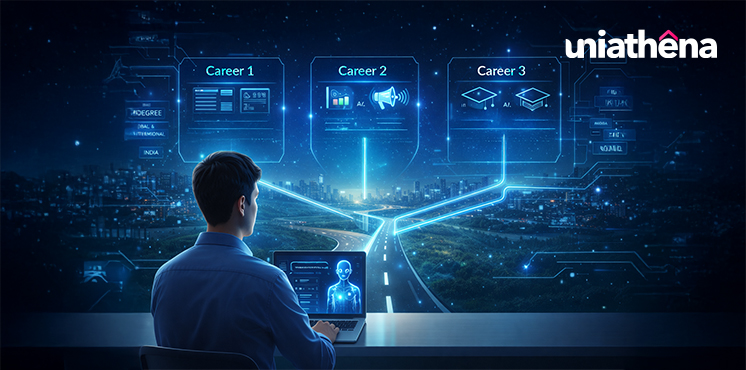
What if choosing a career didn’t rely on guesswork, scattered advice, or outdated job lists? Think of being in a position to discover thousands of job opportunities, learn about the industries that are growing, and understand which skills will matter most even before they become widely discussed.
This is possible with artificial intelligence. Through the analysis of vast amounts of data on the labour market and industry trends, AI can identify patterns that allow people to investigate career opportunities in a more explicit way.
Instead of providing a fixed list of options, AI-based applications can show new opportunities and match the strengths of people with the future career trends and opportunities, offering a more informed way to navigate the future.
Key Takeaways:
- The information overload and the fast-changing industry are the causes of career confusion today.
- AI is more of a decision-support than a decision-maker.
- The AI career guidance can objectively analyze trends, market trends, and skills gaps.
- Greater decisions are achieved through a hybrid model of AI + self-reflection + mentorship.
- Career development in the modern context requires one to think in terms of skills, adaptability, and lifelong learning.
The Real Problem: Career Confusion in the Age of Infinite Options
Choosing a career was once about selecting a degree. Nowadays, it concerns moving through the ecosystems of talents, qualifications, and sectors.
Thousands of online courses, short certifications, and new specializations exist. The evolving speed of industries is high. Occupations such as AI engineer, sustainability analyst, and digital transformation strategist were not common or even heard of five years ago.
Simultaneously, recruitment has changed. Skill portfolio is becoming an important factor valued by employers compared to degrees only. Career development is now defined by micro-credentials, project work, and demonstrable competencies.
The result? Future uncertainty, information overload. Students ask, How can AI help students choose wisely? Professionals ask whether reskilling is worth the investment. Parents are concerned with stability in the long term.
This is what AI is starting to fill in, not in the sense of removing judgment, but in the sense of sorting complexity.
AI as a Decision-Support System: Beyond Career Guesswork
AI cannot be regarded as a digital fortune teller. Rather, consider it as an analytic layer that enhances career counselling of AI and informed decision-making. It functions in three dimensions.
Pattern Recognition: Making Sense of You
Using AI, your interests, assessment, and behavioral data can be analyzed to find the patterns that you might otherwise not notice.
As an example, it can be used to match your aptitude scores with industry skill demands. It can bring out transferable skills like analytical thinking or communication that open up to the next position.
This is where career planning with the help of AI comes in. It converts self-awareness into organized understanding and makes the career coaching based on artificial intelligence more evidence-based.
Market Intelligence: Interpreting the Direction of Work
The labour market is evolving at a rate where the conventional counselling models fail to keep up. The AI tools will be used to process big data, such as job advertisements, wage trends, industry development reports, and determine the demand indicators.
They will be able to indicate new job positions, salary expectations, and changing skills. This makes AI career insights grounded in real-time data rather than outdated assumptions.
For professionals considering a shift, this market intelligence adds clarity to risk evaluation.
Individualized Learning Pathways: Interested in Action
Instead of vague advice like “consider technology,” AI can translate career interests into structured skill maps. It does so by evaluating three layers: your present competencies, the skills needed in your target position, and the difference between the two.
Following this gap, the AI platforms focus on particular learning modules, industry-established courses, or project-based training, directly responding to the gaps in capabilities.
As an example, when one wants to step into data analytics, AI may identify a difference in statistical reasoning or data visualization and propose targeted learning in those particular fields- instead of proposing a general and unrelated program.
This is where AI advantages in education can be seen. AI does not just propose to study more. It determines what to learn, why it is important, and in which order to do so, relating ambition to tangible improvement.
Also Read: From Morning to Night: 10 Ways AI Is Part of Your Daily Routine
The Hybrid Model: AI + Self-Reflection + Mentorship
The simplest model is the most effective: AI informs. Humans decide. This can be done in three steps:
1. Self-Assessment: Explain what you believe in, what you are good at, your financial limits, and your long-term objectives. No algorithm is able to determine what fulfillment is to you.
2. AI Exploration: Explore different career pathways, analyse skill gaps, and learn about market demand using professional development tools with the help of AI. This is where AI-based career guidance adds measurable insight.
3. Human Validation: Talk to mentors, industry professionals, or alumni networks. Internships and practical exposure validate what data suggests. This combination eliminates emotional bias without sacrificing human judgment.
Also Read: AI Is No Longer Helping You Work. It’s Working With You
From Awareness to Action: Preparing for an AI-Enabled Career Landscape
Knowing what career development in the modern context implies is the exposure that it is an ongoing process. It is not a single degree choice but is a dynamic skill acquisition and adaptation process.
As AI transforms industries, understanding it itself becomes relevant. Formal AI education courses help people in learning about the way AI tools work, their constraints, and their ethical aspects.
For those who want to move beyond using AI tools to understanding them, courses like the Diploma in Artificial Intelligence at UniAthena provide background knowledge about AI through its historical development to its increased significance in the modern world.
The course presents fundamental AI concepts, algorithms, and methods, and it is based on the dynamics of intelligent agents in dynamic environments. It is easy to follow and useful, and it creates a solid foundation as it makes you aware of how AI systems can work in the real world.
For professionals aiming to merge business leadership with intelligent innovation, MBA Essentials with Artificial Intelligence integrates Marketing, Strategic HR & Leadership, Operations, and Financial Management with powerful tools such as PESTEL, SWOT, Ansoff Matrix, and Lean Management.
This 4-5 week self-paced course is designed to impact you, and at the end of the course, you will receive a certification from AUPD, confirming that you are ready to lead in an AI-enabled business environment.
Additionally, with Mastering AI: Fundamentals, Strategies & Representation, you will explore the definition, categories, and the increasing need for AI. You will trace its developmental history and identify its various applications in the real world.
With 1 week of self-paced learning, you will have a balanced foundation to participate in the dynamic AI environment, and successful completion will earn you certification from AUPD.
Together, these pathways create a progressive AI learning ecosystem—equipping professionals not only to adapt to the future of work, but to confidently shape it.
Also Read: From Lazy to Productive: Simple Changes That Work
Conclusion
AI will definitely be useful in adding clarity to career and education choices. It can evaluate trends, discover skill gaps, and propose formal learning directions. It simplifies the process and introduces logic into what seems to be a daunting process.
Nevertheless, AI cannot be considered a final authority. It cannot fully understand your passion, your personal situation, and your long-term goals. It operates on information and trends, not feelings and experience.
Career development cannot be best achieved by making a choice between human judgment and AI, but by integrating the two. The combination of self-reflection, mentorship, and AI-based career guidance leads to making informed decisions and being more confident.
The real question is not whether AI can determine your future career and line of education, but it is whether you are ready to apply both artificial intelligence and human insight wisely.
FAQs
Q1. How can AI help students choose the right career?
A: AI can process the results of the interests, strengths, and aptitude of the student and match them with the existing job market information. It identifies good career choices and demonstrates what skills one needs. This will help students in making better decisions rather than using guesses.
Q2. Is AI career guidance better than traditional career counselling?
A: AI career guidance provides data and market real-time insights to the decision-making process. Traditional counselling brings human experience and emotional understanding. When the two are integrated, the counseling will be more moderate and realistic.
Q3. Can AI suggest what skills I need for a career change?
A: Artificial intelligence can analyze your existing competencies and match them to the demands of the position you want. Based on that gap, it proposes certain areas to work on, allowing you to focus your learning efforts in the right direction.
Q4. Why is learning about AI important for career development today?
A: Many industries and work positions are changing as a result of AI. Knowing how AI works keeps professionals relevant, changing, and making smarter career choices in a world where technology is important.
Explore Related Courses










COMMENTS(0)
Explore Related Courses
Our Popular Insights
Careers are shifting faster than ever, and staying relevant takes more than experience. Explore UniAthena’s most-read blogs for sharp insights, emerging skills, and practical pathways that help you move forward with clarity and confidence in a changing professional world.





Get in Touch

It’s Time to Start
Join NowMost Popular Online Specialization
- Master of International Business Administration
- Master of Business Administration
- MBA in General Management- FastTrack
- Master in Innovation and Entrepreneurship
- MBA-Family Business Management
- Master in Procurement and Contract Management
- Extended Diploma in Business Analytics (SCQF Level 11)
- Diploma in Supply Chain and Logistics Management (SCQF Level 11)
- Strategic Human Resource Management Practitioner
- Master in Data Science
- Master in Engineering Management
Trending Online
- Integrated Doctorate of Business Administration
- Postgraduate Certificate in Finance for Next Generation Managers
- Master of Business Administration- General Management (Fast Track)
- Postgraduate Certificate in Socio-Economic and Legal Framework
- Postgraduate Certificate in Business Sustainability
- Certified Manager
- Supply Chain Management Practitioner
- MBA - AI in Business
- MBA - Accounting & Finance
- Master in Supply Chain and Logistics Management
Top Universities Online Certificates
- Postgraduate Certificate in International Marketing Management
- Postgraduate Certificate In International Human Resource Management
- Postgraduate Certificate in Strategic Management
- Postgraduate Certificate in Procurement & Contracts Management
- Postgraduate Certificate in Business Analytics
- Postgraduate Certificate in Strategic Supply Chain & Logistics Management
- Postgraduate Certificate in Human Resource and Leadership
- Project Management Practitioner
- Postgraduate Certificate in Supply Chain Design & Implementation
- Postgraduate Certificate in Management Accounting and Finance
Accredited Online Degree Program
- MBA - Digital Transformation
- MBA - Family Business Management
- MBA - Marketing Management
- MBA in Quality Management
- MBA - Business Intelligence & Data Analytics
- MBA in Operations & Project Management
- MBA in Energy Management
- MBA In Construction & Safety Management
- Master in Organisational Leadership
- Master in Public Health
- Master in Construction Management
- Bachelor of Arts in Business Administration


 Install Now


UniAthena is an Ed-Tech, offering flexible, affordable learning solutions, including Free-Learning Upskilling Courses and Academic Programs in partnerships with accredited and globally renowned universities and professional qualification bodies.


Do you have any questions ?
Feel free to send us your questions or request a free consultation
Send a message
UK
Athena Global Education
Magdalen Centre,
Robert Robinson Avenue,
Oxford, OX4 4GA, UK
Phone : 01865 784299
MIDDLE EAST
Athena Global Education FZE
Block L-03, First Floor,
P O Box 519265, Sharjah Publishing City,
Free Zone, Sharjah, UAE
Phone : +971 55 879 5492
INDIA
Uniathena Private Limited
9A,Midas Tower
Phase 1
Hinjewadi Rajiv Gandhi Infotech Park
Pune-411057
Phone: +91 9145665544
All Copyrights Reserved @ Athena Global Education 2021-2026