-

Bachelor's

-

Masters
-

MBA
-

Doctorate
-

Micro Credit
-

Explore all Courses
-
Postgraduate Certifications

-
Postgraduate Diploma
-
Undergraduate Diploma
-
Diploma



How to Become An AI Engineer

Author: maharajan p
|7
MINS READ
| 0
| 587
Created On: 21 March, 2026
Share




Table of Contents (TOC):
- Introduction
- Key Takeaways
- What is an AI Engineer?
- What Does an AI Engineer Do?
- AI Engineer vs AI Developer
- What Do AI Engineers Get Paid?
- Skills You Need to Become an AI Engineer
- Step-by-Step Roadmap to Become an AI Engineer
- Conclusion
- FAQs
Introduction
AI engineers make over $100,000 a year in the United States. At big companies like Meta and Apple, some earn more than $300,000.
This job barely existed five years ago. Now it's one of the most in-demand positions in tech, and the barrier to entry is lower than you think. You don't need a computer science degree. You don't need years of experience. What you need is a clear roadmap and the discipline to execute it.
This guide shows you exactly how to become an AI engineer; the skills, the steps, the certifications that matter, and the timeline to get there.
Key Takeaways:
- An AI engineer’s work is end-to-end, and the AI engineer roadmap must cover problem definition, model building, deployment, and ongoing monitoring, not just training models.
- Fundamentals are not optional. Python, statistics, and linear algebra form the base of most AI engineering courses and directly affect how well you understand model behavior and failures.
- Entry-level hiring is driven by execution. Strong projects and a visible portfolio matter more than credentials, especially as AI engineer demand continues to outpace the supply of job-ready talent.
- Salary varies by country, but AI engineers are paid at the higher end of tech roles because their work directly impacts product decisions and automation.
What is an AI Engineer?
An AI engineer builds and deploys systems that use data to make decisions. The role focuses on applying machine learning and artificial intelligence models in real products.
AI engineers work with algorithms, data, and software systems. They train models, test performance, and integrate them into applications that can scale in production.
What Does an AI Engineer Do?
They take a real problem and build an AI system that can operate without constant human input. The work follows a clear sequence, from planning to execution to maintenance.
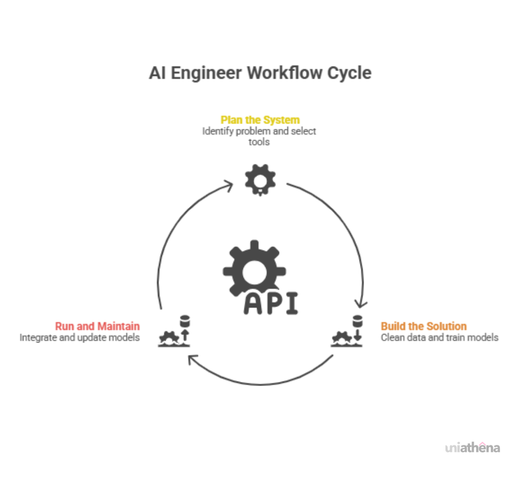
Their responsibility covers the full lifecycle of the AI system, from initial design to ongoing performance.
AI Engineer vs AI Developer
If you are confused between these two roles, it usually comes down to one question: Are you expected to build intelligence, or are you expected to integrate it?
That difference decides the role.
What Do AI Engineers Get Paid?
AI engineering is one of the highest-paying tech roles globally. Salaries vary by country, experience, and industry, but even at entry–mid levels, the pay is high compared with many traditional engineering or software roles.
Below is the latest verified salary data for 2025–2026, based on direct compensation surveys and employer reports.
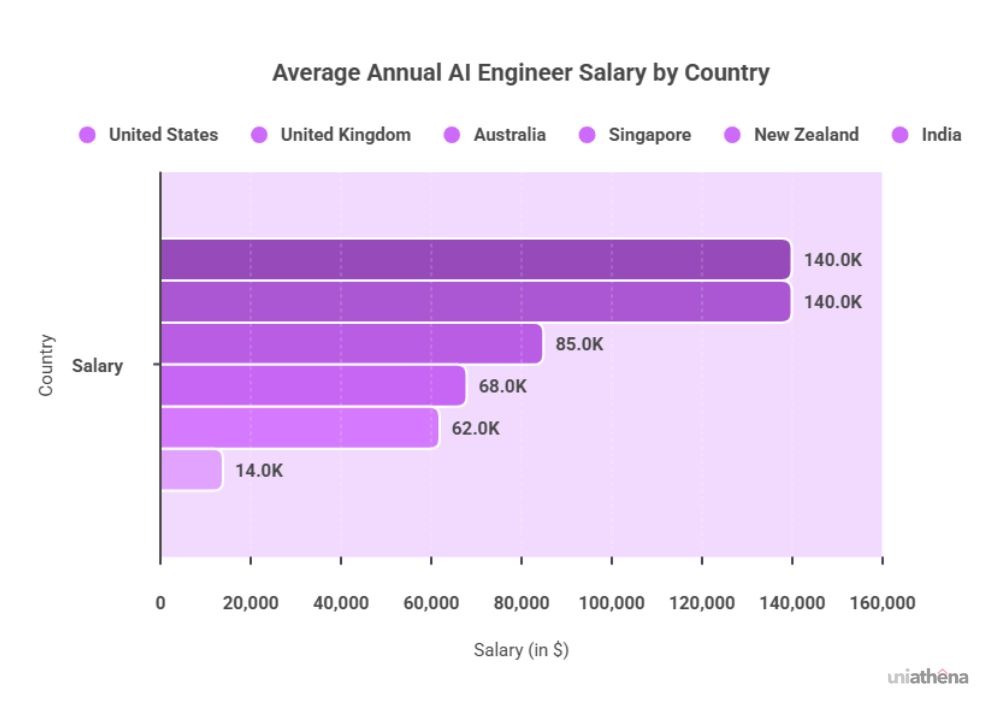
Note: All salary figures are shown in USD, converted from each country’s local currency.
Below are some of the highest-paying employers for AI engineers in the United States along with their reported salary ranges:
In the U.S., average AI engineer salaries often start above $130,000–$150,000 annually for mid-level profiles. Some top companies pay well over $200,000, especially at senior levels or with bonuses.
The range can vary widely based on experience, location within a country, and employer.
Skills You Need to Become an AI Engineer
AI engineering is a skill-heavy role. The work sits across data, models, and systems. These skills fall into three clear groups.
1. Technical Skills
These are non-negotiable.
- Programming: Python is essential. You should be comfortable writing production-level code, not just scripts.
- Machine Learning & AI: Supervised and unsupervised learning. Model evaluation. Feature engineering. Basic deep learning.
- Frameworks and Tools: TensorFlow or PyTorch. Scikit-learn. Basic experience with data pipelines and model deployment.
- Data Handling: Working with structured and unstructured data. Cleaning, transforming, and validating datasets.
2. Math and Core Foundations
You don’t need to be a mathematician, but you need working knowledge.
- Linear Algebra: Vectors, matrices, transformations.
- Probability and Statistics: Distributions, variance, hypothesis testing.
- Algorithms and Logic: Understanding how models and systems behave under constraints.
3. Non-Technical Skills
These affect how well you work, not just what you build.
- Problem Framing: Knowing when AI is useful and when it is not.
- Analytical Thinking: Breaking vague problems into solvable steps.
- Communication: Explaining model behavior and limitations to non-technical teams.
4. Supporting Skills
These are not mandatory at the start but become important over time.
- Cloud Platforms (AWS, GCP, Azure)
- Version Control and Collaboration (Git)
- Basic ML Operations (monitoring, retraining, performance tracking)
Step-by-Step Roadmap to Become an AI Engineer
Step 1: Learn the Basics
You must start with core foundations:
- Learn Python programming thoroughly (syntax, data structures, functions, OOP).
- Understand linear algebra basics (vectors, matrices).
- Learn probability and statistics (distributions, mean/variance, hypothesis testing).
Python gives you the tool you’ll use in almost all AI work. Linear algebra and statistics let you reason about models rather than just run code.
Step 2: Study Core ML/AI Concepts
Move from syntax to concepts:
- Learn machine learning fundamentals (supervised vs. unsupervised, regression, classification).
- Understand neural networks and basic deep learning ideas.
- Learn how AI systems make decisions from data.
At this stage, you’re learning what models do and why they behave the way they behave. Practice on small datasets and simple models.
Also Read: Best Machine Learning Courses
Step 3: Do Hands-On Projects
You must build things. Projects are where concepts become real.
Work on at least these starter projects:
1. Predictive Model: Build a regression or classification model (e.g., price prediction, sentiment classification).
2. Neural Network Project: Train a simple neural network using a framework like TensorFlow or PyTorch.
3. End-to-End Mini-AI App: Take a dataset, build a model, and integrate it into a small application (even a notebook with an interactive interface).
These projects go in your portfolio and show employers you can execute.
Step 4: Build a Portfolio + GitHub
Show, don’t tell:
- Put all code on GitHub with clear READMEs.
- Include project descriptions, results, and insights.
- Each repo must run, no placeholders or half-finished work.
A strong portfolio is proof of ability. Recruiters and hiring managers verify by checking it.
Step 5: Take Recognized Certifications
Once you have basics and projects done, get certified to validate your skills:
1. A Diploma in Artificial Intelligence is a short program for data scientists and AI researchers who want to build a strong foundation in artificial intelligence. You’ll learn essential concepts like, logical frameworks, problem solving techniques, and how intelligent systems process information and make decisions.
2. You can also pursue Mastering Artificial Intelligence Fundamentals, which focuses on the core strategies, knowledge representation methods, and foundational concepts used in AI systems.
3. For deeper credibility, a Postgraduate Certificate in Machine Learning is a stronger option. This CIQ-accredited program carries 20 CIQ credits, signaling structured, university-aligned learning and making it better suited for serious ML roles.
4. If your interest is in AI agents, explore AI Agents Fundamentals. Here you’ll learn how agents work, their key characteristics, different types, and how they interact with various environments.
Certifications help reduce skepticism when you don’t have years of work experience.
Step 6: Apply for Internships / Junior Roles / Freelance Gigs
Now you go to market:
- Apply for AI internships and junior positions.
- Start with contract or freelance AI/ML tasks to build work experience.
- Use your portfolio and certificates to back your applications.
Experience is the step that actually gets you in. Keep learning on the job.
Also Read: What Are the Top 5 AI Skills to Learn
Conclusion
Becoming an AI engineer is a structured process. You start with fundamentals, build practical skills, apply them through projects, and validate your ability with a portfolio and recognized credentials. Salary and demand reflect the value of this skill set, but results depend on execution, not intent.
If you follow the roadmap consistently and focus on building real systems, you position yourself for entry-level and growth roles in AI engineering.
FAQs
Q1. Can you become an AI engineer with no experience?
A: Yes. You can start by learning core skills, building projects, and creating a portfolio. Entry roles value proof of skills more than prior job titles.
Q2. Are AI engineers paid well?
A: Yes. AI engineers earn above-average tech salaries, especially in the US, UK, Australia, and Singapore.
Q3. What should you study to become an AI engineer?
A: Study Python, machine learning, basic AI concepts, linear algebra, and statistics.
Q4. Do AI engineers need to know coding?
A: Yes. Strong coding skills, especially in Python, are required for building and deploying models.
Q5. How long does it take to become an AI engineer?
A: With focused learning, it typically takes 6 to 12 months to reach an entry-level skill level.
Q6. Is a degree mandatory to become an AI engineer?
A: No. A degree helps, but projects, skills, and practical experience matter more.
Explore Related Courses











COMMENTS(0)
Explore Related Courses
Our Popular Insights
Careers are shifting faster than ever, and staying relevant takes more than experience. Explore UniAthena’s most-read blogs for sharp insights, emerging skills, and practical pathways that help you move forward with clarity and confidence in a changing professional world.

What is Business Development?
Read More
6
mins read
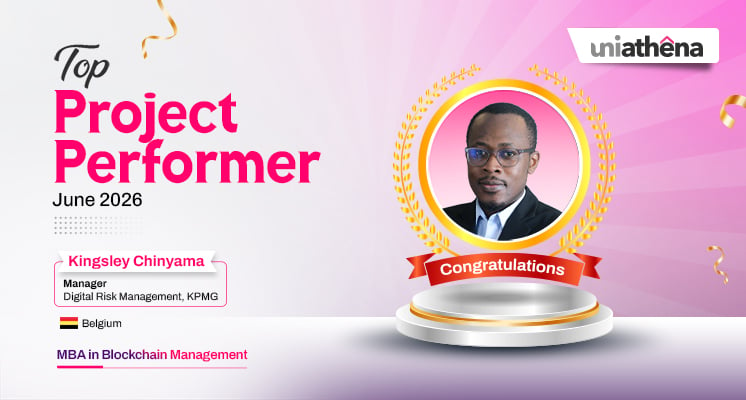
🌟 Top Project Performer – June 2026 🌟
Read More
1
mins read

What is the Role of AI in Education?
Read More
4
mins read


🌟 Top Project Performer – May 2026 🌟
Read More
1
mins read

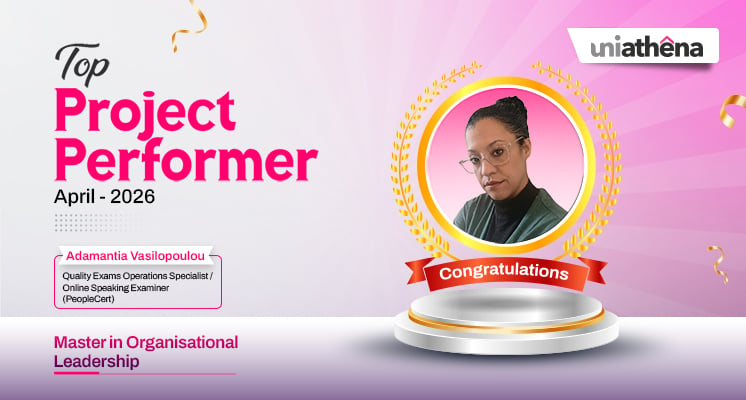
🌟 Top Project Performer – April 2026 🌟
Read More
1
mins read
What is Business Development?
Read more
6
mins read
🌟 Top Project Performer – June 2026 🌟
Read more
1
mins read
What is the Role of AI in Education?
Read more
4
mins read
🌟 Top Project Performer – May 2026 🌟
Read more
1
mins read

🌟 Top Project Performer – April 2026 🌟
Read more
1
mins read
Get in Touch

It’s Time to Start
Join NowMost Popular Online Specialization
- Master of International Business Administration
- Master of Business Administration
- MBA in General Management- FastTrack
- Master in Innovation and Entrepreneurship
- MBA-Family Business Management
- Master in Procurement and Contract Management
- Extended Diploma in Business Analytics (SCQF Level 11)
- Diploma in Supply Chain and Logistics Management (SCQF Level 11)
- Strategic Human Resource Management Practitioner
- Master in Data Science
- Master in Engineering Management
Trending Online
- Integrated Doctorate of Business Administration
- Postgraduate Certificate in Finance for Next Generation Managers
- Master of Business Administration- General Management (Fast Track)
- Postgraduate Certificate in Socio-Economic and Legal Framework
- Postgraduate Certificate in Business Sustainability
- Certified Manager
- Supply Chain Management Practitioner
- MBA - AI in Business
- MBA - Accounting & Finance
- Master in Supply Chain and Logistics Management
Top Universities Online Certificates
- Postgraduate Certificate in International Marketing Management
- Postgraduate Certificate In International Human Resource Management
- Postgraduate Certificate in Strategic Management
- Postgraduate Certificate in Procurement & Contracts Management
- Postgraduate Certificate in Business Analytics
- Postgraduate Certificate in Strategic Supply Chain & Logistics Management
- Postgraduate Certificate in Human Resource and Leadership
- Project Management Practitioner
- Postgraduate Certificate in Supply Chain Design & Implementation
- Postgraduate Certificate in Management Accounting and Finance
Accredited Online Degree Program
- MBA - Digital Transformation
- MBA - Family Business Management
- MBA - Marketing Management
- MBA in Quality Management
- MBA - Business Intelligence & Data Analytics
- MBA in Operations & Project Management
- MBA in Energy Management
- MBA In Construction & Safety Management
- Master in Organisational Leadership
- Master in Public Health
- Master in Construction Management
- Bachelor of Arts in Business Administration


 Install Now


UniAthena is an Ed-Tech, offering flexible, affordable learning solutions, including Free-Learning Upskilling Courses and Academic Programs in partnerships with accredited and globally renowned universities and professional qualification bodies.


Do you have any questions ?
Feel free to send us your questions or request a free consultation
Send a message
UK
Athena Global Education
Magdalen Centre,
Robert Robinson Avenue,
Oxford, OX4 4GA, UK
Phone : 01865 784299
MIDDLE EAST
Athena Global Education FZE
Block L-03, First Floor,
P O Box 519265, Sharjah Publishing City,
Free Zone, Sharjah, UAE
Phone : +971 55 879 5492
INDIA
Uniathena Private Limited
9A,Midas Tower
Phase 1
Hinjewadi Rajiv Gandhi Infotech Park
Pune-411057
Phone: +91 9145665544
All Copyrights Reserved @ Athena Global Education 2021-2026