-

Bachelor's

-

Masters
-

MBA
-

Doctorate
-

Micro Credit
-

Explore all Courses
-
Postgraduate Certifications

-
Postgraduate Diploma
-
Undergraduate Diploma
-
Diploma



Prompt Engineering Guide for 2026: Mastering Multimodal LLMs

Author: pallavi patnaik
|8
MINS READ
| 0
| 1,615
Created On: 30 October, 2025 Updated On: 17 February, 2026
Share




Table of Contents (TOC):
- Introduction
- Key Takeaways
- What Is Prompt Engineering?
- Quick Definitions
- Why Is Prompt Engineering Important?
- How Does Prompt Engineering Work?
- Key Aspects of Prompt Engineering for Multimodal LLMs
- Prompt Engineering Tips: What to Do
- What to Avoid in Prompt Engineering?
- Prompt Engineering vs Prompt Tuning
- Skills Needed For a Prompt Engineer
- Advanced Prompting Techniques for 2026
- Academic and Ethical Considerations
- Conclusion
- FAQs
Introduction
Prompt Engineering in 2026 is far more than clever text instructions for chatbots. It’s a foundational skill for teachers, researchers, and AI professionals working in multimodal environments.
This guide will help readers master prompt creation for multimodal large language models (LLMs), avoid common pitfalls, and enhance AI output. Learn actionable tips, advanced techniques, and discover essential resources to excel in generative AI workflows.[1][3]
Key Takeaways:
- Understand the essentials of prompt engineering for LLMs
- Master best practices for multimodal input (text, image, audio)
- Avoid frequent mistakes and explore advanced prompting strategies
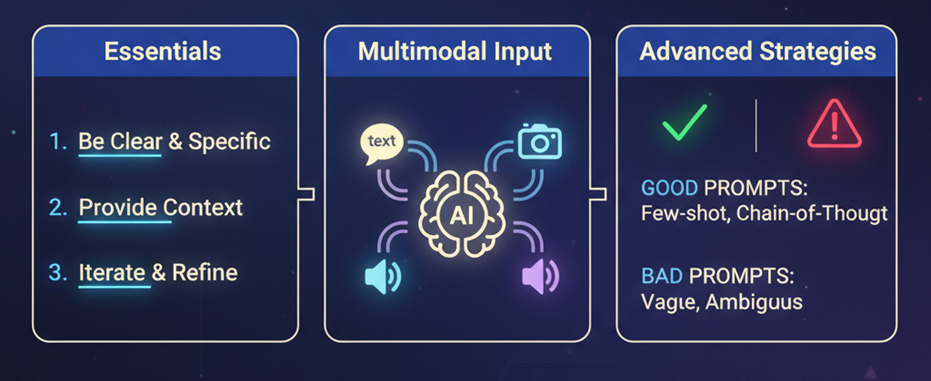
FIG 1: Key takeaways: Prompt Engineering for LLMs
What Is Prompt Engineering?
Prompt Engineering is the systematic process of designing, structuring, and refining prompts, the questions or input we present to LLMs—to obtain accurate, creative, and tailored outputs.
In essence, Prompt engineering is about effective communication with AI. Well-designed prompts lead to powerful, relevant model responses.[3][4]
Core Concepts for Multimodal LLMs:
- Model Interpretation: How does the LLM understand natural language and multimodal input?
- Context & Examples: How do the provided instructions, examples, and constraints shape reasoning?
- Modality Alignment: How does the model integrate text, visual, and audio cues for a coherent response? [2][4]
Quick Definitions
Multimodal Alignment: Ensuring that inputs from different sources (e.g., images, text) are logically connected for the model to process effectively.
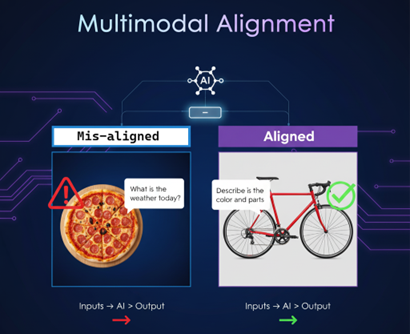
FIG 2: Multimodal Alignment
Chain of Thought Prompting: Structuring a prompt so the AI provides step-by-step reasoning, much like showing your work in math
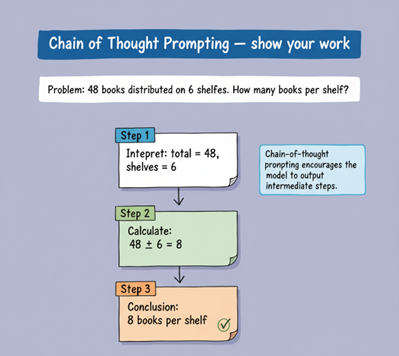
FIG 3: Chain of Thought Prompting
Tree of Thought Prompting: Letting the model explore multiple solution paths before arriving at an answer.
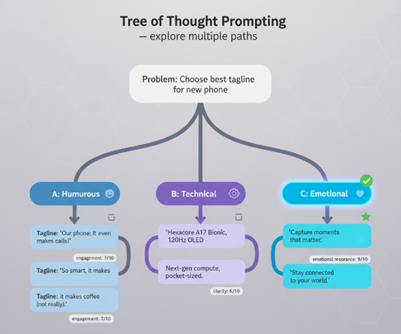
FIG 4: Tree of Thought Prompting
Why Is Prompt Engineering Important?
Prompt engineering is vital across education, research, and industry as it directly shapes AI output quality and efficiency. It enhances accuracy by reducing irrelevant responses, boosts efficiency through clear and concise instructions, enables personalization for diverse users and contexts, promotes transparency and ethical use through structured reasoning, and supports scalability for large-scale AI deployment and optimization.[5][6]
How Does Prompt Engineering Work?
Generative AI models like ChatGPT and Google’s Gemini are built on architectures that allow them to understand different languages and their nuances. They are able to process any data input and provide answers or solutions to the questions and queries posed.
Prompt Engineering plays a very important role in the design and development of these prompts that can be input into these AI models. Prompt engineers ensure that the AI model understands certain prompts in their given context and responds accurately to the queries.
Key Aspects of Prompt Engineering for Multimodal LLMs
Contextual Framing
A well-engineered prompt begins with structured and detailed context. Multimodal LLMs perform best when they are given clear instructions along with relevant background information. Instead of using a vague prompt like “Explain this image,” provide specific details that guide the model’s focus and analytical depth. For example:
“Describe the chart trends on global CO₂ emissions from 2010 to 2026, highlighting major policy shifts.”
This approach ensures the model understands what to analyze, which timeframe to consider, and what insights to extract, resulting in more accurate, context-aware, and meaningful responses.[1][4]
Instruction Precision
LLMs excel when they receive explicit, well-structured instructions. Ambiguity often leads to vague or incomplete outputs, while clarity enables precise reasoning and richer responses. To achieve this, use clear action verbs that define the task explicitly and leave little room for interpretation.
For instance:
“Analyze the data and identify key drivers.”
“Compare two images and summarize the differences.”
By choosing directive verbs like analyze, evaluate, summarize, or interpret, you help the model understand the desired depth and direction of its response—an essential element of prompt engineering best practices.[1][4]
Multimodal Alignment
In multimodal prompt engineering, aligning text, visuals, and audio in a clear, structured sequence enables the model to interpret and reason effectively across formats. Rather than issuing vague commands, prompts should specify how each modality contributes to the task, for instance, referencing an image while guiding the model’s analytical focus.
This deliberate coordination ensures coherence between inputs, producing contextually rich, accurate, and meaningful outputs, ultimately unlocking the full potential of multimodal large language models.[2][3]
Prompt Structure Optimization
Experimenting with prompt structure can significantly improve the depth and quality of LLM outputs. Different techniques guide the model’s reasoning in distinct ways:
- Chain of Thought Prompting – Encourages step-by-step reasoning:
“List each step in solving the equation.” - Tree of Thought Prompting – Explores multiple possibilities before reaching a conclusion:
“List different hypotheses before identifying the most likely one.” - Zero-Shot Prompting – Tests generalization by asking the model to respond without examples.
Using these structured approaches ensures more thorough, coherent, and context-aware outputs, making them essential tools in advanced prompt engineering techniques.[2][4][7]
Prompt Engineering Tips: What to Do
[1][5][6]
What to Avoid in Prompt Engineering?
[3][4]
Tip: Test prompts across platforms (e.g., ChatGPT, Gemini, Claude) to check for broad usability.
Prompt Engineering vs Prompt Tuning
[5][7]
Why it matters: Prompt engineering supports creativity and fast iteration; prompt tuning is ideal for specialized, large-scale applications.
Also Read: Generative AI vs. Prompt Engineering: Exploring Their Roles
Skills Needed For a Prompt Engineer
Here are some skills and knowledge needed for a career in multimodal prompt engineering:
- Familiarity with LLMs and an understanding of their capabilities and limitations.
- Strong and clear communication skills are needed to define goals for the AI model.
- You must be able to translate complex technical concepts into understandable prompts.
- Programming expertise in languages such as Python.
- Firm grasp on data structures and AI algorithms.
- Creativity to design unique prompts in a realistic way.
Advanced Prompting Techniques for 2026
- Hierarchical Prompting: Layer prompts for sequential tasks (“Summarize the text; then rate its persuasiveness.”).
- Context Windows Management: Optimize prompt length for models with extended memory.
- Meta-Prompting: Design prompts that propose new, effective prompts.
- Visual-Guided Prompt Learning: Pair images with captions to improve multimodal reasoning.
These methods boost output quality and ensure robust responses for diverse educational scenarios.[2][6][7]
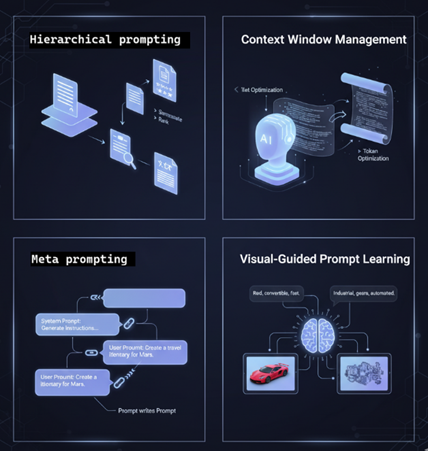
FIG 5: Advanced Prompting Techniques 2026
Academic and Ethical Considerations
Ethical prompt engineering is fundamental to responsible AI practice. Transparency through proper citation and credible references not only strengthens accuracy but also builds trust in AI-generated content. Prompts should be thoughtfully structured to minimize bias, encourage clear reasoning, and ensure that outputs remain fair, explainable, and academically sound.
Conclusion
As generative AI enters a transformative new era, mastering prompt engineering has become essential for unlocking creative, educational, and professional potential. By crafting precise, ethical, and multimodal prompts, practitioners can drive innovation, enhance learning outcomes, and refine AI interactions with clarity and intent. Continuous experimentation, documentation, and collaboration within the global AI community will shape the future of intelligent, human-aligned systems.
FAQs
Q1. Why is prompt clarity essential in working with LLMs?
A: Prompt clarity ensures that the AI model understands exactly what you require it to do. So it is important to avoid vague directions if you want the results to be accurate and exact.
Q2. What is multimodal prompting?
A: Multimodal prompting refers to the type of prompting where input can be found in multiple formats, such as text or images. It gives the user better control to ensure that they create the best possible prompt for their requirement.
Q3. What does a prompt engineer do?
A: A prompt engineer is responsible for designing and testing various prompts for LLMs like ChatGPT or Gemini. The more accurate the prompts, the better the results.
References:
[1] Prompt Engineering Guide. PromptingGuide.ai.
Available at: https://www.promptingguide.ai/
[2] Prompt Engineering in 2025: The Latest Best Practices. AakashG.
Available at: https://www.news.aakashg.com/p/prompt-engineering
[3] What is Prompt Engineering? A Detailed Guide For 2026. DataCamp.
Available at: https://www.datacamp.com/blog/what-is-prompt-engineering-the-future-of-ai-communication
[4] The Art and Science of Prompt Engineering in 2025. Marco Kotrotsos.
Available at: https://kotrotsos.medium.com/the-art-and-science-of-prompt-engineering-in-2025-a-comprehensive-guide-0705fbb43980
[5] Prompt Engineering Best Practices 2025: Top Features to Consider. CodeSignal. Available at: https://codesignal.com/blog/prompt-engineering/prompt-engineering-best-practices-2025/
[6] Prompt Engineering Tools & Techniques [Updated June 2025]. Helicone.ai.
Available at: https://www.helicone.ai/blog/prompt-engineering-tools
[7] The Ultimate Guide to Prompt Engineering in 2025: Mastering LLM Interactions. GenerativeAI.saif.
Available at: https://medium.com/@generativeai
Explore Related Courses














COMMENTS(0)
Explore Related Courses
Our Popular Insights
Careers are shifting faster than ever, and staying relevant takes more than experience. Explore UniAthena’s most-read blogs for sharp insights, emerging skills, and practical pathways that help you move forward with clarity and confidence in a changing professional world.

Best AI Tools for Content Creation
Read More
9
mins read

🌟 Top Project Performer – June 2026 🌟
Read More
1
mins read


🌟 Top Project Performer – May 2026 🌟
Read More
1
mins read


Best AI Tools for Content Creation
Read more
9
mins read
🌟 Top Project Performer – June 2026 🌟
Read more
1
mins read
🌟 Top Project Performer – May 2026 🌟
Read more
1
mins read
Get in Touch

It’s Time to Start
Join NowMost Popular Online Specialization
- Master of International Business Administration
- Master of Business Administration
- MBA in General Management- FastTrack
- Master in Innovation and Entrepreneurship
- MBA-Family Business Management
- Master in Procurement and Contract Management
- Extended Diploma in Business Analytics (SCQF Level 11)
- Diploma in Supply Chain and Logistics Management (SCQF Level 11)
- Strategic Human Resource Management Practitioner
- Master in Data Science
- Master in Engineering Management
Trending Online
- Integrated Doctorate of Business Administration
- Postgraduate Certificate in Finance for Next Generation Managers
- Master of Business Administration- General Management (Fast Track)
- Postgraduate Certificate in Socio-Economic and Legal Framework
- Postgraduate Certificate in Business Sustainability
- Certified Manager
- Supply Chain Management Practitioner
- MBA - AI in Business
- MBA - Accounting & Finance
- Master in Supply Chain and Logistics Management
Top Universities Online Certificates
- Postgraduate Certificate in International Marketing Management
- Postgraduate Certificate In International Human Resource Management
- Postgraduate Certificate in Strategic Management
- Postgraduate Certificate in Procurement & Contracts Management
- Postgraduate Certificate in Business Analytics
- Postgraduate Certificate in Strategic Supply Chain & Logistics Management
- Postgraduate Certificate in Human Resource and Leadership
- Project Management Practitioner
- Postgraduate Certificate in Supply Chain Design & Implementation
- Postgraduate Certificate in Management Accounting and Finance
Accredited Online Degree Program
- MBA - Digital Transformation
- MBA - Family Business Management
- MBA - Marketing Management
- MBA in Quality Management
- MBA - Business Intelligence & Data Analytics
- MBA in Operations & Project Management
- MBA in Energy Management
- MBA In Construction & Safety Management
- Master in Organisational Leadership
- Master in Public Health
- Master in Construction Management
- Bachelor of Arts in Business Administration


 Install Now


UniAthena is an Ed-Tech, offering flexible, affordable learning solutions, including Free-Learning Upskilling Courses and Academic Programs in partnerships with accredited and globally renowned universities and professional qualification bodies.


Do you have any questions ?
Feel free to send us your questions or request a free consultation
Send a message
UK
Athena Global Education
Magdalen Centre,
Robert Robinson Avenue,
Oxford, OX4 4GA, UK
Phone : 01865 784299
MIDDLE EAST
Athena Global Education FZE
Block L-03, First Floor,
P O Box 519265, Sharjah Publishing City,
Free Zone, Sharjah, UAE
Phone : +971 55 879 5492
INDIA
Uniathena Private Limited
9A,Midas Tower
Phase 1
Hinjewadi Rajiv Gandhi Infotech Park
Pune-411057
Phone: +91 9145665544
All Copyrights Reserved @ Athena Global Education 2021-2026