-

Bachelor's

-

Masters
-

MBA
-

Doctorate
-

Micro Credit
-

Explore all Courses
-
Postgraduate Certifications

-
Postgraduate Diploma
-
Undergraduate Diploma
-
Diploma



Time Management Tips for Students

Author: munazzah ali
|6
MINS READ
| 0
| 123
Created On: 11 May, 2026
Share




Table of Contents (TOC):
- Introduction
- Key Takeaways
- Why Time Management Matters for Students
- Common Time Management Mistakes Students Make
- Top Time Management Tips for Students
- Bonus Tips for Better Productivity
- Conclusion
- FAQ’s
Introduction
Do you ever feel like the day starts with good intentions—but somehow ends with unfinished tasks, pending assignments, and a long list of “I’ll do it tomorrow”?
That’s the reality for most students, not because they don’t have enough time, but because time management keeps slipping through without a clear structure.
Student life nowadays is full of demands all the time: lectures, assignments, exams, group work, personal responsibilities, and distractions that never really switch off. Time does not simply go by in the midst of all this, but it gets scattered. And that is when the stress starts to build.
What separates students who stay ahead from those who always feel behind isn’t extra hours in the day—it’s how intentionally they use the hours they already have. When you develop strong time management skills, time will no longer become a burden but rather a resource. It simplifies handling work, deadlines become less intimidating, and studying is less disorganized and more intentional.
Mastering time management and skill development in one's youth can not only benefit in exams, but also impart discipline, regularity, and confidence that will benefit far beyond academics.
Key Takeaways:
- Time management skill is a critical skill that improves academic achievement and reduces stress.
- Most students are struggling due to poor prioritization and procrastination.
- The simplest time management tips could be extremely useful in increasing productivity.
- Consistency and planned organization are more important than long study time.
- Digital tools and practices can help students to be organized and focused.
Why Time Management Matters for Students
Time management for students is not just about making a schedule; it plays a key role in learning, improving performance, and helping them manage stress effectively.
- Enhances Academic Performance: When students follow structured time management strategies, they will study more efficiently and remember more of what they study as opposed to cramming.
- Lessens Stress and Pressure: You will no longer need to be stressed by deadlines, as soon as you know what is important and when it is important, with proper time management techniques, and there won’t be any last-minute rush.
- Develops Long-term Discipline: Good time management skills extend beyond the academic area, and it ensures consistency, responsibility, and focus, which are carried over to the workplace and leadership roles.
Understanding why time management is important is the first step towards being in full control of academic life, rather than always responding to it.
Common Time Management Mistakes Students Make
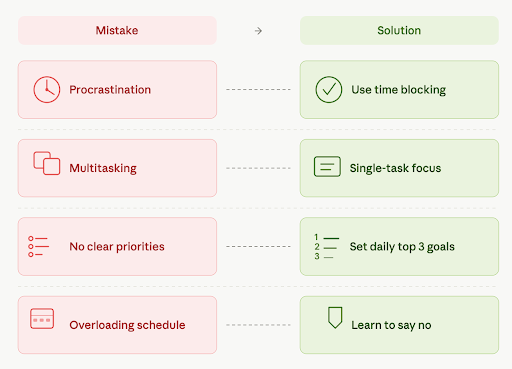
Most students don’t struggle because they can’t manage time— they struggle because their time is being managed by habits that are silently working against them.
- Procrastination Trap: Pushing things off until “later” gradually becomes last-minute panic, a hasty job, and needless stress that are easily avoided with a little planning.
- Multitasking Confusion: Attempting to do everything simultaneously can seem productive, yet it actually divides the mind, undermines concentration, and results in shallow comprehension.
- Lack of Priorities: When it seems that all things are important, students tend to waste time doing the wrong tasks, while important work continues to wait.
- Hectic Schedules: When you say yes to all things, you are left with a hectic schedule, which might seem like a productive schedule in theory, but in reality, it is a case of burnout and low productivity.
It is not about the time that we lack, but rather how we are spending it.
Top Time Management Tips for Students
Good time management isn’t about doing more—it’s about doing things smarter, with clarity and control. These simple habits can completely change how students go about their day:
1. Set Clear Objectives
Don’t have vague plans; specify what you wish to accomplish. The SMART method will help in breaking it down into daily, weekly, and monthly targets to remain focused and easily monitor the progress.
2. Develop a Study Plan
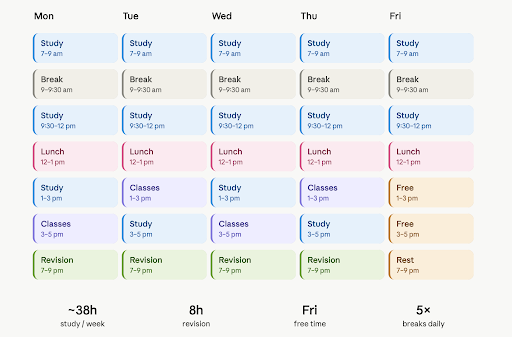
Consistency is brought about by an orderly routine. Take time to study, revise, and have short breaks to make sure that your mind is fresh and normal.
3. Prioritize Smartly (Important vs Urgent)
Not everything deserves immediate attention. You need to know how to focus on things that actually impact your academic performance as opposed to dealing with every need at the same time.
4. Beat Procrastination
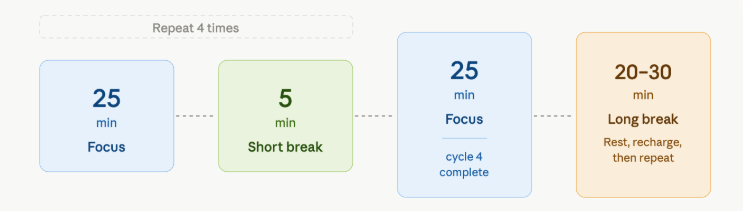
The real productivity killer is delay. Strategies such as the Pomodoro method—focused study for 30 minutes and a short break- help in keeping the pace and being more concentrated.
5. Eliminate Distractions
Phones, social media, and distracting noises steal attention without making a sound. One of the most potent tools of effective studying is a distraction-free space.
6. Have Purposeful Breaks
Breaks do not constitute wasted time; they reset your brain. Brief pauses enhance concentration, energy, and long-term retention.
7. Utilize Productivity Tools
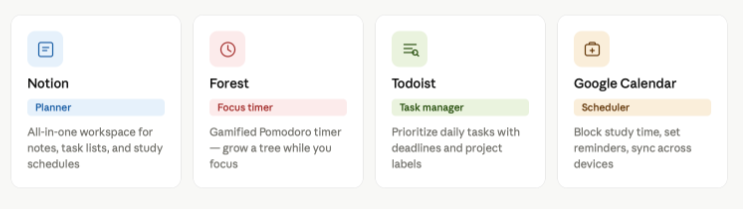
Digital calendars, planners, and reminder programs can add order to your day, and it is easier to follow tasks and deadlines.
8. Learn to Say No
Each “yes” adds to your burden. Protect your time by not making unnecessary engagements that cause distraction.
9. Stay Consistent
True progress is not achieved by periodic bursts of effort. Small, consistent practices create strong habits in the long run.
10. Reflect and Revise
Review what is and is not working. Change your strategy every week and get more efficient and organized over time.
Time management is a process that is developed over time, and these are the habits that turn chaos into clarity.
Also Read: Academic Burnout: Why It Happens and How to Avoid It
Bonus Tips for Better Productivity
- Prioritize Good Sleep: Good sleep is not just a luxury, but a performance booster. It improves memory, boosts concentration, and allows you to study better and faster.
- Be Physically Active and Hydrated: A healthy body is a healthy mind. Physical activity and hydration keep the body energetic and focused during the daytime.
- Have an Orderly Workspace: A tidy desk will give you clarity of mind. Once you have your place sorted, your mind must follow, and distractions are automatically minimized.
These simple and effective routines may be small, but when put together, they can create a solid foundation to concentrate better, be more productive, and make better use of time.
Conclusion
Time management is not about the number of things you can fit in your day; it is about the way you utilize your time. By using time management strategies in an organized way, students enhance discipline and academic performance.
The trick is easy: begin small, be consistent, and improve as time goes by. To develop core competencies in areas like communication, planning, and leadership, in addition to productivity, UniAthena offers courses such as
- Basics of Business Communication,
- Essentials of Operations and Project Management, and
- Basics of Project Planning,
which are meant to help learners develop holistically.
Also Read: How to Earn Money Online as a Student?
FAQ’s
Q1. What is the best way to start time management as a student?
A: Begin by creating a simple study plan and setting achievable daily goals. Do not attempt to plan everything simultaneously, but concentrate on little things that are easy to manage.
Q2. How many hours should a student study in a day?
A: There is no fixed number, but rather it depends on the person. The key is concentrated and regular time of study instead of prolonged hours of unproductive time.
Q3. What are the most effective time management techniques for students?
A: Pomodoro technique, prioritization of tasks (important vs urgent), and time blocking are good practices to increase focus and productivity.
Q4. How can students avoid procrastination?
A: Break down the task into smaller sections, set specific deadlines, get rid of distractors, and take short study sessions to be focused and motivated.
Explore Related Courses













COMMENTS(0)
Explore Related Courses
Our Popular Insights
Careers are shifting faster than ever, and staying relevant takes more than experience. Explore UniAthena’s most-read blogs for sharp insights, emerging skills, and practical pathways that help you move forward with clarity and confidence in a changing professional world.


How to Switch Career to Data Analytics?
Read More
6
mins read





How to Switch Career to Data Analytics?
Read more
6
mins read

Get in Touch

It’s Time to Start
Join NowMost Popular Online Specialization
- Master of International Business Administration
- Master of Business Administration
- MBA in General Management- FastTrack
- Master in Innovation and Entrepreneurship
- MBA-Family Business Management
- Master in Procurement and Contract Management
- Extended Diploma in Business Analytics (SCQF Level 11)
- Diploma in Supply Chain and Logistics Management (SCQF Level 11)
- Strategic Human Resource Management Practitioner
- Master in Data Science
- Master in Engineering Management
Trending Online
- Integrated Doctorate of Business Administration
- Postgraduate Certificate in Finance for Next Generation Managers
- Master of Business Administration- General Management (Fast Track)
- Postgraduate Certificate in Socio-Economic and Legal Framework
- Postgraduate Certificate in Business Sustainability
- Certified Manager
- Supply Chain Management Practitioner
- MBA - AI in Business
- MBA - Accounting & Finance
- Master in Supply Chain and Logistics Management
Top Universities Online Certificates
- Postgraduate Certificate in International Marketing Management
- Postgraduate Certificate In International Human Resource Management
- Postgraduate Certificate in Strategic Management
- Postgraduate Certificate in Procurement & Contracts Management
- Postgraduate Certificate in Business Analytics
- Postgraduate Certificate in Strategic Supply Chain & Logistics Management
- Postgraduate Certificate in Human Resource and Leadership
- Project Management Practitioner
- Postgraduate Certificate in Supply Chain Design & Implementation
- Postgraduate Certificate in Management Accounting and Finance
Accredited Online Degree Program
- MBA - Digital Transformation
- MBA - Family Business Management
- MBA - Marketing Management
- MBA in Quality Management
- MBA - Business Intelligence & Data Analytics
- MBA in Operations & Project Management
- MBA in Energy Management
- MBA In Construction & Safety Management
- Master in Organisational Leadership
- Master in Public Health
- Master in Construction Management
- Bachelor of Arts in Business Administration


 Install Now


UniAthena is an Ed-Tech, offering flexible, affordable learning solutions, including Free-Learning Upskilling Courses and Academic Programs in partnerships with accredited and globally renowned universities and professional qualification bodies.


Do you have any questions ?
Feel free to send us your questions or request a free consultation
Send a message
UK
Athena Global Education
Magdalen Centre,
Robert Robinson Avenue,
Oxford, OX4 4GA, UK
Phone : 01865 784299
MIDDLE EAST
Athena Global Education FZE
Block L-03, First Floor,
P O Box 519265, Sharjah Publishing City,
Free Zone, Sharjah, UAE
Phone : +971 55 879 5492
INDIA
Uniathena Private Limited
9A,Midas Tower
Phase 1
Hinjewadi Rajiv Gandhi Infotech Park
Pune-411057
Phone: +91 9145665544
All Copyrights Reserved @ Athena Global Education 2021-2026