-

Bachelor's

-

Masters
-

MBA
-

Doctorate
-

Micro Credit
-

Explore all Courses
-
Postgraduate Certifications

-
Postgraduate Diploma
-
Undergraduate Diploma
-
Diploma



How to Manage Stress at Work

Author: maharajan p
|5
MINS READ
| 0
| 91
Created On: 23 April, 2026
Share




Table of Contents (TOC):
- Introduction
- Key Takeaways
- Common Workplace Stressors
- Why Most People Manage Stress Wrong
- 5 Strategies You Can Use to Manage Your Stress at Work
- Final Take
- FAQs
Introduction
Ever notice how the same workload can feel completely different depending on the day? On some days, you move through tasks effortlessly—ticking them off, staying ahead. On others, the exact same amount of work feels like it's closing in on you. You can't focus clearly. Even small tasks start feeling urgent, and a single unexpected interruption throws the entire day off.
Think you slipped because you have too much on your plate today? Not quite. What you're feeling is pressure, and it rose because demands kept arriving faster than you could clear them, leaving no room to breathe between one task and the next.
The key is to recognize these triggers early, before they start stacking up and taking control of your day.
Key Takeaways:
- Stress at work is usually triggered by structure. Deadlines, unclear priorities, interruptions, and lack of control create pressure. Identifying these triggers is the first step if you want to manage stress at work more effectively.
- Avoiding stress only postpones it; it doesn’t remove it. Scrolling, taking random breaks, or mentally escaping may feel relieving, but the pressure often returns the next day and can eventually affect mental health in workplace environments.
- Stress often comes from vagueness. When you define small actions, your brain focuses on progress instead of pressure.
- Speaking up about workload and closing your day with a clear plan reduces mental carryover and long-term stress buildup.
Common Workplace Stressors
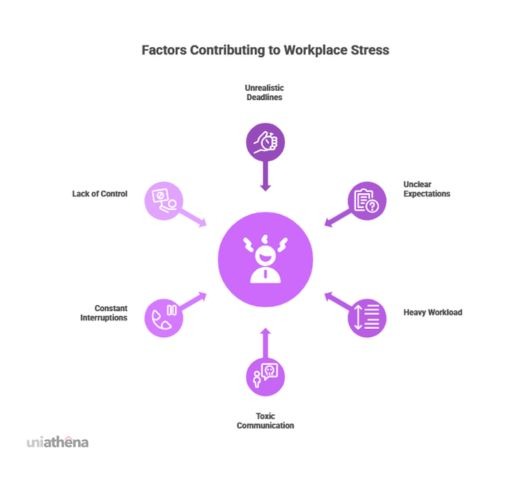
Workplaces can be a minefield for stress, even for the most experienced professionals. Some of the biggest triggers include:
- Unrealistic Deadlines: Being asked to deliver too much, too fast, can leave you constantly anxious.
- Unclear Expectations: Not knowing exactly what’s expected makes every task feel like walking blindfolded.
- Heavy Workload: Too many tasks on your plate can make even small mistakes feel catastrophic.
- Toxic Communication: Gossip, constant criticism, or lack of support from colleagues or managers drains mental energy.
- Constant Interruptions: Emails, calls, and notifications keep breaking your focus, making it impossible to settle into deep work.
- Lack of Control: Feeling like decisions are made over your head can make you powerless and frustrated.
Why Most People Manage Stress Wrong
Most people try to "escape" stress. They take a day off, scroll endlessly on their phones, binge-watch something late into the night, or simply hope the pressure will fade on its own. For a moment, it feels better.
But workplace stress rarely disappears. It just PAUSES.
The next morning, it returns in the form of unread emails and pending deadlines. The workload hasn't changed. The environment hasn't changed. The stress simply resumes exactly where it left off.
And if you keep doing this (escaping, returning, escaping again), stress will not only affect your mental health. It starts wearing on your body, too. According to a Headspace workforce survey of 2,000 U.S.-based employees and business leaders, 77% said workplace stress was affecting their physical health, with fatigue and disrupted sleep among the most common outcomes.
That's what prolonged avoidance actually costs.
The starting point isn't another escape. It's a different response entirely, and that's what the five strategies below are built around.
Also Read: 10 Work Tips to Succeed in the Corporate World
5 Strategies You Can Use to Manage Your Stress at Work
1. Triage Before You React
Yes, you will check your email. That’s normal. But don’t immediately start responding to everything.
Instead, scan your inbox and categorize:
- Urgent and important
- Important but not urgent
- Can wait
Decide what truly needs attention first. When you choose your response instead of reacting automatically, you reduce unnecessary stress and regain control of your workflow.
2. Break Large Tasks Into Smaller Actions
A large assignment feels stressful because it’s vague. Define it clearly.
Instead of writing “Complete monthly report,” break it into:
- Gather required data
- Analyze key numbers
- Draft summary
- Review and edit
When you focus on one small action at a time, the task stops feeling overwhelming. Clear steps reduce mental resistance.
3. Set Clear Boundaries Around Your Time
Constant interruptions increase stress because they fragment your focus. Every time you switch tasks, your brain spends energy recalibrating.
Block specific time slots for deep work. Turn off non-essential notifications during that time. Let colleagues know when you will be available to respond. Protecting your focus protects your energy.
4. Communicate When Workload Is Unrealistic
Many professionals carry silent stress because they hesitate to speak up.
If your workload becomes unmanageable, communicate early. Instead of saying “I can’t handle this,” say:
“I can complete A and B today. For C, I’ll need additional time. Which one should take priority?”
This shifts the conversation from complaint to collaboration. Clear communication prevents hidden stress from building up.
5. Close Your Day With a Reset
Unfinished tasks often follow you home mentally. Before ending your workday, review what you completed and list tomorrow’s top priorities.
This simple reset prevents your brain from replaying unfinished work at night. You create a mental boundary between work and rest.
Also Read: Low-Stress Jobs That Pay Well
Final Take
You may not eliminate stress from your work life. Deadlines, expectations, and pressure will always exist in some form.
What you can control is how you respond to them. When you structure your tasks, communicate clearly, and manage your focus intentionally, stress becomes manageable instead of overwhelming.
The goal isn’t to escape pressure. It’s to handle it with clarity and control.
FAQs
Q1. What causes stress at work?
A: Workplace stress is commonly triggered by tight deadlines, heavy workloads, unclear expectations, multitasking, and a lack of control over tasks.
Q2. Is workplace stress always harmful?
A: Not always. Short-term pressure can improve focus and performance. Stress becomes harmful when it is constant and unmanaged.
Q3. How do I know if my stress levels are too high?
A: Warning signs include constant fatigue, irritability, sleep disruption, lack of focus, and feeling overwhelmed daily.
Q4. Can better time management reduce stress?
A: Yes. Prioritizing tasks, breaking large projects into smaller steps, and planning your day reduces uncertainty and mental overload.
Q5. Should I talk to my manager about workload stress?
A: Yes. Clear communication about priorities and realistic timelines prevents silent burnout and builds mutual understanding.
Q6. Does multitasking increase stress?
A: Frequent task-switching increases cognitive strain. Focusing on one priority at a time improves productivity and lowers stress.
Explore Related Courses









COMMENTS(0)
Explore Related Courses
Our Popular Insights
Careers are shifting faster than ever, and staying relevant takes more than experience. Explore UniAthena’s most-read blogs for sharp insights, emerging skills, and practical pathways that help you move forward with clarity and confidence in a changing professional world.


How to Switch Career to Data Analytics?
Read More
6
mins read





How to Switch Career to Data Analytics?
Read more
6
mins read

Get in Touch

It’s Time to Start
Join NowMost Popular Online Specialization
- Master of International Business Administration
- Master of Business Administration
- MBA in General Management- FastTrack
- Master in Innovation and Entrepreneurship
- MBA-Family Business Management
- Master in Procurement and Contract Management
- Extended Diploma in Business Analytics (SCQF Level 11)
- Diploma in Supply Chain and Logistics Management (SCQF Level 11)
- Strategic Human Resource Management Practitioner
- Master in Data Science
- Master in Engineering Management
Trending Online
- Integrated Doctorate of Business Administration
- Postgraduate Certificate in Finance for Next Generation Managers
- Master of Business Administration- General Management (Fast Track)
- Postgraduate Certificate in Socio-Economic and Legal Framework
- Postgraduate Certificate in Business Sustainability
- Certified Manager
- Supply Chain Management Practitioner
- MBA - AI in Business
- MBA - Accounting & Finance
- Master in Supply Chain and Logistics Management
Top Universities Online Certificates
- Postgraduate Certificate in International Marketing Management
- Postgraduate Certificate In International Human Resource Management
- Postgraduate Certificate in Strategic Management
- Postgraduate Certificate in Procurement & Contracts Management
- Postgraduate Certificate in Business Analytics
- Postgraduate Certificate in Strategic Supply Chain & Logistics Management
- Postgraduate Certificate in Human Resource and Leadership
- Project Management Practitioner
- Postgraduate Certificate in Supply Chain Design & Implementation
- Postgraduate Certificate in Management Accounting and Finance
Accredited Online Degree Program
- MBA - Digital Transformation
- MBA - Family Business Management
- MBA - Marketing Management
- MBA in Quality Management
- MBA - Business Intelligence & Data Analytics
- MBA in Operations & Project Management
- MBA in Energy Management
- MBA In Construction & Safety Management
- Master in Organisational Leadership
- Master in Public Health
- Master in Construction Management
- Bachelor of Arts in Business Administration


 Install Now


UniAthena is an Ed-Tech, offering flexible, affordable learning solutions, including Free-Learning Upskilling Courses and Academic Programs in partnerships with accredited and globally renowned universities and professional qualification bodies.


Do you have any questions ?
Feel free to send us your questions or request a free consultation
Send a message
UK
Athena Global Education
Magdalen Centre,
Robert Robinson Avenue,
Oxford, OX4 4GA, UK
Phone : 01865 784299
MIDDLE EAST
Athena Global Education FZE
Block L-03, First Floor,
P O Box 519265, Sharjah Publishing City,
Free Zone, Sharjah, UAE
Phone : +971 55 879 5492
INDIA
Uniathena Private Limited
9A,Midas Tower
Phase 1
Hinjewadi Rajiv Gandhi Infotech Park
Pune-411057
Phone: +91 9145665544
All Copyrights Reserved @ Athena Global Education 2021-2026