-

Bachelor's

-

Masters
-

MBA
-

Doctorate
-

Micro Credit
-

Explore all Courses
-
Postgraduate Certifications

-
Postgraduate Diploma
-
Undergraduate Diploma
-
Diploma



Best AI Tools for Content Creation
Author: aishwarya sancheti
|8
MINS READ
| 0
| 922
Created On: 06 May, 2026
Share




Table of Content (TOC):
- Introduction
- Key Takeaways
- First, Let’s Kill the Misconception
- What is AI Generated Content, Exactly?
- How AI Fits Into the 5-Stage Content Workflow
- Best AI Tools for Content Creation in 2026 - By Stage
- Other Free AI Tools for Content Creation
- Pros and Cons of AI Generated Content
- What Should You Avoid While Using AI Tools?
- How to Use AI for Content Creation - A 5-Step Starter Plan
- Level Up Your AI Skills - Recommended Courses
- Conclusion
- FAQs
Introduction
You’ve googled this before. You’ve seen lists of 40+ AI tools with identical descriptions. You’ve felt that familiar mix of excitement and overwhelm and closed the tab without trying a single one.
Whether you’re a solo creator running a newsletter, a marketer managing five brand accounts, or a founder trying to punch above your weight, let’s have a look at what is for you.
Key Takeaways:
- AI tools accelerate content creation but still require human creativity and editing.
- The best results come from combining AI efficiency with human insight and voice.
- Choosing the right tool for each stage of content creation is crucial.
- Over-reliance on AI can reduce originality and content quality.
- A simple stack (ChatGPT + Canva + Grammarly) can cover most content needs.
First, Let’s Kill the Misconception
AI for content creation is not a magic button that writes viral posts while you sleep. That version of AI doesn't exist yet.
What does exist is something better: AI-powered content creation tools that cut your research time in half, give you a starting draft instead of a black page, and help you stay consistent even on your worst creative days.
The real question isn't “can I use AI to create content?” The answer is yes - everyone can. The better question is: “ how do I use AI for content creation without sounding like a robot?”
That’s what we’re here for.
Stat Check
85% of marketers now use AI tools for content creation up from 61% in 2023. The global AI content creation market is projected to grow by $60+ billion at a CAGR of 39.1% through 2029. This isn’t a trend anymore but a new baseline.
What is AI Generated Content, Exactly?
AI generated content is any text, image, video, or audio produced - fully or partly by an artificial intelligence system trained on large datasets.
That blog post drafted by ChatGPT? AI generated content. The thumbnail your designer polished in Canva using an AI layout? Also AI generated content. The short-form video you team repurposed using Opus Clip? Yes,. Same category.
Here’s the thing about AI generated content examples you see online: the best ones are never 100% AI. They’re human-shaped. A creator gives direction, a tool generates the draft, a human edits for voice and nuance and the result is 10x faster than going solo.
How AI Fits Into the 5-Stage Content Workflow
Instead of a random list of tools, here’s how to think about AI for content creation mapped to how content actually gets made:
1. Ideas & Research: Find topics, spot trends, understand your audience.
2. Writing & Drafting: Turn outlines into first drafts, blog posts, scripts, and copy.
3. Visuals & Design: Generate images, thumbnails, and on-brand graphics.
4. Video & Audio: Produce video content, voiceovers, and podcast edits.
5. Publishing & SEO: Optimize for search, schedule posts, repurpose across channels.
Now let’s assign the right tools to the right stages.
Best AI Tools for Content Creation in 2026 - By Stage
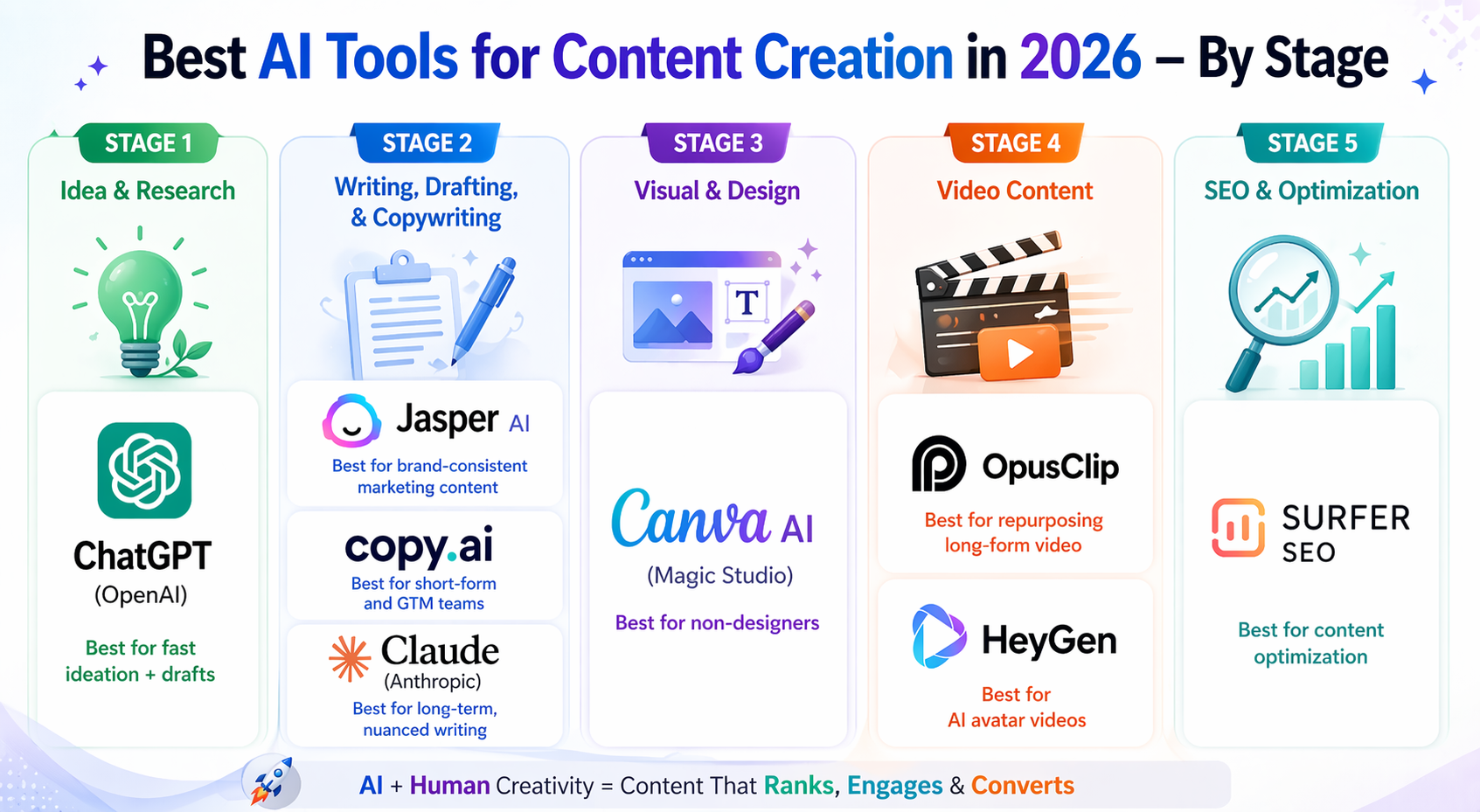
Stage 1: Idea & Research
ChatGPT (Open AI) - Best for Fast Ideation + Drafts
ChatGPT is still the Swiss Army knife of AI writing tools. Drop in a rough idea and get 10 angles, 5 headlines, or a full outline in under two minutes. The Plus version unlocks GPT- 4 with Deep Research, ideal for pulling sources and building content briefs fast. Free tier available.
Stage 2: Writing, Drafting, & Copywriting
Jasper AI - Best for Brand-Consistent Marketing Content
If your content team needs to scale without losing brand voice, Jasper is built for that. With 50+ templates and custom brand kits, it handles everything from long-form article writing to email sequences. Best AI tool for copywriting at the enterprise level.
Copy. ai - Best for Short-Form and GTM Teams
For AI tools for copywriting, think ads, product descriptions, email subject lines - Copy.ai is the tool. It's fast, template-rich, and beginner-friendly. A favourite in fintech and e-commerce for keeping copy clear and compliant. Free plan available.
Claude (Anthropic) - Best for Long-term, Nuanced Writing
Claude consistently delivers natural, thoughtful long-form content that doesn't scream ‘AI-written’. It's an excellent choice for artificial intelligence for content writing when you need depth, context, and a genuinely human-feeling output. Great for blogs, thoughts, leadership, and strategic content. Available via Claude.ai
Stage 3: Visual & Design
Canva AI (Magic Studio) - Best for Non-Designers
Canva has evolved into a full AI-powered content creation platform. Magic Design generates layouts from prompts, Magic Write drafts copy in-editor, and Magic Switch adapts your design across formats and aspect ratios automatically. Best AI tool for social media content visuals. Free tier available.
Stage 4: Video Content
Opus Clip - Best for Repurposing Long-form Video
This is the best AI for video content creation if you produce long YouTube videos, webinars, or podcasts. Opus Clip automatically finds the most compelling 60-second clips, adds captions, and formats them for TikTok, Instagram Reels, and YouTube Shorts. Massive time-saver. Cuts production time by up to 60%.
HeyGen - Best for AI Avatar Videos
Need explainer videos without appearing on camera? HeyGen creates realistic AI avatars that can deliver your script in multiple languages. Ideal for product demos, onboarding videos, and global content teams. The 2026 update adds Studio Sound for professional voice quality.
Stage 5: SEO & Optimization
Surfer SEO - Best for Content Optimization
Surfer SEO sits in a category of its own - it's not a content generator, it's a content optimizer. It analyses top-ranking pages for your keyword and scores your draft in real time, showing you exactly what to add or fix before publishing. The 2026 version now also tracks how AI models reference your content - a nod to the rise of GEO (Generative Engine Optimization).
Other Free AI Tools for Content Creation
The best free AI writing tools aren’t free forever, they’re free enough to let you build a workflow and prove the value before you commit to a paid plan. Start with ChatGPT + Canva + Grammarly. That trio covers 80% of a typical content creator’s needs at zero cost.
Pros and Cons of AI Generated Content
What Should You Avoid While Using AI Tools?
This section most blogs skip. Don’t.
- Publishing raw AI output without editing: It reads flat. Your audience will notice, even if they can’t say why.
- Using AI as a replacement for strategy: AI doesn’t know your brand positioning, your audience’s pain points, or what stage of the funnel you’re targeting. You do.
- Ignoring fact-checking: AI tools hallucinate. A confident wrong answer is still the wrong answer. Always verify facts, stats, and sources.
- Picking the wrong tool for the job: ChatGPT is not a video editor. Canva is not an SEO tool. Match tools to use cases.
- Skipping the human edit: The magic happens in the layer between the AI draft and your final published piece. Don’t skip it. After completing the human editing process, some creators use an AI humanizer to make AI-assisted writing sound more natural while maintaining the intended meaning and tone.
How to Use AI for Content Creation - A 5-Step Starter Plan
If you’re new to this, here’s a practical on-ramp that works without a budget:
1. Start with One Tool: ChatGPT free is enough to start. Don’t tool-hop.
2. Give it Context, Not Commands: “Write a blog post” gets mediocre output. “Write a 600-word intro for a blog targeting beginner content marketers about using AU for ideation, in a conversational tone” gets something useful.
3. Edit for Your Voice: Rewrite 20 - 30% of every AI draft to inject your persona and brand tone.
4. Add Visual: Use Canva AI to pair every content piece with a scroll-stopping visual.
5. Repurpose Relentlessly: One blog post = 3 social captions + 1 newsletter snippet + 1 short video script. AI makes this fast.
Level Up Your AI Skills - Recommended Courses
Understanding the tools is step one. Understanding how to use them strategically is where the real edge comes from. Platforms like UniAthena helps you get along with industry-relevant, up to date and certified programs that give you that foundation.
Programs like Basics of Artificial Intelligence helps you understand what AI actually is and how it works, and where content creation fits in the bigger picture. Then you can move to Basics of Artificial Intelligence: Learning Models, where you can go deeper on how language models generate texts. Knowing this makes you a better prompter immediately.
Also programs like Basics of Content Marketing and Diploma in Artificial Intelligence helps those ready to go from user to practitioner.
Pairing hands-on tool use with foundational knowledge is what separates creators who use AI well from those who use it poorly.
Conclusion
AI-powered content creation is not the future. It is the present tense happening right away, in every industry, at every level.
The creators winning it aren’t using the most tools. They’re using the right tools, with a clear workflow, and they never let AI replace the one thing no model can replicate: their unique perspective.
So here’s your action step: pick one tool from this list, use it on your next piece of content, and see what happens. Not to replace your process - to speed it up.
That’s how you start. Everything else follows from there.
Your Starter Stack (Free)
ChatGPT (ideas + drafts) + Canva AI (visuals) + Grammarly (editing).
These three free AI tools for content creation covers the full workflow. Zero cost. Start today.
FAQs
Q1. What are the best AI tools for content creation?
A: ChatGPT, Jasper, Canva AI, Opus Clip, and Surfer SEO are among the top tools in 2026.
Q2. Is AI-generated content good for SEO?
A: Yes, if it’s high-quality, human-edited, and optimized properly.
Q3. Can AI replace content creators?
A: No, AI supports content creation but cannot replace human creativity and strategy.
Q4. How do I use AI without sounding robotic?
A: Add your voice, edit outputs, and provide detailed prompts with context.
Q5. What is the biggest risk of using AI for content?
A: Publishing unedited AI content can lead to generic, inaccurate, or low-quality output.
Our Popular Courses

$14000


Doctoral Degree in Business Administration
Universidad Catolica De Murcia (UCAM), Spain
Duration:
2 - 3 Years
$17500*
Integrated Doctorate of Business Administration
Guglielmo Marconi University, Italy
Universidad Catolica De Murcia (UCAM), Spain
Duration:
2.5 - 3.5 Years
$5600*
Master of Business Administration
Guglielmo Marconi University, Italy
Duration:
12 - 24 Months
$5600*
MBA in Operations & Project Management
Guglielmo Marconi University, Italy
Duration:
12 - 24 Months
$5600*
Master in Supply Chain and Logistics Management
Guglielmo Marconi University, Italy
Duration:
12 - 24 Months
$5950*
Master in Data Sciences
Guglielmo Marconi University, Italy
Duration:
12 - 24 Months
$5600*
Master in Engineering Management
Guglielmo Marconi University, Italy
Duration:
12 - 24 Months
$5600*
Master in Procurement and Contract Management
Guglielmo Marconi University, Italy
Duration:
12 - 24 Months
$5600*
Master in Public Health
Guglielmo Marconi University, Italy
Duration:
12 - 24 MonthsOur Popular Courses
COMMENTS(0)
Our Popular Courses
$14000
Doctoral Degree in Business Administration
Universidad Catolica De Murcia (UCAM), Spain
Duration:
2 - 3 Years
$17500*
Integrated Doctorate of Business Administration
Guglielmo Marconi University, Italy
Universidad Catolica De Murcia (UCAM), Spain
Duration:
2.5 - 3.5 Years
$5600*
Master of Business Administration
Guglielmo Marconi University, Italy
Duration:
12 - 24 Months
$5600*
MBA in Operations & Project Management
Guglielmo Marconi University, Italy
Duration:
12 - 24 Months
$5600*
Master in Supply Chain and Logistics Management
Guglielmo Marconi University, Italy
Duration:
12 - 24 Months
$5950*
Master in Data Sciences
Guglielmo Marconi University, Italy
Duration:
12 - 24 Months
$5600*
Master in Engineering Management
Guglielmo Marconi University, Italy
Duration:
12 - 24 Months
$5600*
Master in Procurement and Contract Management
Guglielmo Marconi University, Italy
Duration:
12 - 24 Months
$5600*
Master in Public Health
Guglielmo Marconi University, Italy
Duration:
12 - 24 MonthsOur Popular Courses
Our Popular Insights
Careers are shifting faster than ever, and staying relevant takes more than experience. Explore UniAthena’s most-read blogs for sharp insights, emerging skills, and practical pathways that help you move forward with clarity and confidence in a changing professional world.

What Is Grok AI?
Read More
9
mins read
🌟 Top Project Performer – June 2026 🌟
Read More
1
mins read


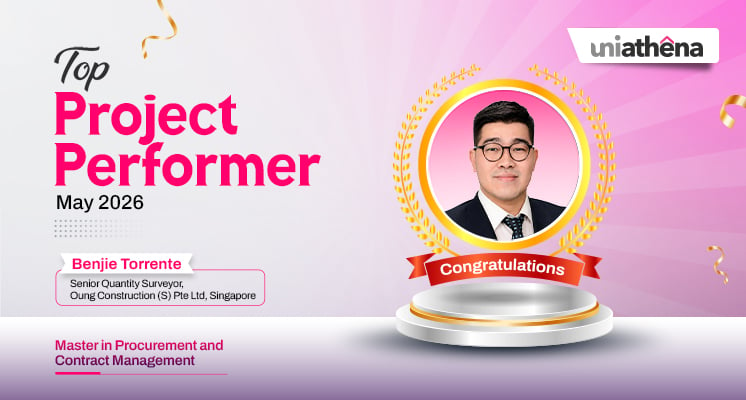
🌟 Top Project Performer – May 2026 🌟
Read More
1
mins read

Top Cybersecurity Courses in Ghana
Read More
7
mins read

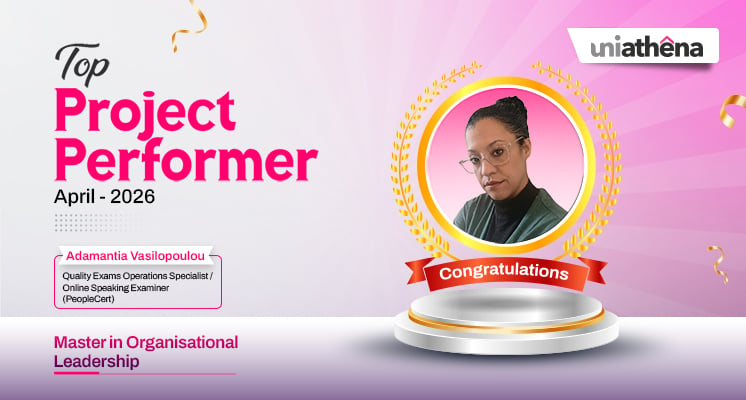
🌟 Top Project Performer – April 2026 🌟
Read More
1
mins read
What Is Grok AI?
Read more
9
mins read
🌟 Top Project Performer – June 2026 🌟
Read more
1
mins read
🌟 Top Project Performer – May 2026 🌟
Read more
1
mins read
Top Cybersecurity Courses in Ghana
Read more
7
mins read
🌟 Top Project Performer – April 2026 🌟
Read more
1
mins read
Get in Touch

It’s Time to Start
Join NowMost Popular Online Specialization
- Master of International Business Administration
- Master of Business Administration
- MBA in General Management- FastTrack
- Master in Innovation and Entrepreneurship
- MBA-Family Business Management
- Master in Procurement and Contract Management
- Extended Diploma in Business Analytics (SCQF Level 11)
- Diploma in Supply Chain and Logistics Management (SCQF Level 11)
- Strategic Human Resource Management Practitioner
- Master in Data Science
- Master in Engineering Management
Trending Online
- Integrated Doctorate of Business Administration
- Postgraduate Certificate in Finance for Next Generation Managers
- Master of Business Administration- General Management (Fast Track)
- Postgraduate Certificate in Socio-Economic and Legal Framework
- Postgraduate Certificate in Business Sustainability
- Certified Manager
- Supply Chain Management Practitioner
- MBA - AI in Business
- MBA - Accounting & Finance
- Master in Supply Chain and Logistics Management
Top Universities Online Certificates
- Postgraduate Certificate in International Marketing Management
- Postgraduate Certificate In International Human Resource Management
- Postgraduate Certificate in Strategic Management
- Postgraduate Certificate in Procurement & Contracts Management
- Postgraduate Certificate in Business Analytics
- Postgraduate Certificate in Strategic Supply Chain & Logistics Management
- Postgraduate Certificate in Human Resource and Leadership
- Project Management Practitioner
- Postgraduate Certificate in Supply Chain Design & Implementation
- Postgraduate Certificate in Management Accounting and Finance
Accredited Online Degree Program
- MBA - Digital Transformation
- MBA - Family Business Management
- MBA - Marketing Management
- MBA in Quality Management
- MBA - Business Intelligence & Data Analytics
- MBA in Operations & Project Management
- MBA in Energy Management
- MBA In Construction & Safety Management
- Master in Organisational Leadership
- Master in Public Health
- Master in Construction Management
- Bachelor of Arts in Business Administration


 Install Now


UniAthena is an Ed-Tech, offering flexible, affordable learning solutions, including Free-Learning Upskilling Courses and Academic Programs in partnerships with accredited and globally renowned universities and professional qualification bodies.


Do you have any questions ?
Feel free to send us your questions or request a free consultation
Send a message
UK
Athena Global Education
Magdalen Centre,
Robert Robinson Avenue,
Oxford, OX4 4GA, UK
Phone : 01865 784299
MIDDLE EAST
Athena Global Education FZE
Block L-03, First Floor,
P O Box 519265, Sharjah Publishing City,
Free Zone, Sharjah, UAE
Phone : +971 55 879 5492
INDIA
Uniathena Private Limited
9A,Midas Tower
Phase 1
Hinjewadi Rajiv Gandhi Infotech Park
Pune-411057
Phone: +91 9145665544
All Copyrights Reserved @ Athena Global Education 2021-2026