-

Bachelor's

-

Masters
-

MBA
-

Doctorate
-

Micro Credit
-

Explore all Courses
-
Postgraduate Certifications

-
Postgraduate Diploma
-
Undergraduate Diploma
-
Diploma



The Shift from Job Security to Skill Security
Author: munazzah ali
|7
MINS READ
| 0
| 56
Created On: 05 June, 2026
Share




Table of Contents (TOC):
- Introduction
- Key Takeaways
- Why Traditional Job Security Feels Less Predictable Today
- The Rise of Skill Security in Modern Careers
- Skills Becoming More Valuable Across Industries
- Why Continuous Learning Is Becoming Essential
- Start Building Your Skill Security With UniAthena
- Practical Ways to Build Skill Security
- Conclusion
- FAQs
Introduction
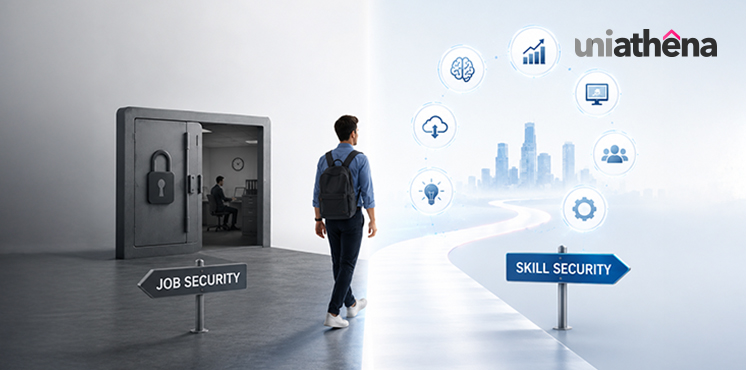
Loss of a job may not be the greatest career risk in 2026, but it might be skills that will no longer keep up with the job market.
The concept of job security over the years has been associated with stable jobs, growth, and long organizational commitment. Nevertheless, businesses have become automated and digital, and with changing market demands, professionals are beginning to consider skill security instead. Now, it is not about “how secure is my role?” but “how marketable are my skills in a shifting economy”?
This change is transforming the way businesses recruit, the way professionals develop, and what long-term career stability in a skill-based economy really entails.
Key Takeaways:
- Skill security is gaining momentum over job security.
- There is also a shift towards skills-first hiring by employers.
- It is through continuous learning that helps professionals stay relevant in changing industries.
- Digital capabilities and human-centric skills are also valuable nowadays.
- Future-ready skills increase the sustainability of careers in the long run.
Why Traditional Job Security Feels Less Predictable Today?
Lifetime employment is gradually shifting because the industries are dynamically changing more than ever. It is not that jobs are disappearing completely, but the roles are changing at a higher rate than some of the professionals predicted.
Rapid Technological Shifts
The way businesses are conducted is changing due to AI, automation, and digital systems. Most of the repetitive work has become automated, and new positions demand a combination of technical and analytical skills. This has increased the skills gap that is in existence in industries.
Economic and Workplace Uncertainty
Organizations have grown agile due to global economic changes, restructuring, and shifting business priorities. Firms are changing rapidly, and this also implies that professionals must remain flexible as opposed to just trusting the stability of an organization.
Skills Have a Shorter Shelf Life
The majority of the skills that are important in a job today might change in just a few years. This is one of the reasons why practitioners are investing more in upskilling and lifelong learning so that they can remain competitive.
The Rise of Skill Security in Modern Careers
Development of Transferable Skills that Remain Relevant
Skill security is the ability to acquire skills that are not outdated, even when there is a change in industries, technology, or occupation. Rather than being reliant on a single employer or single qualification, professionals are concentrating on cross-portable skills.
Flexibility Builds Resilience in the Career
A marketing specialist with an understanding of data analytics can be more helpful to campaigns. In the same manner, a finance executive knowledgeable in AI tools will be in a better position to cope with digital transformation in the industry.
Continuous Learning Supports Long-Term Growth
As professionals continuously upgrade their knowledge, they are usually in a better position to adapt to the changes in the workplace. That is why certifications, online education, and industry-focused programs are getting more popular.
Skill-Based Hiring Is Reforming Hiring
Many organizations are now focusing more on practical skills, rather than just traditional qualifications. This shift towards skills-based employment is encouraging professionals to focus on applied skills and problem-solving skills.
Skills Becoming More Valuable Across Industries
1. Technical and Digital Abilities
Digital literacy, awareness of AI, and data interpretation are becoming requirements in almost every industry. Employers are increasingly valuing professionals who are well-versed with the current digital applications and can adjust to technology-driven settings.
2. Business and Leadership Skills
Strategic thinking, communication, and project management remain very relevant. In the current working environments that are highly collaborative, workers are supposed to do more than just technical performance.
3. Human Centric Skills Matter More Than Ever
As automation is being used to deal with repetitive tasks, organizations are increasingly emphasizing human-centric capabilities, including emotional intelligence, adaptability, creativity, and decision-making. These are the skills that are difficult to substitute with technology.
This also explains a rising question of professionals: Which soft skills are most valued by employers? Increasingly, it is the capacity to communicate effectively, lead teams, and solve problems under uncertainty.
Why Continuous Learning Is Becoming Essential?
Careers Today Require Ongoing Reinvention
Professionals are no longer building careers once and relying on the same knowledge for decades. The increasing popularity of online certification, flexible learning platforms, and short online courses is indicative of the increasing need to embrace lifelong learning.
Flexible Learning For Working Professionals
In the contemporary work environment, learning models that accommodate work schedules and enable professionals to acquire skills that are in demand are favored by modern professionals.
Staying Relevant in a Skill-Based Economy
The contemporary work environment rewards those who never give up on learning and change. This is particularly significant in an expanding skill-based economy, where employability is becoming more and more a matter of capability, as opposed to just fixed qualifications.
Start Building Your Skill Security With UniAthena
If you want to move beyond basics and step up to a new, higher level of awareness and learn how leadership, technology, business, and workplace systems are changing, explore these free short courses offered at UniAthena:
1. Basics of Business Communication
The course will address interpersonal communication, the flow of information within organizations, and the ethical practices of business communication. Having 4-6 hours of self-paced learning and free access to course materials, learners have an opportunity to develop practical communication skills at their own convenience.
2. Master ChatGPT
With this course, students gain insights into the history of ChatGPT, how to get started, and explore the power of prompts to improve AI interactions. You will also explore advanced prompt methods, creative applications, including visual generation to content generation, and the future of artificial intelligence.
Delivered in a self-paced learning format, it can be completed in just 1 week, enabling learners to upskill at their own pace and get certified with a Blockchain-verified certification upon successful completion.
3. Diploma in Data Analytics
This course provides learners with knowledge on how they can utilize data to make informed business decisions in different business functions. The course also introduces key concepts, methods, and issues of business analytics, enabling learners to use analytical techniques to address real-life business issues.
Designed as a free-to-learn, self-paced learning experience, the course can be completed in 1–2 weeks, allowing learners to build valuable analytical skills at their own pace and enhance their ability to make data-driven decisions.
4. Executive Diploma in Project Management
The course equips you with the knowledge of project management with emphasis on the management of teams, resources, time, cost, and scope in order to deliver successful project deliverables. Learners will also discuss the main concepts of project management, such as project goal, deliverables, constraints, performance measures, resources needed, and control.
Complete the course in as little as 2-3 weeks and develop the vital project management and leadership skills at your own pace.
5. Diploma in Artificial Intelligence
The essential concepts of AI, such as intelligent agents, problem-solving methods, knowledge representation, logical reasoning, algorithms, and learning frameworks, are discussed in the course. The course curriculum is self-paced and can be completed within just 1-2 weeks, which makes it an accessible method of developing AI knowledge and becoming a confident student in this fast-changing sphere.
Also Read: How to Learn Job-Ready Skills Online and Get Hired Faster
Practical Ways to Build Skill Security
1. Follow Industry Trends
The realization of the impact of change in the workplace can enable professionals to realize new opportunities earlier.
2. Learn Complementary Skills
Technical skills coupled with leadership or communication skills can be very useful in enhancing career flexibility in the long run.
3. Invest in Upskilling
Resilience in careers can be enhanced through the acquisition of important skills, whether through certification programs, online learning, or through projects.
4. Build Adaptability
Curious, flexible, and open-minded professionals are usually better equipped to tackle the changing workplaces.
Conclusion
The move towards skill security, as opposed to job security, is indicative of a more widespread change in the contemporary work environment. Although stable jobs remain important, the long-term development of the career is more and more reliant on flexibility, life-long learning, and transferable knowledge.
The most adaptable professionals in 2026 may not be the experienced professionals alone, but those who are capable of learning, growing, and using the appropriate skills in the evolving industries.
Also Read: Skills You Need to Work in a Multinational Enterprise
FAQs
Q1. What do you mean by Job Security?
A: Job security is the stability and the constant nature of employment within a position or a company over the long run.
Q2. What is Skill Security?
A: Skill security refers to the acquisition of flexible and transferable skills that are not lost in case of an industry or workplace transformation.
Q3. What are the skills that will be most in demand in the future?
A: The skills expected to be very useful include AI literacy, strategic thinking, communication, data analysis, leadership, and adaptability.
Q4. Why is continuous learning important today?
A: Industries are changing at a fast pace, and lifelong learning is the only way of remaining competitive and employable.
Q5. What is skills-first hiring?
A: Skills-first hiring is a method of recruitment in which the employer focuses on practical skills and abilities rather than on qualifications alone.
Explore Related Courses











COMMENTS(0)
Explore Related Courses
Our Popular Insights
Careers are shifting faster than ever, and staying relevant takes more than experience. Explore UniAthena’s most-read blogs for sharp insights, emerging skills, and practical pathways that help you move forward with clarity and confidence in a changing professional world.

Best AI Tools for Content Creation
Read More
9
mins read

🌟 Top Project Performer – June 2026 🌟
Read More
1
mins read


🌟 Top Project Performer – May 2026 🌟
Read More
1
mins read


Best AI Tools for Content Creation
Read more
9
mins read
🌟 Top Project Performer – June 2026 🌟
Read more
1
mins read
🌟 Top Project Performer – May 2026 🌟
Read more
1
mins read
Get in Touch

It’s Time to Start
Join NowMost Popular Online Specialization
- Master of International Business Administration
- Master of Business Administration
- MBA in General Management- FastTrack
- Master in Innovation and Entrepreneurship
- MBA-Family Business Management
- Master in Procurement and Contract Management
- Extended Diploma in Business Analytics (SCQF Level 11)
- Diploma in Supply Chain and Logistics Management (SCQF Level 11)
- Strategic Human Resource Management Practitioner
- Master in Data Science
- Master in Engineering Management
Trending Online
- Integrated Doctorate of Business Administration
- Postgraduate Certificate in Finance for Next Generation Managers
- Master of Business Administration- General Management (Fast Track)
- Postgraduate Certificate in Socio-Economic and Legal Framework
- Postgraduate Certificate in Business Sustainability
- Certified Manager
- Supply Chain Management Practitioner
- MBA - AI in Business
- MBA - Accounting & Finance
- Master in Supply Chain and Logistics Management
Top Universities Online Certificates
- Postgraduate Certificate in International Marketing Management
- Postgraduate Certificate In International Human Resource Management
- Postgraduate Certificate in Strategic Management
- Postgraduate Certificate in Procurement & Contracts Management
- Postgraduate Certificate in Business Analytics
- Postgraduate Certificate in Strategic Supply Chain & Logistics Management
- Postgraduate Certificate in Human Resource and Leadership
- Project Management Practitioner
- Postgraduate Certificate in Supply Chain Design & Implementation
- Postgraduate Certificate in Management Accounting and Finance
Accredited Online Degree Program
- MBA - Digital Transformation
- MBA - Family Business Management
- MBA - Marketing Management
- MBA in Quality Management
- MBA - Business Intelligence & Data Analytics
- MBA in Operations & Project Management
- MBA in Energy Management
- MBA In Construction & Safety Management
- Master in Organisational Leadership
- Master in Public Health
- Master in Construction Management
- Bachelor of Arts in Business Administration


 Install Now


UniAthena is an Ed-Tech, offering flexible, affordable learning solutions, including Free-Learning Upskilling Courses and Academic Programs in partnerships with accredited and globally renowned universities and professional qualification bodies.


Do you have any questions ?
Feel free to send us your questions or request a free consultation
Send a message
UK
Athena Global Education
Magdalen Centre,
Robert Robinson Avenue,
Oxford, OX4 4GA, UK
Phone : 01865 784299
MIDDLE EAST
Athena Global Education FZE
Block L-03, First Floor,
P O Box 519265, Sharjah Publishing City,
Free Zone, Sharjah, UAE
Phone : +971 55 879 5492
INDIA
Uniathena Private Limited
9A,Midas Tower
Phase 1
Hinjewadi Rajiv Gandhi Infotech Park
Pune-411057
Phone: +91 9145665544
All Copyrights Reserved @ Athena Global Education 2021-2026