-

Bachelor's

-

Masters
-

MBA
-

Doctorate
-

Micro Credit
-

Explore all Courses
-
Postgraduate Certifications

-
Postgraduate Diploma
-
Undergraduate Diploma
-
Diploma



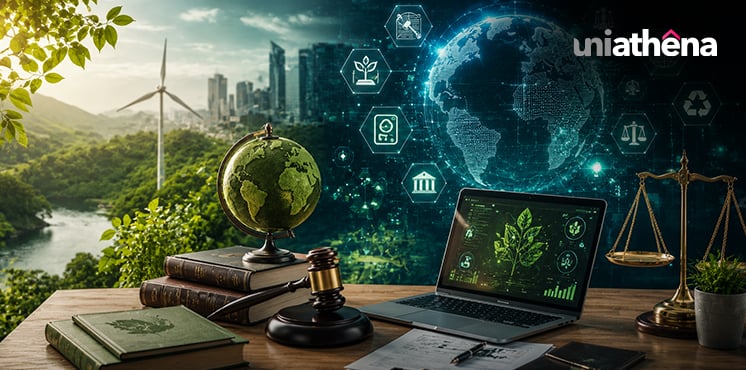
How Environmental Law in the Digital Age Is Creating New Career Pathways
Author: munazzah ali
|6
MINS READ
| 0
| 36
Created On: 07 July, 2026
Share




Table of Contents (TOC):
- Introduction
- Key Takeaways
- What Is Environmental Law?
- From Paper Trails to Data Trails: Environmental Law's Digital Reset
- The New Job Titles Climate Accountability Is Creating
- What It Takes to Build a Career in This Evolving Field
- Preparing for Careers in Environmental Governance
- Environmental Law's Future Is Interdisciplinary
- FAQs
Introduction
Ever wondered how someone can spot illegal deforestation taking place in the heart of the Amazon, where there is no one to witness it? It turns out that a satellite does. An AI model will scan the images, identify a patch of forest that has disappeared, and mark it in hours. Not weeks.
The single warning could wind up in a regulatory filing, and then it could be in a courtroom, much faster than the traditional paperwork ever could. It is the environmental law of today, and honestly speaking, it hardly resembles the discipline that people learned a decade ago, and is quietly creating environmental law positions that did not exist at the time.
And here is the most surprising part: the lawyer doing that case is no longer flipping through statutes. They're reading satellite data, checking whether an AI got its emissions numbers right, and are basing their whole case on drone footage and sensor logs rather than a pile of documents. That is what the careers in environmental law now look like - and it is transforming who is hired and what they really need to know from day one.
Key Takeaways:
- The environmental law has stopped being paper based and has gone to data-driven enforcement, which runs on satellite imaging, blockchain, and AI.
- New environmental law roles are now a combination of legal expertise and technical abilities, and ESG reporting.
- Environmental compliance careers are now more and more demanding of ease in using data tools, rather than legal expertise.
- Professionals stepping here benefit from guided education in international environmental law as well as digital governance tools.
- It is an interdisciplinary field that favors interdisciplinary thinkers - a lawyer, policy strategist, analyst, etc.
What Is Environmental Law?
It is the set of rules, treaties, and regulations that regulate the interaction of people, businesses, and governments with the natural world — covering things such as pollution control, use of resources, protection of wildlife, and climate agreements between nations.
For decades, this field ran almost entirely on paperwork: permits, court submissions, compliance audits, and slow-moving hearings in the tribunal.
What has evolved is the process of enforcement of these rules, and that is precisely why this profession is becoming a source of new career opportunities that didn't exist a decade ago.
From Paper Trails to Data Trails: Environmental Law's Digital Reset
Enforcement referred to laws and long trials in the courts. Now it means data. Remote sensing and GIS mapping are becoming the main sources of climate litigation, proving environmental damage, with a level of precision that paper records never offered.
The blockchain has also made an appearance, particularly in carbon credit markets, where it assists in confirming that a credit is not counted twice or created by a scammer.
The regulation is evolving at an equal pace. ESG reporting tools are now pulling real-time data as opposed to the annual disclosures. Digital monitoring, reporting, and verification (MRV) systems are emerging as the new trend in monitoring emissions in relation to national and corporate targets.
Corporations are no longer expected to just declare compliance, but they are expected to demonstrate it with facts. For legal professionals, it implies that the job has taken a new turn at the intersection of law, environmental management, and information systems. And it is that crossroads where a new hiring market is emerging.
The New Job Titles Climate Accountability Is Creating
It is this digital transformation that has created a fresh set positions, each with a legal foundation and technical fluency:
Environmental Compliance Tech Analyst
Oversees the compliance of the company with the environmental regulations through compliance software and sensor data, identifying violations before it becomes a legal conflict.
Climate Litigation & Data Specialist
Develops and authenticates the data foundation of climate cases, converting satellite images and emissions data into data that can be trusted in court.
ESG & Sustainability Reporting Consultant
Assists organisations in organising and certifying their ESG reporting, so reports address the changing regulatory and investor demands.
Policy Analyst for Digital Environmental Governance
Helps regulators and institutions in defining policy concerning new technologies such as AI monitoring and blockchain-based carbon tracking.
Carbon Market & Blockchain Compliance Roles
Manages the integrity of the carbon credit transactions, ensuring blockchain-recorded credits meet legal and verification standards.
Each of these environmental law jobs reflects the same underlying trend: legal expertise is now expected to coexist with digital literacy.
What It Takes to Build a Career in This Evolving Field
Success in modern environmental law careers requires more than understanding regulations. Professionals must possess both legal and digital awareness, as well as sustainability expertise, given that technology is playing an increasingly significant role in environmental governance.
- Understand Environmental Regulations: A solid knowledge of environmental laws, policies, and international agreements can guide professionals to negotiate the complex compliance requirements and sustainability issues.
- Learn How to be Digitally Savvy: Becoming familiar with GIS mapping, environmental monitoring software, and data analytics tools will enable professionals to make sense of the information that is increasingly becoming the foundation of environmental decision-making.
- Learn ESG and Sustainability Concepts: Learning how companies quantify and report environmental performance is a mandatory part of compliance, consulting, and governance roles.
- Develop Cross-Functional Thinking: The most effective professionals are able to bridge policy, technology, and sustainability objectives, enabling organizations to make sound decisions in a rapidly changing regulatory landscape.
Also Read: What is Environmental Impact Assessment (EIA)?
Preparing for Careers in Environmental Governance
Environmental Law's Future Is Interdisciplinary
The takeaway is simple: environmental law careers are not "just legal" anymore. They are at the intersection of policy, technology, and environmental innovation, and that intersection is the very place where the growth is occurring.
With digital tools continuing to transform the nature of how environmental harm is detected, measured, and regulated, professionals who are able to navigate between regulatory frameworks and data-driven knowledge will be in a good place to advance the future of environmental governance.
Also Read: AI and the Environment: Can Intelligent Energy Systems Drive Sustainability?
FAQs
1. What are the current environmental law career skills?
A: The current environmental law professions demand a combination of regulatory expertise, policy insight, sustainability consciousness, and understanding in dealing with environmental data and digital tools.
2. What are the industries that an environmental law professional can work in?
A: Government agencies, consulting firms, energy and infrastructure companies, non-profit organisations, international organisations, and sustainability-oriented businesses are some of the opportunities available to environmental law professionals.
3. What is the impact of technology on careers in environmental law?
A: The use of AI, satellite surveillance, GIS mapping, and digital reporting systems is transforming the process of monitoring, enforcing, and managing environmental regulations, providing new professional options along the way.
Explore Related Courses










COMMENTS(0)
Explore Related Courses
Our Popular Insights
Careers are shifting faster than ever, and staying relevant takes more than experience. Explore UniAthena’s most-read blogs for sharp insights, emerging skills, and practical pathways that help you move forward with clarity and confidence in a changing professional world.


How to Switch Career to Data Analytics?
Read More
6
mins read




How to Switch Career to Data Analytics?
Read more
6
mins read

Get in Touch

It’s Time to Start
Join NowMost Popular Online Specialization
- Master of International Business Administration
- Master of Business Administration
- MBA in General Management- FastTrack
- Master in Innovation and Entrepreneurship
- MBA-Family Business Management
- Master in Procurement and Contract Management
- Extended Diploma in Business Analytics (SCQF Level 11)
- Diploma in Supply Chain and Logistics Management (SCQF Level 11)
- Strategic Human Resource Management Practitioner
- Master in Data Science
- Master in Engineering Management
Trending Online
- Integrated Doctorate of Business Administration
- Postgraduate Certificate in Finance for Next Generation Managers
- Master of Business Administration- General Management (Fast Track)
- Postgraduate Certificate in Socio-Economic and Legal Framework
- Postgraduate Certificate in Business Sustainability
- Certified Manager
- Supply Chain Management Practitioner
- MBA - AI in Business
- MBA - Accounting & Finance
- Master in Supply Chain and Logistics Management
Top Universities Online Certificates
- Postgraduate Certificate in International Marketing Management
- Postgraduate Certificate In International Human Resource Management
- Postgraduate Certificate in Strategic Management
- Postgraduate Certificate in Procurement & Contracts Management
- Postgraduate Certificate in Business Analytics
- Postgraduate Certificate in Strategic Supply Chain & Logistics Management
- Postgraduate Certificate in Human Resource and Leadership
- Project Management Practitioner
- Postgraduate Certificate in Supply Chain Design & Implementation
- Postgraduate Certificate in Management Accounting and Finance
Accredited Online Degree Program
- MBA - Digital Transformation
- MBA - Family Business Management
- MBA - Marketing Management
- MBA in Quality Management
- MBA - Business Intelligence & Data Analytics
- MBA in Operations & Project Management
- MBA in Energy Management
- MBA In Construction & Safety Management
- Master in Organisational Leadership
- Master in Public Health
- Master in Construction Management
- Bachelor of Arts in Business Administration


 Install Now


UniAthena is an Ed-Tech, offering flexible, affordable learning solutions, including Free-Learning Upskilling Courses and Academic Programs in partnerships with accredited and globally renowned universities and professional qualification bodies.


Do you have any questions ?
Feel free to send us your questions or request a free consultation
Send a message
UK
Athena Global Education
Magdalen Centre,
Robert Robinson Avenue,
Oxford, OX4 4GA, UK
Phone : 01865 784299
MIDDLE EAST
Athena Global Education FZE
Block L-03, First Floor,
P O Box 519265, Sharjah Publishing City,
Free Zone, Sharjah, UAE
Phone : +971 55 879 5492
INDIA
Uniathena Private Limited
9A,Midas Tower
Phase 1
Hinjewadi Rajiv Gandhi Infotech Park
Pune-411057
Phone: +91 9145665544
All Copyrights Reserved @ Athena Global Education 2021-2026