-

Bachelor's

-

Masters
-

MBA
-

Doctorate
-

Micro Credit
-

Explore all Courses
-
Postgraduate Certifications

-
Postgraduate Diploma
-
Undergraduate Diploma
-
Diploma



What is Environmental Impact Assessment (EIA)?
Author: maharajan p
|8
MINS READ
| 0
| 529
Created On: 25 March, 2026
Share




Table of Contents (TOC):
- Introduction
- Key Takeaways
- What is EIA?
- What Does an EIA Actually Assess?
- How Does the EIA Process Work?
- How to Get Into EIA
- Conclusion
- FAQs
Introduction
You’ve probably come across the term Environmental Impact Assessment (EIA) somewhere, maybe in college, in a course syllabus, or while reading about infrastructure or industrial projects. The term comes up often, but what it actually means is not always clear.
At a basic level, EIA is an assessment. But an assessment of what? Why is it required before certain projects are approved? And what kind of decisions does it influence?
This article explains Environmental Impact Assessment in a clear and structured way. It covers what EIA is, what it assesses, how the process works, and how professionals can build a career in this field.
Key Takeaways:
- EIA assesses measurable, data-driven impacts across multiple systems. It examines air, water, soil, ecosystems, and socio-economic factors using baseline data, modelling techniques, and regulatory benchmarks that guide real-world EIA processes.
- Environmental impact assessment stages follow a structured workflow. From screening and scoping to impact assessment, mitigation, reporting, and post-approval monitoring, each step builds on the previous one to manage environmental risk throughout the project lifecycle.
- EIA offers a structured career path for technical professionals. With the right background and skills in regulations, data analysis, impact modelling, and reporting, learners can enter roles such as EIA consultant, environmental analyst, compliance officer, or specialist assessor.
What is EIA?
Environmental Impact Assessment (EIA) is a structured process used to:
- Identify potential environmental and social impacts of a proposed project
- Predict how these impacts might occur
- Evaluate their significance before a project is approved
It helps decision-makers understand what could happen if a project moves forward.
Large-scale projects, like highways, industrial plants, or energy facilities can significantly affect the surrounding environment. These impacts may include:
- Water Resources: Rivers, groundwater, and drainage patterns
- Air Quality: Emissions, dust, and pollutants
- Soil Conditions: Contamination, erosion, or changes in land use
- Biodiversity: Habitat loss, endangered species, or ecosystem changes
- Local Communities: Health, livelihoods, and infrastructure
Some effects are direct and immediate, while others are indirect or long-term. EIA examines all these carefully and measures how significant they are.
The purpose of an EIA is not to eliminate every impact. It assesses the seriousness of each effect and recommends ways to avoid, reduce, or manage harm. All findings are compiled into a formal report, which helps regulatory authorities decide whether the project can proceed and under what conditions.
What Does an EIA Actually Assess?
An Environmental Impact Assessment examines multiple systems together to understand the full range of potential consequences before approval is granted.
Here are the core areas it assesses:
- Air Quality and Emissions: It measures existing ambient levels of pollutants such as PM2.5, PM10, NOx, SO₂, CO, and VOCs. Meteorological data like wind speed and direction are collected to run dispersion models.
- Water Quality and Hydrology: It studies both surface water and groundwater. Baseline parameters include pH, dissolved oxygen, BOD, COD, turbidity, and heavy metals. The assessment also examines water withdrawal, wastewater discharge, drainage changes, and flood risks using hydrological modeling.
- Soil, Land Use, and Geotechnical Conditions: It evaluates soil composition, erosion potential, contamination risks, and land use patterns.
- Biological and Ecological Systems: It includes species inventories, habitat mapping, and identification of sensitive or protected areas. The assessment looks at habitat loss, fragmentation, and risks to endangered species.
- Socio-economic and Public Health Impacts: It evaluates demographic data, livelihoods, land acquisition impacts, cultural heritage sites, and community infrastructure.
In short, EIA quantifies the magnitude, duration, reversibility, and significance of each impact using measurable indicators and regulatory benchmarks.
How Does the EIA Process Work?
The EIA process is organized into a series of structured and interconnected stages. Each stage informs the next and together they support project planning before regulatory approval is granted.
Here is how the process works:
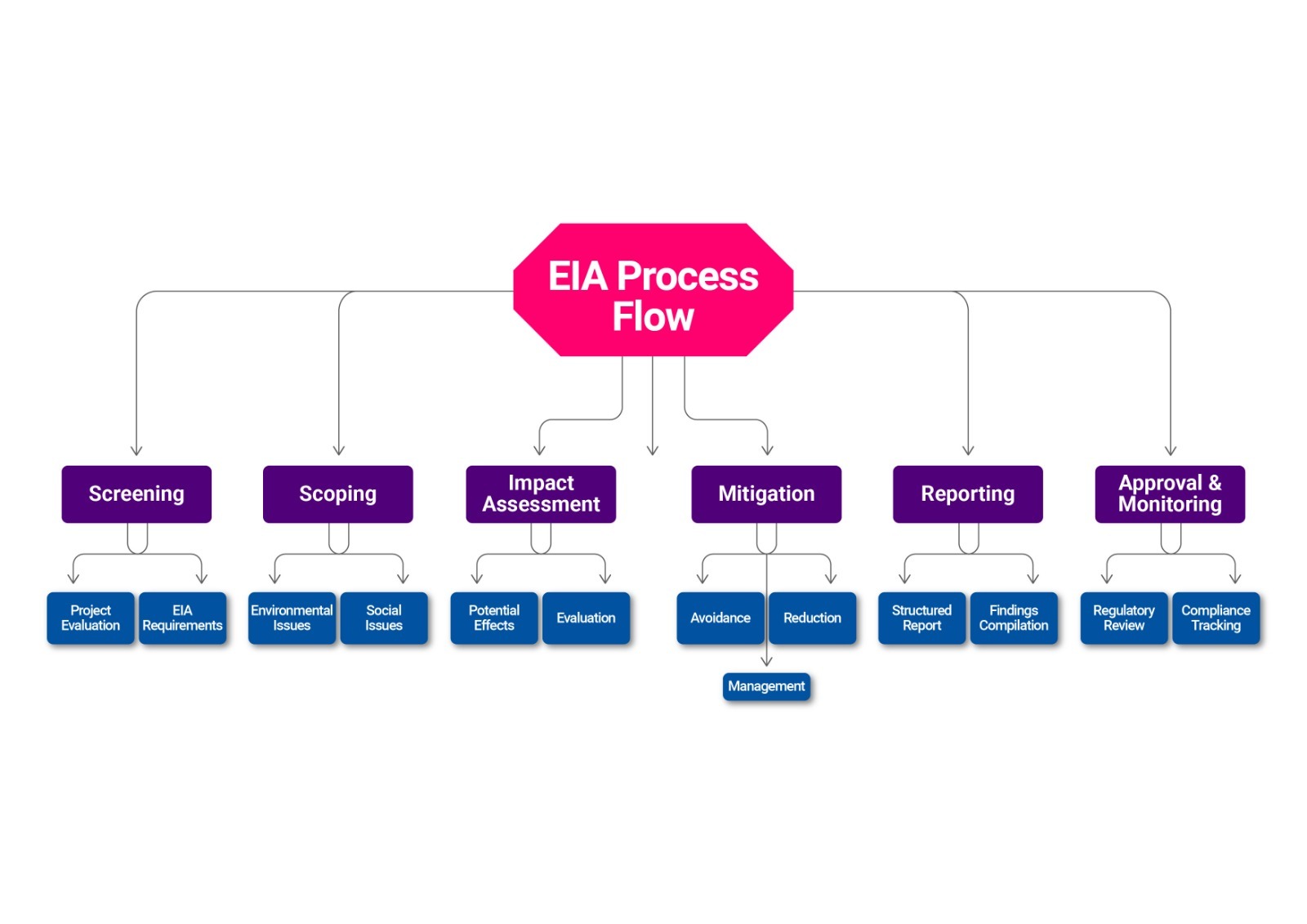
1. Screening – Does the Project Require an EIA?
Screening determines whether a proposed project needs a full Environmental Impact Assessment. Not every project automatically requires one.
Regulatory authorities review the project’s size, location, and potential risk. Projects involving large-scale construction, industrial operations, mining, power generation, or infrastructure typically fall under mandatory EIA categories. Smaller projects may require only a limited assessment, depending on national regulations.
2. Scoping – Which Environmental Issues Should Be Studied?
Scoping defines the boundaries of the assessment. It identifies which environmental and social issues are relevant and which are not.
At this stage, experts determine:
- What environmental components may be affected.
- What baseline data must be collected.
- What geographic area should be studied.
- What methodologies and models will be used.
Stakeholder consultations often occur during scoping. This ensures that community concerns and regulatory expectations are included early in the process.
3. Impact Assessment – Analyzing Potential Effects
Baseline data is collected through field surveys, sampling, laboratory analysis, and secondary data sources. Predictive models are then used to estimate how project activities will change existing conditions.
Impacts are classified as:
- Direct or indirect
- Short-term or long-term
- Reversible or irreversible
- Minor, moderate, or significant
Cumulative impacts are also evaluated, especially where multiple projects operate in the same region.
4. Mitigation – How to Minimize Environmental Harm
Once impacts are identified, mitigation measures are developed.
These measures may include:
- Design modifications
- Pollution control systems
- Waste management plans
- Habitat restoration strategies
- Operational controls
The objective is to avoid impacts where possible. If avoidance is not feasible, impacts must be reduced, managed, or compensated.
5. Reporting – Documenting Findings Clearly
All findings are compiled into a formal document, often called an Environmental Impact Statement (EIS).
The report includes:
- Project description
- Baseline environmental conditions
- Predicted impacts
- Mitigation measures
- Monitoring plans
The document must be transparent and supported by data. It forms the technical basis for regulatory review.
6. Approval & Monitoring – Ensuring Compliance After Implementation
Regulatory authorities review the EIA report and decide whether the project can proceed. Approval may come with specific environmental conditions.
After approval, monitoring becomes critical. Environmental parameters such as air quality, water discharge, and noise levels are regularly measured. This ensures the project complies with mitigation commitments and regulatory standards.
How to Get Into EIA
If you’re serious about starting a career in Environmental Impact Assessment (EIA), there’s a clear path to follow.
- First, you need to know whether this field aligns with your background and interests.
- Next, explore the types of roles currently available in your country.
- Then, focus on building the technical skills that employers are looking for.
Finally, apply for entry-level positions to get your foot in the door. Following this sequence is the most practical way to break into the EIA field.
Who is EIA For?
Environmental Impact Assessment (EIA) is multidisciplinary by nature. Having a relevant educational background definitely helps, but the exact entry requirements can differ from country to country. Most professionals come from areas like:
- Environmental Science and Environmental Engineering
- Civil, Chemical, or Geological Engineering
- Ecology and Biology
- Urban and Regional Planning
- Public Health or Environmental Policy
Roles You Can Aim For in EIA
If you’re looking to get into EIA, there are a variety of roles you can step into, depending on your background and interests. Here are some of the main options:
- EIA Consultant / Specialist: You’ll coordinate assessments, prepare reports, and guide clients on compliance.
- Environmental Analyst / Scientist: Collect and analyze environmental data that feed into EIA studies.
- Environmental Compliance Officer: Make sure projects follow regulations and mitigation measures.
- Environmental Planner / Project Manager: Integrate EIA requirements into project planning and approvals.
- Technical Specialist Roles: Focus on areas like hydrology, ecology, air quality, or GIS to support assessments.
These roles can be great entry points and give you a path to grow into more senior or specialised positions as you gain experience.
Core Technical Skills You Need to Learn
To work in EIA, you need a mix of technical, regulatory, and analytical skills. Here’s what to focus on:
- Environmental Law & Regulations: Understand how environmental laws and EIA procedures shape project decisions.
- EIA Principles & Processes: Learn how assessments are structured, from screening and scoping to impact evaluation and mitigation.
- Data Collection & Analysis: Conduct field surveys, measure air, water, and soil parameters, and analyse ecological and social data.
- Impact Modelling & Mitigation Planning: Predict project effects and design strategies to reduce environmental harm.
- Report Writing & Communication: Present findings clearly to regulators, stakeholders, and project teams.
If you’re trying to build these skills from scratch, the process can feel overwhelming. You might know the concepts, but translating them into practical EIA work, like understanding regulations, interpreting environmental data, or structuring an assessment report usually requires structured learning.
That’s where focused programs can help. For example, UniAthena offers several short courses that cover different parts of the EIA skill set:
- Basics of Environmental Impact Assessment: A starting point that introduces the core concepts and structure of EIA.
- Essentials of Environmental Law and Impact Assessment: Focuses on regulatory frameworks, such as the adoption of NEPA in the United States, and explains how environmental laws guide project approvals.
- Diploma in Environmental Impact Assessment: A broader program that brings together EIA processes, stakeholder involvement, sector-based impact analysis, and related strategic assessments such as SEA and SIA.
- Mastering Sustainable Environmental Impact Assessment: Explores advanced topics on protecting the environment through sustainable development, energy conservation, and pollution control.
Depending on where you are in your learning journey, one of these programs can help you build the technical foundation needed to step into EIA-related roles.
Conclusion
Environmental Impact Assessment (EIA) is a structured process that evaluates a project’s potential environmental and social impacts and recommends ways to minimize harm.
For learners and professionals, EIA offers clear career paths, from consultants and analysts to compliance officers and technical specialists. Success requires the right background, technical skills, and practical experience.
Understanding EIA equips you to support sustainable project planning and effective environmental management.
FAQs
Q1. What exactly is an EIA?
A: EIA is a process used to identify, predict, and evaluate the environmental and social impacts of a proposed project before it starts. It helps decision-makers understand potential risks and plan mitigation measures.
Q2. Why is EIA important?
A: It ensures projects are environmentally and socially responsible, helps avoid legal issues, and protects ecosystems and communities from harmful impacts.
Q3. Who can work in EIA?
A: Professionals with backgrounds in environmental science, engineering, ecology, urban planning, or public health can enter the field. Specialist roles like GIS analysts, hydrologists, or air quality experts also support EIAs.
Q4. What are the main steps in the EIA process?
A: Screening → Scoping → Impact Assessment → Mitigation → Reporting → Approval & Monitoring. Each stage builds on the previous to ensure thorough evaluation.
Q5. What skills are needed for an EIA career?
A: Key skills include understanding environmental regulations, data collection and analysis, impact modelling, mitigation planning, and clear report writing.
Q6. What career roles exist in EIA?
A: Common roles include EIA Consultant/Specialist, Environmental Analyst, Compliance Officer, Environmental Planner, and technical specialist roles in ecology, hydrology, or GIS.
Explore Related Courses








COMMENTS(0)
Explore Related Courses
Our Popular Insights
Careers are shifting faster than ever, and staying relevant takes more than experience. Explore UniAthena’s most-read blogs for sharp insights, emerging skills, and practical pathways that help you move forward with clarity and confidence in a changing professional world.

Best AI Tools for Content Creation
Read More
9
mins read

🌟 Top Project Performer – June 2026 🌟
Read More
1
mins read


🌟 Top Project Performer – May 2026 🌟
Read More
1
mins read


Best AI Tools for Content Creation
Read more
9
mins read
🌟 Top Project Performer – June 2026 🌟
Read more
1
mins read
🌟 Top Project Performer – May 2026 🌟
Read more
1
mins read
Get in Touch

It’s Time to Start
Join NowMost Popular Online Specialization
- Master of International Business Administration
- Master of Business Administration
- MBA in General Management- FastTrack
- Master in Innovation and Entrepreneurship
- MBA-Family Business Management
- Master in Procurement and Contract Management
- Extended Diploma in Business Analytics (SCQF Level 11)
- Diploma in Supply Chain and Logistics Management (SCQF Level 11)
- Strategic Human Resource Management Practitioner
- Master in Data Science
- Master in Engineering Management
Trending Online
- Integrated Doctorate of Business Administration
- Postgraduate Certificate in Finance for Next Generation Managers
- Master of Business Administration- General Management (Fast Track)
- Postgraduate Certificate in Socio-Economic and Legal Framework
- Postgraduate Certificate in Business Sustainability
- Certified Manager
- Supply Chain Management Practitioner
- MBA - AI in Business
- MBA - Accounting & Finance
- Master in Supply Chain and Logistics Management
Top Universities Online Certificates
- Postgraduate Certificate in International Marketing Management
- Postgraduate Certificate In International Human Resource Management
- Postgraduate Certificate in Strategic Management
- Postgraduate Certificate in Procurement & Contracts Management
- Postgraduate Certificate in Business Analytics
- Postgraduate Certificate in Strategic Supply Chain & Logistics Management
- Postgraduate Certificate in Human Resource and Leadership
- Project Management Practitioner
- Postgraduate Certificate in Supply Chain Design & Implementation
- Postgraduate Certificate in Management Accounting and Finance
Accredited Online Degree Program
- MBA - Digital Transformation
- MBA - Family Business Management
- MBA - Marketing Management
- MBA in Quality Management
- MBA - Business Intelligence & Data Analytics
- MBA in Operations & Project Management
- MBA in Energy Management
- MBA In Construction & Safety Management
- Master in Organisational Leadership
- Master in Public Health
- Master in Construction Management
- Bachelor of Arts in Business Administration


 Install Now


UniAthena is an Ed-Tech, offering flexible, affordable learning solutions, including Free-Learning Upskilling Courses and Academic Programs in partnerships with accredited and globally renowned universities and professional qualification bodies.


Do you have any questions ?
Feel free to send us your questions or request a free consultation
Send a message
UK
Athena Global Education
Magdalen Centre,
Robert Robinson Avenue,
Oxford, OX4 4GA, UK
Phone : 01865 784299
MIDDLE EAST
Athena Global Education FZE
Block L-03, First Floor,
P O Box 519265, Sharjah Publishing City,
Free Zone, Sharjah, UAE
Phone : +971 55 879 5492
INDIA
Uniathena Private Limited
9A,Midas Tower
Phase 1
Hinjewadi Rajiv Gandhi Infotech Park
Pune-411057
Phone: +91 9145665544
All Copyrights Reserved @ Athena Global Education 2021-2026