-

Bachelor's

-

Masters
-

MBA
-

Doctorate
-

Micro Credit
-

Explore all Courses
-
Postgraduate Certifications

-
Postgraduate Diploma
-
Undergraduate Diploma
-
Diploma



What is the Difference Between Leadership and Management?

Author: urvi malusare
|9
MINS READ
| 0
| 7
Created On: 22 July, 2026
Share




Table of Contents (TOC):
- Key Takeaways
- What Is Leadership?
- What Is Management?
- Leadership vs Management: Which One To Choose?
- How To Become a Better Leader?
- How To Become a Skilled Manager?
- Gain Managerial and Leadership Qualities With UniAthena
- FAQs
If you are a manager, are you also a leader?
If this question haunts your mind, it’s time to understand the difference between leadership and management. Because not all managers are leaders and not all leaders are managers.
First, let’s understand what leadership and management are as concepts and how they are important in their own way.
Key Takeaways:
- Leaders are responsible for guiding teams and individuals, resolving issues between team members and departments, building strong relationships within the organization, and inspiring others around them.
- Leaders also create a safe space for employees to make mistakes, voice their opinions, and take risks. They are influential and can change the way they lead depending on the situation.
- Without proper leadership, people tend to work without direction, and bad leadership can even lead to employees leaving the organization.
- The main responsibility of management is to manage budgets, allocate resources, and delegate tasks to the team.
- Without proper management, there would be a lack of a plan of action, the process would lack quality checks, and there would be less accountability for people’s work and actions.
What Is Leadership?
Leadership refers to the idea of leading and motivating people to reach their full potential and a specific goal. Leadership in an organization comes in various forms. Leading teams, individuals, resolving issues among the team, relationship building, and inspiring people are all part of a leader’s job.
Leadership Concepts
Here are some factors that define leadership:
- Situational Fluidity: Great leaders are able to adapt to the situation and pivot their leadership style at a moment’s notice.
- Creating a Safe Space: The people who are being led must be able to feel safe in their surroundings. Under empathetic leadership, they are able to take risks and voice their opinions.
- Social Influence: Leadership goes beyond compliance and authority. These professionals are able to influence others to follow their lead.
Importance of Leadership
Without proper leadership, an organization will lack direction. The importance of leadership can be seen in the following manner:
- When navigating through extremely volatile situations, leadership acts as a stabilizing force.
- In high-stress work environments, employees can turn to trusted leaders for support rather than quietly burning out or resigning.
- Leaders provide teams with the space to think outside the box without the pressure of perfection.
- A lot of the time, when people leave their jobs, they are leaving because of bad leadership. Having emotionally intelligent and empathetic leaders improves the employee retention rate.
What Is Management?
Management refers to the responsibility of managing tasks, people, and resources with the aim of achieving organizational goals. Management is more goal-focused, and it involves a lot of coordination and collaboration. Creating plans, setting goals, managing budgets and resources, and delegating tasks are all part of a manager’s responsibility.
Management Concepts
Here are some frameworks and concepts management depends upon:
- The P-O-L-C Framework: Planning, Organizing, Leading, and Controlling are the core functions of a manager.
- Resource Optimization: Managers are responsible for maximizing the efficiency of the operations. They find the bottlenecks in a system and work on solving the issues.
- Standardization and Predictability: Management thrives on consistency. The goal is to build processes that bring the exact same, high-quality result every single time, regardless of external chaos.
Importance of Management
Without management, leadership’s ideas and plans might never see the light of day. The importance of management can be seen in the following manner:
- They are able to translate strategy into action. When leaders share their goals, it's the managers who create a plan of action to achieve said goals.
- Managers also provide stability and structure by defining clear tasks, setting up meetings, and creating performance metrics.
- Managers are responsible for monitoring budgets, tracking timelines, and enforcing deadlines, ensuring that the company doesn't run out of cash before reaching its strategic goals.
- Management maintains quality control by ensuring that the product works, the service is delivered on time, and customer complaints are handled efficiently every single day.
Leadership vs Management: Which One To Choose?
To put it into perspective, here is what your career route would be depending on your goals, expectations, and passions:
How To Become a Better Leader?
If you have recently been promoted to a role where you are leading a team, here is how you can ensure that you are a strong leader for your team:
Be a Coach, Not Just a Problem Solver
When a team member comes to you with a problem, the natural managerial instinct is to give them the answer instantly. It saves time, but it fosters dependency.
The next time an employee says, "We have a problem with this project," don't give the solution. Pause and ask: "What do you think our options are here, and which one would you recommend?" Encourage them to think critically.
Practice Active Listening
As a leader, your team is constantly throwing subtle cues at you about their workload, frustrations, and ideas. If you are always talking and never listening, you will miss them.
Be the last person to speak in the room. Give others the space to speak and listen to their ideas. Make your team feel heard and make the final decision based on everyone’s input.
Build a Culture of Psychological Safety
Your teams should not be hiding their mistakes from you. Create a level of trust that they will come to you when they make a mistake.
You can build this trust by showing the team that you make mistakes as well. Highlight your errors and let them know that mistakes are not the worst they could do.
Master the Art of the "Feedback Loop"
Vague praise ("Great job on that deck!") is just as unhelpful as vague criticism ("This needs to be better").
Rather, praise the details. This could be regarding a certain strategy your team member has implemented, it could be about a change in behaviour, or it could even be about a future project you might be thinking of handing over to them.
Protect Your Team's Focus
As a leader, you should be able to cut through the constant administrative noise and guide your team to focus on the right tasks.
Actively push back on low-value disruptions. If executive leadership throws a sudden, non-urgent task at your department, negotiate the timeline before it hits your team's desks.
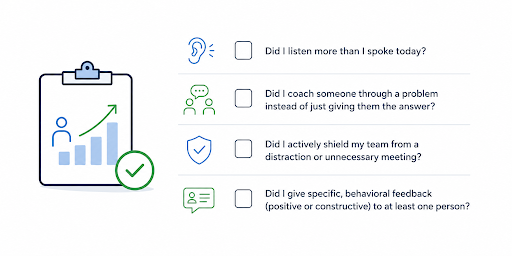
Use this daily checklist to measure your leadership growth:
How To Become a Skilled Manager?
If you are looking to climb up the career ladder and become a manager in your organization, here is how you can achieve this goal:
Provide Role Clarity
When your employees don’t know what’s expected of them, they are not able to achieve their goals. It is your responsibility as a manager to define clear roles and responsibilities.
Don't just say, "Can you look over this financial report?" Instead, say, "Please audit this financial report for Q2 discrepancies, flag any variance over 5%, and drop it in my inbox by Thursday at 3 PM."
Master the Weekly 1-on-1
Many managers only connect with their employees when something goes wrong. Instead, you should maintain a consistent, predictable cadence of communication to catch bottlenecks before they turn into corporate emergencies.
Set a non-negotiable, 30-minute weekly 1-on-1 meeting with each direct report.
Establish Systematized Workflows
A manager’s ultimate goal is to build a department that runs perfectly even when they are out of the office. If everything grinds to a halt the moment you take a day off, you aren't really managing anything.
Every time your team solves a recurring problem or handles a standard task, document it. Create SOPs and ensure everyone is on the same page.
Build Better Relationships Across Departments
Departments not collaborating, hoarding information, or being at odds with each other helps nobody. It is the responsibility of the managers to ensure their departments work together smoothly.
Once a month, have a casual coffee chat with a manager from an adjacent department. Use this time to build a relationship that is trusted and respected on both sides.
Transition from "Doing" to "Managing"
The hardest part of becoming a manager is letting go of the technical work you used to be great at. If you are constantly stepping in to rewrite an article, fix a line of code, or redesign a slide yourself, you are micromanaging and stalling your team's growth.
Apply the 70% Rule. If a team member can do a task at least 70% as well as you can, you must delegate it.
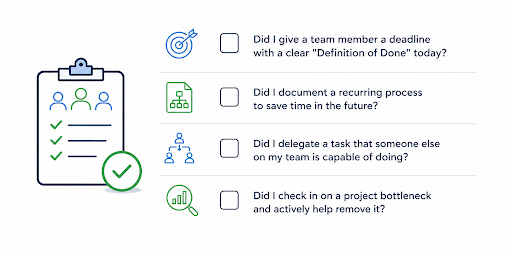
Use this checklist to measure your growth as a manager:
Gain Managerial and Leadership Qualities With UniAthena
Leaders and managers both are equally important for the success of an organization. So whether you are interested in leadership or management, you will need certain skills to lead, manage, and influence others.
UniAthena offers the following free short courses in effective leadership and management processes:
- Essentials of Management and Leadership in Business
- Basics of Leadership Management & Theories
- Mastering Management and Leadership Approaches
- Diploma in Operations Management
- Diploma in Operations & Project Management
For those leaders and managers who are looking to go beyond just the fundamentals, we also offer Master programs and professional certifications that can be completed 100% online.
- Master in Organisational Leadership: 90 ECTS | Triple Certification from Guglielmo Marconi University, Italy, Cambridge International Qualifications, UK, and Chartered Management Institute, UK.
- Master of International Business Administration: 90 ECTS | Triple Certification from Guglielmo Marconi University, Italy, Qualifications Scotland, UK, and Chartered Management Institute, UK.
- Certified Manager: Professional certification from Chartered Management Institute, UK.
Instead of debating leadership vs management, it's best to gain skills for both. Managers who are able to lead strong teams are extremely effective in ensuring that goals are achieved with the help of every team member involved. Similarly, leaders who can manage tasks and plans can lead the organization more strategically.
Gaining skills and competencies in both leadership and management will be the best option for aspirants.
FAQs
Q1. What are the different management styles?
A: The four main management techniques are Autocratic (directive), Democratic (participative), Laissez-Faire (delegative), and Transformational (inspirational).
Q2.How does leadership differ from management?
A: Leadership focuses on leading and motivating people in the achievement of goals, while management focuses on the process of achieving the goals and how to optimize it.
Q3.How to develop leadership and management skills?
A: To become a leader and manager, you need to have certain skills. You can develop these skills with a free short course at UniAthena and then apply what you have learned to practice in the workplace.
Q4.Is leadership more important than management?
A: Visionary leadership and practical management are both equally important in the success of a business. Leaders give the organization a direction, and managers create the plan to enforce the ideas.
Q5.What are the similarities between management and leadership?
A: The main similarity between effective leadership and management is that the primary focus is to guide teams to success and to influence them to achieve the goals set for the organization. The difference comes in the method by which these professionals approach reaching the goal.
Our Popular Courses

$14000


Doctoral Degree in Business Administration
Universidad Catolica De Murcia (UCAM), Spain
Duration:
2 - 3 Years
$17,500*
Integrated Doctorate of Business Administration
Guglielmo Marconi University, Italy
Universidad Catolica De Murcia (UCAM), Spain
Duration:
2.5 - 3.5 Years
$5,600*
Master of Business Administration
Guglielmo Marconi University, Italy
Duration:
12 - 24 Months
$5,600*
MBA in Operations & Project Management
Guglielmo Marconi University, Italy
Duration:
12 - 24 Months
$5,600*
Master in Supply Chain and Logistics Management
Guglielmo Marconi University, Italy
Duration:
12 - 24 Months
$5,950*
Master in Data Sciences
Guglielmo Marconi University, Italy
Duration:
12 - 24 Months
$5,600*
Master in Engineering Management
Guglielmo Marconi University, Italy
Duration:
12 - 24 Months
$5,600*
Master in Procurement and Contract Management
Guglielmo Marconi University, Italy
Duration:
12 - 24 Months
$5,600*
Master in Public Health
Guglielmo Marconi University, Italy
Duration:
12 - 24 MonthsOur Popular Courses
COMMENTS(0)
Our Popular Courses
$14000
Doctoral Degree in Business Administration
Universidad Catolica De Murcia (UCAM), Spain
Duration:
2 - 3 Years
$17,500*
Integrated Doctorate of Business Administration
Guglielmo Marconi University, Italy
Universidad Catolica De Murcia (UCAM), Spain
Duration:
2.5 - 3.5 Years
$5,600*
Master of Business Administration
Guglielmo Marconi University, Italy
Duration:
12 - 24 Months
$5,600*
MBA in Operations & Project Management
Guglielmo Marconi University, Italy
Duration:
12 - 24 Months
$5,600*
Master in Supply Chain and Logistics Management
Guglielmo Marconi University, Italy
Duration:
12 - 24 Months
$5,950*
Master in Data Sciences
Guglielmo Marconi University, Italy
Duration:
12 - 24 Months
$5,600*
Master in Engineering Management
Guglielmo Marconi University, Italy
Duration:
12 - 24 Months
$5,600*
Master in Procurement and Contract Management
Guglielmo Marconi University, Italy
Duration:
12 - 24 Months
$5,600*
Master in Public Health
Guglielmo Marconi University, Italy
Duration:
12 - 24 MonthsOur Popular Courses
Our Popular Insights
Careers are shifting faster than ever, and staying relevant takes more than experience. Explore UniAthena’s most-read blogs for sharp insights, emerging skills, and practical pathways that help you move forward with clarity and confidence in a changing professional world.

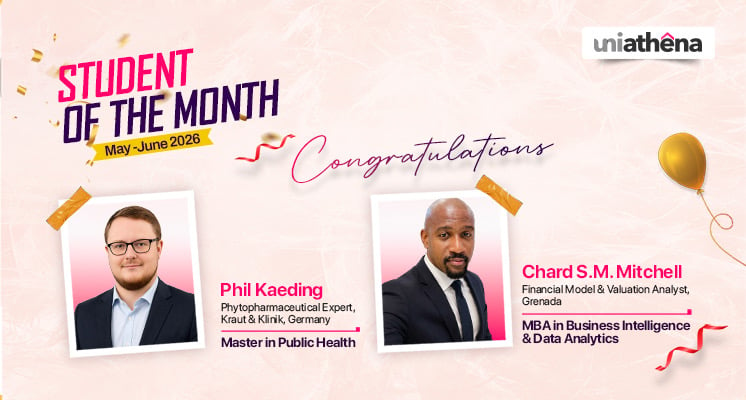
🌟 Students of the Month | May – June 2026 🌟
Read More
1
mins read




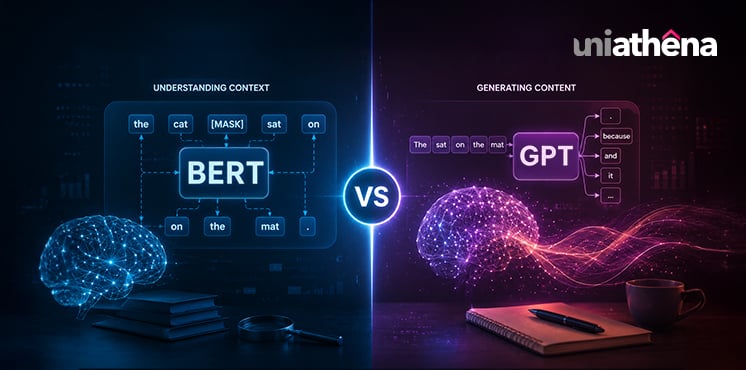


🌟 Students of the Month | May – June 2026 🌟
Read more
1
mins read
Get in Touch

It’s Time to Start
Join NowMost Popular Online Specialization
- Master of International Business Administration
- Master of Business Administration
- MBA in General Management- FastTrack
- Master in Innovation and Entrepreneurship
- MBA-Family Business Management
- Master in Procurement and Contract Management
- Extended Diploma in Business Analytics (SCQF Level 11)
- Diploma in Supply Chain and Logistics Management (SCQF Level 11)
- Strategic Human Resource Management Practitioner
- Master in Data Science
- Master in Engineering Management
Trending Online
- Integrated Doctorate of Business Administration
- Postgraduate Certificate in Finance for Next Generation Managers
- Master of Business Administration- General Management (Fast Track)
- Postgraduate Certificate in Socio-Economic and Legal Framework
- Postgraduate Certificate in Business Sustainability
- Certified Manager
- Supply Chain Management Practitioner
- MBA - AI in Business
- MBA - Accounting & Finance
- Master in Supply Chain and Logistics Management
Top Universities Online Certificates
- Postgraduate Certificate in International Marketing Management
- Postgraduate Certificate In International Human Resource Management
- Postgraduate Certificate in Strategic Management
- Postgraduate Certificate in Procurement & Contracts Management
- Postgraduate Certificate in Business Analytics
- Postgraduate Certificate in Strategic Supply Chain & Logistics Management
- Postgraduate Certificate in Human Resource and Leadership
- Project Management Practitioner
- Postgraduate Certificate in Supply Chain Design & Implementation
- Postgraduate Certificate in Management Accounting and Finance
Accredited Online Degree Program
- MBA - Digital Transformation
- MBA - Family Business Management
- MBA - Marketing Management
- MBA in Quality Management
- MBA - Business Intelligence & Data Analytics
- MBA in Operations & Project Management
- MBA in Energy Management
- MBA In Construction & Safety Management
- Master in Organisational Leadership
- Master in Public Health
- Master in Construction Management
- Bachelor of Arts in Business Administration


 Install Now


UniAthena is an Ed-Tech, offering flexible, affordable learning solutions, including Free-Learning Upskilling Courses and Academic Programs in partnerships with accredited and globally renowned universities and professional qualification bodies.


Do you have any questions ?
Feel free to send us your questions or request a free consultation
Send a message
UK
Athena Global Education
Magdalen Centre,
Robert Robinson Avenue,
Oxford, OX4 4GA, UK
Phone : 01865 784299
MIDDLE EAST
Athena Global Education FZE
Block L-03, First Floor,
P O Box 519265, Sharjah Publishing City,
Free Zone, Sharjah, UAE
Phone : +971 55 879 5492
INDIA
Uniathena Private Limited
9A,Midas Tower
Phase 1
Hinjewadi Rajiv Gandhi Infotech Park
Pune-411057
Phone: +91 9145665544
All Copyrights Reserved @ Athena Global Education 2021-2026