-

Bachelor's

-

Masters
-

MBA
-

Doctorate
-

Micro Credit
-

Explore all Courses
-
Postgraduate Certifications

-
Postgraduate Diploma
-
Undergraduate Diploma
-
Diploma



Reframing Corporate Governance: The Strategic Role of Blockchain in Auditability and Control

Author: maria rashid
|5
MINS READ
| 0
| 81
Created On: 06 April, 2026
Share




Table of Contents (TOC):
- Introduction
- Key Takeaways
- What is Blockchain, and Why Does It Matter for Governance?
- What is Corporate Governance?
- Principles of Corporate Governance
- Types of Blockchain Technology & Their Uses in Governance
- Applications of Blockchain Technology in Corporate & Government Systems
- Improving Auditability and Control through Blockchain
- Conclusion
- FAQs
Introduction
Audit failures, compliance complexity, and growing concerns around data integrity have intensified the pressure on organizations to strengthen governance systems. In today’s business environment, organizations face increasing expectations for transparency, trust, and accountability.
This is where blockchain-integrated corporate governance becomes relevant. By combining governance structures with blockchain technology, organizations can build more reliable, auditable, and tamper-resistant systems.
In this blog, we explore how blockchain technology enhances trust, reliability, and accountability in modern enterprises, while also examining its practical limitations and implementation challenges.
Key Takeaways:
- Blockchain technology provides accountability and immutability to enhance corporate governance.
- The auditability provided for blockchain governance enables real-time, verifiable records for compliance and audits.
- Various types of blockchain governance technologies serve different regulatory and compliance needs.
- Blockchain governance frameworks help in defining how controls, decisions, and accountability are managed.
- Implementation must balance transparency with scalability, cost, and regulatory constraints.
What is Blockchain, and Why Does It Matter for Governance?
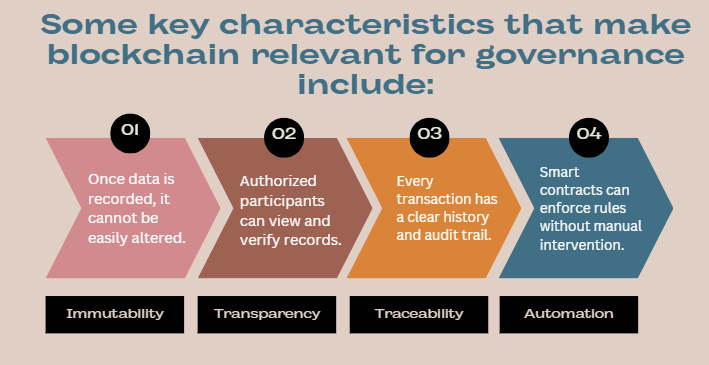
Blockchain is a technology that stores records in a distributed digital ledger that is secure, transparent, and resistant to tampering. Instead of relying on a central authority, blockchain validates transactions through decentralized consensus mechanisms.
Today, blockchain extends beyond cryptocurrencies and is increasingly used in finance, supply chains, corporate compliance, healthcare, and public administration.
These characteristics align strongly with governance systems where trust, accountability, and transparency are critical. However, while blockchain strengthens data integrity, it does not eliminate the need for governance oversight or regulatory interpretation.
What is Corporate Governance?
Understanding corporate governance is essential in today’s business environment due to increasing scrutiny around accountability and compliance. Corporate governance refers to the system of rules, practices, and processes through which an organization is directed and controlled.
It balances the interests of stakeholders, including shareholders, employees, customers, suppliers, regulators, and the broader community.
Principles of Corporate Governance
Despite these principles, many organizations still rely on outdated processes, fragmented data, and delayed reporting, reducing governance effectiveness and increasing exposure to risk.
Blockchain can address these inefficiencies by embedding transparency and traceability into governance systems, but its effectiveness depends on how it is implemented and governed.
Types of Blockchain Technology & Their Uses in Governance
Understanding different types of blockchain technology is important, as governance requirements vary across organizations.
Each type of blockchain supports different applications depending on factors such as scalability, transparency, and control.
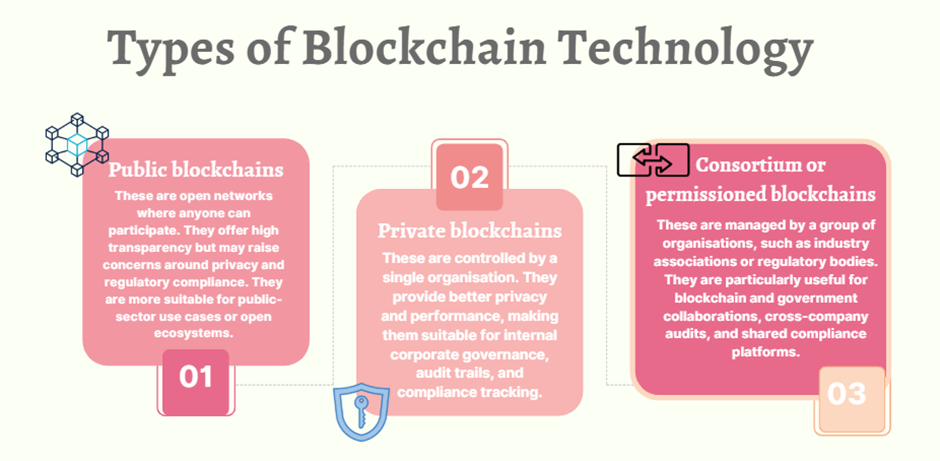
For example, private blockchains offer greater control and privacy but may reduce decentralization benefits, while public blockchains enhance transparency but raise concerns around scalability and regulatory compliance.
Also Read: Why Blockchain Is the Future of Trustworthy Public Records
Applications of Blockchain Technology in Corporate & Government Systems
The application of blockchain is expanding across both private and public sectors, and the use varies according to whether it is implemented in corporate organizations or government systems.
Now we will compare the applications of blockchain in the governance of the corporate and government sectors.
Despite these applications, the effectiveness of blockchain depends on integration with existing systems, regulatory alignment, and organizational readiness.
Also Read: How to Become a Blockchain Developer?
Improving Auditability and Control through Blockchain
One of the most significant aspects of blockchain in corporate governance is the ability to improve auditability and control. Traditional audits pull data from multiple systems and rely on manual checks, which pose human errors and risk of fraud. Also, traditional auditing is time-consuming. Blockchain technology changes this by providing a tamper-resistant digital ledger where records are kept in real-time.
The following are the benefits of blockchain auditability and control:
Real-time and continuous visibility of audit trails because transactions and governance decisions are recorded in real-time as they happen.
Blockchains preserve data integrity and trust as records cannot be easily altered once they are entered in the blockchain.
It improves accountability of the process as data can be traced back to its source.
There is no need for the auditor to reconcile data from multiple systems, as it is possible through blockchain to verify information directly from the ledger.
Due to real-time monitoring, there is early detection of anomalies or breaches, therefore, enhancing risk management.
However, blockchain-based auditing is not without limitations. High implementation costs, integration complexity, and the need for skilled oversight can affect adoption. Additionally, governance still depends on human judgment, especially in interpreting data and enforcing accountability.
Also Read: How Blockchain Technology is Shaping the Future of Insurance
Conclusion
Blockchain is reshaping how organizations approach auditability and control by introducing greater transparency, traceability, and efficiency into governance systems. However, its role should be viewed as an enabler rather than a standalone solution.
The future of corporate governance will likely depend on how effectively organizations combine blockchain capabilities with strong regulatory frameworks, human oversight, and strategic implementation.
Organizations that approach blockchain as part of a broader governance transformation, rather than a technological fix, will be better positioned to build resilient and trustworthy systems.
FAQs
Q1. How does blockchain help in improving corporate governance?
A: Blockchain improves corporate governance by improving data integrity, accountability, traceability, and transparency by providing real-time monitoring and control of data.
Q2. Which is better - blockchain auditing or traditional auditing?
A: Blockchain auditing is better as it provides real-time monitoring of audit trails and fast verification of records, which reduces human errors and possible breaches.
Q3. What are the main uses of blockchain in corporate governance?
A: The main uses include tamper-resistant record keeping, end-to-end traceability, verifiable records, and enhanced accountability.
References;
- https://www.blackduck.com/glossary/what-is-blockchain.html
- https://www.investopedia.com/terms/c/corporategovernance.asp
- https://consensys.io/blockchain-use-cases/government-and-the-public-sector
- https://www.isaca.org/resources/news-and-trends/industry-news/2024/how-blockchain-technology-is-revolutionizing-audit-and-control-in-information-system
Explore Related Courses













COMMENTS(0)
Explore Related Courses
Our Popular Insights
Careers are shifting faster than ever, and staying relevant takes more than experience. Explore UniAthena’s most-read blogs for sharp insights, emerging skills, and practical pathways that help you move forward with clarity and confidence in a changing professional world.

🌟 Top Project Performer – June 2026 🌟
Read More
1
mins read


🌟 Top Project Performer – May 2026 🌟
Read More
1
mins read

🌟 Top Project Performer – April 2026 🌟
Read More
1
mins read
🌟 Top Project Performer – June 2026 🌟
Read more
1
mins read
🌟 Top Project Performer – May 2026 🌟
Read more
1
mins read
🌟 Top Project Performer – April 2026 🌟
Read more
1
mins read
Get in Touch

It’s Time to Start
Join NowMost Popular Online Specialization
- Master of International Business Administration
- Master of Business Administration
- MBA in General Management- FastTrack
- Master in Innovation and Entrepreneurship
- MBA-Family Business Management
- Master in Procurement and Contract Management
- Extended Diploma in Business Analytics (SCQF Level 11)
- Diploma in Supply Chain and Logistics Management (SCQF Level 11)
- Strategic Human Resource Management Practitioner
- Master in Data Science
- Master in Engineering Management
Trending Online
- Integrated Doctorate of Business Administration
- Postgraduate Certificate in Finance for Next Generation Managers
- Master of Business Administration- General Management (Fast Track)
- Postgraduate Certificate in Socio-Economic and Legal Framework
- Postgraduate Certificate in Business Sustainability
- Certified Manager
- Supply Chain Management Practitioner
- MBA - AI in Business
- MBA - Accounting & Finance
- Master in Supply Chain and Logistics Management
Top Universities Online Certificates
- Postgraduate Certificate in International Marketing Management
- Postgraduate Certificate In International Human Resource Management
- Postgraduate Certificate in Strategic Management
- Postgraduate Certificate in Procurement & Contracts Management
- Postgraduate Certificate in Business Analytics
- Postgraduate Certificate in Strategic Supply Chain & Logistics Management
- Postgraduate Certificate in Human Resource and Leadership
- Project Management Practitioner
- Postgraduate Certificate in Supply Chain Design & Implementation
- Postgraduate Certificate in Management Accounting and Finance
Accredited Online Degree Program
- MBA - Digital Transformation
- MBA - Family Business Management
- MBA - Marketing Management
- MBA in Quality Management
- MBA - Business Intelligence & Data Analytics
- MBA in Operations & Project Management
- MBA in Energy Management
- MBA In Construction & Safety Management
- Master in Organisational Leadership
- Master in Public Health
- Master in Construction Management
- Bachelor of Arts in Business Administration


 Install Now


UniAthena is an Ed-Tech, offering flexible, affordable learning solutions, including Free-Learning Upskilling Courses and Academic Programs in partnerships with accredited and globally renowned universities and professional qualification bodies.


Do you have any questions ?
Feel free to send us your questions or request a free consultation
Send a message
UK
Athena Global Education
Magdalen Centre,
Robert Robinson Avenue,
Oxford, OX4 4GA, UK
Phone : 01865 784299
MIDDLE EAST
Athena Global Education FZE
Block L-03, First Floor,
P O Box 519265, Sharjah Publishing City,
Free Zone, Sharjah, UAE
Phone : +971 55 879 5492
INDIA
Uniathena Private Limited
9A,Midas Tower
Phase 1
Hinjewadi Rajiv Gandhi Infotech Park
Pune-411057
Phone: +91 9145665544
All Copyrights Reserved @ Athena Global Education 2021-2026