-

Bachelor's

-

Masters
-

MBA
-

Doctorate
-

Micro Credit
-

Explore all Courses
-
Postgraduate Certifications

-
Postgraduate Diploma
-
Undergraduate Diploma
-
Diploma



Why Employees Prefer Remote Jobs Over Office Jobs

Author: maharajan p
|6
MINS READ
| 0
| 44
Created On: 29 April, 2026
Share




Table of Contents (TOC):
- Introduction
- Key Takeaways
- Do Remote Jobs Really Pay Well?
- 6 Key Benefits of Working Remotely
- The Challenges of Remote Work
- Final Take
- FAQs
Introduction
Companies are redesigning offices: adding catered lunches, phone booths, wellness rooms—pulling every lever they can think of. Still, the demand for remote roles hasn’t really gone down over the last few years.
You know what’s more interesting? Some employees are willing to accept lower pay in exchange for flexibility, the ability to work on their own time, and more time with family.
Which begs the question: what does remote work offer that offices still can’t, even at their best?
Key Takeaways:
- In roles that can be done remotely, nearly three out of four employees now work outside the office at least part of the week, reflecting the growing appeal of jobs with flexible hours and location freedom.
- Many remote roles offer competitive salaries while allowing professionals to work from anywhere, giving them access to global opportunities without relocating.
- One of the biggest reasons professionals prefer remote work is the clear work-from-home benefits, including lower commuting costs, fewer workplace interruptions, and greater control over daily routines.
- Remote work rewards discipline. Success depends on self-management, clear communication, and maintaining visibility despite physical distance.
Do Remote Jobs Really Pay Well?
Yes, for many workers, remote jobs do pay well, and that’s one of the biggest reasons people choose them over traditional office roles. But it’s important to understand that remote work isn’t a single pay level; it’s a broad category that includes both high-paying professional roles and more modest positions.
According to a recent report from Forbes, remote roles, particularly in tech and professional fields, often offer very competitive compensation:
- The average pay for a fully remote job in the U.S. is around $107,000 per year, well above many traditional office jobs.
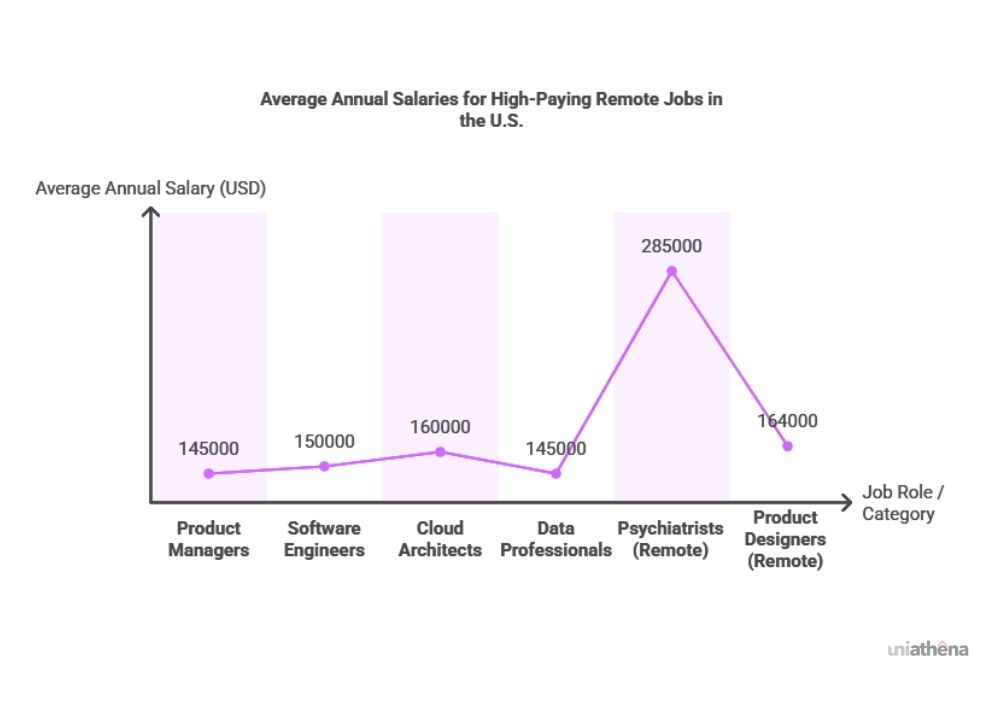
- The highest paying remote roles include positions like Psychiatrists (~$285K), Medical Directors (~$246K), Loan Officers (~$184K), and Product Designers (~$164K).
- Broad professional categories like Product Managers, Cloud Architects, Software Engineers, Data Scientists, and Cybersecurity specialists command salaries in the range of $120,000 to $200,000+.
In fact, in the latest comprehensive remote job salary report:
- Senior and executive remote professionals often earn $115,000 to $250,000+, depending on experience and role level.
- Even mid-level tech and data roles tend to be above the six-figure mark in many cases.
At the same time, it’s worth noting that not all remote jobs pay top dollar. Entry-level remote roles such as basic virtual assistant positions or customer service jobs often fall below the six-figure bracket. But as you move into skilled professions, especially in tech, healthcare, finance, and management, remote salaries become highly competitive.
6 Key Benefits of Working Remotely
1. You Can Save Costs in Ways You Actually Notice Every Month
This is not some abstract financial theory. These savings are often visible in monthly expenses.
No daily commute means:
- No fuel expenses
- No public transport passes
- No parking fees
- No vehicle wear and tear
Then add:
- No daily takeaway coffees
- No office lunch spending
- Fewer “I need new clothes for work” purchases
For many professionals, this quietly saves hundreds of dollars every month. Over a year, that becomes a serious amount.
2. You Can Get More Done Without Constant Interruptions
When you work remotely, you can avoid distractions like colleagues stopping by your desk, background conversations, and office noise.
You can:
- Batch meetings instead of scattering them
- Take short breaks without losing momentum
- Work during your personal peak energy hours
3. You Can Design a Work Environment That Actually Suits You
Not everyone thrives under fluorescent lights and fixed desk layouts. When you work remotely, you control your space.
You can:
- Choose a quiet room instead of a noisy open office
- Adjust lighting to reduce eye strain
- Invest in a chair that supports your back
- Play background music if it helps you think
- Keep the temperature exactly how you prefer it
These might sound small, but they affect how you feel for 8+ hours a day.
4. You Can Focus Deeply Without Feeling Mentally Drained
In many offices, even when you’re working, your brain is partially alert: reacting to noise, conversations, or the possibility of being interrupted.
Remote work can reduce that background mental load for many professionals.
You can:
- Turn off notifications during deep work
- Close unnecessary tabs and tools
- Work in silence when needed
- Block specific hours just for thinking
That uninterrupted stretch, even 60 to 90 minutes, can help you solve complex problems faster and with less stress.
5. You Can Take Better Care of Your Physical and Mental Health
You can:
- Sleep a little longer instead of commuting
- Cook proper meals instead of relying on fast food
- Take short walks during breaks
- Stretch between tasks
- Schedule doctor appointments without taking a full day off
Mentally, the reduced rush and pressure can help reduce stress levels for many people. You’re not constantly racing traffic or watching the clock. It’s not that remote work magically fixes health, but it gives you the space to manage it better.
6. You Can Spend More Meaningful Time With Your Family
When you remove commuting alone, you often gain one to three extra hours a day. That time doesn’t disappear.
It becomes:
- Breakfast with your children instead of rushing out
- Picking them up from school
- Being home when they return
- Having dinner without checking the clock
- Supporting elderly parents when needed
Even for those without children, it means being present, with a partner, with loved ones, or simply being available when it matters.
Also Read: How to Earn Money Online as a Student?
The Challenges of Remote Work
Remote work offers flexibility and autonomy, but it is not free from complications. Without structure, visibility, and in-person collaboration, small issues can easily turn into bigger professional setbacks. To succeed in a remote setup, you need to be intentional, disciplined, and aware of where things can go wrong.
Here are some areas where remote workers need to be especially careful:
- Isolation and lack of social interaction
- Communication gaps due to limited face-to-face discussion
- Time zone differences in global teams
- Blurred boundaries between work and personal life
- Overworking because “log off” feels unclear
- Reduced visibility in front of leadership
- Distractions at home
- Dependence on stable internet and tech infrastructure
- Misalignment caused by unclear expectations
- Self-discipline challenges without supervision
If you cannot manage your time, communicate clearly, and create structure for yourself, flexibility can quickly become chaos. Employees who thrive remotely tend to be deliberate about how they work.
Also Read: High Demand Skills for the Next 10 Years
Final Take
The pay can be competitive, the flexibility is real, and the personal benefits are practical. But remote work also demands discipline, clarity, and accountability.
If you value autonomy, focus, and control over your time, remote work can be a powerful choice. If you rely heavily on structure and in-person collaboration, a traditional office may still suit you better.
FAQs
Q1. Do remote jobs pay less than office jobs?
A: Not necessarily. Many remote roles, especially in tech and management, offer salaries equal to or higher than office-based positions.
Q2. Are remote jobs available only in tech fields?
A: No. Remote roles exist in marketing, finance, healthcare, education, design, customer support, and many other industries.
Q3. Is remote work suitable for entry-level professionals?
A: Yes, but it requires strong communication skills, self-discipline, and the ability to work independently without constant supervision.
Q4. Does remote work reduce productivity?
A: For many professionals, productivity improves due to fewer interruptions and better control over their work environment.
Q5. What are the biggest risks of working remotely?
A: Isolation, communication gaps, overworking, reduced visibility to leadership, and difficulty separating work from personal life.
Q6. How do I know if remote work is right for me?
A: If you value autonomy, focus, and time flexibility and can manage yourself effectively, remote work may be a strong fit.
Explore Related Courses















COMMENTS(0)
Explore Related Courses
Our Popular Insights
Careers are shifting faster than ever, and staying relevant takes more than experience. Explore UniAthena’s most-read blogs for sharp insights, emerging skills, and practical pathways that help you move forward with clarity and confidence in a changing professional world.


How to Switch Career to Data Analytics?
Read More
6
mins read





How to Switch Career to Data Analytics?
Read more
6
mins read

Get in Touch

It’s Time to Start
Join NowMost Popular Online Specialization
- Master of International Business Administration
- Master of Business Administration
- MBA in General Management- FastTrack
- Master in Innovation and Entrepreneurship
- MBA-Family Business Management
- Master in Procurement and Contract Management
- Extended Diploma in Business Analytics (SCQF Level 11)
- Diploma in Supply Chain and Logistics Management (SCQF Level 11)
- Strategic Human Resource Management Practitioner
- Master in Data Science
- Master in Engineering Management
Trending Online
- Integrated Doctorate of Business Administration
- Postgraduate Certificate in Finance for Next Generation Managers
- Master of Business Administration- General Management (Fast Track)
- Postgraduate Certificate in Socio-Economic and Legal Framework
- Postgraduate Certificate in Business Sustainability
- Certified Manager
- Supply Chain Management Practitioner
- MBA - AI in Business
- MBA - Accounting & Finance
- Master in Supply Chain and Logistics Management
Top Universities Online Certificates
- Postgraduate Certificate in International Marketing Management
- Postgraduate Certificate In International Human Resource Management
- Postgraduate Certificate in Strategic Management
- Postgraduate Certificate in Procurement & Contracts Management
- Postgraduate Certificate in Business Analytics
- Postgraduate Certificate in Strategic Supply Chain & Logistics Management
- Postgraduate Certificate in Human Resource and Leadership
- Project Management Practitioner
- Postgraduate Certificate in Supply Chain Design & Implementation
- Postgraduate Certificate in Management Accounting and Finance
Accredited Online Degree Program
- MBA - Digital Transformation
- MBA - Family Business Management
- MBA - Marketing Management
- MBA in Quality Management
- MBA - Business Intelligence & Data Analytics
- MBA in Operations & Project Management
- MBA in Energy Management
- MBA In Construction & Safety Management
- Master in Organisational Leadership
- Master in Public Health
- Master in Construction Management
- Bachelor of Arts in Business Administration


 Install Now


UniAthena is an Ed-Tech, offering flexible, affordable learning solutions, including Free-Learning Upskilling Courses and Academic Programs in partnerships with accredited and globally renowned universities and professional qualification bodies.


Do you have any questions ?
Feel free to send us your questions or request a free consultation
Send a message
UK
Athena Global Education
Magdalen Centre,
Robert Robinson Avenue,
Oxford, OX4 4GA, UK
Phone : 01865 784299
MIDDLE EAST
Athena Global Education FZE
Block L-03, First Floor,
P O Box 519265, Sharjah Publishing City,
Free Zone, Sharjah, UAE
Phone : +971 55 879 5492
INDIA
Uniathena Private Limited
9A,Midas Tower
Phase 1
Hinjewadi Rajiv Gandhi Infotech Park
Pune-411057
Phone: +91 9145665544
All Copyrights Reserved @ Athena Global Education 2021-2026