-

Bachelor's

-

Masters
-

MBA
-

Doctorate
-

Micro Credit
-

Explore all Courses
-
Postgraduate Certifications

-
Postgraduate Diploma
-
Undergraduate Diploma
-
Diploma



Why Is There Demand for Construction Managers?

Author: aishwarya sancheti
|10
MINS READ
| 0
| 205
Created On: 16 April, 2026
Share




Table of Contents (TOC):
- Introduction
- Key Takeaways
- What Do Construction Managers Actually Do?
- Core Construction Manager Roles and Responsibilities
- Why Is There Demand for Construction Managers? The 6 Real Reasons
- What Construction Manager Skills Are Employers Actually Looking For?
- The Construction Manager Career Path
- Construction Manager vs Project Manager - What’s the Difference?
- Construction Manager Salary: What Can You Expect?
- How to Become a Construction Manager
- Is a Construction Management Degree Worth It?
- Construction Management Future: What's Ahead?
- Conclusion
- FAQs
Introduction
Every skyline you see was someone's responsibility. Every road you drive on, every hospital you walk into, every school your child attends, behind each one stood a construction manager who made sure it didn't fall apart before it was finished. In a world that never stops building, that person is irreplaceable.
And yet, the question persists: why is there such persistent, growing, and urgent demand for construction managers?
The answer is not simple and it shouldn't be. It cuts across infrastructure investment, a global workforce crisis, technological transformation, and a construction industry that is expanding faster than the talent pipeline can fill it. This blog lays it all out.
Key Takeaways:
- Construction manager employment is projected to grow 9% through 2034 more than double the national average for all occupations.
- Nearly 48,100 new openings are expected every year, driven by retirements, infrastructure investment, and urban expansion.
- The median salary for construction managers in the U.S. stands at $106,980, with top earners exceeding $165,300.
- Construction managers are not site supervisors - they are strategists, safety officers, financial controllers, and team leaders rolled into one.
- Safety knowledge is non-negotiable: construction sites account for 20% of all U.S. workplace fatalities, and OSHA penalties now reach $165,514 per repeat violation.
- Technology is increasing, not decreasing, the need for skilled construction managers, as BIM, AI, and drones add complexity to every project.
- The construction manager career path can progress from entry-level to executive within 10–15 years, with 30–50% salary increases at each step.
What Do Construction Managers Actually Do?
Before exploring why they are in demand, it's essential to understand what construction managers do because the scope of this role often surprises people.
A construction manager (CM) is the central professional responsible for planning, coordinating, executing, and supervising construction projects from the first shovel to the final handover. They are not just supervisors. They are strategists, financial controllers, safety officers, communicators, and problem-solvers.
Core Construction Manager Roles and Responsibilities
- Project Planning & Scheduling: Developing timelines, setting milestones, and managing resource deployment across all project phases.
- Budget Management: Preparing, monitoring, and controlling project budgets to ensure cost-effective delivery, often overseeing multi-million dollar projects.
- Site Safety Management: Implementing and enforcing safety regulations, conducting inspections, managing OSHA compliance, and developing site-specific safety programs, one of the most legally critical responsibilities in the role.
- Team Leadership & Coordination: Directing subcontractors, tradespeople, engineers, and architects to ensure seamless collaboration.
- Quality Assurance & Code Compliance: Ensuring all work meets specifications, building codes, zoning laws, and contractual obligations.
- Stakeholder Communication: Serving as the primary liaison between clients, architects, government inspectors, suppliers, and field crews.
- Risk Management: Anticipating delays, cost overruns, safety hazards, and contract disputes and mitigating them proactively.
- Technology Integration: Leveraging construction management software, Building Information Modeling (BIM), and AI-driven tools for scheduling, tracking, and reporting.
Construction managers are not just people who watch buildings go up. They are the reason buildings go up on time, within budget, and without fatalities. Their absence on a project is not felt as a gap but as a crisis.
Why Is There Demand for Construction Managers? The 6 Real Reasons
1. Infrastructure Investment on a Historic Scale
Governments worldwide are pouring trillions into roads, bridges, transit, and energy grids. In the U.S., the Infrastructure Investment and Jobs Act alone has unlocked billions in federal spending. These are not short-term projects, they are multi-year commitments that need experienced managers from start to finish.
2. A Workforce Retirement Crisis the Industry Cannot Ignore
A large segment of today's construction managers is approaching retirement, and replacements aren't coming fast enough. The BLS attributes a significant share of the projected 48,100 annual openings directly to workforce exits. Even if construction slowed, the vacancies would keep growing.
3. Population Growth and Urbanisation Demand More of Everything
More people mean more housing, hospitals, schools, and roads. Urban expansion across Asia-Pacific, the Middle East, and Africa is accelerating demand at scale. The math is simple: every new structure needs a construction manager.
4. The Green Building and Sustainability Mandate
Retrofitting buildings, developing LEED-certified facilities, and integrating renewable energy all require managers with specialised knowledge. Sustainability that sounded like a trend is now a regulatory reality, creating an entirely new stream of construction management opportunities.
5. Technology Is Creating Complexity - Not Reducing the Need for Managers
BIM, AI planning, drone inspections, and real-time safety monitoring; these tools have made projects more complex, not less. Technology isn't replacing construction managers. It's making those who understand both the jobsite and the software increasingly rare and more valuable.
6. Safety - A Non-Negotiable Pressure Point
Construction accounts for nearly 20% of all U.S. workplace fatalities. OSHA penalties now reach $16,550 per violation, up to $165,514 for repeat offences. The demand for safety-competent construction managers is among the fastest-growing segments in the profession.
What Construction Manager Skills Are Employers Actually Looking For?
Understanding the demand for construction managers also requires understanding what makes a construction manager employable and what sets exceptional ones apart.
- Leadership and Team Management: The ability to motivate, direct, and hold accountable a diverse workforce under pressure.
- Technical Proficiency: Deep knowledge of building codes, structural principles, technical drawings, and construction methodologies.
- Financial Acumen: Budget preparation, cost estimation, procurement, and financial reporting are non-negotiable core skills.
- Construction Safety Knowledge: Understanding of OSHA standards, fire safety regulations, site-specific hazard identification, and safety program development.
- Communication and Negotiation: Constructing bridges between architects, clients, inspectors, contractors, and workers through clear, professional communication.
- Problem-Solving and Decision-Making: The ability to navigate project delays, unexpected events, and resource shortages with speed and precision.
- Adaptability: Comfort with evolving technologies, shifting regulations, and varied project environments.
- Digital Tool Literacy: Proficiency with BIM, scheduling software, estimating platforms, and real-time reporting dashboards.
The Construction Manager Career Path: Where Does It Lead?
The construction manager career path may be seen as a ladder, but is a tree, with multiple branches leading to highly rewarding destinations. Here is a realistic view of how careers in construction management typically progress:
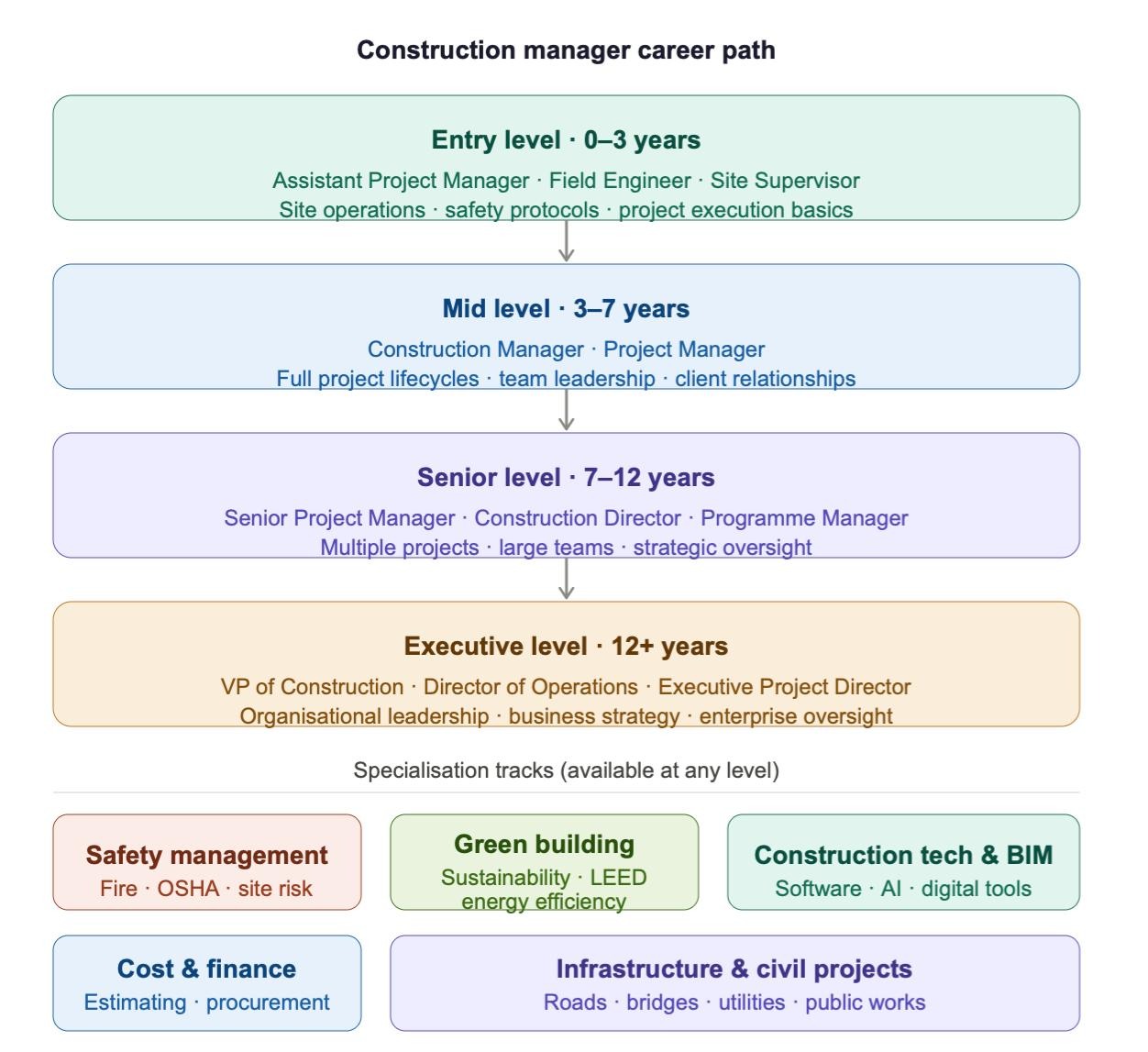
Industry data shows construction management professionals can progress from project engineer to executive director within 10–15 years, with salary increases of 30–50% at each advancement level.
Construction Manager vs Project Manager - What's the Difference?
A common question among those entering the field is how a construction manager differs from a project manager. While the roles overlap, there are meaningful distinctions. A construction manager typically focuses on the physical execution phase - site operations, safety, subcontractor management, and on-the-ground problem-solving.
A project manager often operates across a broader scope, managing the entire project lifecycle, including planning, client communication, financials, and contracts from inception to completion.
Importantly, the construction manager career path frequently converges with and often leads to a project management role. The field expertise gained in construction management is highly transferable and deeply valued in project management contexts.
Construction Manager Salary: What Can You Expect?
Compensation in construction management reflects the responsibility and expertise the role demands.
These figures reflect base compensation. Many construction managers also earn performance bonuses tied to project delivery outcomes. Self-employed construction managers, those who manage their own client portfolios often earn significantly above these benchmarks.
How to Become a Construction Manager: Your Starting Point
The path is more accessible than most realise, and more rewarding than most expect.
Step 1: Get Educated A degree in Construction Management, Civil Engineering, or Architecture gives you the technical foundation employers look for.
Step 2: Get On-Site Degrees open doors. Experience builds careers. Prioritise real jobsite time early.
Step 3: Get Safety-Certified On construction sites, safety is the core job. These programmes build exactly the expertise employers demand:
- Postgraduate Diploma in Construction Management : Develop core skills in project planning, cost control, and site coordination.
- Master in Construction Management : Gain end-to-end expertise in managing complex construction projects.
- MBA in Construction & Safety Management : Step into strategic roles combining business leadership with construction and safety excellence.
- Basics of Fire Safety : Hazard recognition, prevention, and emergency response.
- Diploma in Construction Safety : Risk management, compliance, and safety system design.
- Basics of Construction Safety : OSHA standards, PPE, and safe site practices.
- Executive Diploma in Construction Safety : Advanced safety leadership for senior professionals.
20% of all workplace fatalities happen on construction sites. Safety training is what keeps projects and people safe.
Step 4: Get Certified: Certified Construction Manager (CCM), Associate Constructor (AC), or Certified Professional Constructor (CPC) credentials unlock senior roles. OSHA 10 and 30-Hour are often mandatory.
Step 5: Keep Growing: BIM, sustainability standards, regulatory shifts, the industry evolves constantly. So must you.
Is a Construction Management Degree Worth It?
For those weighing the investment in formal education, the answer is resoundingly yes, with one important caveat.
A degree in construction management provides structured knowledge in areas that are genuinely difficult to acquire informally: contract law, cost estimation, project planning, structural systems, and site safety. It also provides employer credibility at a time when construction management jobs are competitive at the senior level.
The caveat: a degree without experience has limited value, and experience without structured knowledge has a ceiling. The most successful construction managers combine formal education with hands-on time on real projects, professional safety certifications, and continuous upskilling in technology and leadership.
Those already in the workforce who are looking to move into management roles may not need a full degree, but they absolutely need structured professional development. This is why targeted diploma and certificate programmes in construction safety and management have seen significant uptake from working professionals worldwide.
Construction Management Future: What's Ahead?
The construction management profession is entering what many industry analysts are calling its most transformative decade. Several macro-forces are converging to make construction management mission-critical.
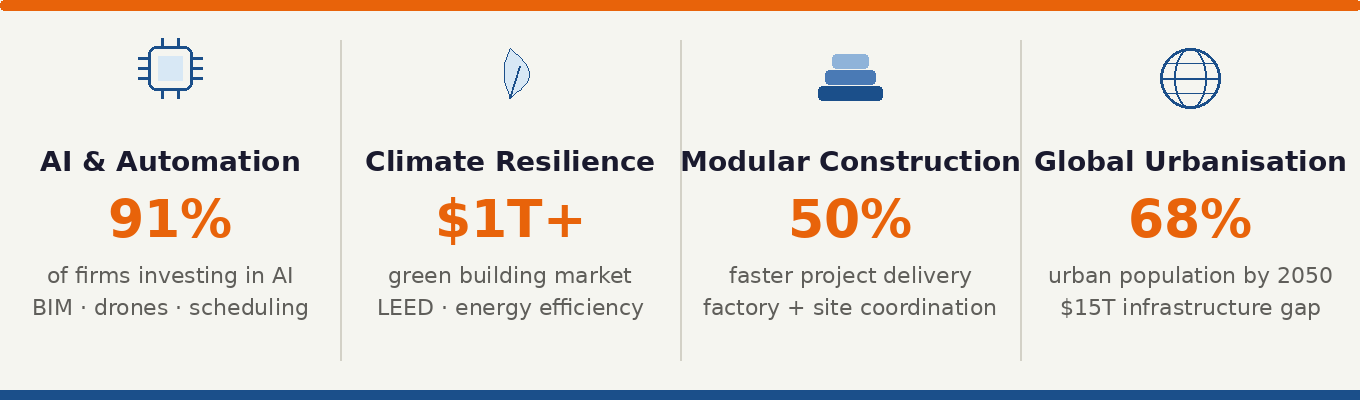
- AI and Automation: 91% of construction companies plan to increase AI investment in 2026. This is raising the bar for what they must know, replacing the construction manager.
- Climate Resilience: As extreme weather events disrupt project timelines, construction managers with expertise in adaptive project planning and climate-resilient design will command a premium.
- Modular and Prefabricated Construction: The growth of off-site manufacturing and modular construction requires construction managers who can coordinate across factory and field environments simultaneously.
- Global Urbanisation: Emerging markets across Asia, Africa, and the Middle East represent an enormous frontier for construction management opportunities as cities expand and infrastructure modernises.
- Regulatory Evolution: Tightening safety codes, environmental regulations, and labour laws mean that construction managers with strong compliance expertise will never be without work.
The construction management profession of 2030 will look different from today, more digital, more regulated, more global. But the need for skilled, safety-conscious, experienced construction managers will only intensify.
Conclusion: The Demand Is Real and It's Not Going Anywhere
The demand for construction managers is not a short-term hiring trend or an industry blip. It is the result of multiple, independent, structural forces all pointing in the same direction: more construction, fewer experienced managers, increasing complexity, and rising stakes.
With a projected 9% job growth rate, nearly 48,100 annual openings, a median salary touching $106,980, and career paths that extend into the executive suite, construction management is one of the most clear-eyed, high-return professions available to anyone willing to invest in their development.
But opportunity favours the prepared. Whether you are a student charting your first career move, a site professional ready to step into management, or a mid-career leader looking to solidify your credentials, the time to invest is now.
Start with the fundamentals. Build your safety knowledge. Pursue structured learning. And take the kind of decisive, forward-looking action that good construction managers are known for.
FAQs
Q1: Why is there such high demand for construction managers?
A: A combination of massive infrastructure investment, an ageing workforce retiring faster than it can be replaced, global urbanisation, green building mandates, and increasing project complexity is driving sustained, structural demand.
Q2: What does a construction manager actually do?
A: They plan, coordinate, budget, and supervise construction projects end-to-end, managing safety, teams, subcontractors, codes, and client communication from groundbreaking to handover.
Q3: How do I become a construction manager?
A: Get a relevant degree, gain on-site experience, complete recognised safety certifications, pursue credentials like the CCM, and commit to continuous learning in technology and regulation.
Q4: Is a construction management degree worth it?
A: Yes, but only when combined with real jobsite experience, safety certifications, and ongoing professional development. A degree alone has a limited ceiling without hands-on expertise.
Q5: Can a construction manager become a project manager?
A: Absolutely. The field expertise and leadership skills gained in construction management are highly transferable and frequently lead to project management roles at senior and executive levels.
Q6: What is the future of construction management?
A: More digital, more regulated, more global - with AI, modular construction, climate resilience, and urban expansion creating new specialisations and unprecedented career opportunities through 2030 and beyond.
Explore Related Courses








.jpg)

COMMENTS(0)
Explore Related Courses
Our Popular Insights
Careers are shifting faster than ever, and staying relevant takes more than experience. Explore UniAthena’s most-read blogs for sharp insights, emerging skills, and practical pathways that help you move forward with clarity and confidence in a changing professional world.



🌟 Top Project Performer – June 2026 🌟
Read More
1
mins read



🌟 Top Project Performer – May 2026 🌟
Read More
1
mins read



🌟 Top Project Performer – April 2026 🌟
Read More
1
mins read
🌟 Top Project Performer – June 2026 🌟
Read more
1
mins read
🌟 Top Project Performer – May 2026 🌟
Read more
1
mins read
🌟 Top Project Performer – April 2026 🌟
Read more
1
mins read
Get in Touch

It’s Time to Start
Join NowMost Popular Online Specialization
- Master of International Business Administration
- Master of Business Administration
- MBA in General Management- FastTrack
- Master in Innovation and Entrepreneurship
- MBA-Family Business Management
- Master in Procurement and Contract Management
- Extended Diploma in Business Analytics (SCQF Level 11)
- Diploma in Supply Chain and Logistics Management (SCQF Level 11)
- Strategic Human Resource Management Practitioner
- Master in Data Science
- Master in Engineering Management
Trending Online
- Integrated Doctorate of Business Administration
- Postgraduate Certificate in Finance for Next Generation Managers
- Master of Business Administration- General Management (Fast Track)
- Postgraduate Certificate in Socio-Economic and Legal Framework
- Postgraduate Certificate in Business Sustainability
- Certified Manager
- Supply Chain Management Practitioner
- MBA - AI in Business
- MBA - Accounting & Finance
- Master in Supply Chain and Logistics Management
Top Universities Online Certificates
- Postgraduate Certificate in International Marketing Management
- Postgraduate Certificate In International Human Resource Management
- Postgraduate Certificate in Strategic Management
- Postgraduate Certificate in Procurement & Contracts Management
- Postgraduate Certificate in Business Analytics
- Postgraduate Certificate in Strategic Supply Chain & Logistics Management
- Postgraduate Certificate in Human Resource and Leadership
- Project Management Practitioner
- Postgraduate Certificate in Supply Chain Design & Implementation
- Postgraduate Certificate in Management Accounting and Finance
Accredited Online Degree Program
- MBA - Digital Transformation
- MBA - Family Business Management
- MBA - Marketing Management
- MBA in Quality Management
- MBA - Business Intelligence & Data Analytics
- MBA in Operations & Project Management
- MBA in Energy Management
- MBA In Construction & Safety Management
- Master in Organisational Leadership
- Master in Public Health
- Master in Construction Management
- Bachelor of Arts in Business Administration


 Install Now


UniAthena is an Ed-Tech, offering flexible, affordable learning solutions, including Free-Learning Upskilling Courses and Academic Programs in partnerships with accredited and globally renowned universities and professional qualification bodies.


Do you have any questions ?
Feel free to send us your questions or request a free consultation
Send a message
UK
Athena Global Education
Magdalen Centre,
Robert Robinson Avenue,
Oxford, OX4 4GA, UK
Phone : 01865 784299
MIDDLE EAST
Athena Global Education FZE
Block L-03, First Floor,
P O Box 519265, Sharjah Publishing City,
Free Zone, Sharjah, UAE
Phone : +971 55 879 5492
INDIA
Uniathena Private Limited
9A,Midas Tower
Phase 1
Hinjewadi Rajiv Gandhi Infotech Park
Pune-411057
Phone: +91 9145665544
All Copyrights Reserved @ Athena Global Education 2021-2026