-

Bachelor's

-

Masters
-

MBA
-

Doctorate
-

Micro Credit
-

Explore all Courses
-
Postgraduate Certifications

-
Postgraduate Diploma
-
Undergraduate Diploma
-
Diploma



Growth Mindset vs Fixed Mindset: The Key to Career Success

Author: urvi malusare
|6
MINS READ
| 0
| 7
Created On: 06 July, 2026
Share




Table of Contents (TOC):
- Key Takeaways
- What Is a Fixed Mindset?
- What Is a Growth Mindset in the Workplace?
- Growth Mindset vs Fixed Mindset: Key Differences and Why They Matter for Career Growth
- How To Change From a Fixed Mindset to a Growth Mindset?
- Self-Development With UniAthena
- FAQs
“Believe you can, and you are halfway there.” – Theodore Roosevelt
The key to self-development is mindset. You can get fixated on what you are unable to achieve, or you can adopt a growth mindset and achieve anything you want.
But what are these terms—growth mindset vs fixed mindset? And which one do you have? Find out in this article.
Key Takeaways:
- Growth mindset vs fixed mindset are two different ways of thinking about one's skills, abilities, and intellect. Those who have a fixed mindset believe that these traits are inherent and cannot be learned, and those who have a growth mindset believe that they can be learned and developed.
- Having a growth mindset can positively affect your life as well as your attitude in the workplace. It can help you take on more responsibility and challenge yourself to achieve higher goals, leading to career advancement.
- Those with a fixed mindset think of effort as a waste of time, and the minute they fail to achieve perfection, they give up. But individuals with a growth mindset keep on persevering. They learn from their mistakes and keep making more efforts until they reach success.
- To go from a fixed mindset to a growth mindset, start by establishing a morning routine where you incorporate the word ‘Yet’ in your vocabulary. Reframe your struggles from roadblocks to learning happening in real-time. Praise the process rather than the end goal. And at the end of every day, conduct a 5-minute audit to learn from your mistakes.
What Is a Fixed Mindset?
A fixed mindset in the workplace refers to the belief that individuals are born with their levels of intelligence, talent, and skills, and you cannot improve on what you do not possess.
People who have a fixed mindset do not believe that success can be achieved by effort or learning, but rather it is an innate ability of an individual that leads them to success. These individuals are less likely to take up challenges in the workplace due to the fear of failure. They believe that they can only achieve results up to their capabilities and they cannot move further than that.
What Is a Growth Mindset in the Workplace?
A growth mindset is a much more positive mindset to have in the workplace.
Growth mindset refers to the belief that individuals can learn to be intelligent, talented, and skilled. Those who live their lives based on this mindset are able to take more challenges in life and in the workplace. They believe that continuous learning and self-development will eventually lead to success in their career.
Growth Mindset vs Fixed Mindset: Key Differences and Why They Matter for Career Growth
How To Change From a Fixed Mindset to a Growth Mindset?
Self-development doesn’t happen overnight. One must work hard to change their mindset and adopt a positive mindset.
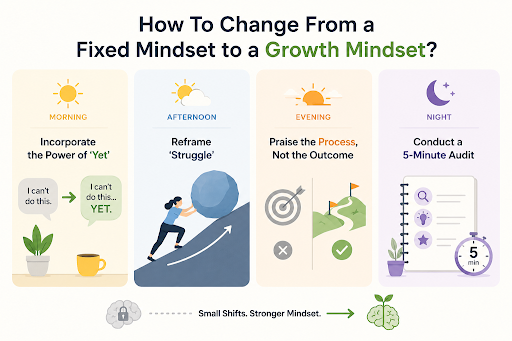
Here is how to develop a growth mindset if you have a fixed mindset:
Incorporate the Power of 'Yet'
Establish a morning routine where you are changing your inner monologue. Whenever you catch yourself saying or thinking, "I don't know how to run a financial analysis" or "I'm not good at managing teams," make yourself add a single word to the end of the sentence: Yet.
Reframe 'Struggle’
Stop viewing mid-day roadblocks and frustrations as lack of natural ability. Instead, pause and consciously reframe the mental struggle. Tell yourself: "This discomfort is the feeling of my brain building new neural connections. The struggle is just the learning happening in real time."
Praise the Process, Not the Outcome
When at the end of your work day you are evaluating your work, stop focusing on the end goal. Instead of saying, “I’m a natural at this” say, “I'm proud of how hard I worked on that feedback to improve the final version.”
Conduct a 5-Minute Audit
Before going to bed, write down one thing that went wrong or felt intimidating during the day. Instead of thinking about it emotionally and playing the blame game, audit it factually. Ask yourself two questions: "What did this experience teach me?" and "How will I adjust my strategy tomorrow based on this data?"
Also Read: Hard Skills vs Soft Skills: Which Is More Important?
Self Development With UniAthena
If you have spent years with a fixed mindset, it will take time to make the shift to a growth mindset. But taking that first step is the most important part.
Here are some free short courses at UniAthena that will help you polish your skills in leadership, problem solving, management, and more. Even if you have so far believed that you do not possess these skills naturally, taking the initiative to learn will be extremely helpful.
- Basics of Leadership Styles & Theories
- Basics of Creativity and Problem Solving
- Mastering Personnel Leadership & Management Planning
- Diploma in Business Administration
- MBA Essentials with Business Analytics
Learning new skills is the first step to adopting a growth mindset. Having a growth mindset is especially important for entrepreneurs and leaders, as you will be leading by example. But even if you are not in any leadership role, a growth mindset will make you more open to better opportunities in your career, leading to a smooth transition to success.
Also Read: What Am I Good At? A Guide to the Art of Self-Discovery
FAQs
Q1. What is a growth mindset example?
A: Here are some examples of a growth mindset in the workplace: saying yes to challenges, learning from your mistakes, incorporating feedback into your work, not backing down from effort, not seeing failure as a sign of weakness, and working on self-improvement.
Q2. What are some examples of a fixed mindset?
A: Here are some examples of a fixed mindset: you get frustrated when you don’t see immediate improvement, you criticize yourself too much, you focus too much on the outcome, and you do not enjoy challenges.
Q3. What do people with a fixed mindset believe?
A: People with a fixed mindset believe that skills and intelligence are inherent traits of a person and they cannot be improved upon with learning or practice.
Q4. How to develop a growth mindset?
A: Giving yourself the opportunity to learn is the first step to self-development and a growth mindset. Instead of taking your failures to heart, learn from them. Figure out what went wrong and in the next attempt, try not to make the same mistakes.
Q5. How to overcome a fixed mindset?
A: To overcome a fixed mindset you need to change your perspective of challenges and failures. Instead of seeing these setbacks as an inherent lack of skill, see them as a learning curve.
Our Popular Courses

$14000


Doctoral Degree in Business Administration
Universidad Catolica De Murcia (UCAM), Spain
Duration:
2 - 3 Years
$17500*
Integrated Doctorate of Business Administration
Guglielmo Marconi University, Italy
Universidad Catolica De Murcia (UCAM), Spain
Duration:
2.5 - 3.5 Years
$5600*
Master of Business Administration
Guglielmo Marconi University, Italy
Duration:
12 - 24 Months
$5600*
MBA in Operations & Project Management
Guglielmo Marconi University, Italy
Duration:
12 - 24 Months
$5600*
Master in Supply Chain and Logistics Management
Guglielmo Marconi University, Italy
Duration:
12 - 24 Months
$5950*
Master in Data Sciences
Guglielmo Marconi University, Italy
Duration:
12 - 24 Months
$5600*
Master in Engineering Management
Guglielmo Marconi University, Italy
Duration:
12 - 24 Months
$5600*
Master in Procurement and Contract Management
Guglielmo Marconi University, Italy
Duration:
12 - 24 Months
$5600*
Master in Public Health
Guglielmo Marconi University, Italy
Duration:
12 - 24 MonthsOur Popular Courses
COMMENTS(0)
Our Popular Courses
$14000
Doctoral Degree in Business Administration
Universidad Catolica De Murcia (UCAM), Spain
Duration:
2 - 3 Years
$17500*
Integrated Doctorate of Business Administration
Guglielmo Marconi University, Italy
Universidad Catolica De Murcia (UCAM), Spain
Duration:
2.5 - 3.5 Years
$5600*
Master of Business Administration
Guglielmo Marconi University, Italy
Duration:
12 - 24 Months
$5600*
MBA in Operations & Project Management
Guglielmo Marconi University, Italy
Duration:
12 - 24 Months
$5600*
Master in Supply Chain and Logistics Management
Guglielmo Marconi University, Italy
Duration:
12 - 24 Months
$5950*
Master in Data Sciences
Guglielmo Marconi University, Italy
Duration:
12 - 24 Months
$5600*
Master in Engineering Management
Guglielmo Marconi University, Italy
Duration:
12 - 24 Months
$5600*
Master in Procurement and Contract Management
Guglielmo Marconi University, Italy
Duration:
12 - 24 Months
$5600*
Master in Public Health
Guglielmo Marconi University, Italy
Duration:
12 - 24 MonthsOur Popular Courses
Our Popular Insights
Careers are shifting faster than ever, and staying relevant takes more than experience. Explore UniAthena’s most-read blogs for sharp insights, emerging skills, and practical pathways that help you move forward with clarity and confidence in a changing professional world.


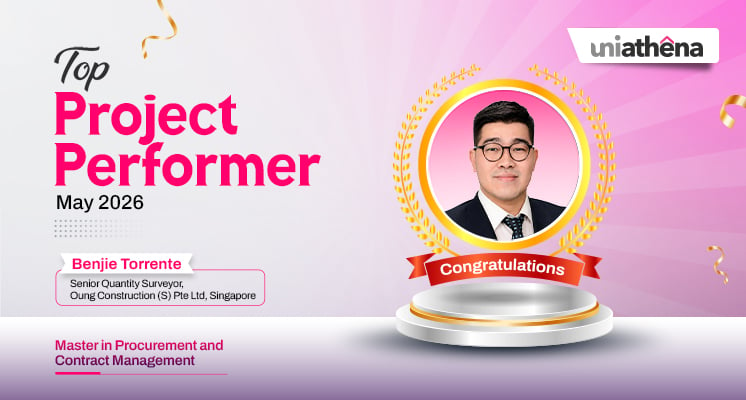
🌟 Top Project Performer – May 2026 🌟
Read More
1
mins read


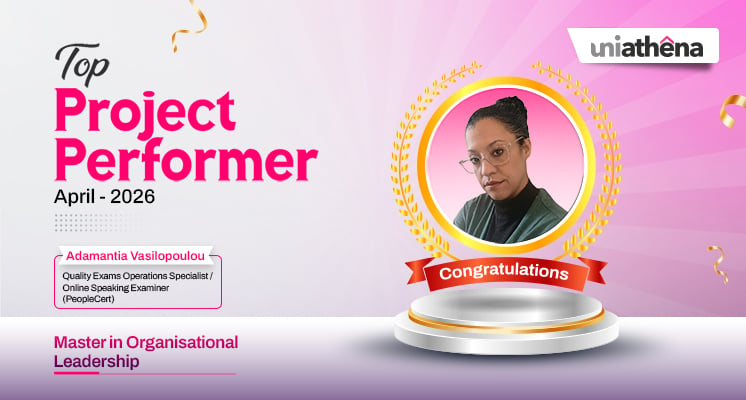
🌟 Top Project Performer – April 2026 🌟
Read More
1
mins read


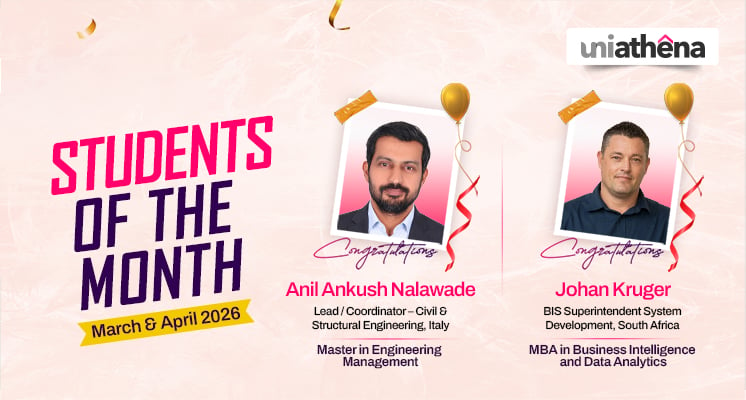
🌟 Top Project Performer – May 2026 🌟
Read more
1
mins read
🌟 Top Project Performer – April 2026 🌟
Read more
1
mins read
Get in Touch

It’s Time to Start
Join NowMost Popular Online Specialization
- Master of International Business Administration
- Master of Business Administration
- MBA in General Management- FastTrack
- Master in Innovation and Entrepreneurship
- MBA-Family Business Management
- Master in Procurement and Contract Management
- Extended Diploma in Business Analytics (SCQF Level 11)
- Diploma in Supply Chain and Logistics Management (SCQF Level 11)
- Strategic Human Resource Management Practitioner
- Master in Data Science
- Master in Engineering Management
Trending Online
- Integrated Doctorate of Business Administration
- Postgraduate Certificate in Finance for Next Generation Managers
- Master of Business Administration- General Management (Fast Track)
- Postgraduate Certificate in Socio-Economic and Legal Framework
- Postgraduate Certificate in Business Sustainability
- Certified Manager
- Supply Chain Management Practitioner
- MBA - AI in Business
- MBA - Accounting & Finance
- Master in Supply Chain and Logistics Management
Top Universities Online Certificates
- Postgraduate Certificate in International Marketing Management
- Postgraduate Certificate In International Human Resource Management
- Postgraduate Certificate in Strategic Management
- Postgraduate Certificate in Procurement & Contracts Management
- Postgraduate Certificate in Business Analytics
- Postgraduate Certificate in Strategic Supply Chain & Logistics Management
- Postgraduate Certificate in Human Resource and Leadership
- Project Management Practitioner
- Postgraduate Certificate in Supply Chain Design & Implementation
- Postgraduate Certificate in Management Accounting and Finance
Accredited Online Degree Program
- MBA - Digital Transformation
- MBA - Family Business Management
- MBA - Marketing Management
- MBA in Quality Management
- MBA - Business Intelligence & Data Analytics
- MBA in Operations & Project Management
- MBA in Energy Management
- MBA In Construction & Safety Management
- Master in Organisational Leadership
- Master in Public Health
- Master in Construction Management
- Bachelor of Arts in Business Administration


 Install Now


UniAthena is an Ed-Tech, offering flexible, affordable learning solutions, including Free-Learning Upskilling Courses and Academic Programs in partnerships with accredited and globally renowned universities and professional qualification bodies.


Do you have any questions ?
Feel free to send us your questions or request a free consultation
Send a message
UK
Athena Global Education
Magdalen Centre,
Robert Robinson Avenue,
Oxford, OX4 4GA, UK
Phone : 01865 784299
MIDDLE EAST
Athena Global Education FZE
Block L-03, First Floor,
P O Box 519265, Sharjah Publishing City,
Free Zone, Sharjah, UAE
Phone : +971 55 879 5492
INDIA
Uniathena Private Limited
9A,Midas Tower
Phase 1
Hinjewadi Rajiv Gandhi Infotech Park
Pune-411057
Phone: +91 9145665544
All Copyrights Reserved @ Athena Global Education 2021-2026