-

Bachelor's

-

Masters
-

MBA
-

Doctorate
-

Micro Credit
-

Explore all Courses
-
Postgraduate Certifications

-
Postgraduate Diploma
-
Undergraduate Diploma
-
Diploma



Who Is the Father of AI? His Role, Contributions, and Impact
Author: urvi malusare
|6
MINS READ
| 0
| 9
Created On: 02 July, 2026
Share




Table of Contents (TOC):
- Key Takeaways
- Who Is the Father of AI?
- Impact John McCarthy Had on Modern AI
- Evolution of Artificial Intelligence
- Learning AI? Start Here
- Conclusion
- FAQs
When you type a prompt into ChatGPT, do you pause and think where it all might have started?
Of course, we know that it's OpenAI, led by Sam Altman, that is behind ChatGPT, but that’s not the beginning of AI.
If you are curious to know who the father of AI technology is and how he contributed to the modern AI that we know and use today, keep reading…
Key Takeaways:
- John McCarthy’s contribution to AI coining the term artificial intelligence, inventing the LISP programming language, and creating the foundation for time-sharing computing marked him down as the father of AI.
- Tools like Google Workspace, Figma, and Salesforce have all evolved from the time-sharing technology frameworks. The idea of cloud computing itself is based on this.
- Technologies like self-driving cars and advanced robotics all use logical reasoning and common-sense reasoning that lets them make decisions like humans.
- Even before the father of AI technology made his inventions, the 1700s-1800s was a time period when Gottfried Wilhelm Leibniz envisioned a universal logical language based on calculations.
Who Is the Father of AI?
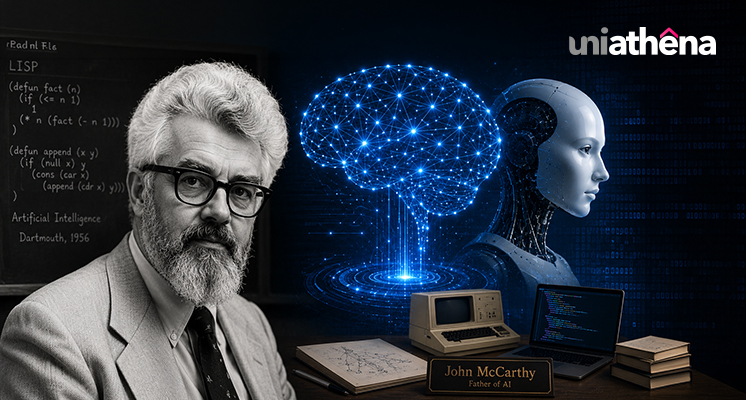
One of the most important men in artificial intelligence history is John McCarthy, AKA the artificial intelligence pioneer and the father of AI.
John McCarthy not only coined the term Artificial Intelligence in 1956, but he also provided a clear framework for engineers to understand the mechanics of machine learning that powered AI.
Role of John McCarthy in AI
Before John McCarthy, the concept of artificial intelligence was just a theoretical idea floating around in academic circles. He played a key role in establishing AI as a formal discipline that could create human-like responses.
He believed that AI could be taught to think and act like humans, and with enough training and the right combination of algorithms, it would be able to reason and solve problems just like humans.
John McCarthy united researchers, mathematicians, computer scientists, and engineers and provided them with a clear direction, which marked the beginning of AI.
John McCarthy’s Contribution to AI
Here are some of the key ways in which the father of AI technology, John McCarthy, contributed to the development of AI:
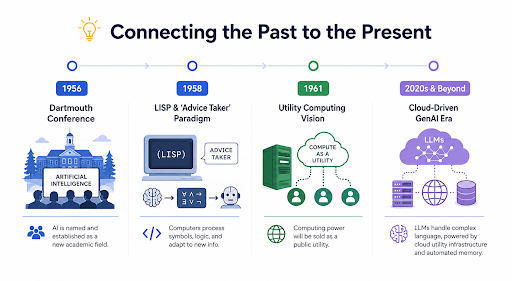
- LISP Programming Language: Before LISP, computer programming languages used to be rigid and strictly designed for heavy mathematical computations. John McCarthy invented the LISP programming language in 1958. For decades, LISP became the universal standard language for almost all serious AI development, powering everything from early robotics to the first expert systems.
- AI Research Frameworks: McCarthy didn’t just write the technical foundations for AI; he single-handedly built the academic and institutional frameworks that allowed the field to survive and grow. In 1956, he organized the historic Dartmouth Summer Research Project on Artificial Intelligence, which is widely recognized as the official birth event of the discipline.
- Logical Reasoning in Machines: In 1958, McCarthy proposed the "Advice Taker," a conceptual program that would use logical deductions to learn from its environment and make autonomous decisions.
Impact John McCarthy Had on Modern AI
From LISP to Large Language Models (LLMs)
While modern generative AI models like ChatGPT, Claude, and Gemini are written primarily in languages like Python, their genetic code belongs to McCarthy’s LISP. LISP was built entirely on symbolic processing, the idea that computers can manipulate words, concepts, and semantic relationships rather than just crunching numbers.
So every time an LLM dynamically tokenizes language to predict the next word in a sentence, it is executing symbolic processing.
The Blueprint for Cloud Computing and SaaS
In 1961, McCarthy made a prediction that computer time-sharing would eventually evolve into a public utility, just like electricity or water. He pioneered Time-Sharing Systems, which allowed multiple people to log into a single mainframe computer at the same time from different terminals.
This concept is the literal foundation of modern Cloud Computing. We use tools like Google Workspace, Figma, and Salesforce, which have directly evolved from the time-sharing model.
Common-Sense Reasoning and Autonomous Systems
McCarthy famously argued that an AI cannot navigate the real world using pure mathematics alone; it requires a baseline of "common-sense knowledge" and the ability to make logical assumptions when data is missing.
Today, we see an evolved version of this logic being used in self-driving cars and advanced robotics.
Also Read: How Much Can AI Really Remember? Inside the LLM Context Window
Evolution of Artificial Intelligence
Artificial intelligence history goes far beyond John McCarthy’s contribution. In fact, the groundwork was laid back as far as the 1700s.
Here is a representation of the timeline of the evolution of AI:
- 1700s - 1800s: Gottfried Wilhelm Leibniz envisions a universal logical language to reduce human debate to simple calculation. Later, Charles Babbage designed the Analytical Engine, and Ada Lovelace wrote the first algorithm for it, realizing machines could manipulate more than just numbers.
- 1950: Alan Turing publishes his landmark paper, "Computing Machinery and Intelligence," introducing the Imitation Game (The Turing Test).
- 1956: John McCarthy officially coined the term "Artificial Intelligence" at the Dartmouth Summer Research Project.
- 1950s - 1970s: Programs like the Logic Theorist prove mathematical theorems, and Joseph Weizenbaum builds ELIZA, the world's first conversational chatbot.
- 1974 - 1980: The initial hype hits a wall. Government agencies pull funding after the famous Lighthill Report criticizes AI's lack of practical progress, plunging the industry into its first major stagnation.
- 1980s: AI experiences a massive commercial revival through Expert Systems.
- 1987 - 1993: Specialized hardware for expert systems proves incredibly expensive to maintain and difficult to update.
- 1997: IBM's Deep Blue defeats world chess champion Garry Kasparov in a highly publicized six-game match.
- 2012: A neural network called AlexNet crushes the competition at the ImageNet visual recognition contest by a massive margin.
- 2017: Google researchers publish the groundbreaking paper, "Attention Is All You Need," introducing the Transformer architecture.
- 2020s - 2026: Large Language Models (LLMs) transition from simple text predictors into advanced multimodal agents capable of reasoning, coding, analyzing scientific data, and operating seamlessly across the cloud to transform everyday corporate and creative workflows.
Also Read: What are the Different Types of AI?
Learning AI? Start Here
UniAthena offers plenty of beginner-friendly free short courses for those interested in learning AI. Here are some of the best AI courses available for you for free:
- Basics of Artificial Intelligence
- Basics of Artificial Intelligence: Learnings Models
- Basics of Machine Learning Algorithms
- Diploma in Artificial Intelligence
- Executive Diploma in Machine Learning
- MBA Essentials with Artificial Intelligence
- MBA Essentials with Machine Learning
Conclusion
While artificial intelligence is still new and developing for us, in the technical fields, it has been a developing phenomenon for years. You can trace the AI development history back to the 1700s.
The 1950s were the truly revolutionary years for AI technology but even after years of research and development there were a few limitations and roadblocks that were encountered. But the AI tools we use today still use the same frameworks that the father of AI, John McCarthy, laid down decades ago. The next time you work with AI, take a moment to think about how far we have come and how far we are yet to go.
Also Read: How to Become An AI Engineer
FAQs
Q1. Who is the father of modern AI?
A: John McCathry is famously recognized as the artificial intelligence pioneer and the father of modern AI.
Q2. How did AI come into existence?
A: Mathematicians, engineers, and researchers in the 1950s were on a philosophical quest of finding out if machines are capable of thinking and reasoning like humans. From this theoretical idea, AI was born.
Q3. When did AI become popular?
A: In the AI history timeline, this tech became popular in 2022 with the development and launch of OpenAI’s ChatGPT, making AI tech mainstream.
Q4. What did John McCarthy do?
A: John McCarthy coined the term artificial intelligence in the 1950s. He also invented the LISP programming language upon which AI functioned, and he laid down the foundation for time-sharing computing, which is the early iteration of today’s cloud computing.
Our Popular Courses

$14000


Doctoral Degree in Business Administration
Universidad Catolica De Murcia (UCAM), Spain
Duration:
2 - 3 Years
$17500*
Integrated Doctorate of Business Administration
Guglielmo Marconi University, Italy
Universidad Catolica De Murcia (UCAM), Spain
Duration:
2.5 - 3.5 Years
$5600*
Master of Business Administration
Guglielmo Marconi University, Italy
Duration:
12 - 24 Months
$5600*
MBA in Operations & Project Management
Guglielmo Marconi University, Italy
Duration:
12 - 24 Months
$5600*
Master in Supply Chain and Logistics Management
Guglielmo Marconi University, Italy
Duration:
12 - 24 Months
$5950*
Master in Data Sciences
Guglielmo Marconi University, Italy
Duration:
12 - 24 Months
$5600*
Master in Engineering Management
Guglielmo Marconi University, Italy
Duration:
12 - 24 Months
$5600*
Master in Procurement and Contract Management
Guglielmo Marconi University, Italy
Duration:
12 - 24 Months
$5600*
Master in Public Health
Guglielmo Marconi University, Italy
Duration:
12 - 24 MonthsOur Popular Courses
COMMENTS(0)
Our Popular Courses
$14000
Doctoral Degree in Business Administration
Universidad Catolica De Murcia (UCAM), Spain
Duration:
2 - 3 Years
$17500*
Integrated Doctorate of Business Administration
Guglielmo Marconi University, Italy
Universidad Catolica De Murcia (UCAM), Spain
Duration:
2.5 - 3.5 Years
$5600*
Master of Business Administration
Guglielmo Marconi University, Italy
Duration:
12 - 24 Months
$5600*
MBA in Operations & Project Management
Guglielmo Marconi University, Italy
Duration:
12 - 24 Months
$5600*
Master in Supply Chain and Logistics Management
Guglielmo Marconi University, Italy
Duration:
12 - 24 Months
$5950*
Master in Data Sciences
Guglielmo Marconi University, Italy
Duration:
12 - 24 Months
$5600*
Master in Engineering Management
Guglielmo Marconi University, Italy
Duration:
12 - 24 Months
$5600*
Master in Procurement and Contract Management
Guglielmo Marconi University, Italy
Duration:
12 - 24 Months
$5600*
Master in Public Health
Guglielmo Marconi University, Italy
Duration:
12 - 24 MonthsOur Popular Courses
Our Popular Insights
Careers are shifting faster than ever, and staying relevant takes more than experience. Explore UniAthena’s most-read blogs for sharp insights, emerging skills, and practical pathways that help you move forward with clarity and confidence in a changing professional world.



🌟 Top Project Performer – May 2026 🌟
Read More
1
mins read


🌟 Top Project Performer – April 2026 🌟
Read More
1
mins read



🌟 Top Project Performer – May 2026 🌟
Read more
1
mins read
🌟 Top Project Performer – April 2026 🌟
Read more
1
mins read
Get in Touch

It’s Time to Start
Join NowMost Popular Online Specialization
- Master of International Business Administration
- Master of Business Administration
- MBA in General Management- FastTrack
- Master in Innovation and Entrepreneurship
- MBA-Family Business Management
- Master in Procurement and Contract Management
- Extended Diploma in Business Analytics (SCQF Level 11)
- Diploma in Supply Chain and Logistics Management (SCQF Level 11)
- Strategic Human Resource Management Practitioner
- Master in Data Science
- Master in Engineering Management
Trending Online
- Integrated Doctorate of Business Administration
- Postgraduate Certificate in Finance for Next Generation Managers
- Master of Business Administration- General Management (Fast Track)
- Postgraduate Certificate in Socio-Economic and Legal Framework
- Postgraduate Certificate in Business Sustainability
- Certified Manager
- Supply Chain Management Practitioner
- MBA - AI in Business
- MBA - Accounting & Finance
- Master in Supply Chain and Logistics Management
Top Universities Online Certificates
- Postgraduate Certificate in International Marketing Management
- Postgraduate Certificate In International Human Resource Management
- Postgraduate Certificate in Strategic Management
- Postgraduate Certificate in Procurement & Contracts Management
- Postgraduate Certificate in Business Analytics
- Postgraduate Certificate in Strategic Supply Chain & Logistics Management
- Postgraduate Certificate in Human Resource and Leadership
- Project Management Practitioner
- Postgraduate Certificate in Supply Chain Design & Implementation
- Postgraduate Certificate in Management Accounting and Finance
Accredited Online Degree Program
- MBA - Digital Transformation
- MBA - Family Business Management
- MBA - Marketing Management
- MBA in Quality Management
- MBA - Business Intelligence & Data Analytics
- MBA in Operations & Project Management
- MBA in Energy Management
- MBA In Construction & Safety Management
- Master in Organisational Leadership
- Master in Public Health
- Master in Construction Management
- Bachelor of Arts in Business Administration


 Install Now


UniAthena is an Ed-Tech, offering flexible, affordable learning solutions, including Free-Learning Upskilling Courses and Academic Programs in partnerships with accredited and globally renowned universities and professional qualification bodies.


Do you have any questions ?
Feel free to send us your questions or request a free consultation
Send a message
UK
Athena Global Education
Magdalen Centre,
Robert Robinson Avenue,
Oxford, OX4 4GA, UK
Phone : 01865 784299
MIDDLE EAST
Athena Global Education FZE
Block L-03, First Floor,
P O Box 519265, Sharjah Publishing City,
Free Zone, Sharjah, UAE
Phone : +971 55 879 5492
INDIA
Uniathena Private Limited
9A,Midas Tower
Phase 1
Hinjewadi Rajiv Gandhi Infotech Park
Pune-411057
Phone: +91 9145665544
All Copyrights Reserved @ Athena Global Education 2021-2026