-

Bachelor's

-

Masters
-

MBA
-

Doctorate
-

Micro Credit
-

Explore all Courses
-
Postgraduate Certifications

-
Postgraduate Diploma
-
Undergraduate Diploma
-
Diploma



The Role of Data Analytics in Supply Chain Management
Author: priyanka chatterjee
|6
MINS READ
| 0
| 9
Created On: 02 July, 2026
Share




Table of Contents (TOC):
- Turning Supply Chain Data into Smarter Business Decisions
- What Is Supply Chain Management?
- Understanding Data Analytics in Supply Chain Management
- The Importance of Analytics in Supply Chain
- Predictive Analytics in Supply Chain Management
- Demand Forecasting Analytics for Better Planning
- Inventory Optimization Through Data Analytics
- Real-Time Supply Chain Monitoring
- Supply Chain Risk Analytics
- Logistics Performance Management
- How Data Analytics Improves Supply Chain Management
- Conclusion
Turning Supply Chain Data into Smarter Business Decisions
Imagine managing a supply chain without knowing what customers will buy next month, where delays might occur, or how much inventory should be stored in a warehouse. Businesses would constantly face stock shortages, excess inventory, delivery disruptions, and rising operational costs. In today's competitive market, organizations can no longer rely on intuition alone. Instead, they are increasingly using data-driven insights to improve efficiency and make informed decisions.
This growing reliance on analytics highlights the role of data analytics in supply chain management. By transforming raw operational data into actionable intelligence, businesses can optimize inventory, improve logistics performance, predict future demand, and reduce risks across the entire supply chain network.
What Is Supply Chain Management?
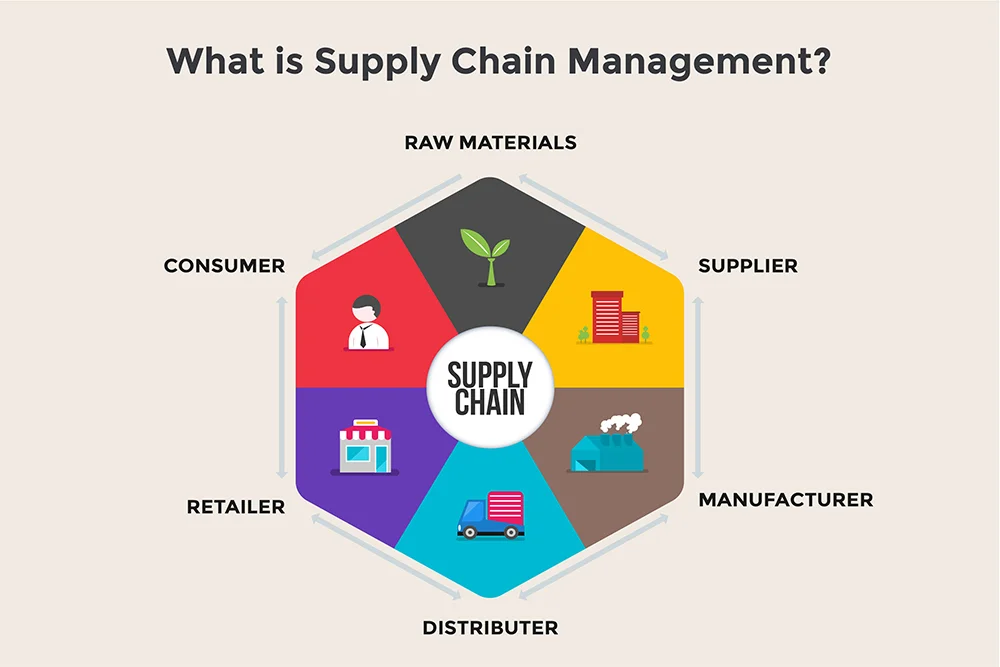
Before exploring analytics, it is important to understand what supply chain management is. Supply chain management (SCM) refers to the coordination of activities involved in sourcing raw materials, manufacturing products, managing inventory, transporting goods, and delivering products to customers.
The primary goal of SCM is to ensure that products reach customers efficiently while minimizing costs and maximizing service quality. However, modern supply chains generate enormous amounts of data every day, making analytics an essential tool for effective management.
Understanding Data Analytics in Supply Chain Management
Data analytics in supply chain management involves collecting, processing, and analyzing data from various supply chain activities to support better decision-making. This data may come from inventory systems, transportation networks, suppliers, customer orders, warehouse operations, and market trends.
By analyzing this information, organizations gain valuable insights into operational performance, customer behavior, demand patterns, and potential disruptions. These insights help businesses respond quickly to changing market conditions and improve overall supply chain efficiency.
Despite these benefits, many organizations face challenges when implementing supply chain analytics. Fragmented data systems, inconsistent information, limited analytical capabilities, legacy technologies, and integration difficulties can reduce the effectiveness of analytics initiatives. Successful implementation often requires investments in technology, data governance, and workforce capabilities.
The Importance of Analytics in Supply Chain
The importance of analytics in supply chain operations has grown significantly due to increasing customer expectations and global market complexity.
Traditional supply chains often react to problems after they occur. Analytics enables businesses to take a proactive approach by identifying trends and predicting future events before they impact operations.
Organizations can use analytics to:
- Improve operational visibility
- Enhance decision-making accuracy
- Reduce supply chain costs
- Improve customer satisfaction
- Increase efficiency and productivity
- Respond faster to market changes
As a result, companies become more agile, competitive, and resilient.
However, analytics is not a guarantee against disruptions. Forecasting models remain dependent on the quality of data and can struggle during unprecedented events such as pandemics, geopolitical disruptions, or sudden changes in consumer behavior. Organizations must therefore balance analytical insights with human judgment and operational flexibility.
Predictive Analytics in Supply Chain Management
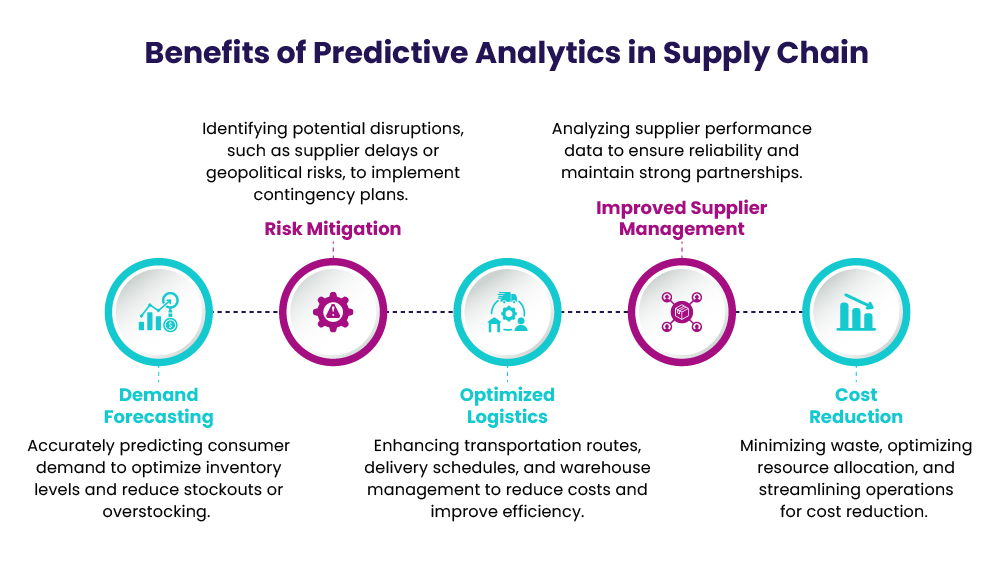
One of the most powerful applications of analytics is predictive analytics in supply chain management. Predictive analytics uses historical data, statistical models, and machine learning techniques to forecast future outcomes.
Rather than simply reviewing past performance, businesses can anticipate future demand, identify potential disruptions, and optimize resource allocation.
For example, retailers can predict seasonal demand spikes and prepare inventory accordingly, while manufacturers can anticipate production requirements and reduce operational bottlenecks.
This predictive capability helps organizations make smarter strategic decisions and improve long-term planning.
However, predictive models are not infallible. Forecast accuracy depends heavily on historical data quality and may decline during periods of significant market disruption or changing consumer behavior. Predictive analytics should therefore support decision-making rather than replace managerial judgment.
Also Read: AI in Logistics: Benefits, Tools & Future Trends
Demand Forecasting Analytics for Better Planning
Accurate forecasting is critical for supply chain success. Demand forecasting analytics helps businesses estimate future customer demand based on historical sales data, market conditions, and consumer trends.
Effective demand forecasting offers several advantages:
- Reduces stock shortages
- Prevents overstocking
- Improves production scheduling
- Enhances customer service
- Supports better procurement decisions
When businesses understand future demand more accurately, they can align inventory and production levels with customer needs, resulting in improved efficiency and profitability.
Inventory Optimization Through Data Analytics
Maintaining the right inventory levels is one of the biggest challenges in supply chain operations. Excess inventory increases storage costs, while insufficient inventory can lead to lost sales opportunities.
Inventory optimization uses data analytics to determine optimal stock levels across warehouses and distribution centers.
By analyzing demand patterns, supplier performance, and inventory turnover rates, businesses can maintain the right balance between availability and cost efficiency. This reduces waste, improves cash flow, and ensures products remain available when customers need them.
Also Read: Supply Chains as Systems: An Engineer’s View of Flow, Failure, and Recovery
Real-Time Supply Chain Monitoring
Modern supply chains require constant visibility. Real-time supply chain monitoring allows organizations to track shipments, inventory movements, production activities, and supplier performance as they happen.
Using technologies such as IoT sensors, cloud platforms, and analytics dashboards, businesses can quickly detect delays, disruptions, or operational inefficiencies.
Real-time visibility enables faster decision-making and helps organizations minimize the impact of unexpected events, improving overall supply chain responsiveness.
However, greater visibility also generates larger volumes of information. Organizations must develop the capabilities to interpret real-time data effectively and avoid overwhelming decision-makers with excessive or poorly prioritized information.
Supply Chain Risk Analytics
Supply chains face numerous risks, including supplier failures, transportation disruptions, geopolitical events, and natural disasters.
Supply chain risk analytics helps organizations identify, assess, and mitigate these risks before they cause significant operational damage.
By analyzing historical incidents, supplier reliability, market conditions, and external risk factors, businesses can develop contingency plans and strengthen supply chain resilience. This proactive approach reduces vulnerabilities and supports business continuity.
Also Read: A Critical Evaluation of Supply Chain Resilience Strategies in Emerging Markets
Logistics Performance Management
Transportation and distribution are essential components of supply chain operations. Logistics performance management uses analytics to evaluate key performance indicators such as delivery times, transportation costs, route efficiency, and fleet utilization.
These insights help organizations optimize logistics processes, reduce delays, improve delivery accuracy, and enhance customer satisfaction.
As logistics networks become increasingly complex, data-driven performance management provides the visibility needed to maintain operational excellence.
How Data Analytics Improves Supply Chain Management
Understanding how data analytics improves supply chain management comes down to one key principle: better decisions lead to better outcomes.
Analytics enables organizations to forecast demand accurately, optimize inventory levels, monitor operations in real time, manage risks proactively, and improve logistics performance. These capabilities can help organizations build more efficient, responsive, and cost-effective supply chains while improving their ability to anticipate disruptions and respond to changing market conditions.
Also Read: Inside the Supply Chain Manager Role: Skills, Salary, and Career Path
Conclusion
The role of data analytics in supply chain management has become increasingly important in helping businesses improve efficiency, reduce costs, and make informed decisions. Through tools such as predictive analytics in supply chain management, demand forecasting analytics, inventory optimization, and real-time supply chain monitoring, organizations can enhance performance, manage risks effectively, and respond quickly to changing market demands. As supply chains become increasingly digital and interconnected, competitive advantage may depend less on collecting more data and more on transforming trusted information into faster, smarter, and more resilient decisions.
Organizations that combine analytics with strong governance, operational flexibility, and human expertise will be better positioned to navigate uncertainty and achieve sustainable business growth.
References:
Our Popular Courses

$14000


Doctoral Degree in Business Administration
Universidad Catolica De Murcia (UCAM), Spain
Duration:
2 - 3 Years
$17500*
Integrated Doctorate of Business Administration
Guglielmo Marconi University, Italy
Universidad Catolica De Murcia (UCAM), Spain
Duration:
2.5 - 3.5 Years
$5600*
Master of Business Administration
Guglielmo Marconi University, Italy
Duration:
12 - 24 Months
$5600*
MBA in Operations & Project Management
Guglielmo Marconi University, Italy
Duration:
12 - 24 Months
$5600*
Master in Supply Chain and Logistics Management
Guglielmo Marconi University, Italy
Duration:
12 - 24 Months
$5950*
Master in Data Sciences
Guglielmo Marconi University, Italy
Duration:
12 - 24 Months
$5600*
Master in Engineering Management
Guglielmo Marconi University, Italy
Duration:
12 - 24 Months
$5600*
Master in Procurement and Contract Management
Guglielmo Marconi University, Italy
Duration:
12 - 24 Months
$5600*
Master in Public Health
Guglielmo Marconi University, Italy
Duration:
12 - 24 MonthsOur Popular Courses
COMMENTS(0)
Our Popular Courses
$14000
Doctoral Degree in Business Administration
Universidad Catolica De Murcia (UCAM), Spain
Duration:
2 - 3 Years
$17500*
Integrated Doctorate of Business Administration
Guglielmo Marconi University, Italy
Universidad Catolica De Murcia (UCAM), Spain
Duration:
2.5 - 3.5 Years
$5600*
Master of Business Administration
Guglielmo Marconi University, Italy
Duration:
12 - 24 Months
$5600*
MBA in Operations & Project Management
Guglielmo Marconi University, Italy
Duration:
12 - 24 Months
$5600*
Master in Supply Chain and Logistics Management
Guglielmo Marconi University, Italy
Duration:
12 - 24 Months
$5950*
Master in Data Sciences
Guglielmo Marconi University, Italy
Duration:
12 - 24 Months
$5600*
Master in Engineering Management
Guglielmo Marconi University, Italy
Duration:
12 - 24 Months
$5600*
Master in Procurement and Contract Management
Guglielmo Marconi University, Italy
Duration:
12 - 24 Months
$5600*
Master in Public Health
Guglielmo Marconi University, Italy
Duration:
12 - 24 MonthsOur Popular Courses
Our Popular Insights
Careers are shifting faster than ever, and staying relevant takes more than experience. Explore UniAthena’s most-read blogs for sharp insights, emerging skills, and practical pathways that help you move forward with clarity and confidence in a changing professional world.



🌟 Top Project Performer – May 2026 🌟
Read More
1
mins read



🌟 Top Project Performer – April 2026 🌟
Read More
1
mins read



🌟 Top Project Performer – May 2026 🌟
Read more
1
mins read
🌟 Top Project Performer – April 2026 🌟
Read more
1
mins read
Get in Touch

It’s Time to Start
Join NowMost Popular Online Specialization
- Master of International Business Administration
- Master of Business Administration
- MBA in General Management- FastTrack
- Master in Innovation and Entrepreneurship
- MBA-Family Business Management
- Master in Procurement and Contract Management
- Extended Diploma in Business Analytics (SCQF Level 11)
- Diploma in Supply Chain and Logistics Management (SCQF Level 11)
- Strategic Human Resource Management Practitioner
- Master in Data Science
- Master in Engineering Management
Trending Online
- Integrated Doctorate of Business Administration
- Postgraduate Certificate in Finance for Next Generation Managers
- Master of Business Administration- General Management (Fast Track)
- Postgraduate Certificate in Socio-Economic and Legal Framework
- Postgraduate Certificate in Business Sustainability
- Certified Manager
- Supply Chain Management Practitioner
- MBA - AI in Business
- MBA - Accounting & Finance
- Master in Supply Chain and Logistics Management
Top Universities Online Certificates
- Postgraduate Certificate in International Marketing Management
- Postgraduate Certificate In International Human Resource Management
- Postgraduate Certificate in Strategic Management
- Postgraduate Certificate in Procurement & Contracts Management
- Postgraduate Certificate in Business Analytics
- Postgraduate Certificate in Strategic Supply Chain & Logistics Management
- Postgraduate Certificate in Human Resource and Leadership
- Project Management Practitioner
- Postgraduate Certificate in Supply Chain Design & Implementation
- Postgraduate Certificate in Management Accounting and Finance
Accredited Online Degree Program
- MBA - Digital Transformation
- MBA - Family Business Management
- MBA - Marketing Management
- MBA in Quality Management
- MBA - Business Intelligence & Data Analytics
- MBA in Operations & Project Management
- MBA in Energy Management
- MBA In Construction & Safety Management
- Master in Organisational Leadership
- Master in Public Health
- Master in Construction Management
- Bachelor of Arts in Business Administration


 Install Now


UniAthena is an Ed-Tech, offering flexible, affordable learning solutions, including Free-Learning Upskilling Courses and Academic Programs in partnerships with accredited and globally renowned universities and professional qualification bodies.


Do you have any questions ?
Feel free to send us your questions or request a free consultation
Send a message
UK
Athena Global Education
Magdalen Centre,
Robert Robinson Avenue,
Oxford, OX4 4GA, UK
Phone : 01865 784299
MIDDLE EAST
Athena Global Education FZE
Block L-03, First Floor,
P O Box 519265, Sharjah Publishing City,
Free Zone, Sharjah, UAE
Phone : +971 55 879 5492
INDIA
Uniathena Private Limited
9A,Midas Tower
Phase 1
Hinjewadi Rajiv Gandhi Infotech Park
Pune-411057
Phone: +91 9145665544
All Copyrights Reserved @ Athena Global Education 2021-2026