-

Bachelor's

-

Masters
-

MBA
-

Doctorate
-

Micro Credit
-

Explore all Courses
-
Postgraduate Certifications

-
Postgraduate Diploma
-
Undergraduate Diploma
-
Diploma



Productivity vs Efficiency: How to Work Smarter, Not Harder

Author: urvi malusare
|7
MINS READ
| 0
| 4
Created On: 25 June, 2026
Share




Table of Contents (TOC):
- Key Takeaways
- Key Difference Between Efficiency and Productivity
- 5 Strategies To Improve Productivity
- 5 Strategies To Improve Efficiency
- Learn to Work Smarter With UniAthena
- Conclusion
- FAQs
You’ve been sitting at your desk for nine hours, and you’ve crossed exactly two minor tasks off your never-ending to-do list.
You wonder to yourself, ‘Where did all my time go?’
When we struggle to get things done, our immediate reaction is usually to push harder, spend more time, work harder, skip breaks, but that’s not the way. Spending more time on a task doesn’t mean you’re doing better work.
Today we are going to learn to break this cycle and work smarter, not harder. But first, let’s start with understanding these two terms: productivity vs efficiency.
Key Takeaways:
- Productivity focuses on the volume of the output, while efficiency refers to the quality of input utilization.
- The productivity formula is as follows → Output ÷ Time, vs the efficiency formula is → Actual Resources Used ÷ Standard Resources Allowed.
- Constantly focusing on improving productivity can lead to burnout. Instead, one must focus on getting work done efficiently and maintaining that efficiency throughout all tasks.
- You can improve productivity at the workplace by following these tips → practice quiet time, leverage others, compartmentalise, one task at a time, and get in the zone.
- Similarly, you can improve efficiency by following these tips → set realistic goals, flexible work hours, measure time for tasks, use efficiency tools, and commit to deadlines.
Key Difference Between Efficiency and Productivity
Are these terms interchangeable, or is there a difference between productivity and efficiency? Let’s find out:
5 Strategies To Improve Productivity
If you are chasing volume and scale and wish to get as much work done as possible, then you are looking to be more productive. This method is useful for short periods of time when you suddenly need to catch up with a lot of work. But if used for the long run, this could leave you burned out.
But if you are looking for strategies to improve productivity, here are some tips:
1. Practice Quiet Time
When focusing on completing as many tasks as you can, you could sometimes run out of mental energy. To avoid this from happening, you must prioritize quiet time to get some of that energy back.
Taking a quiet walk, sitting in silence and meditation, or even playing some music could be particularly helpful.
2. Leverage Others
You don’t need to do everything yourself. Especially if you work in a team, it is important to utilize your team and get help from others whenever you need it. Not only will you get more work done, but you will also get different creative ideas and perspectives on the same task.
Identify areas or tasks that you frequently struggle with and leverage someone who is better at them than you.
3. Learn to Compartmentalise
Maintaining work-life balance while being as productive as you can can be difficult. But it is important to learn to separate your work life from your personal life. If you let your personal problems overwhelm you during work hours, you will see a drop in productivity.
The best way to start compartmentalising your life is by creating a routine that lets you make the shift from work mode to relax mode and vice versa.
4. One Task At a Time
Instead of juggling four different tasks at the same time, fully focus on one task at a time. When you pick a task to complete, allot a focus time for yourself. Now it will be your responsibility to complete the task in the given time before you move on to the next.
Use a timer like Pomodoro when starting a new task. This will allow you to focus on the task and work on the momentum.
5. Get in the Zone
Speaking of momentum, it is important to have the right environment of work to ensure productivity. Not only do you need to be in the right place physically but also mentally. Starting work angry, frustrated, or upset will not work in your favour.
Using a noise-cancelling headphone can help you get in the zone; creating a to-do list first thing in the morning can help you mentally prepare for the work you need to accomplish.
Also Read: The Shift from Job Security to Skill Security
5 Strategies To Improve Efficiency
On the other hand, if your goal is to optimize all your resources thoughtfully and streamline workflow, you are looking to improve your efficiency. This is a great way of ensuring that you are not wasting any resources, ensuring quality, and preventing burnout.
Here are some strategies to improve efficiency:
1. Establish Realistic Goals
The right efficiency formula includes you setting realistic and achievable goals given the resources available. If you need to achieve five tasks in the day, ensure that you know which are priorities and where to start.
Making a to-do list by priority can help you better understand your day. If there are priority tasks allocated to you that you do not have enough time to complete, use alternative resources at hand.
2. Follow Flexible Work Hours
Not everyone feels productive first thing in the morning. If you find yourself being more productive in the quiet afternoons or evenings, plan your focus tasks during those hours. Have an open conversation with your managers regarding your productivity goals and share with them your perspective to get flexible work hours.
3. Measure Your Time
When first starting out on a task, set a timer. This will help you understand how much time you need to complete this particular task. This way, if it is a recurring task, you can allocate a fixed amount of time for it every day and position the rest of your tasks around it.
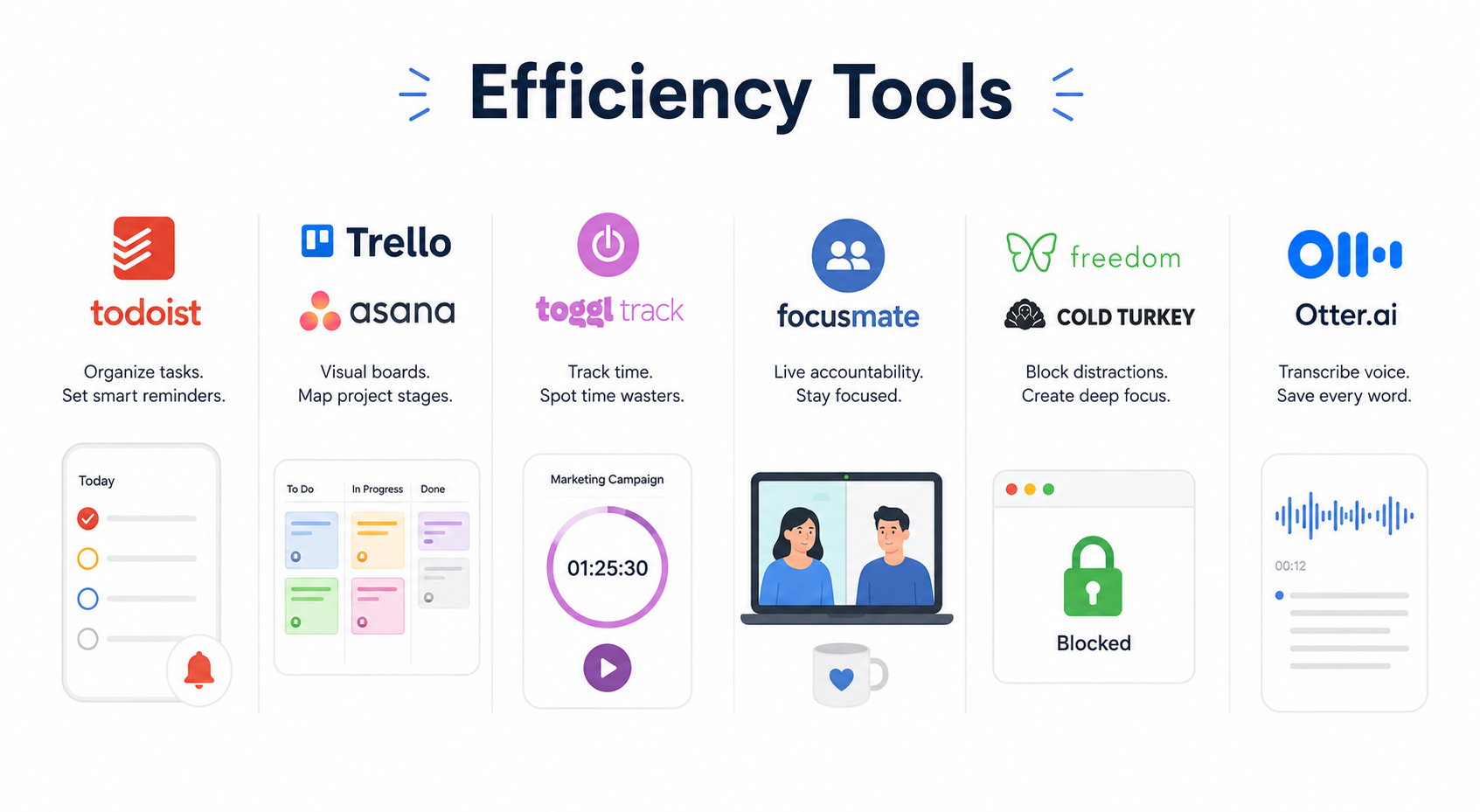
4. Use Effective Tools
When working on limited resources such as time and budget, it is important to at least use effective tools that will help you improve your efficiency.
Here are some tools to help you work smarter
5. Commit to Deadlines
Set your own deadlines for tasks. This will help you prioritize tasks and stay ahead of the real deadlines. You can add your tasks and their deadlines in a task tracker like Habitica. Then, depending on the deadlines, you can choose to complete your tasks.
Also Read: Jobs for People With Anxiety
Learn to Work Smarter With UniAthena
From freshers to leaders, everyone needs to work on improving their productivity and becoming efficient. Implementing the above strategies will help you get closer to your goal.
But if you want to go a step further, here are some useful free short courses at UniAthena for you:
- Basics of Motivation and Leadership
- Basics of Project Execution Skills
- Diploma in Business Administration
- Executive Diploma in Business Communication
- Executive Diploma in Managerial Psychology
- Executive Diploma in Project Management
Conclusion
Implementing these strategies to improve productivity and efficiency can completely change the way you work. You will start getting more done in less time. At first, it might seem all too much of a change or hard to keep track of, but once you get used to using these productivity tools, your workday will become much easier.
Instead of debating productivity vs efficiency, learn to utilize both depending on the work. Constantly chasing productivity can lead to burnout, but efficiency cannot be the solution for all workloads.
Also Read: Skills You Need to Work in a Multinational Enterprise
FAQs
Q1. How to improve work performance?
A: You can improve your work performance and efficiency by setting realistic and measurable goals, getting your priorities straight, having a dedicated focus time slot, and taking sufficient breaks.
Q2. Why does productivity matter?
A: Productivity and these strategies to improve productivity matter because they help you achieve your goals faster, finish your work quicker, and prioritize your work-life balance.
Q3. Is productivity the same as efficiency?
A: While they are commonly used interchangeably, there is a difference between productivity and efficiency. Productivity is quantity focused, and efficiency is quality focused. Productivity is all about getting as many things done in as little time as possible, and efficiency takes into account the resources available to get the same things done.
Our Popular Courses

$14000


Doctoral Degree in Business Administration
Universidad Catolica De Murcia (UCAM), Spain
Duration:
2 - 3 Years
$17500*
Integrated Doctorate of Business Administration
Guglielmo Marconi University, Italy
Universidad Catolica De Murcia (UCAM), Spain
Duration:
2.5 - 3.5 Years
$5600*
Master of Business Administration
Guglielmo Marconi University, Italy
Duration:
12 - 24 Months
$5600*
MBA in Operations & Project Management
Guglielmo Marconi University, Italy
Duration:
12 - 24 Months
$5600*
Master in Supply Chain and Logistics Management
Guglielmo Marconi University, Italy
Duration:
12 - 24 Months
$5950*
Master in Data Sciences
Guglielmo Marconi University, Italy
Duration:
12 - 24 Months
$5600*
Master in Engineering Management
Guglielmo Marconi University, Italy
Duration:
12 - 24 Months
$5600*
Master in Procurement and Contract Management
Guglielmo Marconi University, Italy
Duration:
12 - 24 Months
$5600*
Master in Public Health
Guglielmo Marconi University, Italy
Duration:
12 - 24 MonthsOur Popular Courses
COMMENTS(0)
Our Popular Courses
$14000
Doctoral Degree in Business Administration
Universidad Catolica De Murcia (UCAM), Spain
Duration:
2 - 3 Years
$17500*
Integrated Doctorate of Business Administration
Guglielmo Marconi University, Italy
Universidad Catolica De Murcia (UCAM), Spain
Duration:
2.5 - 3.5 Years
$5600*
Master of Business Administration
Guglielmo Marconi University, Italy
Duration:
12 - 24 Months
$5600*
MBA in Operations & Project Management
Guglielmo Marconi University, Italy
Duration:
12 - 24 Months
$5600*
Master in Supply Chain and Logistics Management
Guglielmo Marconi University, Italy
Duration:
12 - 24 Months
$5950*
Master in Data Sciences
Guglielmo Marconi University, Italy
Duration:
12 - 24 Months
$5600*
Master in Engineering Management
Guglielmo Marconi University, Italy
Duration:
12 - 24 Months
$5600*
Master in Procurement and Contract Management
Guglielmo Marconi University, Italy
Duration:
12 - 24 Months
$5600*
Master in Public Health
Guglielmo Marconi University, Italy
Duration:
12 - 24 MonthsOur Popular Courses
Our Popular Insights
Careers are shifting faster than ever, and staying relevant takes more than experience. Explore UniAthena’s most-read blogs for sharp insights, emerging skills, and practical pathways that help you move forward with clarity and confidence in a changing professional world.



🌟 Top Project Performer – May 2026 🌟
Read More
1
mins read

How Do I Improve My Grammar?
Read More
5
mins read

How to Start a Business?
Read More
8
mins read

🌟 Top Project Performer – April 2026 🌟
Read More
1
mins read


🌟 Top Project Performer – May 2026 🌟
Read more
1
mins read
How Do I Improve My Grammar?
Read more
5
mins read
How to Start a Business?
Read more
8
mins read
🌟 Top Project Performer – April 2026 🌟
Read more
1
mins read
Get in Touch

It’s Time to Start
Join NowMost Popular Online Specialization
- Master of International Business Administration
- Master of Business Administration
- MBA in General Management- FastTrack
- Master in Innovation and Entrepreneurship
- MBA-Family Business Management
- Master in Procurement and Contract Management
- Extended Diploma in Business Analytics (SCQF Level 11)
- Diploma in Supply Chain and Logistics Management (SCQF Level 11)
- Strategic Human Resource Management Practitioner
- Master in Data Science
- Master in Engineering Management
Trending Online
- Integrated Doctorate of Business Administration
- Postgraduate Certificate in Finance for Next Generation Managers
- Master of Business Administration- General Management (Fast Track)
- Postgraduate Certificate in Socio-Economic and Legal Framework
- Postgraduate Certificate in Business Sustainability
- Certified Manager
- Supply Chain Management Practitioner
- MBA - AI in Business
- MBA - Accounting & Finance
- Master in Supply Chain and Logistics Management
Top Universities Online Certificates
- Postgraduate Certificate in International Marketing Management
- Postgraduate Certificate In International Human Resource Management
- Postgraduate Certificate in Strategic Management
- Postgraduate Certificate in Procurement & Contracts Management
- Postgraduate Certificate in Business Analytics
- Postgraduate Certificate in Strategic Supply Chain & Logistics Management
- Postgraduate Certificate in Human Resource and Leadership
- Project Management Practitioner
- Postgraduate Certificate in Supply Chain Design & Implementation
- Postgraduate Certificate in Management Accounting and Finance
Accredited Online Degree Program
- MBA - Digital Transformation
- MBA - Family Business Management
- MBA - Marketing Management
- MBA in Quality Management
- MBA - Business Intelligence & Data Analytics
- MBA in Operations & Project Management
- MBA in Energy Management
- MBA In Construction & Safety Management
- Master in Organisational Leadership
- Master in Public Health
- Master in Construction Management
- Bachelor of Arts in Business Administration


 Install Now


UniAthena is an Ed-Tech, offering flexible, affordable learning solutions, including Free-Learning Upskilling Courses and Academic Programs in partnerships with accredited and globally renowned universities and professional qualification bodies.


Do you have any questions ?
Feel free to send us your questions or request a free consultation
Send a message
UK
Athena Global Education
Magdalen Centre,
Robert Robinson Avenue,
Oxford, OX4 4GA, UK
Phone : 01865 784299
MIDDLE EAST
Athena Global Education FZE
Block L-03, First Floor,
P O Box 519265, Sharjah Publishing City,
Free Zone, Sharjah, UAE
Phone : +971 55 879 5492
INDIA
Uniathena Private Limited
9A,Midas Tower
Phase 1
Hinjewadi Rajiv Gandhi Infotech Park
Pune-411057
Phone: +91 9145665544
All Copyrights Reserved @ Athena Global Education 2021-2026